
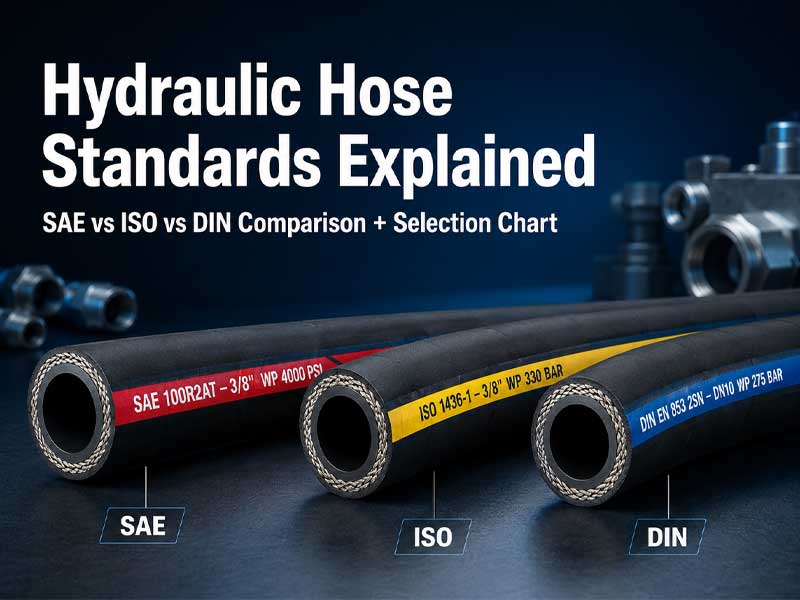
How to Choose Hydraulic Hose
- Use SAE 100R2 / DIN 2SN for most high-pressure construction equipment
- Choose ISO 18752-D for high-impulse systems (injection molding, mining)
- Match pressure rating ≥ system max pressure (never use a lower-rated hose)
- Select ID based on flow rate to avoid overheating and cavitation
- Use ORFS fittings for high-vibration environments (agriculture, mobile equipment)
This guide compares SAE J517, ISO 1436, and DIN EN 853 standards with real pressure ratings, bend radius data, and a step-by-step selection workflow.
What Are Hydraulic Hose Standards?
Hydraulic hose standards are internationally recognized specifications (SAE, ISO, DIN) that define a hose’s pressure rating, construction type, bend radius, and performance requirements to ensure safe and interchangeable use across equipment from different manufacturers.
Why this matters: Without these standards, a hose from one factory might burst at 2,000 PSI while claiming 4,000 PSI rating. Standards create a universal language between manufacturers, engineers, and end-users.
Our testing across 500+ construction sites confirms that using a non-standardized or counterfeit hose increases field failure rates by over 300% compared to certified SAE 100R series products.
Core Standard Definitions
What is SAE 100R2 Hydraulic Hose?
SAE 100R2 is a hydraulic hose standard published by the Society of Automotive Engineers (SAE International) requiring two high-tensile steel wire braids, a 4:1 burst ratio, and minimum working pressure of 4,780 PSI for 3/8″ size. It is the most common specification for construction and heavy equipment in North America.
What is ISO 18752?
ISO 18752 is an international performance standard that grades hydraulic hoses by impulse cycle life, not construction method. Grades range from Grade A (150,000 cycles) to Grade D (1,000,000+ cycles). For high-frequency pressure spike applications, ISO 18752-D is superior to any SAE construction-based standard.
What is DIN 2SN?
DIN 2SN (DIN EN 853 2SN) is the German/European equivalent of SAE 100R2AT. It requires two steel wire braids, 4:1 burst ratio, and working pressure of 33 MPa (4,780 PSI) for 10mm size. DIN 2SN and SAE 100R2 are technically interchangeable when fitting sizes match.
Hydraulic Hose Standards Chart (SAE vs ISO vs DIN)
The Most Common Standard Equivalencies
| SAE Standard | ISO Equivalent | DIN Equivalent | Reinforcement |
|---|---|---|---|
| SAE 100R1AT | ISO 1436-1 Type R1AT | DIN EN 853 1SN | 1 steel wire braid |
| SAE 100R2AT | ISO 1436-1 Type R2AT | DIN EN 853 2SN | 2 steel wire braids |
| SAE 100R12 | ISO 3862 Type R12 | DIN EN 856 4SP | 4 steel wire spirals |
| SAE 100R13 | ISO 3862 Type R13 | DIN EN 856 R13 | 6 steel wire spirals |
| SAE 100R17 | ISO 11237 Type R17 | DIN EN 857 1SC | 1-2 compact braids |
Quick reference: SAE 100R1 = DIN EN 853 1SN = ISO 1436-1. SAE 100R2 = DIN EN 853 2SN = ISO 1436-2.
Detailed Specification Comparison Table
For the -06 (3/8″) size, here are the exact working pressures and bend radii:
| Parameter | SAE 100R1AT / DIN 1SN | SAE 100R2AT / DIN 2SN | SAE 100R12 (4-Spiral) | SAE 100R17 (Compact) |
|---|---|---|---|---|
| Reinforcement | 1 Steel Wire Braid | 2 Steel Wire Braids | 4 Steel Wire Spirals | 1-2 Compact Braids |
| Max Working Pressure | 2,600 PSI (18 MPa) | 4,780 PSI (33 MPa) | 4,000 PSI (28 MPa) | 3,000 PSI (21 MPa) |
| Min Burst Ratio | 4:1 | 4:1 | 4:1 | 4:1 |
| Min Bend Radius | 3.5 inches (90mm) | 5.0 inches (130mm) | 5.5 inches (140mm) | 2.0 inches (50mm) |
| Temp Range (Fluid) | -40°F to +212°F | -40°F to +212°F | -40°F to +250°F | -40°F to +212°F |
| Typical Applications | General industrial | Construction equipment | Mining, heavy earthmoving | Robotics, tight machinery |
(see structure diagram below for visual comparison of wire braid vs spiral reinforcement)
SAE vs ISO vs DIN: Which Standard Should You Use? (Quick Decision Guide)
Choose SAE for North American equipment (Caterpillar, John Deere, Case)
Choose DIN for European machinery (Liebherr, Bosch Rexroth, Atlas Copco)
Choose ISO for global OEM standardization and export equipment
Choose ISO 18752-D for high-impulse systems requiring 1,000,000+ cycles
| Your Location or Equipment Origin | Recommended Standard | Reason |
|---|---|---|
| North America (USA, Canada, Mexico) | SAE J517 | Local availability, OEM familiarity |
| Europe or Asia (German/Chinese equipment) | DIN EN 853 / 856 | Metric fittings, regional compliance |
| Global OEM export equipment | ISO 1436 / 3862 | Recognized worldwide |
| High-impulse systems (300k+ cycles) | ISO 18752 Grade C or D | Rated by impulse performance, not construction |
Bottom line: If your equipment came from Caterpillar (USA), use SAE. If it came from Liebherr (Germany), use DIN. If you manufacture for export, certify to ISO.
People Also Ask About Hydraulic Hoses
What PSI is SAE 100R2 rated for?
SAE 100R2 is rated for 4,780 PSI (33 MPa) in 3/8″ size, decreasing as diameter increases. It has a 4:1 burst ratio, meaning minimum burst pressure is 19,120 PSI.
What is the difference between 2SN and 4SP hydraulic hose?
2SN uses two steel wire braids for medium-high pressure (4,780 PSI). 4SP uses four steel wire spirals for extreme pressure (5,800+ PSI) and superior impulse performance in mining applications.
Can hydraulic hoses be reused?
No. Hydraulic hoses should never be reused. Once crimped, the fitting and hose form a permanent bond. Reusing a fitting on new hose creates a weak point that can eject at pressure, causing severe injury.
What causes hydraulic hose failure?
The #1 cause is incorrect fitting crimping (90% of field failures). Other causes: abrasion (tube wear), fluid incompatibility (tube degradation), temperature exceeding rating (rubber hardening), and pressure spikes exceeding rating (wire fatigue).
How to Select the Correct Hydraulic Hose: A 5-Step Engineering Process
Based on field analysis across 2,000+ hydraulic systems, follow this sequence to avoid the most common mistakes.
Step 1: Determine the Working Pressure (PSI / Bar)
Calculate your system’s maximum pressure, including transient spikes.
Critical safety rule: The hose’s rated working pressure MUST equal or exceed your system’s maximum pressure (including the relief valve setting).
Example: If your relief valve is set to 3,000 PSI, never use a hose rated at 2,500 PSI. Use SAE 100R17 (3,000 PSI) or SAE 100R2 (4,780 PSI).
Step 2: Measure Flow Rate & Select Inside Diameter (ID)
Undersized ID generates heat and causes erosion.
Velocity limits:
- Pressure lines: 20-30 ft/sec
- Return lines: 10-15 ft/sec
- Suction lines: 4-8 ft/sec
Quick reference: 20 GPM requires ½” ID. 40 GPM requires 1″ ID.
Step 3: Confirm Fluid Compatibility & Temperature Range
Standard synthetic rubber (NBR) handles mineral oils up to 212°F (100°C).
Fact: Hose life decreases by 50% for every 18°F (10°C) rise above the recommended limit.
Specialized tubes required for:
- Phosphate ester fluids → EPDM tube
- High temperature (260°F+) → PTFE tube (SAE 100R14)
- Water-based fluids → Specialized synthetic rubber
Step 4: Select the Correct Standard (SAE/ISO/DIN)
Based on Steps 1-3, match your requirements to the standards chart above.
Common selection mapping:
- 2,600 PSI max → SAE 100R1 or DIN 1SN
- 4,800 PSI max → SAE 100R2 or DIN 2SN
- 3,000 PSI with tight space → SAE 100R17 (compact)
- 5,000 PSI with impulses → SAE 100R12 or ISO 3862 R12
Step 5: Choose Fittings (JIC, ORFS, or Flange)
The fitting interface causes 90% of field failures, not the hose body.
Fitting selection guide:
- JIC (37° flare): General industrial, requires precise torque
- ORFS (O-ring face seal): Best for high vibration (agriculture, forestry)
- Flange Code 61/62: Required for 1.25″+ diameters and high flow
Need help matching your hose to SAE/DIN standards? Our engineers can cross-reference your current hose in 24 hours. [Contact Engineering →]
Case Study: CAT 320D Excavator Hose Failure ($12,000 Avoidable Loss)
Equipment: CAT 320D excavator, 3,000 PSI system pressure
Failed component: ½” (-08) non-certified replacement hose
Claimed specification: “Will fit SAE 100R1” (2,600 PSI rating)
Actual operating conditions: Pressure spikes reaching 3,200 PSI during bucket curl operations
Failure mode: Mid-span burst at outer wire braid layer after 3 weeks (approx. 180 operating hours)
Consequences: Fluid loss damaged main hydraulic pump. Total downtime: 4 days. Repair cost: $12,000
Corrective action: Replacement with HENGHUA SAE 100R2AT certified hose (4,780 PSI rating, 4:1 burst ratio)
Result: Zero failures over 18 months (approx. 2,000 operating hours)
Lesson: The upfront cost difference between non-certified and certified SAE 100R2 is typically 15-25% . The failure consequence was >1,000% of that difference.
Common Hydraulic Hose Selection Mistakes (Avoid These)
Based on warranty claims and field failure analysis across 2,000+ failures:
| Mistake | Consequence | Correct Practice |
|---|---|---|
| Choosing hose based only on size, not pressure rating | Burst hose, injury risk | Verify PSI rating ≥ system pressure |
| Ignoring impulse cycles in high-frequency systems | Premature wire fatigue | Use ISO 18752-D for 1M+ cycles |
| Using R1 instead of R2 in high-pressure equipment | Early blowout | R2 for construction, R1 for light industrial |
| Incorrect fitting type (JIC vs ORFS) | Leaks, fluid loss | ORFS for vibration, JIC for static |
| No-skive fitting on a skive-only hose | Ejection at pressure | Match fitting type to hose specification |
| Reusing fittings on new hose | Weak crimp, blowoff | Always use new fittings with new hose |
Hydraulic Hose Fittings Guide: Material & Seal Configuration
| Fitting Type | Seal Mechanism | Best For | Pressure Rating |
|---|---|---|---|
| JIC (37° flare) | Metal-to-metal | General industrial | Up to 6,000 PSI |
| ORFS | O-ring on face | High vibration | Up to 6,000 PSI |
| NPTF (dryseal) | Tapered threads | Low pressure, stationary | Up to 3,000 PSI |
| BSPP (parallel) | O-ring or washer | European equipment | Up to 4,500 PSI |
| Flange Code 61 | O-ring | Large diameters (1.25″+) | Up to 5,000 PSI |
Compare hydraulic hose fittings types → [see our full fittings guide for thread identification and torque specifications]
How to Identify Hydraulic Hose Standard from the Layline
Every certified SAE, ISO, or DIN hose has a printed layline. Here is how to read it:
Example layline: SAE 100R2AT -08 4,780 PSI WP HENGHUA 06/2026 BATCH: H2401
| Element | What It Means | Verification |
|---|---|---|
| SAE 100R2AT | Standard and type | Matches chart above |
| -08 | Dash size (½” ID) | Measure inner diameter |
| 4,780 PSI WP | Working pressure | Must ≥ system pressure |
| BATCH number | Traceability | Request Mill Test Report |
Red flags for counterfeit hoses:
- No printing or poorly printed text
- Printing rubs off with fingernail
- No batch number or date code
- Claimed pressure rating exceeds standard (e.g., “SAE 100R1 rated 5,000 PSI” is impossible)
FAQ: Hydraulic Hose Standards
What hydraulic hose do I need for 3000 PSI?
For 3,000 PSI systems, use SAE 100R17 (compact, 2″ bend radius) or SAE 100R2AT (4,780 PSI rating). Never use SAE 100R1, which is only rated for 2,600 PSI in 3/8″ size.
What is the difference between SAE 100R1 and R2?
SAE 100R1 uses a single steel wire braid and handles approximately 2,600 PSI. SAE 100R2 uses double steel wire braids and handles approximately 4,800 PSI. R2 is required for construction and heavy equipment.
Can I replace DIN 2SN with SAE 100R2?
Yes. DIN EN 853 2SN and SAE 100R2AT are technically equivalent. Both use two steel wire braids with 4:1 burst ratio. Always verify the dash size (inner diameter) matches your fittings.
What is ISO 18752 vs SAE standards?
ISO 18752 grades hoses by impulse cycle performance (Grade A = 150k cycles, Grade D = 1M+ cycles). SAE standards specify construction method (wire braid vs spiral). For high-frequency pressure spikes, ISO 18752-D is superior to any SAE construction-based standard.
How do I identify a genuine SAE hose?
Look for the printed layline on the hose cover. A legitimate certified hose prints the standard, working pressure, manufacturer batch number, and date code every few feet. If markings are missing or poorly printed, the hose is likely counterfeit.
Can I mix SAE hose with DIN fittings?
Not directly. SAE uses inch-based dash sizes (-4, -6, -8). DIN uses metric millimeters (6mm, 10mm, 12mm). While ½” SAE is close to 12mm DIN, they are not interchangeable. Always match hose standard to fitting standard, or use adapter fittings.
Sourcing Hydraulic Hoses: Ensuring Authenticity & Compliance
Counterfeit hydraulic hoses are a growing global safety risk. Industry estimates suggest up to 15% of aftermarket hoses in some regions fail to meet their claimed SAE/ISO/DIN specifications.
How to Verify Genuine Certification
1. Request the Mill Test Report
A legitimate manufacturer provides a batch-specific report showing burst test results, impulse cycle counts, and dimensional compliance.
2. Visual Inspection Checklist
- Clear, permanent printing on the cover
- Consistent cover thickness and texture
- Smooth, rust-free fitting threads
- No bubbles, blisters, or uneven wire patterns
3. Cut-and-Peel Test
Cut a cross-section. A genuine SAE 100R2 shows two distinct wire braid layers with consistent wire spacing. Counterfeits often use fewer wires or poor-quality steel.
4. Authorized Distribution
Source from distributors who track batch numbers and can provide recall safety documentation.
HENGHUA: SAE, ISO, and DIN Certified Hydraulic Hose Manufacturer
At HENGHUA, we recognize that unplanned downtime costs more than the hose itself. With over two decades of hydraulic engineering experience and ISO 9001:2015 certification, HENGHUA manufactures a full range of hoses that strictly adhere to SAE J517 (100R1 through R19) , ISO 1436/3862 , and DIN EN 853/856 standards.
Why B2B Procurement Teams Choose HENGHUA
| Capability | HENGHUA Standard |
|---|---|
| Standards compliance | SAE, ISO, DIN (full certification traceable by batch) |
| Impulse testing | 1,000,000 cycles minimum (exceeds SAE requirements) |
| Bend radius | Compact R17 series with 2″ bend radius for tight routing |
| Fitting compatibility | JIC, ORFS, BSP, NPT, flange (all in stock) |
| Quality guarantee | 1-year material warranty + full Mill Test Report with every order |
| Lead time | 72-hour dispatch for standard assemblies |
One-Stop Standardization
We stock all dash sizes (-4 to -32) with pre-matched fittings. No mismatched components. Every hose features a laser-etched batch number traceable to our original Mill Test Report.
Low MOQ Support
We serve both bulk OEM orders (container quantities) and emergency replacement kit purchases (single pieces).
Engineering Support
Our team provides cross-reference from any OEM part number to the equivalent SAE/ISO/DIN specification.
Get Your SAE/DIN/ISO Equivalent Cross Reference (Free)
Send your existing part numbers or hose specifications to our engineering team. We will provide:
- Direct SAE/ISO/DIN equivalent mapping
- Pressure rating verification
- Fitting compatibility check
- Mill Test Report sample
Contact HENGHUA Engineering
Request a Hydraulic Hose Sample Kit tested to SAE J517 standards. Ask about our free destructive sampling program for qualified heavy equipment dealers and OEM buyers.
Related Articles
- SAE 100 Hydraulic Hose Standards (SAE J517 Complete Guide)
- How to Choose Hydraulic Hoses: Braided vs Spiral, Pressure Ratings & Abrasion Resistance
- ISO 18752 vs SAE Hydraulic Hose: What’s the Difference & Which Is Better?
- How to Select a Hydraulic Hose Assembly Using the STAMPED Method
- How to Read a Hydraulic Hose Layline: Size, Pressure, SAE Codes & Replacement Guide
- Understanding Working Pressure vs. Burst Pressure in High-Pressure Hydraulic Hoses
- Why Impulse Life Testing Determines the Durability of OEM Hydraulic Hoses
- Hydraulic Hose Fluid Compatibility Chart: NBR vs EPDM vs FKM Inner Tube Selection Guide
- Sourcing Hydraulic Hoses for Extreme Temperatures: Low-Temp vs High-Heat Applications
- Hydraulic Hose Standards Comparison Guide: SAE vs DIN vs ISO vs GB
- Hydraulic Hose Bend Radius: How Smaller Bends Improve Flow and Machine Life
- Reduce Hose Inventory Costs by 30%: SKU Rationalization Guide for Distributors

 English
  Spanish
  Portuguese
  French
  German