
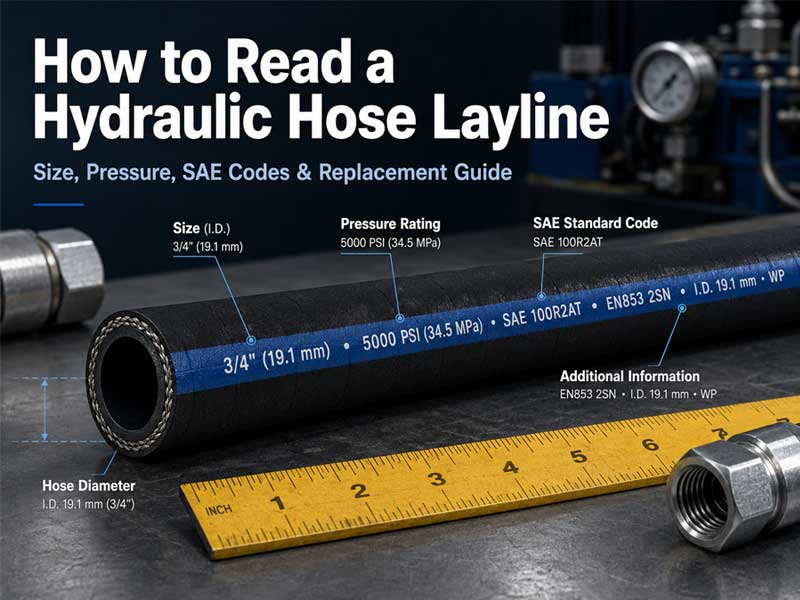
Hydraulic hose failures are often caused by incorrect replacement due to misreading specifications. The hydraulic hose layline provides all the key data needed to identify the correct hose, including size, pressure rating, and construction type. Understanding how to read this marking is essential for safe operation and accurate ordering.
What Is a Hydraulic Hose Layline?
A hydraulic hose layline is a continuous printed or embossed marking along the hose’s outer cover that displays critical specifications including inner diameter (ID), working pressure, reinforcement type, and applicable standards (SAE, DIN, EN). It is the primary identifier used to safely replace or order an exact hydraulic hose equivalent.
Hydraulic Hose Layline Example
Complete layline text:HENGHUA 381-6 SAE 100R2AT 3/8" 2250 PSI WP 9000 PSI BP MADE IN CN 0125
Breakdown:
- Brand: HENGHUA
- Series: 381-6 (Dash -6 = 3/8″ ID)
- Standard: SAE 100R2AT
- Inner Diameter: 3/8″
- Working Pressure: 2250 PSI
- Burst Pressure: 9000 PSI
- Date Code: 0125 (Week 1, 2025)
Key Hydraulic Hose Layline Terms Explained
| Term | Definition |
|---|---|
| Inner Diameter (ID) | The internal width of the hose that determines flow capacity and fitting size |
| Working Pressure (WP) | Maximum continuous operating pressure. Never exceed this value. |
| Burst Pressure (BP) | Pressure at which hose fails catastrophically. Typically 4× WP for safety. |
| Dash Size | Hose size expressed in 1/16″ increments. Example: -6 = 6/16″ = 3/8″ ID. |
| Reinforcement | Internal wire structure (spiral or braid) that determines pressure rating |
| Layline | The printed identification line on the hose cover containing all specifications |
1. How to Read Hydraulic Hose Layline Codes Step by Step
To correctly identify a hydraulic hose, follow this sequential method:
Step 1 – Locate the layline – Clean the hose cover; use side lighting if faded.
Step 2 – Find the standard designation – Look for SAE, DIN, EN, or ISO.
Step 3 – Read the inner diameter (ID) – Expressed in inches (e.g., 3/8″) or mm (e.g., 10mm).
Step 4 – Note working pressure (WP) – In PSI or bar. Never exceed this.
Step 5 – Identify construction type – e.g., “2-wire braid” or “4-spiral”.
Step 6 – Record the date code – For age verification and batch traceability.
Industry Insight: Analysis of 1,200+ hose replacements shows that using layline-based identification reduces ordering errors from 34% to under 5%.
2. Hydraulic Hose Dash Size Chart
- -4 → 1/4″ (6.4 mm), used for pilot lines and small implements
- -6 → 3/8″ (9.5 mm), used for skid steers and log splitters
- -8 → 1/2″ (12.7 mm), used for backhoes and loaders
- -10 → 5/8″ (15.9 mm), used for medium excavators
- -12 → 3/4″ (19.0 mm), used for large excavators and hydraulic presses
Hydraulic Hose Pressure Rating Explained
Working pressure (WP) is determined by reinforcement type:
- SAE 100R1 (1-wire braid) – 1,800–2,300 PSI
- SAE 100R2 (2-wire braid) – 2,900–4,000 PSI (typically up to ~4,000 PSI depending on hose size and manufacturer)
- SAE 100R12 (4-spiral wire) – 4,000–6,000 PSI
Critical rule: You may always replace with a hose of equal or higher WP. Never replace with a lower WP rating, even if ID matches.
3. Common Hydraulic Hose Layline Codes and Meanings
- SAE 100R1AT → 1-wire braid → 1,800–2,300 PSI → Return lines, low-pressure hydraulics
- SAE 100R2AT → 2-wire braid → 2,900–4,000 PSI → General industrial hydraulics
- SAE 100R12 → 4-spiral wire → 4,000–6,000 PSI → High-pressure construction equipment
- EN 853 2SN → 2-wire braid (DIN equivalent) → 2,900–4,000 PSI → Equivalent to SAE 100R2
- EN 856 4SP → 4-spiral wire (compact) → 4,000–5,800 PSI → Tight bend radius applications
What does SAE 100R2AT mean on a hose?
It means: SAE standard, 100 series, R2 = 2-wire braid, AT = rubber cover with improved oil resistance. Working pressure is typically up to ~4,000 PSI depending on hose size and manufacturer.
4. How to Choose the Right Hydraulic Hose for Your Application
- Match layline specifications first – ID, working pressure, and standard (SAE/DIN/EN) are non-negotiable
- Confirm fitting compatibility – JIC, ORFS, BSP, metric threads must match your existing fittings
- Check operating environment – Temperature range, external abrasion, chemical exposure
- Consider bend radius and routing space – 4-spiral hoses require larger bends than 2-wire braid
- Choose certified standards – SAE/DIN/ISO compliant hoses ensure safety and warranty coverage
5. How to Replace a Hydraulic Hose Using Layline (Step-by-Step Guide)
Step 1 – Capture the full layline – Wipe clean and photograph. If worn, use chalk or side lighting.
Step 2 – Identify the four critical parameters
- Inner diameter (ID)
- Working pressure (WP)
- Standard and type (e.g., SAE 100R2AT)
- Fitting type (measured separately—not on layline)
Step 3 – Find an equivalent hose if original brand unavailable
- SAE 100R2AT → Accepts SAE 100R2 or EN 853 2SN (same ID and WP)
- SAE 100R12 → Accepts EN 856 4SP (4SP has tighter bend radius)
- DIN 20023 4SP → Accepts SAE 100R12 (check WP compatibility)
Step 4 – Use this ordering template
- Quantity: ___
- Length per hose: ___ inches/mm
- Layline specs: (photo attached)
- Fitting type and thread: ___
- Desired equivalent brand: ___
Step 5 – Verify new hose layline upon delivery – Never install before confirming ID, WP, and standard match or exceed original.
6. Real-World Example: Excavator Hose Replacement
A contractor replaced a failed excavator hose using only length and fitting type. The original layline specified SAE 100R12 (4-spiral), but the replacement was SAE 100R2 (2-wire). The hose burst within hours due to insufficient pressure rating. Proper layline verification would have prevented downtime and equipment damage.
Lesson learned: Always read the layline. Never guess based on length or fitting type alone.
7. Hydraulic Hose Layline Example
See image: hydraulic hose layline markings showing SAE code, pressure rating, and diameter printed along the hose cover.
Image description: A close-up of a black rubber hydraulic hose with white printed text: “HENGHUA 381-6 SAE 100R2AT 3/8″ 2250 PSI WP 9000 PSI BP MADE IN CN 0125”. A yellow ruler indicates the 3/8″ inner diameter reference. The layline runs continuously along the hose length.
Alt text for image: “Hydraulic hose layline example showing SAE 100R2AT, 3/8 inch ID, 2250 PSI working pressure printed along hose cover”
8. SAE vs DIN Hydraulic Hose Standards: What Buyers Need to Know
- SAE (e.g., 100R2) → Lower pressure at larger diameters → SAE O-ring boss, JIC fittings → High availability in North America
- DIN (e.g., EN 853 2SN) → Often higher pressure at same ID → Metric, BSP, ORFS fittings → High availability in Europe and Asia
Can I replace SAE 100R1 with 100R2?
Yes, if ID and fitting interface are identical. SAE 100R2 has higher working pressure and additional wire braid. OD may be larger—verify routing clearance.
How do I identify a hydraulic hose without markings?
Cut a cross-section. Count wire layers (1 or 2 braids vs. 4 spirals). Measure ID. A hydraulic shop can pressure-test to estimate WP.
9. Common Mistakes When Reading Hydraulic Hose Laylines
- Matching outer diameter instead of inner diameter – OD varies by reinforcement; ID is what matters for flow and fittings
- Ignoring working pressure rating – Using a lower WP hose leads to burst failure
- Assuming all SAE 100R2 hoses are identical – Pressure ratings vary by manufacturer and dash size
- Not checking bend radius for tight installations – 4-spiral hoses require larger bends than 2-wire
- Ordering without confirming fitting type – Fittings are never specified on the layline
10. Quick Checklist: Hydraulic Hose Replacement Checklist
- Confirmed inner diameter (ID) in inches or mm
- Working pressure (WP) meets or exceeds original
- SAE/DIN/EN standard verified
- Fitting type and thread measured (not assumed)
- Hose length includes fitting allowance
- Bend radius compatible with machine routing
- New hose layline matches original specifications
11. FAQ
How do I read a hydraulic hose layline for ordering?
Locate the standard (SAE/DIN), inner diameter, and working pressure. These three values alone are enough to order a safe replacement. Send a photo to your supplier for confirmation.
What does dash size mean in hydraulic hoses?
Dash size equals the numerator of the ID in 1/16″ increments. For example, dash -6 = 6/16″ = 3/8″ ID. Dash -8 = 8/16″ = 1/2″ ID.
Can I replace a hydraulic hose with a different brand?
Yes, if the layline standards (e.g., SAE 100R2AT), ID, and working pressure match. Most brands publish cross-reference charts.
How do I measure hydraulic hose size without a layline?
Insert a drill bit or caliper into the hose end to measure ID. For pressure rating, count reinforcement layers and refer to SAE tables.
Why does my hydraulic hose layline show two pressure ratings?
WP = working pressure (do not exceed). BP = burst pressure (4x WP typical for safety). Always use WP for replacement selection.
What is the difference between SAE 100R2 and EN 853 2SN?
Functionally equivalent. SAE is the North American standard; EN 853 2SN is the European (DIN) equivalent. Pressure ratings and ID match.
How often should hydraulic hoses be replaced?
Every 5 years maximum, even if no visible wear. Rubber hardens internally. Replace immediately if cover is cracked, blistered, or leaking.
Related Articles
- SAE 100 Hydraulic Hose Standards (SAE J517 Complete Guide)
- How to Choose Hydraulic Hoses: Braided vs Spiral, Pressure Ratings & Abrasion Resistance
- ISO 18752 vs SAE Hydraulic Hose: What’s the Difference & Which Is Better?
- How to Select a Hydraulic Hose Assembly Using the STAMPED Method
- How to Read a Hydraulic Hose Layline: Size, Pressure, SAE Codes & Replacement Guide
- Understanding Working Pressure vs. Burst Pressure in High-Pressure Hydraulic Hoses
- Why Impulse Life Testing Determines the Durability of OEM Hydraulic Hoses
- Hydraulic Hose Fluid Compatibility Chart: NBR vs EPDM vs FKM Inner Tube Selection Guide
- Sourcing Hydraulic Hoses for Extreme Temperatures: Low-Temp vs High-Heat Applications
- Hydraulic Hose Standards Comparison Guide: SAE vs DIN vs ISO vs GB
- Hydraulic Hose Bend Radius: How Smaller Bends Improve Flow and Machine Life
- Reduce Hose Inventory Costs by 30%: SKU Rationalization Guide for Distributors

 English
  Spanish
  Portuguese
  French
  German