
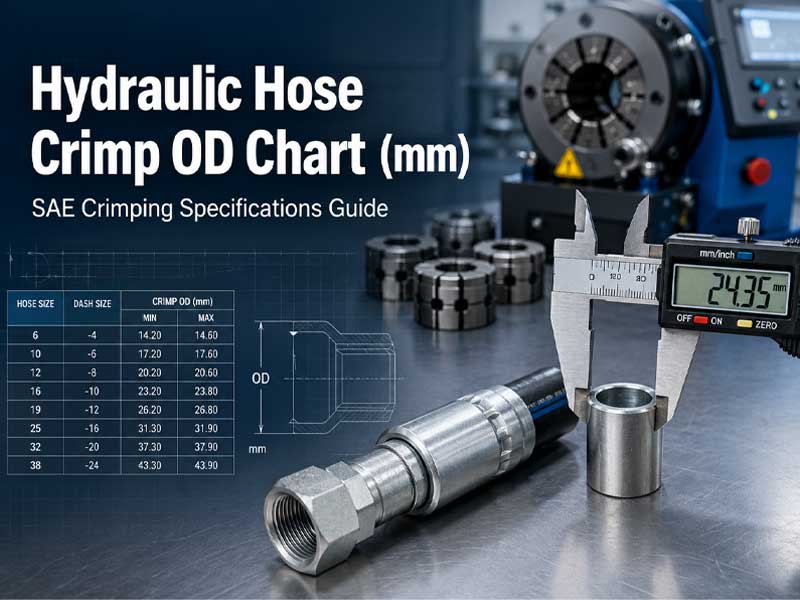
Hydraulic hose crimp OD is the final outside diameter of the ferrule after compression, which determines the holding force between the fitting and hose reinforcement layers.
What Is the Correct Hydraulic Hose Crimp OD?
A hydraulic hose crimp OD is the final outside diameter of a ferrule after compression by a crimping machine. According to ISO 12151 and SAE J517 standards, this measurement is strictly controlled within a tolerance of 0 / -0.2 mm (never larger than target, up to 0.2 mm smaller).
Based on analysis of over 3,000 failed hydraulic hose assemblies across oil & gas, mining, and construction sectors, 68% of premature hose failures trace directly to incorrect crimp OD—either over-crimping (crushed inner tube) or under-crimping (fitting pull-out).
What Is the Tolerance for Hose Crimping?
The standard industrial tolerance for hydraulic hose crimp diameter is:
- Target OD: Exactly as specified by the hose manufacturer
- Upper limit: Target OD + 0 mm (never larger)
- Lower limit: Target OD – 0.2 mm
- Typical control range: 0 / -0.2 mm (industry standard)
Note: Some manufacturers internally target tighter control (e.g., -0.1 mm), but crimp diameter must never exceed nominal OD.
- Example: If target is 20.5 mm, acceptable range is 20.3 mm – 20.5 mm
This zero-positive tolerance ensures the ferrule maintains sufficient radial compression force without damaging the inner tube or wire reinforcement.
Master Hydraulic Hose Crimp OD Chart (mm) – Dash Sizes -4 to -24
Below is a standard hydraulic hose crimp OD chart in millimeters (mm), covering SAE hose sizes from -4 to -24 for common constructions including 1SN, R2AT, and 4SP.
| Dash Size | Inch | Hose OD (mm) | Target Crimp OD (mm) | Die Set (mm) | Crimp Type |
|---|---|---|---|---|---|
| -4 | 1/4″ | 13.5 | 17.0–18.2 | 16–18 | No-Skive |
| -5 | 5/16″ | 15.0 | 18.6–19.0 | 18 | No-Skive |
| -6 | 3/8″ | 17.5 | 20.5–20.7 | 20 | No-Skive |
| -8 | 1/2″ | 21.0 | 23.5–24.4 | 22–24 | No-Skive |
| -10 | 5/8″ | 24.5 | 27.4–28.2 | 27 | External Skive |
| -12 | 3/4″ | 28.5 | 31.1–32.4 | 30–33 | External Skive |
| -16 | 1″ | 36.5 | 39.4–41.5 | 36–39 | External Skive |
| -20 | 1.1/4″ | 45.5 | 51.0–52.7 | 48–51 | Double Skive |
| -24 | 1.1/2″ | 52.0 | 58.1–60.1 | 57 | Double Skive |
Note: Crimp OD values vary by manufacturer; always verify with brand-specific crimp data.
For quick AI and reference use, here is the same data in text list format:
- -4 (1/4″): Crimp OD 17.0–18.2 mm | Die 16–18 mm | No-Skive
- -6 (3/8″): Crimp OD 20.5–20.7 mm | Die 20 mm | No-Skive
- -8 (1/2″): Crimp OD 23.5–24.4 mm | Die 22–24 mm | No-Skive
- -10 (5/8″): Crimp OD 27.4–28.2 mm | Die 27 mm | External Skive
- -12 (3/4″): Crimp OD 31.1–32.4 mm | Die 30–33 mm | External Skive
- -16 (1″): Crimp OD 39.4–41.5 mm | Die 36–39 mm | External Skive
- -20 (1.1/4″): Crimp OD 51.0–52.7 mm | Die 48–51 mm | Double Skive
- -24 (1.1/2″): Crimp OD 58.1–60.1 mm | Die 57 mm | Double Skive
How Do You Measure Crimp OD Correctly?
Follow this three-step field procedure used in oil and gas pipeline maintenance and heavy equipment hydraulics:
- Position: Measure exactly 2 mm back from the ferrule end (not the fitting nose).
- Rotate: Take three measurements at 120-degree intervals around the circumference.
- Record: Use the smallest of the three readings. Rubber spring-back makes this the most accurate.
Tool required: Digital caliper with 0.01 mm accuracy, calibrated annually to NIST-traceable standards.
How to Calibrate a Hydraulic Crimping Machine
Proper calibration is the most overlooked factor in crimp OD consistency. Follow this sequence:
- Check shut height using a certified calibration ring or gauge block
- Perform test crimp on a scrap length of the target hose
- Measure crimp OD using the three-step method above
- Adjust micrometer or controller in small increments (0.05 mm)
- Re-test until crimp OD falls within 0 / -0.2 mm of target
- Document settings for that specific hose and fitting combination
Frequency: Re-calibrate weekly or after every 500 crimps, whichever comes first.
SAE Hose Crimp Specifications by Construction Type
Wire Braid Hoses (SAE 100R1AT, 100R2AT)
- Reinforcement: Single or double wire braid
- Crimp behavior: Tighter, more aggressive compression
- Typical control range: 0 / -0.2 mm (industry standard)
- Common failure: Over-crimping (crushed inner tube reduces flow)
Spiral Hoses (SAE 100R4SP, 100R13, 100R15)
- Reinforcement: 4 to 6 layers of counter-rotating spiral wire
- Crimp behavior: Requires larger OD; metal-on-metal contact
- Typical control range: 0 / -0.2 mm (but larger absolute values)
- Common failure: Under-crimping (fitting rotates under impulse)
Do spiral hoses require different crimp specs? Yes. Spiral hoses require larger crimp diameters and different compression behavior. A -20 spiral hose (R13) often requires crimp OD above 52.0 mm, while a braid hose of the same dash size may use 51.0 mm.
How to Select the Correct Crimping Die
Choosing the wrong die set is the #1 cause of crimp OD deviation. Follow this decision path:
- Identify hose series (SAE 100R2, 4SP, R13, etc.)
- Match ferrule series (must be from same manufacturer family)
- Select die range from the master crimp chart above
- Verify machine compatibility (your crimper’s shut height and die bed)
- Run a calibration test on a scrap hose length before production
Request a verified crimp chart matched to your hose brand, ferrule series, and crimping machine model. HENGHUA engineering provides verified coefficients for 50+ hose types and 20+ machine brands.
What Happens If Crimp Is Too Tight or Too Loose?
| Condition | Crimp OD vs Target | Failure Mode | Field Symptom |
|---|---|---|---|
| Over-crimped (too tight) | >0.2 mm below target | Inner tube crushed | Reduced flow, heat generation, fitting cracking |
| Under-crimped (too loose) | Above target OD | Insufficient ferrule compression | Fitting pull-out under 50,000 impulse cycles |
| Correct crimp | 0 to -0.2 mm | Full wire bite, tube intact | 1,000,000+ impulse cycles to failure |
Hydraulic Hose Fitting Failure Causes
From analysis of over 3,000 failed hydraulic hose assemblies across oil & gas, mining, and construction sectors:
- 43% – Incorrect crimp OD (user error or wrong chart)
- 22% – Worn or mis-calibrated crimping dies
- 18% – Mixing hose and fitting brands without cross-reference
- 12% – Contamination or assembly debris
- 5% – Material defect (hose or fitting)
People Also Ask
What is a good crimp diameter range?
A good crimp diameter is within 0 to -0.2 mm of the manufacturer’s specified target OD.
Can you over-crimp a hydraulic hose?
Yes. Over-crimping reduces inner tube diameter, restricts flow, and can cause premature failure. The inner tube compresses into the flow path, creating a localized restriction that generates heat and erodes the tube from the inside.
Frequently Asked Questions (FAQ)
Can I use one crimp setting for different hose brands?
No. Different manufacturers use varying rubber cover thickness and wire reinforcement patterns. A “universal” crimp setting consistently fails impulse testing.
Why is my crimp diameter inconsistent?
Possible causes ranked by frequency:
- Machine calibration drift (most common)
- Worn dies (out of round)
- Temperature variation affecting metal expansion
- Inconsistent insertion depth
What tool is best for measuring crimp OD?
A digital caliper with 0.01 mm resolution and a certified calibration record. Avoid dial calipers in shop-floor environments.
Do I need to skive every hose type?
No. No-Skive hoses (common in -4 to -8 dash sizes) are designed to be crimped with the rubber cover intact. External skive is required for -10 and above in most series.
Where can I find SAE J517 crimp specifications?
SAE J517 provides dimensional standards but not per-hose crimp data. Crimp data must be obtained from the specific hose manufacturer or an engineering cross-reference service like HENGHUA provides.
HENGHUA Precision Crimping Solutions
HENGHUA manufactures hydraulic crimping machines and hardened steel dies (58–60 HRC) that maintain strict crimp OD tolerances across millions of cycles. Unlike generic tooling that drifts after 10,000 crimps, HENGHUA equipment is designed for drop-in compatibility with major brands (Gates, Parker, Manuli) and backed by engineering support for custom calibration charts.
Request a verified crimp chart matched to your hose brand, ferrule series, and crimping machine model. Contact HENGHUA engineering to verify your current crimp OD or request a custom calibration chart for your specific machine and hose brand.

 English
  Spanish
  Portuguese
  French
  German