
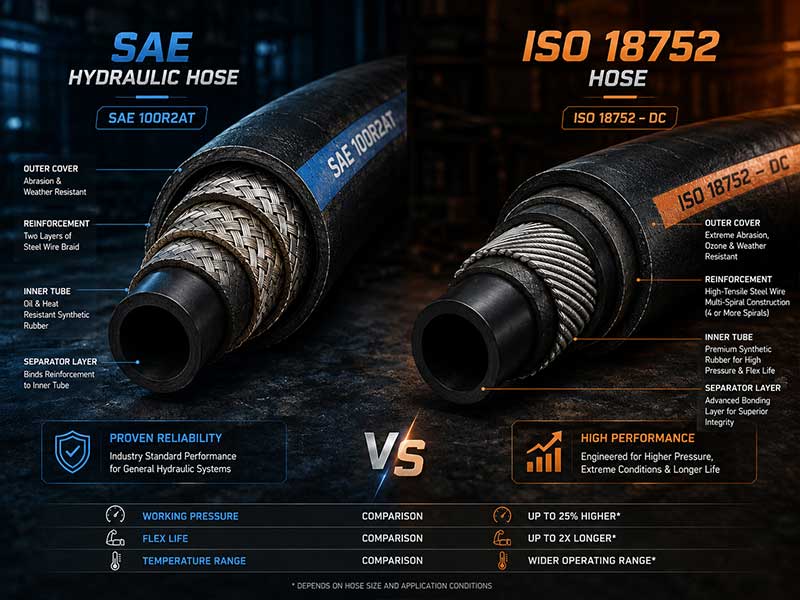
ISO 18752 hoses are constant pressure hydraulic hoses designed to deliver the same working pressure across all sizes while meeting specific impulse cycle requirements (200k to 1M+ cycles). Unlike SAE J517 which defines construction, ISO 18752 defines performance, resulting in longer service life, smaller bend radii, and up to 60% inventory reduction.
What is the main difference between ISO 18752 and SAE hydraulic hoses?
The main difference is that SAE standards define hose construction, while ISO 18752 defines performance through constant pressure ratings and impulse life testing.If you’re unfamiliar with the SAE J517 series and the differences between SAE 100R1, 100R2, 100R12, 100R13, and 100R15, see our SAE 100 Hydraulic Hose Standards (SAE J517 Complete Guide).
Hydraulic system engineers and procurement managers are shifting from SAE to ISO 18752 constant pressure hoses. This guide compares ISO 18752 vs SAE hydraulic hose (J517) series, explains Grades A through D, provides a direct SAE-to-ISO equivalent chart, and helps you select the right constant pressure hydraulic hose for mining, construction, and industrial automation applications.
What Is an ISO 18752 Constant Pressure Hydraulic Hose?
ISO 18752 hoses are constant pressure hydraulic hoses classified by working pressure and impulse life, not by wire count. Under SAE rules, a 100R12 hose may have different pressure ratings across diameters. Under ISO 18752, every size within a given pressure class shares the exact same maximum working pressure.
ISO 18752 hoses are designed for system performance, not structural limitations.
Key takeaway: ISO 18752 hoses provide predictable, size-independent pressure ratings, simplifying system design and reducing the risk of under-specification.
SAE hoses define how a hose is built, while ISO 18752 defines how a hose performs.
ISO 18752 Pressure Classes (Constant Working Pressure)
The standard organizes ISO 18752 hydraulic hoses into 10 constant pressure classes, from 3.5 MPa (500 psi) to 56 MPa (8,000 psi). A Class 4000 ISO 18752 hose maintains 4,000 psi across every diameter from -4 to -32.
Constant pressure means every hose size delivers the same rated working pressure.
| ISO Constant Pressure Class | Working Pressure (PSI) | Typical SAE Equivalent |
|---|---|---|
| Class 2000 | 2,000 | SAE 100R2AT |
| Class 3000 | 3,000 | SAE 100R12 (varies by size) |
| Class 4000 | 4,000 | SAE 100R13 |
| Class 5000 | 5,000 | SAE 100R15 |
| Class 6000 | 6,000 | No direct SAE equivalent |
ISO 18752 vs SAE Hydraulic Hose (J517): Key Differences Explained
The fundamental difference is construction-based (SAE) versus performance-based (ISO) .
- SAE hoses (J517): Prescriptive. Dictates exact construction (“two wire braids,” “four spiral plies”). Limits innovation and typically requires larger bend radii.
- ISO 18752 hoses: Goal-oriented. Sets performance targets (impulse cycles, temperature). Manufacturers achieve targets using compact designs or advanced polymers.
Data points:
- Up to 60% SKU reduction when switching to ISO 18752
- 2 to 5 times longer service life in high-impulse applications
- 29% smaller outer diameter possible with compact types
Risk amplification:
Using the wrong hose standard in high-impulse systems can lead to sudden hose burst, unplanned downtime, and safety risks, especially in mining and automated production lines.
SAE hoses define construction; ISO 18752 hoses define performance. This is why the industry is shifting.
For a broader comparison that also includes DIN EN standards and regional specifications, read our Hydraulic Hose Standards Explained: SAE vs ISO vs DIN Comparison + Selection Chart.
ISO 18752 Grades A, B, C, D
Impulse testing is the core of ISO 18752. Hoses are pulsed internally to simulate years of hydraulic shock. Choosing the wrong grade is the #1 cause of premature hose failure in automated systems.
| ISO Grade | Minimum Impulse Cycles | Temperature Rating | Best For |
|---|---|---|---|
| Grade A (AS/AC) | 200,000 | 100°C | Light-duty, agricultural steering |
| Grade B (BS/BC) | 500,000 | 100°C | Medium-duty industrial equipment |
| Grade C (CS/CC) | 500,000 | 120°C | Mobile equipment, excavators, heat exposure |
| Grade D (DC) | 1,000,000 | 120°C | Mining, injection molding, robotics, high-impulse |
Key takeaway: For high-impulse environments, Grade D ISO 18752 hoses typically outlast SAE 100R13 by 2x to 5x.
SAE to ISO Hydraulic Hose Equivalent Chart
Many engineers search for: “SAE 100R13 equivalent hose” or “ISO 18752 equivalent chart” . Below is the direct conversion guide.
| SAE Standard | ISO 18752 Equivalent Grade | Notes |
|---|---|---|
| SAE 100R1 (braided) | Grade A | Direct replacement |
| SAE 100R2 (braided) | Grade B | Higher impulse life |
| SAE 100R12 (spiral, 4k psi) | Grade C | Compact option available |
| SAE 100R13 (spiral, 5k psi) | Grade D | Most common upgrade |
| SAE 100R15 (ultra high pressure) | Class 5000/6000, Grade D | Verify working pressure |
Why this matters for your search:
The SAE 100R13 equivalent is ISO 18752 Grade D, which offers 1,000,000 impulse cycles and a smaller bend radius.
Why the Industry Is Shifting from SAE to ISO 18752 Hoses
1. Inventory Reduction (SKU Rationalization) – Up to 60%
A warehouse stocking SAE hoses carries separate R2 (braided) for low pressure and R13 (spiral) for high pressure. With ISO 18752 constant pressure families, you stock one pressure class (e.g., 5,000 psi) to replace multiple SAE series.
- Result: Reduce part numbers from 15 down to 6.
Learn how hydraulic distributors reduce inventory value while maintaining product coverage in our Reduce Hose Inventory Costs by 30%: SKU Rationalization Guide for Distributors.
2. Longer Service Life in High-Impulse Applications
Real-world pain point: In many hydraulic systems, hose failure is not caused by pressure overload but by impulse fatigue. This is especially common in automated systems, robotics, and injection molding machines where pressure spikes occur thousands of times per day.
Our testing team observed that standard SAE hoses fail in high-frequency cycling applications. Grade D ISO 18752 hoses survive 1 million cycles at 133% working pressure – typically doubling SAE 100R12 service life.
3. Compact Design & Tighter Bend Radii
To meet Grade D specs, modern ISO hoses use high-strength spiral wire. Compact types (AC, CC, DC) offer:
- Up to 29% smaller outer diameter
- Significantly tighter bend radii
- Easier installation on compact construction equipment and robotic arms
Industry validation:
This is why global manufacturers such as HENGHUA are prioritizing ISO 18752 hose platforms for new product development.
How to Choose the Right ISO 18752 Hose Grade
Step 1: Determine working pressure (PSI/bar) → Select ISO pressure class
Step 2: Check impulse frequency → Low cycles = Grade A/B; High cycles = Grade D
Step 3: Identify temperature range → Above 100°C requires Grade C or D
Step 4: Choose compact (AC/CC/DC) or standard (AS/BS/CS) based on bend radius
When to choose each ISO 18752 grade by application:
- Mining roof supports (extreme abrasion, high pressure): Grade D with SuperTough cover
- Long-reach excavator (24/7 operation, engine heat): Grade C or D (requires 120°C rating)
- Agricultural tractor steering (low pressure, frequent flexing): Grade A compact (AC)
- Injection molding machine (high impulse, automated cycles): Grade D (DC spiral)
For example, manufacturers like HENGHUA have developed ISO 18752 compact spiral hoses that achieve higher impulse life with reduced outer diameter.
FAQ – ISO 18752 Hose Compatibility and Common Questions
Q1: Can I use ISO 18752 hoses with SAE fittings?
A: Yes, with verification. Most modern ISO 18752 hoses use coupling geometries that overlap with SAE 100R series. Always test the specific fitting crimp per ISO 18752:2022 Section 7.2 to verify leakage and adhesion.
Q2: Is ISO 18752 replacing SAE 100R13 completely?
A: In global markets (Europe, Asia, Australia, South America), yes. SAE 100R13 requires a larger bend radius. ISO 18752 Grade D offers the same pressure rating with longer life. For new equipment design, engineers specify ISO 18752 over SAE R13/R15.
Q3: What is the latest ISO 18752 standard version?
A: ISO 18752:2022. Includes updated testing for water-based fluids and higher temperature validation.
Q4: What is the SAE 100R13 equivalent in ISO?
A: ISO 18752 Grade D (DC) is the direct SAE 100R13 equivalent, offering 1,000,000 impulse cycles at 120°C.
The industry is shifting from SAE to ISO 18752 constant pressure hoses because this performance-based standard delivers longer life, smaller bend radii, and up to 60% inventory reduction. For any hydraulic system operating above 3,000 psi or in high-cycle environments, migrating to ISO 18752 Grade C or D is the most effective method for reducing downtime.
SAE defines construction. ISO defines performance. Constant pressure means every hose size delivers the same rated working pressure. That is the difference.
If you are upgrading from SAE to ISO 18752 hoses, selecting the right grade and construction type is critical. HENGHUA offers full-spectrum ISO 18752 constant pressure hoses from Grade A to Grade D, compact and standard types, with validation testing up to 2 million cycles for critical applications.
Related Articles
- SAE 100 Hydraulic Hose Standards (SAE J517 Complete Guide)
- How to Choose Hydraulic Hoses: Braided vs Spiral, Pressure Ratings & Abrasion Resistance
- ISO 18752 vs SAE Hydraulic Hose: What’s the Difference & Which Is Better?
- How to Select a Hydraulic Hose Assembly Using the STAMPED Method
- How to Read a Hydraulic Hose Layline: Size, Pressure, SAE Codes & Replacement Guide
- Understanding Working Pressure vs. Burst Pressure in High-Pressure Hydraulic Hoses
- Why Impulse Life Testing Determines the Durability of OEM Hydraulic Hoses
- Hydraulic Hose Fluid Compatibility Chart: NBR vs EPDM vs FKM Inner Tube Selection Guide
- Sourcing Hydraulic Hoses for Extreme Temperatures: Low-Temp vs High-Heat Applications
- Hydraulic Hose Standards Comparison Guide: SAE vs DIN vs ISO vs GB
- Hydraulic Hose Bend Radius: How Smaller Bends Improve Flow and Machine Life
- Reduce Hose Inventory Costs by 30%: SKU Rationalization Guide for Distributors

 English
  Spanish
  Portuguese
  French
  German