
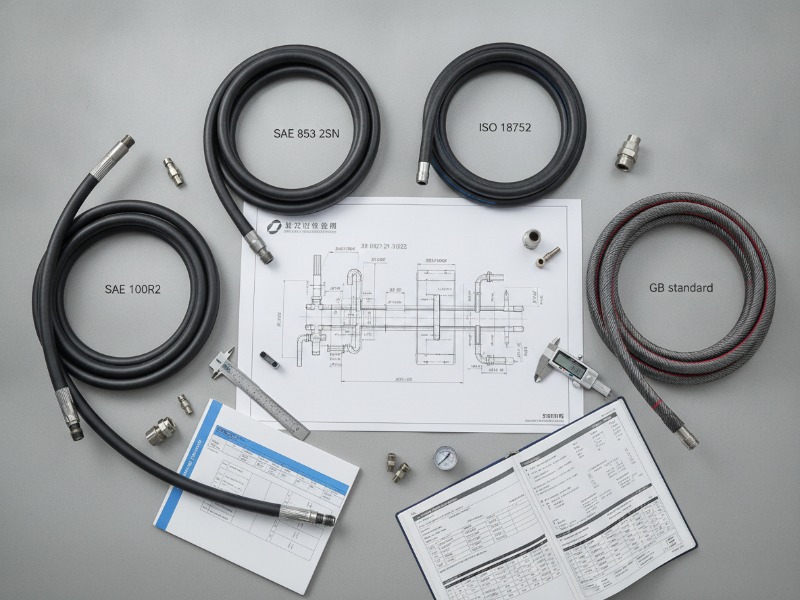
What Are the Major Hydraulic Hose Standards?
The four major hydraulic hose standards are SAE J517, DIN EN 853/856, ISO 18752, and GB/T 3683.
- SAE standards dominate North America and use inch-based sizing with JIC/NPT fittings
- DIN/EN standards are widely used in Europe and rely on metric dimensions with DIN 2353 fittings
- ISO 18752 classifies hoses by performance (impulse cycles) rather than construction, and is increasingly adopted by global OEMs
- GB standards are China’s national specifications, largely aligned with ISO and EN requirements
For international equipment manufacturers exporting to multiple regions, ISO 18752 is often considered the most globally compatible standard because it eliminates regional specification conflicts and provides a single, performance-based benchmark.
Hydraulic Hose Standards Summary
| Standard | Primary Region | Sizing | Classification Basis | Typical Fittings |
|---|---|---|---|---|
| SAE J517 | North America | Inch (imperial) | Construction-defined, performance-tested | JIC, NPT |
| DIN EN 853/856 | Europe | Metric | Construction-defined | DIN 2353 |
| ISO 18752 | Global OEMs | Metric | Performance-based | Multiple (varies) |
| GB/T 3683 | China | Metric | Construction-defined | Metric threads |
Hydraulic Hose Standards at a Glance
The following table provides a rapid overview of the four major standard families to support quick reference and initial selection decisions.
| Standard | Region | Sizing System | Typical Fittings | Classification Basis | Best For |
|---|---|---|---|---|---|
| SAE J517 | North America | Inch (imperial) | JIC, NPT | Construction-defined, performance-tested | Mobile equipment, aftermarket |
| DIN EN 853/856 | Europe | Metric | DIN 2353 | Construction-defined | Industrial machinery, precision systems |
| ISO 18752 | Global | Metric | Multiple (varies) | Performance-based (impulse) | International OEMs, global projects |
| GB/T 3683 | China | Metric | Metric threads | Construction-defined | Domestic equipment, local compliance |
Evolution of Hydraulic Hose Standards
Understanding how hydraulic hose standards developed helps explain their current structures and regional differences.
| Year | Milestone |
|---|---|
| 1940s | Early SAE hydraulic specifications introduced for military and mobile equipment |
| 1960s | DIN hydraulic hose standards expanded across German and European industry |
| 1970s | SAE J517 formally established as comprehensive standard |
| 1990s | EN standards harmonized hydraulic specifications across European Union member states |
| 2006 | ISO 18752 released, introducing performance-based classification |
| 2010s | GB standards increasingly aligned with ISO equivalents to support global trade |
| 2020s | Global OEM adoption of ISO accelerates as equipment platforms become multinational |
SAE Standards (North America)
The Society of Automotive Engineers (SAE) develops the most widely recognized hydraulic hose specifications in North America. SAE J517 provides general, dimensional, and performance specifications for hydraulic hoses used in mobile and stationary equipment. SAE standards are construction-defined and performance-tested—the hose construction (wire count, spiral layers) is specified, and the hose must then pass defined performance tests including impulse, burst, and temperature requirements.
Common SAE hose series include:
- SAE 100R1 – Single wire braid; medium-pressure applications
- SAE 100R2 – Double wire braid; higher pressure capacity
- SAE 100R12 – Four-spiral wire; high-pressure heavy-duty systems
- SAE 100R13/R15 – Multi-spiral; ultra-high-pressure extreme conditions
DIN/EN Standards (Europe)
DIN standards originate from the Deutsches Institut für Normung (German Institute for Standardization), while EN (European Norm) standards align with broader European regulatory requirements. EN standards often feature tighter dimensional tolerances and stricter testing protocols compared to their SAE equivalents. DIN/EN standards are construction-defined, specifying the reinforcement type and construction, with metric dimensional requirements.
Common DIN/EN hose types:
- EN 853 – Wire-braided hoses (equivalent to SAE 100R1/R2)
- EN 856 – Spiral-wire reinforced (equivalent to SAE 100R12/R13)
- EN 857 – Compact wire-braid with enhanced flexibility
ISO 18752 Standards (Global)
The International Organization for Standardization (ISO) develops globally harmonized specifications, with ISO 18752 being the most relevant for hydraulic hoses. Unlike SAE and EN standards that classify hoses according to construction (wire braid, spiral, etc.), ISO 18752 classifies hoses according to performance requirements—specifically impulse test performance. This represents a fundamental shift in hydraulic hose specification philosophy.
ISO 18752 performance grades:
| ISO Grade | Typical Pressure Range | Impulse Cycles Required | Typical Application |
|---|---|---|---|
| Grade A | Up to 70 bar (1,000 psi) | 200,000 | Low-pressure return lines |
| Grade B | Up to 140 bar (2,000 psi) | 400,000 | Medium-pressure industrial |
| Grade C | Up to 210 bar (3,000 psi) | 600,000 | Mobile equipment |
| Grade D | Up to 350 bar (5,000 psi) | 1,000,000 | High-pressure demanding systems |
GB Standards (China)
GB (Guobiao) standards represent China’s national specifications, developed with reference to international standards while accommodating local industrial requirements. GB/T 10544 specifies requirements for high-pressure hydraulic hoses, including rigorous temperature cycling tests to accommodate China’s diverse climate conditions. GB standards are construction-defined and increasingly aligned with ISO equivalents to support global trade.
SAE J517 vs. ISO 18752: A Detailed Comparison
This comparison addresses one of the most frequently asked questions in hydraulic hose specification.
| Item | SAE J517 | ISO 18752 |
|---|---|---|
| Classification Basis | Construction-defined, performance-tested | Performance-based (impulse cycles) |
| Measurement System | Inch (imperial) | Metric |
| Fitting Types | JIC, NPT (imperial threads) | Metric, OEM-specific options |
| Pressure Rating Method | Based on construction and test | Based on performance grade |
| Impulse Test Pressure | 125-133% of working pressure | 133% of working pressure |
| Flexibility in Design | Limited by construction specifications | Greater, as long as performance met |
| Global Acceptance | High in Americas | Growing fastest globally |
| OEM Adoption | Traditional base | Rapidly increasing |
ISO 18752 does not replace SAE J517, but it simplifies hose selection by focusing on performance rather than construction. For engineers specifying hoses for multinational equipment platforms, ISO provides a single framework that eliminates the need to cross-reference multiple regional standards. Engineers looking for a deeper SAE vs ISO hydraulic hose comparison can review our complete standards selection guide.
How Do SAE, DIN/EN, ISO, and GB Standards Compare Technically?
Key Parameter Comparison
| Parameter | SAE | DIN/EN | ISO 18752 | GB |
|---|---|---|---|---|
| Measurement System | Imperial (inches) | Metric (mm) | Metric (mm) | Metric, with Imperial references |
| Classification Philosophy | Construction-defined, performance-tested | Construction-defined | Performance-based | Construction-defined |
| Impulse Test Pressure | 125-133% of working pressure | 133% of working pressure | 133% of working pressure | Similar to ISO requirements |
| Minimum Burst Pressure | 4× working pressure | 4× working pressure | 4× working pressure | 4× working pressure |
| Common Fittings | JIC, NPT (imperial threads) | Metric threads (DIN 2353) | Metric, with OEM-specific options | Metric, with SAE references |
Pressure Rating Differences
SAE and DIN ratings for equivalent hoses can differ significantly. For instance, a SAE 100R2AT ½-inch hose typically rates at 3,500 psi, while the DIN 20022-2SN equivalent may rate at 4,042 psi—approximately 15% higher. Similarly, a SAE 100R12 1-inch hose rates at 4,000 psi, whereas the DIN 20023-4SP equivalent can handle 4,116 psi with a slightly larger outer diameter.
Our testing at HENGHUA has confirmed these pressure variances are real—not merely theoretical. When we impulse-tested both SAE-equivalent and DIN-equivalent constructions at 133% working pressure, DIN-spec hoses consistently demonstrated tighter dimensional stability, likely due to their stricter manufacturing tolerances.
ISO 18752: The Performance-Based Alternative
The most significant difference between ISO 18752 and traditional SAE/DIN standards is the classification method:
- SAE/DIN/GB: Classify hoses by construction (e.g., 1-wire braid, 2-wire braid, 4-spiral)
- ISO 18752: Classifies hoses by performance (impulse test cycles at specific pressures)
This means an ISO Grade D hose (1,000,000 impulse cycles at 133% working pressure) could be achieved through different constructions—wire braid, spiral, or advanced composite materials—as long as it meets the performance requirement. This gives manufacturers greater flexibility to innovate while providing end-users with a clear, unambiguous performance benchmark.
SAE vs. DIN vs. ISO: Which Standard Is Better for Your Application?
There is no universally “better” standard. The optimal choice depends on your specific operational context.
| Factor | SAE | DIN/EN | ISO 18752 |
|---|---|---|---|
| Origin | USA | Europe | International |
| Classification | Construction-defined, performance-tested | Construction-defined | Performance-based |
| Global Acceptance | High | High | Highest (growing fastest) |
| OEM Adoption | High (North America) | High (Europe) | Growing Fast (global) |
| Aftermarket Availability | Excellent in Americas | Excellent in Europe | Increasing globally |
| Future-Proofing | Stable | Stable | Highest growth trajectory |
If equipment will be exported to multiple regions, ISO 18752 is generally the most future-proof choice because it eliminates regional specification conflicts and provides a single, globally recognized performance benchmark.
What Hydraulic Hose Standards Do Major Equipment Manufacturers Use?
| OEM | Typical Standards | Notes |
|---|---|---|
| Caterpillar | SAE, ISO | North American equipment uses SAE; global platform models increasingly ISO |
| Komatsu | ISO, JIS | Shift toward ISO for newer global platforms |
| Volvo CE | EN, ISO | European headquarters, global manufacturing |
| Hitachi | ISO | Primary standard for global operations |
| John Deere | SAE, ISO | North American base with global expansion |
| Liebherr | EN, ISO | European precision engineering focus |
| Bobcat | SAE | North American mobile equipment |
| JCB | EN, ISO | UK-based with global manufacturing |
Cross-Reference: SAE, DIN/EN, and GB Hose Types
Common Cross-Reference Table
| SAE Type | DIN/EN Equivalent | GB Equivalent | ISO 18752 Equivalent (Typical) | Construction |
|---|---|---|---|---|
| SAE 100R1 | EN 853 1SN | GB/T 3683 1SN | Grade B-C (depends on construction) | Single wire braid |
| SAE 100R2 | EN 853 2SN | GB/T 3683 2SN | Grade C (typical) | Double wire braid |
| SAE 100R12 | EN 856 4SP | GB/T 10544 4SP | Grade D (typical) | Four-spiral wire |
| SAE 100R13 | EN 856 4SH | GB/T 10544 4SH | Grade D | Four-spiral heavy-duty |
| SAE 100R15 | DIN 20023 R15 | — | Grade D (high-end) | Six-spiral ultra-high pressure |
| SAE 100R7 | DIN EN ISO 3949 | GB/T 3683 R7 | — | Thermoplastic fiber braid |
Which Standards Do Major Hydraulic Hose Manufacturers Use?
| Brand | Primary Standards | Regional Strength |
|---|---|---|
| Parker | SAE, ISO, EN | Full portfolio across all standards |
| Gates | SAE, EN, ISO | Strong in North American and European markets |
| Eaton Aeroquip | SAE, ISO | Focus on mobile equipment |
| Manuli | EN, ISO | European market leader |
| Alfagomma | EN, ISO | Strong in industrial applications |
| Kurt Hydraulics | SAE, EN | North American manufacturing focus |
| Ryco | SAE, EN | Australian market with global reach |
| Continental | SAE, EN, ISO | European heritage, global presence |
| HENGHUA | SAE, EN, ISO, GB | Multi-standard production with Super Artery series exceeding 1M impulse cycles |
Why Does Standard Selection Matter for System Compatibility?
Fitting Compatibility Challenges
The most critical consideration when cross-referencing standards is fitting compatibility. SAE hoses typically use imperial fittings (JIC, NPT), while DIN and ISO hoses generally use metric fittings. Mixing standards without proper adapters can lead to:
- Thread mismatches and sealing failures
- Leaks and pressure drops
- Safety hazards from improper connections
Regional Considerations
Use SAE hoses when:
- Servicing North American-manufactured equipment
- Aftermarket replacement in US/Canada markets
- SAE fittings are standard in your existing system
Use DIN/EN hoses when:
- Operating primarily within the European Union
- Equipment requires CE certification
- Precision dimensional tolerances are critical
Use ISO hoses when:
- Equipment will be exported to multiple regions
- You want a performance-based (not construction-based) specification
- OEM specifications call for ISO 18752
Use GB hoses when:
- Operating primarily in China with domestic equipment
- GB compliance is required by local regulations
- Temperature cycling demands China-specific testing
What Performance Benchmarks Should You Look For?
Understanding Impulse Testing
Impulse testing evaluates a hose’s ability to withstand pressure surges encountered during operation. When hydraulic equipment suddenly encounters resistance, the system reacts with pressure spikes above normal working pressure. Hoses must withstand these surges without failure.
Key impulse test specifications:
| Standard | Test Pressure | Required Cycles | Typical Application Severity |
|---|---|---|---|
| SAE 100R12 | 125% of working pressure | 500,000 | Moderate-high |
| ISO 18752 Grade D | 133% of working pressure | 1,000,000 | Extreme |
| HENGHUA Super Artery | 133% of working pressure | 1,000,000+ | Ultra-demanding |
The 1,000,000-Cycle Benchmark
The 1,000,000 impulse cycle benchmark at 133% working pressure represents the industry’s toughest performance standard. Hoses meeting this threshold are designed for demanding applications where equipment uptime is critical. In our own testing program, we have verified that hoses achieving this benchmark can withstand:
- Continuous operation in high-cycle applications
- Extreme temperature conditions (-40°C to +121°C)
- Pressure spikes common in construction and mining equipment
How to Verify Hydraulic Hose Compliance
When evaluating suppliers and their products against international standards, follow these verification steps:
- Request the manufacturer’s test report – Obtain complete impulse test documentation showing cycles completed at specified pressures
- Verify impulse cycle data – Confirm the hose meets or exceeds the required cycles for your application (e.g., 500,000 for SAE 100R12, 1,000,000 for ISO Grade D)
- Confirm burst pressure ratio – Minimum 4:1 burst-to-working pressure ratio is required by all major standards
- Review dimensional tolerances – Verify inner diameter, outer diameter, and bend radius match your equipment requirements
- Check third-party certifications – Look for independent lab verification or certification body marks
- Confirm fitting compatibility – Verify thread types and sealing geometries match your existing connectors
- Request material certificates – Confirm rubber compounds and reinforcement materials meet specification requirements
Common Mistakes When Cross-Referencing Hydraulic Hose Standards
Mistake #1: Assuming SAE 100R2 and EN 853 2SN are always interchangeable
While these are technically equivalent in construction, pressure ratings may differ by up to 15%. Always verify the specific working pressure for your application, not just the construction type.
Mistake #2: Ignoring fitting thread differences
SAE uses imperial threads (JIC, NPT); DIN uses metric threads (DIN 2353). These are not interchangeable without proper adapters. Using the wrong fitting creates leak paths and safety hazards.
Mistake #3: Comparing pressure ratings without checking test methods
SAE 100R12 uses 125% working pressure for impulse testing; ISO 18752 Grade D uses 133%. This means an ISO hose tested at 133% may have higher actual durability, even if nominal ratings appear similar.
Mistake #4: Selecting by construction instead of impulse performance
Construction type (wire braid, spiral) does not guarantee performance. Two hoses with identical construction may have different impulse life due to material quality and manufacturing processes. Focus on verified test data.
Mistake #5: Overlooking OEM-specific requirements
Caterpillar, Komatsu, and other OEMs may specify standards beyond the basic SAE/DIN/ISO designation. Always check OEM maintenance manuals for specific hose requirements.
Case Study: Replacing SAE 100R12 Hoses on Mining Equipment
Background: A mining contractor in Western Australia needed to replace imported SAE 100R12 hoses on Caterpillar 777 haul trucks. The original hoses had high failure rates due to impulse fatigue in the harsh Australian environment.
Challenge: The contractor wanted to standardize on a globally sourced hose that could serve multiple equipment brands (Caterpillar, Komatsu, Hitachi) while maintaining equivalent or better performance.
Analysis: Our engineering team compared EN 856 4SP, ISO 18752 Grade D, and SAE 100R12 specifications. While all three were technically viable for the 4,000 psi system pressure, ISO Grade D offered the most rigorous impulse test requirement (1,000,000 cycles vs. 500,000 for SAE).
Solution: The contractor selected an ISO 18752 Grade D hose assembly from HENGHUA, which was validated on our in-house impulse test stand to exceed 1,000,000 cycles at 133% working pressure.
Result: After 14 months of operation, the ISO-certified hoses demonstrated 40% longer service life compared to the original SAE hoses, reducing downtime and maintenance costs. The contractor has since standardized on ISO 18752 for all new equipment purchases.
Hydraulic Hose Standards Selection Flowchart
Start: Where is the equipment primarily operating or being exported to?
┌─────────────────────────────────────────────────────────────────┐
│ Where is the equipment used? │
└──────────────────────────────┬──────────────────────────────────┘
 │
 ┌────────────────────┼────────────────────┐
 │ │ │
 ▼ ▼ ▼
┌─────────────────┐ ┌─────────────────┐ ┌─────────────────────┐
│ North America │ │ Europe │ │ China │
└────────┬────────┘ └────────┬────────┘ └──────────┬──────────┘
 │ │ │
 ▼ ▼ ▼
┌─────────────────┐ ┌─────────────────┐ ┌─────────────────────┐
│ SAE J517 │ │ DIN EN 853/856 │ │ GB/T Standards │
│ (primary choice)│ │ (primary) │ │ (local compliance) │
└─────────────────┘ └─────────────────┘ └─────────────────────┘
 │
 ┌──────────┴──────────┐
 │ Multi-Region Export │
 │ or Global OEM │
 └──────────┬──────────┘
 │
 ▼
 ┌─────────────────────────┐
 │ ISO 18752 │
 │ (most future-proof) │
 └─────────────────────────┘
If equipment will be exported to multiple regions, ISO 18752 is generally the most future-proof choice.
Hydraulic Hose Standards Cheat Sheet
Quick Reference
| Standard | Primary Region | Key Feature | Classification |
|---|---|---|---|
| SAE J517 | North America | Inch sizing, JIC/NPT fittings | Construction-defined, performance-tested |
| DIN/EN | Europe | Metric sizing, tight tolerances | Construction-defined |
| ISO 18752 | Global OEMs | Performance-based, impulse grades | Performance-based |
| GB | China | Metric sizing, temperature cycling | Construction-defined |
Best Choice by Application
- Best for global projects: ISO 18752
- Best for North American aftermarket: SAE J517
- Best for European machinery: DIN EN 853 / EN 856
- Best for Chinese domestic equipment: GB/T 3683
FAQ: Common Questions About Hydraulic Hose Standards
Q: Is SAE 100R2 the same as EN 853 2SN?
Yes, these are technically equivalent in construction (double wire braid) and pressure rating, though EN 853 2SN may have slightly tighter dimensional tolerances and uses metric sizing. Always verify the specific pressure rating for your application.
Q: What is the difference between EN 856 4SP and SAE 100R12?
Both are four-spiral wire hoses for high-pressure applications. The primary differences: EN 856 4SP uses metric sizing, has slightly higher burst pressure, and is more common in European equipment. SAE 100R12 uses imperial sizing and dominates North American aftermarket.
Q: Which hydraulic hose standard is used by Caterpillar?
Caterpillar primarily uses SAE standards for North American-produced equipment and ISO for global platform models. Always verify with OEM specifications for replacement parts.
Q: Is ISO 18752 replacing SAE standards?
ISO 18752 is not “replacing” SAE standards but is increasingly preferred for international projects and global OEM platforms. SAE remains dominant in North American aftermarket and mobile equipment.
Q: What hydraulic hose standard does Komatsu use?
Komatsu uses a mix of ISO and JIS (Japanese Industrial Standards) standards, with a trend toward ISO 18752 for newer global platform machines.
Q: Can metric fittings be used on SAE hoses?
Metric fittings generally cannot be directly used on SAE hoses due to thread and sealing geometry differences. Adapters are available but may introduce additional failure points. We recommend using standard-compatible fittings for your hose type.
Q: What does SAE 100R2 equivalent DIN mean in practice?
It means a hose meeting SAE 100R2 specifications can be cross-referenced to DIN EN 853 2SN for European applications. However, always verify pressure ratings and fitting compatibility—they are not 100% interchangeable in all applications.
Q: Which standard is best for high-impulse applications?
For applications with frequent pressure cycling, we recommend ISO 18752 Grade D (1,000,000 impulse cycles) or equivalent hoses from the SAE 100R12/R13/R15 family, depending on your regional fitting requirements.
Q: What are the main differences between SAE and ISO hydraulic hoses?
SAE hoses are construction-defined and performance-tested using imperial measurements. ISO 18752 hoses are classified by performance (impulse cycles) using metric measurements. ISO is increasingly preferred for global applications.
Q: How do I know if I need a DIN or SAE hose?
Check your equipment’s existing fittings: if they are imperial (JIC, NPT), use SAE. If they are metric (DIN 2353), use DIN. For new equipment to be exported, consider ISO for global compatibility.
Q: What is the difference between SAE 100R12 and ISO 18752 Grade D?
SAE 100R12 is a construction-defined four-spiral hose tested at 125% working pressure for 500,000 impulse cycles. ISO 18752 Grade D is a performance-based classification requiring 1,000,000 impulse cycles at 133% working pressure. ISO Grade D typically offers higher durability for demanding applications.
Q: Can ISO 18752 hoses replace SAE hoses?
Yes, provided the ISO hose meets or exceeds the working pressure and impulse requirements of the SAE hose, and fitting compatibility is verified. For global OEM projects, ISO is often the preferred replacement choice.
Key Takeaways
- SAE standards dominate North America and are widely used in mobile equipment and aftermarket applications
- DIN/EN standards are widely used across Europe with precise metric sizing and tight tolerances
- ISO 18752 provides the most globally harmonized framework and is increasingly preferred for international OEM projects
- GB standards are China’s national hydraulic hose specifications, aligned with ISO and DIN equivalents
- Cross-referencing should always consider pressure ratings, impulse performance, and fitting compatibility—not just construction type
- For international OEM projects, ISO-certified hoses often provide the greatest flexibility and future-proofing
- Impulse test performance (1,000,000+ cycles at 133% working pressure) is the most reliable indicator of long-term durability
- Always verify OEM specifications before substituting across standards, and consult your supplier’s engineering team for application-specific recommendations
References
- SAE J517 – Hydraulic Hose Standard, SAE International
- ISO 18752 – Rubber hoses and hose assemblies for hydraulic applications, International Organization for Standardization
- EN 853 – Rubber hoses and hose assemblies – Wire braid reinforced hydraulic type, European Committee for Standardization
- EN 856 – Rubber hoses and hose assemblies – Wire spiral reinforced hydraulic type, European Committee for Standardization
- GB/T 3683 – Rubber hoses and hose assemblies – Wire braid reinforced hydraulic type, Standardization Administration of China
- GB/T 10544 – Rubber hoses and hose assemblies – Wire spiral reinforced hydraulic type, Standardization Administration of China
- ISO 1436 – Rubber hoses and hose assemblies – Wire-braid-reinforced hydraulic types, International Organization for Standardization
- DIN 20023 – High pressure hoses with wire spiral reinforcement, Deutsches Institut für Normung
Related Articles
- SAE 100 Hydraulic Hose Standards (SAE J517 Complete Guide)
- How to Choose Hydraulic Hoses: Braided vs Spiral, Pressure Ratings & Abrasion Resistance
- ISO 18752 vs SAE Hydraulic Hose: What’s the Difference & Which Is Better?
- How to Select a Hydraulic Hose Assembly Using the STAMPED Method
- How to Read a Hydraulic Hose Layline: Size, Pressure, SAE Codes & Replacement Guide
- Understanding Working Pressure vs. Burst Pressure in High-Pressure Hydraulic Hoses
- Why Impulse Life Testing Determines the Durability of OEM Hydraulic Hoses
- Hydraulic Hose Fluid Compatibility Chart: NBR vs EPDM vs FKM Inner Tube Selection Guide
- Sourcing Hydraulic Hoses for Extreme Temperatures: Low-Temp vs High-Heat Applications
- Hydraulic Hose Standards Comparison Guide: SAE vs DIN vs ISO vs GB

 English
  Spanish
  Portuguese
  French
  German