
Banjo Hydraulic Fittings
Banjo Hydraulic Fittings: Bolts, Bodies, and Crush Washers
Banjo hydraulic fittings solve a common problem: connecting a hose to a port that has almost no room around it. A hollow banjo bolt passes through a ring-shaped body and threads into the port, so the hose can rotate to any angle before the bolt is tightened, and fluid flows through the bolt itself. This page covers our complete banjo range — metric and UNF banjo bolts, single and double bodies, hose-tail and cone-end variants, and matched crush washer kits — plus thread and torque data, washer selection, installation steps, and ordering terms. Identify your thread, body style, and washer from the tables, then request a quote in minutes.
Why Buy from Us
Five facts that separate us from a parts reseller:
| Trust Anchor | What It Means for You | |
|---|---|---|
| 1 | Factory Direct Manufacturer | We produce banjo bodies, banjo bolts, and the fittings they connect, not just resell them. |
| 2 | Tested Sealing Performance | Thread accuracy is gauged to size, washer seating is verified on a flatness fixture, and samples are pressure-tested above rated working pressure. |
| 3 | Complete Banjo Range | Metric banjo bolts and UNF sizes, single and double bodies, hose-tail and cone ends, with matched crush washer kits. |
| 4 | Verified Quotes in One Business Day | Send the thread size, body style, and hose type. You get a confirmed part number, price, and lead time in one working day. |
| 5 | Engineering Support | Thread and torque confirmation, washer spec sheets, and free samples for qualified projects. |
Showing all 4 results


What Are Banjo Hydraulic Fittings?
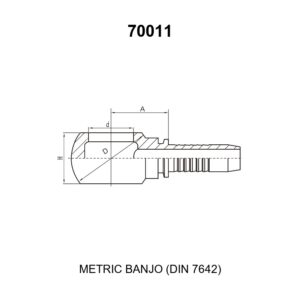
A banjo fitting is a compact fluid connection with three parts: a hollow banjo bolt with a cross-drilled port, a ring-shaped banjo body (also called a banjo union) with a side port for the hose, and two soft sealing washers. One washer sits under the bolt head; the other sits between the body and the mating component. Fluid flows from the hose into the side port, around the bolt inside the body cavity, and through the cross-drill into the component — or the reverse, depending on system design.
The seal works by plastic deformation, not by thread pressure. When the bolt is torqued to spec, the soft washers crush and flow into the microscopic roughness of both flat faces, filling every irregularity. The washers carry the sealing job; the threads only provide clamping force. That single principle explains both why banjo joints seal so reliably, and why almost every banjo leak traces back to a washer, a torque value, or a damaged face rather than the fitting itself.
Where banjo hydraulic fittings earn their place:
- Angular freedom — the body rotates around the bolt, so you can point the hose exactly where routing needs it without twisting the line.
- Compact envelope — on manifolds and engine bays, a banjo saves the space an elbow plus swivel adapter would take.
- Short flow path — fluid turns through the bolt cross-drill rather than a stack of adapters, keeping the assembly short and light.
Core value: choose the right bolt thread, body style, and washer, torque to spec — and a banjo joint stays dry for years; skip the washer change, and it will weep.
Three customer paths:
- For OEM manufacturers — standardize banjo ports across a machine or vehicle platform with matched bolts, bodies, and washer kits.
- For end users and maintenance teams — fix a weeping joint correctly the first time: new washers, correct torque, clean faces.
- For distributors — stock metric and UNF banjo families with washer kits and private-label packaging.
Key Specifications
Connection-Side: Banjo Bolt Threads and Torque
Metric banjo bolts follow DIN 7642; UNF sizes cover aftermarket brake and custom-line practice. Torque values assume dry threads, new crush washers, and room temperature.
| Bolt Thread | Typical Torque | Common Applications |
|---|---|---|
| M8 x 1.25 | 10–15 Nm (7–11 ft-lb) | Small fuel and oil lines, scooter brakes |
| M10 x 1.0 / 1.25 | 15–25 Nm (11–18 ft-lb) | Motorcycle and car brake calipers, fuel rails |
| M12 x 1.5 | 25–35 Nm (18–26 ft-lb) | Power steering, hydraulic manifolds, oil coolers |
| M14 x 1.5 | Confirm against the machine spec | Larger manifolds and industrial ports |
| 3/8-24 UNF | 12–18 Nm (9–13 ft-lb) | Aftermarket brake fittings, custom lines |
| 1/2-20 UNF | 20–30 Nm (15–22 ft-lb) | Large calipers, racing and truck brake banjos |
Lubricated threads reduce clamping force by roughly 20 to 30 percent, so clean the threads and follow the published value rather than tightening by feel. Banjo bodies are supplied with hose ends in hose-tail, 24° cone, JIC, ORFS, BSPP, and NPT forms.
Seal-Side: Choosing the Crush Washer
Washer material and size decide whether a banjo joint seals for years or fails on the first heat cycle.
| Washer Material | Sealing Behavior | Reusable? | Max Continuous Temp | Best For |
|---|---|---|---|---|
| Copper | Softest; flows into surface roughness, tolerates minor face imperfections | No — work-hardens after the first crush | ~250 °C | Brake and fuel systems, most general hydraulics |
| Aluminum | Light and moderately soft; corrosion-sensitive with some coolants and synthetic esters | No — single use | ~180 °C | OEM automotive, weight-sensitive assemblies |
| Steel | Hard; needs clean, flat, precision faces | Sometimes, on perfect surfaces | 400 °C+ (grade dependent) | High-pressure hydraulics on machined steel ports |
| Bonded (Dowty-style) | Metal shell with a rubber sealing lip; seals at low torque, dampens vibration | Limited — rubber ages | 120–150 °C (rubber dependent) | High-vibration oil lines, aluminum ports |
Washer sizing follows the bolt thread and boss diameter, not the hose diameter: the inner bore must slide freely over the threads yet seat on the solid boss (roughly 0.2–0.5 mm larger than the thread size), and the outer diameter must fully cover the sealing face on both sides.
Body-Side: Banjo Body Styles
| Body Style | Description | Typical Use |
|---|---|---|
| Single banjo eye | One hose port on the ring body | Standard hose-to-port connection |
| Double banjo | Two hose ports sharing one bolt | Feeding two lines from one port |
| Banjo to hose tail | Ring body with a barbed tail | Low-pressure fuel, air, oil lines |
| Banjo to 24° cone | Ring body with a DIN 2353 cone end | Metric hydraulic systems |
| Banjo elbow | Ring body with a 45° or 90° outlet | Routing around obstacles |
| Weld-on boss | Banjo seat welded to a tank or manifold | Custom reservoirs and fabrications |
| Pressure-switch banjo | Bolt with an integrated switch | Motorcycle brake-light circuits |
Custom threads, outlet angles, restrictor bores, and special bodies are available on request.
Hose-Side: Matching the Crimp End
Where a banjo body includes a hose tail, the hose end is crimped exactly like any other assembly, using the ferrule series matched to your hose family — 1SN and 2SN braided hoses for general service, 4SP/4SH and R12 spirals for high pressure, and PTFE constructions for corrosive media. Assembly pressure rating follows the lower of the hose rating and the banjo joint rating; we confirm both with each quote.
Materials and Finish
| Component | Standard Option | Corrosive-Service Option |
|---|---|---|
| Banjo body and bolt (metric) | Carbon steel, zinc or clear trivalent chrome | Stainless steel |
| Banjo body and bolt (UNF) | Carbon steel, zinc plating | Stainless steel |
| Low-pressure and fuel service | Brass | Stainless steel |
| Crush washers | Copper (standard), aluminum | Bonded Dowty-style, steel |
Key Features
- Three-part sealing system: hollow bolt, ring body, two crush washers
- Body rotates around the bolt before tightening — no twisted hose lines
- Compact envelope that replaces elbow-plus-swivel stack-ups on tight ports
- Metric (DIN 7642) and UNF banjo bolts with matched washer kits
- Washer material matched to fluid, temperature, and service interval
Crimping and Installation
Because the washers do the sealing on every banjo hydraulic fittings joint, installation discipline decides the outcome. Work through these steps every time:
- Depressurize and drain the line before opening the joint.
- Clean the fitting area so grit cannot fall into the open port.
- Inspect the bolt for stretch, thread galling, or cracks, and both sealing faces for scratches, pitting, or debris.
- Remove the banjo bolt and replace both washers with new ones of the correct size and material.
- Dress minor face scratches with 400–600 grit abrasive on a flat backing block; machine or replace deeply damaged faces.
- Reassemble washer, body, washer onto the bolt, thread by hand to avoid cross-threading, and orient the body so the hose runs without twist.
- Torque to the published value with a calibrated torque wrench.
- Re-pressurize, wipe the joint dry, and check for weeping; retorque once after the first heat cycle.
Rules that prevent repeats:
- Never reuse a crush washer — copper work-hardens on the first crush.
- Never use thread sealant or PTFE tape on a banjo bolt; the washers seal, and tape shreds can block downstream passages.
- Support the hose with clamps so vibration cannot lever the body off square.
- Recheck torque on high-vibration equipment at every service interval.
Nomenclature: Describing a Banjo Fitting
A banjo fitting is described by three fields. Learn them and you can read any line item:
| Field | Meaning | Example |
|---|---|---|
| Bolt thread | The port thread size and pitch | M12 x 1.5 |
| Body style | Ring body configuration | Double banjo |
| Hose end | The outlet type and size | Hose tail, 3/8 in |
A typical description reads: M12 x 1.5 double banjo body, hose tail x 3/8 in hose. We assign the exact bolt, body, and washer kit for your configuration on request — send the thread size, body style, and hose size, and our engineers confirm the code before you order.
Matching and Identification
Banjo hydraulic fittings are identified by measuring three things with a caliper: the bolt thread diameter and pitch, the boss (sealing face) diameter, and the washer that fits between them. Use this table to separate the common connection styles:
| Consideration | Banjo Fitting | AN / JIC Fitting |
|---|---|---|
| Sealing method | Crush washers compressed by the bolt | Flared tube against a tapered seat |
| Hose rotation | Rotates freely around the bolt | Fixed orientation |
| Torque sensitivity | High — washers seal in a narrow window | Moderate — the seat is forgiving within range |
| Flow restriction | Slight — fluid turns through the cross-drill | Minimal — straight-through bore |
| Service cost | Low — two washers per service | Higher — new ends and sleeves to rework |
Washer bore references for the common bolt threads: M8 x 1.25 takes approximately 8.2–8.5 mm; M10 x 1.0/1.25 about 10.2–10.5 mm; M12 x 1.5 about 12.2–12.5 mm; 3/8-24 UNF about 9.8–10.0 mm; 1/2-20 UNF about 13.0–13.2 mm. If you are unsure, send the two measurements and we confirm the correct washer kit before you order.
Applications and Industries
Banjo hydraulic fittings suit compact, serviceable connections across fluid power:
- Brake calipers and master cylinders
- Fuel rails and injection lines
- Turbo oil feed and oil cooler lines
- Power steering pumps and racks
- Hydraulic manifolds on pumps, valves, and motors
- Machine tools and compact power units
- Agricultural and utility equipment service points
Operating temperature follows the washer and the hose: copper washers run to about 250 °C, aluminum to about 180 °C, bonded washers to roughly 120–150 °C depending on the rubber compound, and steel washers higher still.
Ordering and Packaging
- Unit of measure: sold per piece (EA); washer kits sold per set
- MOQ: one box per size; mixed-size sample kits available
- Supplied as matched sets: bolt, body, and two crush washers, or as separate components
- Customization: thread size, outlet angle, restrictor bore, material, washer specification, private labeling
- Export packing: corrugated cartons with moisture barrier for sea freight
Banjo Hydraulic Fittings FAQ
How do banjo hydraulic fittings seal? Through two soft crush washers, not through the threads. The bolt clamps the ring body and washers against flat faces; at correct torque the washers plastically deform into the surface roughness and seal. The threads only provide clamping force.
Can I reuse copper crush washers? No. Copper work-hardens on the first crush and cannot re-flow into the surface on reassembly, which is why reused washers are the leading cause of leaks after a service. Annealing restores softness in an emergency, but a new washer is the reliable fix.
How tight should a banjo bolt be? Torque varies with thread size, bolt material, and the component it threads into. Typical references are M10 at 15–25 Nm, M12 x 1.5 at 25–35 Nm, and 1/2-20 UNF at 20–30 Nm with dry threads and new washers. Always confirm the exact value for your component.
Should I use PTFE tape or sealant on a banjo bolt? No. The joint seals at the washers, so tape or sealant cannot stop a leak there — and PTFE shreds can travel downstream and block passages. Replace the washers and torque to spec instead.
Why does my banjo fitting only leak under full pressure? A joint that weeps only at full system pressure usually points to under-torque or a washer that is too hard or too thick for the joint. Fit fresh washers and torque to spec; if it returns, inspect the sealing faces.
Which washer material should I choose? Copper is the safest default for brake and fuel service and most general hydraulics. Aluminum suits weight-sensitive OEM assemblies. Steel suits high-pressure machined steel ports with clean faces. Bonded Dowty-style washers suit high-vibration oil lines and aluminum ports.
What is the difference between a banjo and an AN or JIC fitting? A banjo seals with crush washers and lets the hose rotate around the bolt; AN and JIC fittings seal with a flare against a tapered seat and hold a fixed orientation. Banjos win on compact routing and service cost; flared fittings win on straight-through flow.
- Hydraulic Hose2727 products
- Steel Wire Spiraled Hydraulic Hose66 products
- Steel Wire braided Hydraulic Hose1010 products
- Textile Reinforced Hydraulic Hose33 products
- Thermoplastic Hydraulic Hose33 products
- Industrial Hose5959 products
- Air Hose99 products
- Water Hose1111 products
- Oil Hose1616 products
- Chemical Hose66 products
- Steam Hose33 products
- Multipurpose Hose22 products
- Food & Beverage Hoses44 products
- Concrete Hose44 products
- Cement Hose22 products
- Material Handling Hose1111 products
- Dredge Hose44 products
- Hydraulic Fittings162162 products
- Reusable Hose Fittings66 products
- Socketless Hose Fittings88 products
- JIC Hydraulic Fittings1515 products
- Metric Hydraulic Fittings3838 products
- NPT Hydraulic Fittings66 products
- BSP Hydraulic Fittings2626 products
- SAE Hydraulic Fittings3030 products
- Banjo Hydraulic Fittings44 products
- ORFS Hydraulic Fittings1111 products
- Ferrule1111 products
- Flange Fittings2626 products
- One Piece Fittings2323 products
- Hydraulic Adapters2929 products
Send a Mail
henghua@hhgpipe.com
Make a Call
+15822925523
86-22-83859963
Mon - Sun: 09:00 am - 22:00 pm
Main Office
Tianjin, China
Hezhong Building, Youyi North Road
 English
  Spanish
  Portuguese
  French
  German