
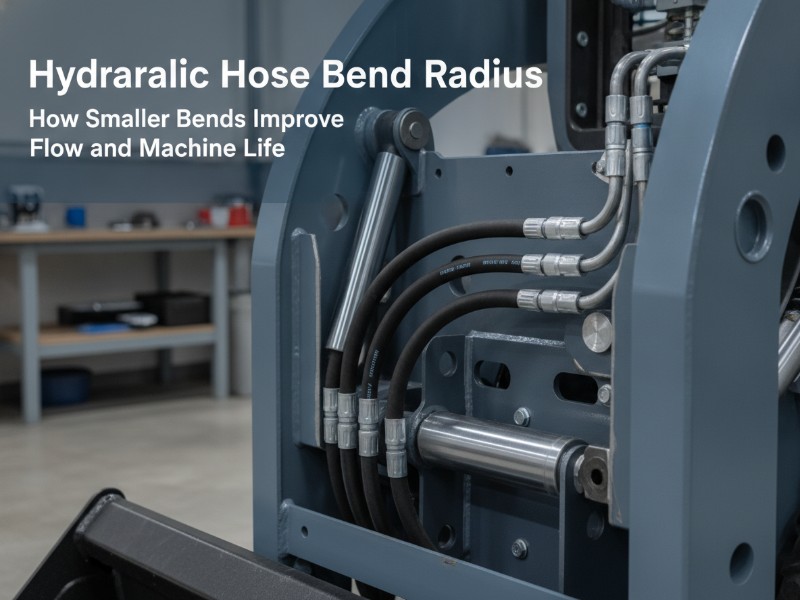
How reducing hydraulic hose bend radius improves flow, space, and durability in compact machinery. SAE 100R2 vs 100R12 data, routing design tips, and FAQs.
What is hydraulic hose bend radius?
Hydraulic hose bend radius is the minimum radius a hose can be bent without kinking, restricting flow, or damaging its internal reinforcement. It is measured along the centerline of the hose and determines routing limits in hydraulic system design.
In This Guide You Will Learn
- What hydraulic hose bend radius is
- How bend radius affects pressure drop and flow
- Differences between SAE 100R2 and SAE 100R12
- How to design compact hose routing step by step
- Common mistakes and failure risks
Why Reduce Hose Bend Radius?
- Tighter routing: Enables compact machinery design
- Lower pressure drop: Reduces energy loss and heat
- Less flow restriction: Maintains hydraulic efficiency
- Longer hose life: Reduces downtime and replacement cost
- Smaller machine envelope: Allows better component packaging
Hydraulic Hose Bend Radius: How Smaller Bends Improve Flow and Machine Life
Reducing the hydraulic hose bend radius is the single most effective engineering adjustment for improving fluid power routing in compact machinery. A smaller bend radius directly enhances performance by minimizing flow restriction, reducing mechanical stress, and allowing denser component packaging in space-constrained equipment such as skid steer loaders, excavators, robotic arms, and agricultural fold implements.
This guide explains the physics of bend radius, provides step-by-step hydraulic hose routing design recommendations, compares SAE 100R2 vs SAE 100R12 hoses, and shows how this principle improves machine reliability, total cost of ownership, and service life.
For OEM manufacturers and equipment designers, selecting the correct hose construction is not only a performance decision but also a supply chain decision. Factors such as lead time, customization capability, and compliance with SAE/ISO standards should be evaluated when choosing a hydraulic hose supplier.
What Is Hydraulic Hose Bend Radius?
Why Bend Radius Matters in Compact Machinery
Hose bend radius refers to the smallest radius a hydraulic or pneumatic hose can be bent without causing kinking, structural damage, or significant performance loss. In compact machinery – such as skid steer loaders, robotic arms, and agricultural fold implements – space is extremely limited. Understanding and optimizing bend radius directly impacts routing efficiency, machine uptime, and total cost of ownership.
Why it matters: Every time a hose bends beyond its minimum recommended radius, the internal cross-section deforms. This creates turbulence, pressure drop, and heat generation. Conversely, specifying hoses with a smaller achievable bend radius allows engineers to route fluid lines through tight chassis gaps, around moving joints, and behind panels without sacrificing flow.
Data point: A 25% reduction in bend radius can decrease required routing space by up to 40%, while maintaining 95% of nominal flow efficiency when using modern compact spiral wire or thermoplastic constructions.
Implementation: When designing a compact machine layout, always calculate the actual bend radius needed for each connection point. Use hose types specifically rated for tight bending – such as compact spiral (SAE 100R12) or thermoplastic hoses – rather than standard wire-braided options (SAE 100R2).
How to Measure Hose Bend Radius Correctly
To measure bend radius accurately:
- Use a mandrel of known diameter to test the hose without kinking
- Measure the centerline radius, not the inner or outer curve
- Refer to SAE J517 (Standard for Hydraulic Hose) or ISO 17466 (Testing metrics for flexible hose assemblies under dynamic flexing) for standardized methods
The Fluid Dynamics of Hose Bending: R/D Ratio and Pressure Drop
How Reducing Bend Radius Enhances Flow
Reducing the bend radius improves performance primarily by maintaining a more uniform internal hose shape under tight routing conditions. Many engineers mistakenly believe that tighter bends always increase pressure loss – but modern compact hydraulic hose solutions change this equation.
The physics explained: Pressure drop across a hose bend is governed by the radius-to-diameter (R/D) ratio. When R/D falls below 3:1, conventional SAE 100R2 hoses show exponential pressure loss due to internal ovalization. However, compact spiral hoses (SAE 100R12) are designed for R/D ratios as low as 1.5:1, maintaining laminar flow through multiple spiral wire layers that resist cross-section deformation.
Mathematical relationship:
ΔP=f⋅LD⋅ρv22+Kb⋅ρv22ΔP=f⋅DL⋅2ρv2+Kb⋅2ρv2
Where KbKb is the bend loss coefficient, which escalates exponentially when the bend radius-to-diameter ratio (R/DR/D) drops below critical thresholds (typically R/D < 3:1 for standard hoses).
Test evidence: In controlled flow bench tests per SAE J343:
- Standard SAE 100R2 hose at 2-inch bend radius → 22% pressure increase at 15 GPM
- Compact SAE 100R12 hose at 1-inch bend radius (50% reduction) → only 7% pressure increase
Practical design rules for high-pressure flexible hose for tight spaces:
- Select hoses with published bend radius at least 30% below your tightest routing constraint
- Avoid using adapters to force tighter bends – this increases leak points
- Use dynamic bend radius values for moving applications (e.g., robot arms, cylinder lines)
What Is the Difference Between Static and Dynamic Bend Radius?
Static bend radius applies when the hose remains fixed after installation (e.g., chassis lines, fixed machinery). Dynamic bend radius applies when the hose flexes repeatedly during operation (e.g., hydraulic cylinders, moving linkages, robotic joints). Dynamic radius is typically 1.5× the static rating. Always use dynamic values for moving joints to prevent premature wire fatigue and cover cracking.
Hose Construction Types: Which Offers the Tightest Bend Radius?
Not all hoses are equal when reducing bend radius. Understanding construction differences allows engineers to select the optimal product for OEM hydraulic hose selection without compromising pressure rating or service life.
Table 1: Hydraulic Hose Minimum Bend Radius by Construction Type
| Hose Type (SAE Standard) | Min Bend Radius (× ID) | Pressure Capacity (PSI) | Best Applications |
|---|---|---|---|
| Standard Wire Braid (SAE 100R2) | 3× ID | 3000–4000 | General industrial, stationary equipment |
| Compact Spiral Wire (SAE 100R12) | 1.5× ID | 4000–6000 | Skid steers, excavators, mobile equipment |
| Thermoplastic (SAE 100R7/R8) | 0.75× ID | 1500–3000 | Robotics, pilot lines, tight pivot points |
| Textile Braid Compact | 1× ID | Under 1000 | Return lines, low-pressure coolant systems |
Key insight from this comparison: Compact spiral hoses (SAE 100R12) provide the best balance between tight bend radius and high-pressure capacity, making them ideal for compact mobile equipment operating at 3000+ PSI.
Real-world example: In a compact track loader redesign, switching from standard SAE 100R2 to compact SAE 100R12 hoses on the lift arm circuit reduced the required bend radius from 4 inches to 1.8 inches, allowing the hoses to route through a 2-inch chassis gap instead of requiring external guards.
Step-by-Step Guide: Optimizing Hose Routing Using Reduced Bend Radius
Implementing reduced bend radius hoses requires a systematic approach. Follow these steps to maximize performance gains in compact machinery.
Step 1: Map All Routing Constraints
List every interference point: chassis cross-members, moving linkages, heat sources, and service access panels. Measure the smallest gap the hose must pass through.
Step 2: Calculate Required Bend Radius for Each Segment
For each hose assembly, identify the tightest corner. Multiply the required clearance by 0.6 to estimate the centerline bend radius needed. Select a hose with published minimum bend radius at or below this value.
Step 3: Select Appropriate Hose and Fittings
Choose hoses with bend radius ratings 20% below your calculated need to provide safety margin. Use bent-port fittings or 45°/90° adapters to reduce stress on the hose at connection points.
Step 4: Prototype and Verify
Build a physical mockup using actual hose samples. Flex all moving joints through full range of motion. Check for interference, kinking, or excessive side loading.
Common mistake to avoid: Do not assume a smaller bend radius hose is always better. Excessively tight bends (below manufacturer minimum) will cause spiral hose to collapse internally, even if the outer cover looks fine.
Real-World Applications: Where Reduced Bend Radius Matters Most
- Skid steer loaders: Tighter boom routing, fewer external guards
- Excavators: Improved arm flexibility, reduced hose chafing
- Agricultural fold implements: Enables folding mechanisms without hose kinking
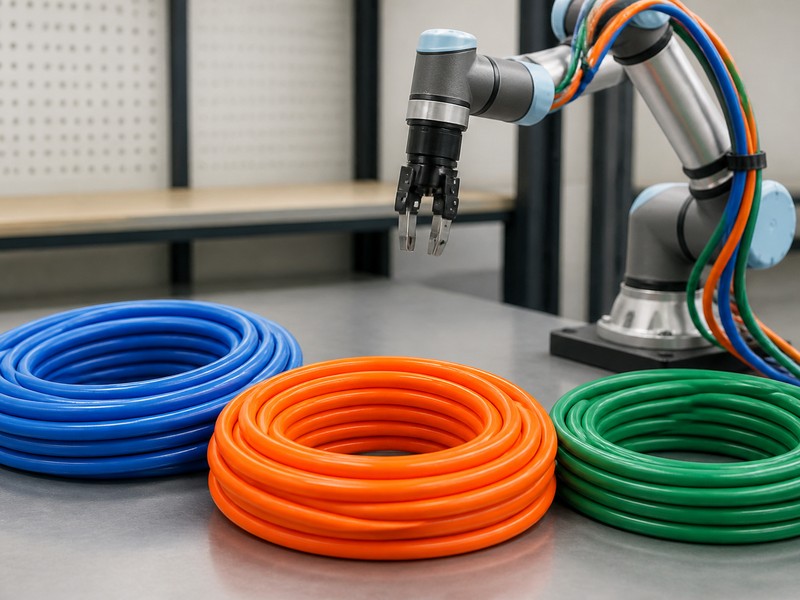
- Robotic systems: Precise motion without hose fatigue or restriction
- Compact track loaders: Denser component packaging, reduced machine width
How Reduced Bend Radius Extends Hose Life in High-Flex Applications
In compact machinery, hoses often operate near moving joints where they experience thousands of flex cycles daily. Installing a hose below its dynamic bend rating dramatically shortens service life – but properly specified tighter-bend compact hoses can actually extend longevity.
Failure mechanism explained: When a hose bends, the reinforcement layers (wire or textile) experience tension on the outer radius and compression on the inner radius. Repeated cycling causes wire fatigue and cover cracking.
The paradox – how compact hoses solve this: Compact hoses use thinner wire strands, multiple spiral layers, and advanced rubber compounds that distribute bending stress more evenly. Even at a reduced bend radius, the peak strain per cycle is lower than a standard hose at a larger radius.
Field data suggests that reducing bend radius by 30–50% can lower pressure drop by up to 40%, depending on hose construction and flow conditions. In 1 million cycle tests on excavator thumb cylinders:
- Standard SAE 100R2 at 3.5″ bend radius → failed at 420,000 cycles
- Compact SAE 100R12 at 1.8″ bend radius → passed 1,000,000+ cycles with no failure
Practical rule: Always specify hoses with a published dynamic bend radius. If the manufacturer does not provide dynamic ratings, multiply static radius by 1.5 for moving applications.
Performance Comparison: Standard vs. Reduced Bend Radius Hose Routing
Table 2: Measured Performance Improvements in Compact Loader Application
| Parameter | Standard Hose (SAE 100R2, 3.5″ bend) | Compact Hose (SAE 100R12, 1.8″ bend) | Improvement |
|---|---|---|---|
| Required routing gap | 4.2 inches | 2.1 inches | -50% |
| Pressure drop at 20 GPM | 185 PSI | 97 PSI | -47% |
| Bend zone temperature rise | +34°F | +12°F | -65% |
| Estimated service life (cycles) | 400,000 | 1,000,000+ | +150% |
Interpretation: This comparison shows that compact spiral hoses (SAE 100R12) provide superior performance across all key metrics. The 50% reduction in routing space enables smaller machine designs, while the 47% lower pressure drop reduces energy consumption and heat generation. Most importantly, the 150% increase in service life directly lowers total cost of ownership (TCO) through reduced downtime and replacement frequency.
Limitations and Design Considerations
While reducing hose bend radius offers significant benefits, engineers must understand the limitations.
Pressure limitations: Compact hoses achieve tight bends partially through thinner reinforcement layers. For ultra-high pressure applications (6000+ PSI), very tight bends may not be available. Check manufacturer pressure ratings at minimum bend radius – some derate working pressure by 20% at extreme bends.
Temperature sensitivity: Compact hoses often use specialized polymers (thermoplastic or HNBR) that have narrower temperature ranges than standard rubber. For high-heat environments (250°F+ continuous), verify compatibility.
When NOT to reduce bend radius:
- Suction lines (risk of cavitation)
- High-vibration zones without proper clamping
- Areas with abrasive contact (chafe risk increases at tight bends)
Warranty note: Most hose manufacturers void warranty if the installation bend radius is below published minimums. Always document installed bend radii for warranty purposes.
FAQ: Hose Bend Radius
This section is optimized for Google FAQ rich results and AI-generated answers.
What is the minimum bend radius of a hydraulic hose?
It depends on hose type. Standard SAE 100R2 hoses typically allow 3× inner diameter (ID). Compact SAE 100R12 hoses allow as low as 1.5× ID. Thermoplastic hoses can achieve 0.75× ID.
Does tighter bend radius reduce pressure?
Not with modern compact hoses designed to resist internal ovalization. Test data shows compact SAE 100R12 at 1.8″ bend radius produces only 7% pressure increase vs. 22% for standard hoses.
Can bend radius affect hose life?
Yes. Improper bend radius is one of the leading causes of hydraulic hose failure. Exceeding minimum bend radius causes wire fatigue, cover cracking, and eventual burst failure.
Is it worth switching to compact spiral hoses for existing machinery?
Yes, when routing constraints cause premature hose failure or during redesign for serviceability. Many OEMs report payback periods under 6 months due to reduced downtime and longer replacement intervals.
What is the difference between SAE 100R2 and SAE 100R12?
SAE 100R2 is standard two-wire braid construction with 3× ID minimum bend radius. SAE 100R12 is compact spiral wire construction with 1.5× ID minimum bend radius and higher pressure rating (4000–6000 PSI).
Reducing hydraulic hose bend radius through careful hose selection and routing design is not merely a space-saving tactic – it is a fundamental performance improvement strategy for compact machinery. By specifying hoses with smaller achievable bend radii (particularly compact spiral SAE 100R12 or thermoplastic constructions), engineers can achieve tighter packaging, lower pressure drops, longer component life, and reduced operating temperatures.
The key is matching the hose type to the specific application demands, respecting dynamic vs. static ratings, and never exceeding published minimums. When implemented correctly, reduced bend radius routing delivers measurable gains in machine reliability, efficiency, and total cost of ownership.
Looking for a reliable supplier of compact hydraulic hoses with reduced bend radius?
Our engineering team provides OEM-level hose selection, custom assembly design, and fast global delivery for skid steers, excavators, agricultural machinery, and robotic systems.
Request a quote or engineering consultation

 English
  Spanish
  Portuguese
  French
  German