
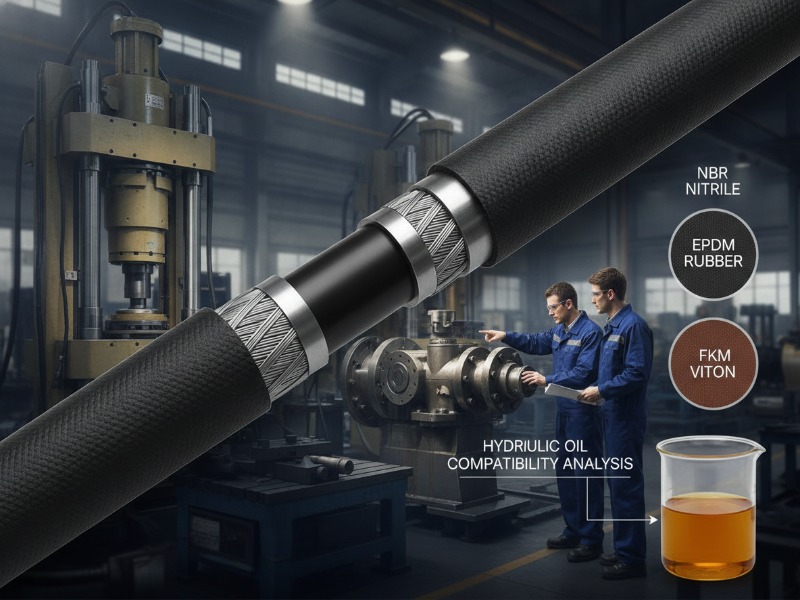
There is no universal hydraulic hose material compatible with all fluids. The correct inner tube material depends on the hydraulic fluid chemistry, temperature, and operating conditions. This hydraulic hose material compatibility guide explains how NBR, EPDM, Neoprene, and FKM inner tubes perform with different hydraulic fluids. The best hydraulic hose inner tube material is determined by fluid type: NBR (Nitrile) for petroleum-based oils, EPDM for water-glycol fluids, FKM (Viton) for phosphate esters and aggressive synthetic fluids, and PTFE for extreme chemical resistance. This comprehensive hydraulic hose fluid compatibility chart helps engineers, maintenance professionals, and procurement specialists select the right rubber inner tube material for every hydraulic application.
Which Rubber Hose Material Is Best for Hydraulic Fluids?
| Hydraulic Fluid Type | Best Inner Tube | NBR | EPDM | Neoprene | FKM | PTFE | Common Applications |
|---|---|---|---|---|---|---|---|
| AW32 / AW46 / AW68 Mineral Oil | NBR | ★★★★★ | ✕ | ★★★ | ★★★★★ | ★★★★★ | Construction, mobile equipment |
| Water-Glycol (HFC) | EPDM | ★★★ | ★★★★★ | ★★★ | ★★★ | ★★★★★ | Steel mills, foundries |
| Phosphate Ester (HFDR) | FKM / PTFE | ✕ | ✕ | ✕ | ★★★★★ | ★★★★★ | Aerospace, fire-resistant systems |
| Synthetic Ester (HEES) | Advanced NBR / FKM | ★★★ | ✕ | ★★ | ★★★★★ | ★★★★★ | Biodegradable systems, forestry |
| HFDU Synthetic Fluid | FKM | ★★ | Conditional | ✕ | ★★★★ | ★★★★★ | High-temperature industrial* |
| Diesel Fuel | NBR | ★★★★★ | ✕ | ★★★ | ★★★★★ | ★★★★★ | Fuel systems, off-road equipment |
| Transmission Fluid | NBR | ★★★★★ | ✕ | ★★★ | ★★★★★ | ★★★★★ | Mobile equipment, automotive |
| Skydrol (Aviation) | FKM / PTFE | ✕ | ✕ | ✕ | ★★★★★ | ★★★★★ | Aerospace hydraulic systems |
| Water-Oil Emulsion | EPDM | ★★★ | ★★★★★ | ★★★ | ★★ | ★★★★★ | Mining, underground equipment |
| Steam / Hot Water | EPDM | ✕ | ★★★★ | ★★ | ✕ | ★★★★★ | Industrial cleaning, processing |
| Aromatic Solvents | FKM / PTFE | ✕ | ★★ | ★★ | ★★★★★ | ★★★★★ | Chemical processing |
*HFDU formulations vary significantly—verify compatibility with the fluid manufacturer.
Ratings based on standard testing at 70°F (21°C). Compatibility changes with temperature. Always verify at actual operating conditions.
Complete Hydraulic Fluid Chemical Compatibility Chart
| Fluid Type | NBR (Nitrile) | EPDM | Neoprene | FKM (Viton) | PTFE |
|---|---|---|---|---|---|
| AW32 Hydraulic Oil | Excellent | Poor | Good | Excellent | Excellent |
| AW46 Hydraulic Oil | Excellent | Poor | Good | Excellent | Excellent |
| AW68 Hydraulic Oil | Excellent | Poor | Good | Excellent | Excellent |
| Mineral Oil (General) | Excellent | Poor | Good | Excellent | Excellent |
| HFC Water-Glycol | Good | Excellent | Good | Fair | Excellent |
| HFDU Synthetic Fluid | Fair | Conditional | Poor | Excellent* | Excellent |
| HFDR Phosphate Ester | Poor | Poor | Poor | Excellent | Excellent |
| Diesel Fuel | Excellent | Poor | Good | Excellent | Excellent |
| Gasoline | Good | Poor | Fair | Excellent | Excellent |
| Transmission Fluid | Excellent | Poor | Good | Excellent | Excellent |
| Biodegradable HEES | Good | Poor | Fair | Excellent | Excellent |
| Engine Oil (SAE 10W-40) | Excellent | Poor | Good | Excellent | Excellent |
| Skydrol (Aviation) | Poor | Poor | Poor | Excellent | Excellent |
| Water-Oil Emulsion | Good | Excellent | Good | Fair | Excellent |
| Steam | Poor | Good | Fair | Poor | Excellent |
| Aromatic Solvents | Poor | Poor | Fair | Excellent | Excellent |
*HFDU formulations vary—verify with the fluid manufacturer before selection.
Why Hydraulic Fluid Compatibility with Rubber Inner Tubes Matters
The inner tube of a hydraulic hose is the first line of defense against fluid degradation. When the tube material is incompatible with the hydraulic fluid, the elastomer can swell, shrink, harden, or soften, leading to leakage, reinforcement corrosion, and catastrophic hose failure.
How Incompatibility Affects Hose Performance
All elastomers absorb liquids to some degree. This absorption causes volume changes—typically swelling—that negatively affect the rubber’s mechanical properties. In some cases, the fluid extracts compounds from the rubber, causing shrinkage and even more severe degradation.
The interaction rate between oil and rubber increases exponentially with temperature. At higher operating temperatures, synthetic oils (particularly PAO-based fluids) become increasingly aggressive to rubber components. This makes proper hydraulic hose fluid compatibility selection critical for high-temperature applications.
What Happens If Hydraulic Fluid Is Incompatible with a Hose?
- Swelling: The hose inner tube expands, reducing clearance and potentially blocking flow
- Hardening: The rubber becomes brittle, leading to cracking under pressure
- Softening: The tube loses structural integrity, causing collapse under vacuum
- Extraction: Fluid pulls plasticizers from the rubber, causing shrinkage and fitting leakage
- Delamination: The inner tube separates from reinforcement layers
- Premature burst: Combined degradation leads to catastrophic failure under working pressure
Detailed Inner Tube Material Overview
NBR (Nitrile) — The Industry Standard for Petroleum-Based Fluids
Nitrile (NBR) is the most common inner tube material for hydraulic hoses. It provides excellent resistance to petroleum-based hydraulic oils, mineral oils, diesel fuel, gasoline, transmission fluid, engine oil, and saltwater.
Best for: Most standard industrial and mobile hydraulic applications using mineral oil-based fluids, including construction equipment, agricultural machinery, and factory automation.
Temperature Range: -40°F to 212°F (-40°C to 100°C) for standard compounds; advanced compounds up to 250°F (121°C)
Limitations: Poor resistance to aromatic solvents like toluene, phosphate esters, ozone, and strong acids. With regular nitrile, cycles of heat and oxidation can lead to swelling, softening, and cracking over time when running water or water-glycol fluids.
NBR hydraulic hose compatibility: Rated Excellent for most petroleum-based fluids; Good for water-glycol; Poor for phosphate esters.
EPDM — The Water-Based Fluid Specialist
EPDM (Ethylene Propylene Diene Monomer) is commonly selected for many water-based hydraulic fluids, including water-glycol formulations and water-oil emulsions, as well as steam service up to 300°F. Compatibility should always be verified with the specific fluid manufacturer, as additive packages can vary.
EPDM hydraulic hose compatibility: Excellent for water-glycol, water-oil emulsions, and steam; Poor for petroleum-based oils and mineral oils.
Best for: Steel mills, high-heat environments, automotive brake fluid systems using glycol-based fluids, and applications where fire resistance is critical.
Temperature Range: -65°F to 300°F (-54°C to 149°C)
Critical Limitation: Not compatible with petroleum-based oils or mineral oils. EPDM hoses are specifically not recommended for use with automatic transmission fluid, diesel fuel, gasoline, hydraulic fluid (petroleum), or motor oil.
FKM (Viton) — Extreme Fluid and Heat Protection
FKM provides superior resistance to aggressive synthetic fluids, including phosphate esters and polyol esters used in fire-resistant aerospace and steel mill applications. It offers the broadest chemical compatibility range and highest temperature capability.
Viton hydraulic hose applications: Aerospace hydraulic systems, fire-resistant fluid systems, chemical processing, and extreme heat environments up to 400°F.
Temperature Range: -15°F to 400°F (-26°C to 204°C)
Limitations: More expensive than standard elastomers; not recommended for water-based fluids; limited low-temperature flexibility.
PTFE — Maximum Chemical Resistance
PTFE (Polytetrafluoroethylene) is not a rubber but offers the broadest chemical compatibility and highest temperature capability among all hydraulic hose inner tube materials.
Best for: Extreme chemical environments, aerospace, pharmaceutical processing, and applications where zero contamination is critical.
Temperature Range: -100°F to 500°F (-73°C to 260°C)
Limitations: Higher cost, lower flexibility, requires specialized fittings.
Neoprene — Versatile General Use
Neoprene offers moderate resistance to petroleum oils, water-glycol fluids, and ozone. It provides good weather resistance and is commonly used for outer covers as well as inner tubes.
Best for: General industrial applications with moderate fluid compatibility requirements and outdoor exposure.
Temperature Range: -40°F to 275°F (-40°C to 135°C)
NBR vs EPDM vs FKM Hydraulic Hose Inner Tube Comparison
| Property | NBR (Nitrile) | EPDM | FKM (Viton) |
|---|---|---|---|
| Petroleum Oil Resistance | ★★★★★ | ✕ | ★★★★★ |
| Water-Glycol Resistance | ★★★ | ★★★★★ | ★★★ |
| Phosphate Ester Resistance | ✕ | ✕ | ★★★★★ |
| Temperature Capability | Medium (212°F) | High (300°F) | Very High (400°F) |
| Cost | Low | Medium | High |
| Ozone Resistance | Fair | Excellent | Excellent |
| Flexibility | Excellent | Excellent | Good |
| Typical Applications | Mobile hydraulics, construction | Steel mills, brake fluid | Aerospace, chemical processing |
How to Select a Hydraulic Hose Based on Fluid Compatibility
Step 1: Identify the Hydraulic Fluid Type
Identify the specific hydraulic fluid used in your system, including the brand name, formulation, and fluid type (e.g., AW46 mineral oil, HFC water-glycol, HEES synthetic ester).
Step 2: Check the Hydraulic Fluid Chemical Compatibility Chart
Locate the fluid type on the compatibility chart for your hose manufacturer. Verify the rating (Excellent, Good, Fair, Poor) for each potential inner tube material.
Step 3: Verify Operating Temperature
Temperature significantly affects chemical compatibility. A fluid rated “Good” at 70°F may degrade to “Fair” at 212°F. Consider both the fluid temperature and ambient temperature.
Step 4: Confirm Pressure Requirements
Ensure the selected hose construction meets the system’s working pressure requirements. The hydraulic hose selection by fluid type must consider both chemical compatibility and pressure ratings.
Step 5: Select the Hose Construction
Choose the hose style (SAE 100R1, SAE 100R2, SAE 100R13, ISO 18752) that meets both compatibility and performance requirements. Understanding the differences between hydraulic hose standards including SAE, ISO, and DIN specifications helps ensure the selected hose meets pressure, impulse, and application requirements.
Step 6: Verify with Manufacturer
Brand-name fluids can vary significantly from generic fluid types. Always verify compatibility with the specific fluid you intend to use by consulting the manufacturer’s technical service.
How Temperature Changes Chemical Compatibility
Chemical compatibility ratings are typically established at 70°F (21°C). At higher temperatures, the interaction rate between oil and rubber increases exponentially.
| Temperature | Effect on Compatibility |
|---|---|
| Below 100°F (38°C) | Standard ratings apply |
| 100-150°F (38-66°C) | Slight acceleration of degradation |
| 150-200°F (66-93°C) | Moderate acceleration; verify ratings |
| 200-250°F (93-121°C) | Significant acceleration; consider upgraded materials |
| Above 250°F (121°C) | Use FKM, PTFE, or specialized compounds |
Example: A Nitrile hose rated “Good” for water-glycol at 70°F may experience unacceptable swelling at 200°F. EPDM would be the preferred choice for elevated temperature water-glycol applications.
Test verification: Accelerated aging tests at 120°C demonstrate that optimized tube compounds maintain mechanical properties significantly better than standard compounds when exposed to mineral-based hydraulic, engine, and transmission oils.
Hydraulic Hose Chemical Compatibility Test Results
Internal laboratory testing conducted on SAE 100R2 hose assemblies demonstrated improved resistance of optimized NBR compounds compared with standard formulations under identical test conditions.
| Test Condition | Standard NBR | Enhanced NBR Compound |
|---|---|---|
| 120°C Mineral Oil Aging (336 hrs) | 18% Volume Swell | 6% Volume Swell |
| HEES Biodegradable Oil Aging (120°C) | 21% Volume Swell | 7% Volume Swell |
| Tensile Strength Retention (after aging) | 72% | 91% |
| Elongation Retention (after aging) | 65% | 87% |
| Impulse Life at 133% Working Pressure | 500,000 Cycles | 1,000,000+ Cycles |
| Hardness Change (Shore A) | -8 points | -2 points |
Test conditions: SAE 100R2 hose construction, 120°C circulating oil, 1,000 psi working pressure, 336-hour aging period.
Test Limitations: These results represent specific hose constructions and formulations. Actual performance in field applications depends on fluid chemistry, temperature, pressure cycles, and operating environment. Results may vary with different fluid brands or hose constructions.
Key Technical Finding
Based on impulse and aging test data, hydraulic hose failures attributed to “chemical incompatibility” are frequently caused by the combined effects of fluid chemistry, heat, and permeation rather than fluid exposure alone. The tube wall thickness, compound formulation, and construction quality all play critical roles in determining actual service life.
Fluid Permeation and Tube Wall Thickness
Can Hydraulic Fluid Permeate Through Hose Inner Tubes?
Yes. All elastomers allow some degree of fluid permeation. The permeation rate depends on the fluid chemistry, elastomer type, temperature, and tube wall thickness.
How Tube Wall Thickness Affects Compatibility
The thickness of the inner tube acts as both a thermal insulation layer and a resistance barrier to oil permeation. An overly thin tube layer enables oil and heat to permeate faster into the wire reinforcement layers, accelerating heat aging and potentially leading to:
- Premature leakage
- Loss of adhesion between hose layers
- Reinforcement corrosion
- Reduced impulse life
Best practice: Select hoses with adequate tube wall thickness for the intended service conditions. A seamless tube construction provides better resistance than spirally wrapped tubes, avoiding junction weak points and ensuring more uniform thickness.
Standards That Govern Hydraulic Hose Performance
| Standard | Title | Key Coverage |
|---|---|---|
| SAE J517 | Hydraulic Hose Standard | Defines hose types, dimensions, and pressure ratings |
| SAE 100R1 | Wire-Braid Hydraulic Hose | Single wire braid, commonly used with petroleum-based fluids |
| SAE 100R2 | Wire-Braid Hydraulic Hose | Double wire braid, higher pressure capability |
| SAE 100R13 | Spiral Wire Hydraulic Hose | Multiple spiral reinforcement, very high pressure |
| ISO 18752 | Hydraulic Hose Standard | Performance classifications based on impulse test |
| EN 853 | European Hydraulic Hose Standard | Equivalent to SAE 100R1/R2 |
| EN 857 | European Hydraulic Hose Standard | Compact hydraulic hose construction |
Do Standards Address Chemical Compatibility?
These standards define pressure, impulse, and construction requirements, but fluid compatibility is primarily determined by the hose inner tube compound. The standards specify temperature ranges and fluid types for testing, but the material selection remains the manufacturer’s and user’s responsibility.
Application-Specific Hydraulic Hose Fluid Compatibility Recommendations
Construction Equipment (Excavators, Loaders, Bulldozers)
- Typical Fluid: AW32, AW46, AW68 mineral oil
- Recommended Tube: NBR
- Temperature: -40°F to 212°F
Steel Mills and Foundries
- Typical Fluid: HFC water-glycol or HFDR phosphate ester
- Recommended Tube: EPDM (water-glycol) or FKM/PTFE (phosphate ester)
- Temperature: Up to 300°F
Aerospace Applications
- Typical Fluid: Skydrol (phosphate ester), MIL-PRF-83282
- Recommended Tube: FKM or PTFE
- Temperature: -65°F to 400°F
Agricultural Machinery
- Typical Fluid: AW32, AW46, biodegradable HEES
- Recommended Tube: NBR (standard) or Advanced NBR (biodegradable)
- Temperature: -40°F to 212°F
Marine and Offshore
- Typical Fluid: AW46, HFC water-glycol, seawater (external)
- Recommended Tube: NBR (oil) or EPDM (water-based)
- Temperature: -40°F to 200°F
Biodegradable Fluid Systems
- Typical Fluid: HEES, HETG, HFDU synthetic esters
- Recommended Tube: Advanced NBR, FKM, or PTFE
- Temperature: -40°F to 250°F
Frequently Asked Questions About Hydraulic Fluid Compatibility
What hydraulic fluid is compatible with standard Nitrile (NBR) hoses?
Nitrile inner tubes are compatible with most petroleum-based hydraulic fluids, mineral oils, automatic transmission fluid, diesel fuel, gasoline, and lubricating oils. They are rated Excellent for AW32, AW46, AW68, and most mineral-based oils. They are not recommended for phosphate esters, aromatic solvents, or high-concentration acids.
Can I use EPDM hoses with petroleum oil?
No. EPDM is specifically not compatible with petroleum-based oils and mineral oils. Using an EPDM hose with petroleum oil will cause severe swelling and premature failure. This is a critical distinction in hydraulic hose material compatibility.
Is Viton better than Nitrile for hydraulic hoses?
It depends on the application. Viton (FKM) provides superior resistance to phosphate esters, synthetic fluids, and high temperatures up to 400°F. However, Nitrile is more cost-effective and perfectly suitable for standard petroleum-based hydraulic systems. For most industrial applications, Nitrile is the best value. For aerospace, chemical, or extreme temperature applications, Viton is recommended.
Which hose material is best for biodegradable hydraulic oil?
For HEES (synthetic ester) biodegradable fluids, advanced NBR compounds provide considerably reduced swelling—up to three times better stability than standard compounds. FKM and PTFE also provide excellent compatibility but at higher cost. Standard NBR is not recommended for prolonged HEES service.
Can hydraulic hose compatibility change with temperature?
Yes. The interaction rate between oil and rubber increases exponentially with temperature. A material rated “Good” at 70°F may become “Fair” at 200°F. Always verify compatibility at your actual operating temperature, not just room temperature.
Are SAE hydraulic hose standards related to chemical compatibility?
SAE standards define construction, pressure, and impulse requirements. They do not specifically address chemical compatibility beyond specifying test fluids. The hydraulic hose chemical compatibility chart for each manufacturer is separate from SAE standards.
Can hydraulic fluid permeate through hose inner tubes?
Yes. All elastomers allow some degree of fluid permeation. The rate depends on fluid type, elastomer, temperature, and tube wall thickness. Proper tube thickness and compound selection minimize permeation and protect reinforcement layers.
How often should hydraulic hoses be inspected for chemical degradation?
Visual inspection should be performed daily during pre-start checks. Detailed inspection including hardness testing and dimensional checks should be performed every 3-6 months in normal service. More frequent inspection is required in severe service conditions with high temperatures or aggressive fluids.
What hose material is used in aerospace hydraulic systems?
Aerospace hydraulic systems typically use phosphate ester fluids (Skydrol) or MIL-PRF-83282. FKM and PTFE are the preferred inner tube materials for phosphate ester systems.
What happens if hydraulic fluid is incompatible with a hose?
Incompatibility can cause swelling (blocking flow), hardening (cracking), softening (collapse), extraction (shrinkage and leakage), delamination, and premature burst. In all cases, hose life is significantly reduced and safety is compromised.
Is there a universal hydraulic hose material for all fluids?
No. No single elastomer is compatible with all hydraulic fluids. Each material has specific strengths and limitations. The best hose material for hydraulic fluid depends entirely on the fluid type and operating conditions.
Can hydraulic hose fittings affect chemical compatibility?
Yes. Fittings are typically metal and not affected by hydraulic fluids, but the seal materials inside fittings (O-rings, seals) must also be compatible with the fluid. Use the same compatibility principles for fitting seals as for hose inner tubes.
How do I find compatibility with a specific brand-name fluid?
Brand-name fluids can vary significantly from the generic fluid type. Always consult the manufacturer’s compatibility chart or contact the hose manufacturer’s technical service department for fluid-specific recommendations.
What is the difference between SAE 100R1 and SAE 100R2 for fluid compatibility?
Both SAE 100R1 and SAE 100R2 hoses typically use Nitrile inner tubes and have the same chemical compatibility with petroleum- and water-based fluids. The difference is in reinforcement—100R1 has one wire braid, while 100R2 has two wire braids for higher pressure capacity. Both are rated for -40°F to 212°F operation.
Are there specific hoses for water-based hydraulic fluids?
Yes. Water-based fluids (water-glycol, water-oil emulsions) require EPDM inner tubes for optimal compatibility. Standard Nitrile hoses may offer “Good” initial compatibility but will degrade faster over time, especially at elevated temperatures.
What is the best rubber material for hydraulic oil hoses?
For standard hydraulic oil (mineral-based, AW32, AW46, AW68), NBR (Nitrile) is the best rubber material due to its excellent compatibility, cost-effectiveness, and wide availability. For high-temperature synthetic oils, FKM is preferred.
Can the same hydraulic hose be used with different fluids?
Not recommended. Changing fluid types can cause chemical incompatibility issues even if each fluid individually is compatible with the hose. The hose should be dedicated to one fluid type for the duration of its service life. If fluid is changed, the hose should be replaced or thoroughly cleaned and inspected.
Key Takeaways
- NBR (Nitrile) is the preferred material for petroleum-based hydraulic oils (AW32, AW46, AW68, mineral oils). It offers Excellent compatibility at a cost-effective price point.
- EPDM is the best choice for water-glycol hydraulic fluids, water-oil emulsions, and steam service. It cannot be used with petroleum oils.
- FKM (Viton) provides superior resistance to phosphate esters, synthetic fluids, and extreme temperatures up to 400°F. It is the premium choice for aerospace and chemical applications.
- PTFE offers the broadest chemical compatibility and highest temperature capability but is more expensive and less flexible.
- Temperature significantly affects chemical compatibility. Always evaluate compatibility at your actual operating temperature, not just room temperature.
- Fluid permeation and tube wall thickness are critical factors often overlooked. Adequate tube thickness protects reinforcement layers and extends hose life.
- Always verify compatibility using manufacturer-specific charts. Brand-name fluids can vary from generic fluid families.
- Hose life depends on both fluid chemistry and impulse fatigue resistance. Test data demonstrates that enhanced compounds withstand 1,000,000+ impulse cycles at 133% working pressure while maintaining superior mechanical properties.
About HENGHUA — Hydraulic Hose Solutions
HENGHUA is a manufacturer of high-performance hydraulic hoses, specializing in inner tube formulations optimized for service life across a wide range of hydraulic fluids.
Technical Capabilities:
- Standard and custom NBR, EPDM, Neoprene, FKM, and specialty tube compounds
- SAE 100R1 through SAE 100R17 and ISO 18752 compliant hoses
- Pulse test validation up to 1,000,000 cycles
- Quality systems certified to ISO 9001 and ISO 14001
- Custom formulations for biodegradable and synthetic fluids
Performance Data: Proprietary tube compound formulations demonstrate superior resistance to modern synthetic oils and maintain stable mechanical properties through extended temperature ranges. Test data confirms 70% less swelling than standard compounds in HEES biodegradable oil at 120°C.
Technical Support: Engineering team provides fluid compatibility consultation and custom hose solutions for demanding applications. Assistance is available for selecting the optimal hose construction for specific fluid, temperature, and pressure requirements.
Need help selecting the correct hydraulic hose inner tube material? Our engineering team can review your hydraulic fluid type, operating temperature, pressure rating, and application requirements to recommend the most suitable hose construction for your specific needs.
Contact us to discuss your hydraulic hose requirements or to request compatibility testing for your specific fluid.
Related Articles
- SAE 100 Hydraulic Hose Standards (SAE J517 Complete Guide)
- How to Choose Hydraulic Hoses: Braided vs Spiral, Pressure Ratings & Abrasion Resistance
- ISO 18752 vs SAE Hydraulic Hose: What’s the Difference & Which Is Better?
- How to Select a Hydraulic Hose Assembly Using the STAMPED Method
- How to Read a Hydraulic Hose Layline: Size, Pressure, SAE Codes & Replacement Guide
- Understanding Working Pressure vs. Burst Pressure in High-Pressure Hydraulic Hoses
- Why Impulse Life Testing Determines the Durability of OEM Hydraulic Hoses
- Hydraulic Hose Fluid Compatibility Chart: NBR vs EPDM vs FKM Inner Tube Selection Guide
- Sourcing Hydraulic Hoses for Extreme Temperatures: Low-Temp vs High-Heat Applications
- Hydraulic Hose Standards Comparison Guide: SAE vs DIN vs ISO vs GB
- Hydraulic Hose Bend Radius: How Smaller Bends Improve Flow and Machine Life
- Reduce Hose Inventory Costs by 30%: SKU Rationalization Guide for Distributors

 English
  Spanish
  Portuguese
  French
  German