
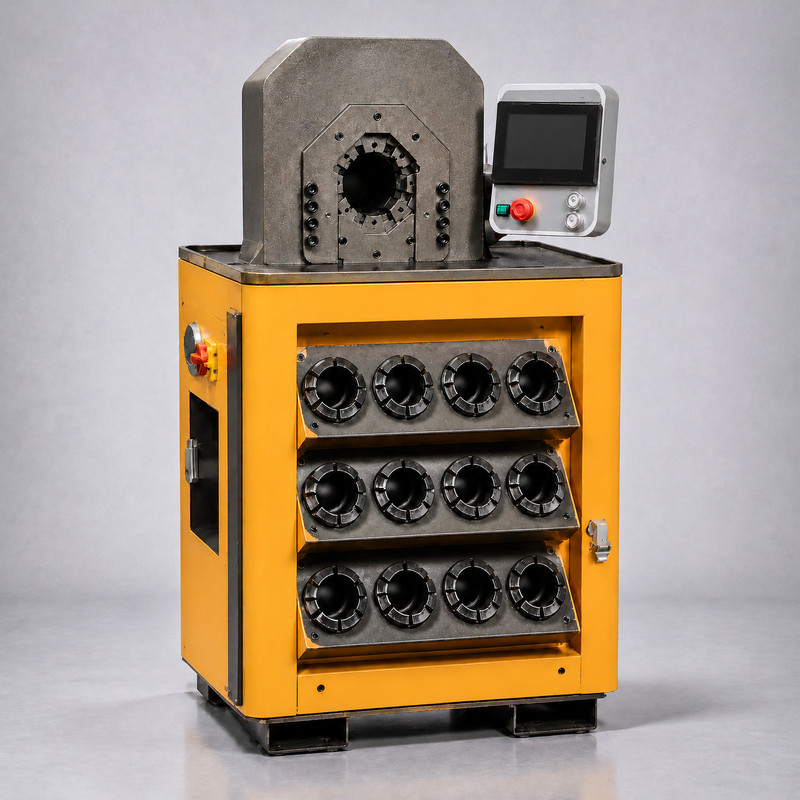
Can one frame close both a 1/4 inch one-wire assembly and a 2 inch four-spiral assembly? Yes, with the right die for each. The HH145F is a 4SP hydraulic hose crimping machine with a 145 mm maximum opening, 3,000 kN crimping force and a catalogue range of 1/4 inch to 2 inch four-spiral, plus 2-1/2 inch two-wire at the top end. It is built for hose mass production, OEM assembly workshops and large-scale maintenance, where the machine has to change construction several times a day. HH is the HENGHUA model prefix for hose crimping machines, and the HH145F is the four-spiral frame in that range.
Working envelope. Every range figure on this page is hose bore unless it says otherwise.
- 4SP four-spiral: 1/4 inch to 2 inch bore. The design centre.
- 2SN two-wire: to 2-1/2 inch bore, which is a larger bore with a lighter ferrule.
- One-wire and two-wire: 1/4 inch to 1-1/2 inch.
- 2 inch six-spiral: the HH145, which is catalogued to 6SP.
- 2-1/2 inch four-spiral and above: the HH195 or the HH190.
- Industrial hose 3-4 inch: the HH190 or the HH300.
1. What does the HH145F crimp?
The HH145F closes a ferrule onto a four-spiral hose end to a diameter the ferrule maker specifies, with 3,000 kN applied through eight die segments. The result depends on three variables: die profile, programmed diameter and dwell. Get any one wrong and the ferrule either flares at the ends or grips unevenly around the circumference.
The catalogue prints the range as 1/4"-2" *4sp (2.5"*2SN). That notation is the most misread line on any crimper datasheet, so it is worth unpacking.
- 1/4″-2″ 4SP means four-spiral hose from 1/4 inch to 2 inch bore.
- 2.5″ 2SN means two-wire braid at 2-1/2 inch bore, a bigger bore but a lighter construction, so the ferrule is smaller and the assembly fits where a 2 inch four-spiral ferrule would.
The real limit is therefore the ferrule outside diameter the 145 mm head will accept, not the bore printed on the hose. A 2 inch four-spiral ferrule and a 2-1/2 inch two-wire ferrule can both be inside the frame; a 2-1/2 inch four-spiral ferrule is not.
Who the frame suits. Production shops building hydraulic assemblies from 1/4 inch to 2 inch, OEM assembly lines, and maintenance departments that rebuild machine hoses rather than buy them. It is also the frame a shop buys when it moves from repair work to production, because 3,000 kN is the force class four-spiral ferrules need at 1-1/4 inch and above.
Typical buyers are an OEM four-spiral line, a distributor stocking 4SP dies for regional workshops, and a heavy-equipment fleet that rebuilds its own assemblies and buys ferrules by the hundred.
2. Technical specifications
| Parameter | Value | Unit |
|---|---|---|
| Maximum opening diameter | 145 | mm |
| Crimping force | 3,000 | kN |
| Crimping hose range (bore) | 1/4″-2″ 4SP; 2-1/2″ 2SN | inch |
| Power supply | 380 / 220 | V, optional |
| Motor | 4 | kW |
| System pressure | 31.5 | MPa |
| Overall weight | 1,000 | kg |
| Outline dimension | 830 × 540 × 1430 | mm |
| Hydraulic oil | 46# | — |
| Foot switch | Yes | — |
Range convention: the figures in the range row are hose bore, and the 4SP / 2SN codes are the hose constructions. Maximum crimp diameter depends on the die and the ferrule and is confirmed against the ferrule drawing for each assembly.
Force, opening and ferrule depth
- 3,000 kN. The working figure. A 2 inch four-spiral ferrule is a thick, hard ring, and the force needed rises steeply with diameter for a given crimp depth. 3,000 kN closes the top of this range without the ram stalling mid-stroke.
- 145 mm opening. The opening sets the largest die stack, and the stack has to be deep enough that the segments do not bottom out on the ferrule. A 2 inch four-spiral ferrule needs a shallow-profile die; a 1/2 inch ferrule can use a deep one.
- 1,000 kg on 830 × 540 × 1430 mm. A narrow, tall frame. The 540 mm depth is why it fits against a wall in an assembly bay; the 1,000 kg is why it should be positioned once and levelled.
3. Which four-spiral and two-wire assemblies fit?
| Assembly | Bore | Fits | Comment |
|---|---|---|---|
| One-wire and two-wire | 1/4″-1-1/2″ | Yes | Deep-profile dies, short hold |
| Two-wire braid | 5/8″-1″ | Yes | Most common production sizes |
| Four-spiral (4SP) | 3/4″-1″ | Yes | Core application of this model |
| Four-spiral (4SP) | 1-1/4″-1-1/2″ | Yes | Confirm ferrule outside diameter |
| Four-spiral (4SP) | 2″ | Yes | Shallow die; confirm the stack before quoting |
| Two-wire (2SN) | 2-1/2″ | Yes | Smaller ferrule than 2″ 4SP |
| Four-spiral | 2-1/2″ | No | HH195 or HH190 |
| Six-spiral (6SP) | 2″ | No | HH145 |
| Industrial hose | 3″-4″ | No | HH195, HH190 or HH300 |
4. Die selection at 2 inch
The HH145F holds eight segments in a quick-change ring. The catalogue states a change in about one second for the ring; plan under a minute for a real size change including the program recall.
Die land at the 2 inch end
- Die length and profile. A four-spiral ferrule is long, and a short die leaves the ferrule ends flared. Specify die length against the ferrule drawing, not against the hose size.
- Segment hardness. Special dies are quenched in a high-temperature vacuum furnace. At 3,000 kN the unit pressure on the segment face is high, so die life is a wear cost worth planning.
- Custom shapes. Hex and non-round crimps are available by custom die; die shape and inner diameter are both customisable.
A check before any 2 inch run. Crimp one assembly, cut the ferrule longitudinally on a scrap piece and look at the wire contact: the spiral layers should be indented evenly around the circumference, with no flat spot and no gap at the ferrule edge. A flat spot means the die is not concentric with the ram; a gap means the die is too short or the diameter is too large.
5. Changeover sequence
- Recall the program for the new assembly, or create one and store it.
- Change the die ring to the ferrule outside diameter, and check the marking.
- Set the opening amount to clear the fitting on return.
- Trial crimp, then measure at mid-ferrule in two directions at 90 degrees.
- Compare the pressure curve with the curve stored for that program.
- Record the measured diameter on the job card, not just “OK”.
Between a 1/2 inch and a 2 inch job the whole changeover should take under two minutes; if it takes longer, the die storage layout is the problem, not the machine.
6. Maintenance
| Interval | Task |
|---|---|
| Every shift | Clean die seats; check the oil level; test the emergency stop |
| Every shift | Wipe the ram and die ring; chips left in a seat cause eccentric crimps |
| Weekly | Inspect segments for cracks, polishing or chipped edges |
| Weekly | Check one stored program against a measured part |
| Monthly | Inspect hoses, fittings and pump seals for seepage; check die ring retainers |
| Monthly | Verify concentricity with a part measured in two directions |
| Every 2,000 h or annually | Change the 46# oil and the suction filter; clean the tank |
| Annually | Check ram guides and die-seat wear; replace before tolerance drifts |
At 3,000 kN the wear parts are the die seats and the segment faces, not the frame. Plan for one die replacement cycle a year in single-shift production and two in double-shift production; that is an estimate from the wear mode, not a catalogue figure.
7. How does the HH145F compare with the HH145 and the HH195?
| Model | Opening | Bore range | Construction | Force | Weight |
|---|---|---|---|---|---|
| HH120 | 120 mm | 6-38 mm | Two-wire to 1-1/2″ | 2,600 kN | 600 kg |
| HH145F | 145 mm | 1/4″-2″ | 4SP, 2SN to 2-1/2″ | 3,000 kN | 1,000 kg |
| HH145 | 150 mm | 1/4″-2″ | 6SP, 2SN to 2-1/2″ | 3,000 kN | 830 kg |
| HH195 | 195 mm | 6-64 mm | Hose and 4″ tube | 3,000 kN | 1,100 kg |
| HH190 | 210 mm | 76 mm | Hose and 4″ industrial | 3,600 kN | 1,100 kg |
The HH145F and the HH145 6SP hose crimping machine sit at the same force and differ by construction: the 145F is the 4SP machine, the HH145 is catalogued to 6SP with a 150 mm opening. A buyer who needs 2 inch six-spiral takes the HH145, not the 145F with a longer hold time. A buyer who also runs long 4 inch industrial ferrules is looking past both, at the HH195 4 inch tube crimping machine.
8. Faults, causes and fixes
| Symptom | Cause | Fix |
|---|---|---|
| Ferrule ends flare at 2″ | Die too short for a long 4SP ferrule | Fit a longer die; check the ferrule drawing |
| Crimp larger at one side | Ram or die seat not concentric; dirt in a seat | Clean the seats; measure two directions; inspect guides |
| Ram stalls before reaching size | Force marginal for the ferrule, or the wrong die | Confirm the 4SP ferrule and die; do not raise pressure above 31.5 MPa |
| Wire broken under the ferrule | Crimp diameter too small for the construction | Return to the ferrule maker’s target; re-die |
| Cover cut at the ferrule mouth | Die too tight, or the hose is not inserted to depth | Check the insertion mark; resize the die |
| Curve differs from the stored curve | Ferrule lot change or die wear | Measure a part; adjust compensation; replace a worn die |
| Oil hot after continuous 2″ work | Duty cycle beyond air cooling | Fit the oil cooling option; alternate sizes to spread the load |
9. FAQ
Does the HH145F crimp 2 inch four-spiral hose? Yes, at the top of the printed range, with a shallow-profile die and the ferrule maker’s crimp diameter. Confirm the die stack before quoting the job.
What does “2.5 inch 2SN” in the range mean? Two-wire braid hose at 2-1/2 inch bore. It is a lighter ferrule than a 2 inch four-spiral, so it fits in the same 145 mm frame.
Can it crimp 2 inch six-spiral? No. Six-spiral 2 inch is the HH145, which is catalogued to 6SP with a 150 mm opening.
How long does a die change take? The catalogue states about one second for the ring change; with the program recall and opening adjustment, plan on under a minute for a size change.
Is a cooling system needed? Not for mixed production. For continuous 2 inch four-spiral work the catalogued oil cooling option is the sensible specification.
What oil and pressure does it use? 46# hydraulic oil at 31.5 MPa system pressure, as printed on the parameter table.
Questions from four-spiral shops
I crimp 3/4 inch 4SP all day and occasionally a 2 inch 4SH assembly — is one frame enough, and what changes between them? One frame is enough. Both sit inside the 1/4-2 inch four-spiral band, so what changes is the die ring and the hold time: the 2 inch ferrule is a thicker, harder ring and wants a shallow die and a longer dwell, while 3/4 inch uses a deeper die and a shorter hold. Keep them as two stored programs so the second one is never run on the first one’s setting.
My shop is on 440 V 60 Hz — what changes on the order? The catalogue prints 380 / 220 V as an option, so 440 V falls outside it and goes through the custom special voltage route. State the voltage and frequency together at quotation: frequency changes motor and pump speed, and a 50 Hz machine run at 60 Hz cycles faster and heats the oil sooner.
The 2 inch crimp measures correct but the assembly fails a proof test — what do I check first? Section one sample and look at the wire layers rather than the diameter. A ferrule that closes to size but leaves the outer spiral loose passes a calliper and fails a proof test; the usual causes are a die land narrower than the ferrule’s cylindrical section, or a die too short for a long 4SH ferrule.
10. Related models and consumables
- HH145 6SP hose crimping machine — the six-spiral version at the same force.
- HH195 4 inch tube crimping machine — long 4 inch industrial ferrules.
- HH120 hydraulic hose crimping machine — 6-38 mm bore for two-wire work.
- Hydraulic hose crimping machines — the full range and selection table.
- Industrial crimp ferrules — four-spiral ferrules in the sizes this frame runs.
11. Ordering, tooling and support
A HH145F quotation needs four inputs: the hose and ferrule part numbers you run, the largest ferrule outside diameter in the mix, the voltage at the site, and the shift pattern. The die list follows from the first two; the cooling option usually follows from the fourth.
Six options can be added at build: rear-view mirror, mould marking, electronic positioning, custom special voltage, oil cooling and a camera. On a 2 inch 4SP line the first two earn their place; the rest depend on shift length and site power.
Standards this page refers to. Four-spiral hose of the type this frame crimps is specified in EN 856 (4SP and 4SH) and ISO 3862, two-wire braid in SAE J517 and ISO 1436, and impulse performance is tested to ISO 6803 with test methods in SAE J343. Those references are what a buyer should compare hose data against; the crimp diameter comes from the ferrule maker’s chart for the specific part number.
Request a die-matched quotation. Send the 4SP and 6SP constructions with their ferrule numbers, and the die list can be confirmed before the machine is ordered. HENGHUA supplies the crimper for export and holds the hose and ferrules it is bought for, so machine, dies and consumables can be quoted together. Company background is on the HENGHUA engineering and supply page.
Author: HENGHUA machine tool and hose assembly engineering team, Hengshui, Hebei, China. Last updated: 23 November 2026 Catalogue source: HH series hydraulic hose crimping machine catalogue, HH145F spread (catalogue pages 9-10).


 English
 Spanish
 Portuguese
 French
 German
 Arabic
 Russian
 Indonesian
 Japanese
 Korean