

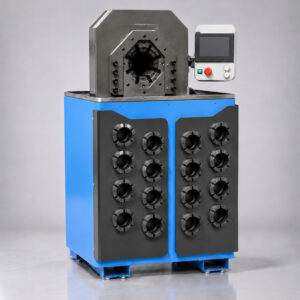
Does 2 inch six-spiral need a bigger frame than 2 inch four-spiral? It needs a different one, not necessarily a bigger one. The HH145 is a 6SP hydraulic hose crimping machine with a 150 mm opening, 3,000 kN crimping force and a catalogue range of 1/4 inch to 2 inch six-spiral, with 2-1/2 inch two-wire at the top end. Six-spiral ferrules are harder and shorter for their diameter than four-spiral, so the die has to be shallow and stiff at the same time, which is what separates this frame from the HH145F. HH is the HENGHUA model prefix for hose crimping machines.
Working envelope. Range figures are hose bore unless stated otherwise.
- 6SP six-spiral: 1/4 inch to 2 inch bore. The lower end is rare in practice; the model earns its place at 1-1/4 inch and 2 inch.
- 2SN two-wire: to 2-1/2 inch bore.
- 4SP four-spiral: to 2 inch, at the same force class.
- 2-1/2 inch six-spiral: the HH195 or the HH190.
- 3 inch hydraulic hose: the HH165 or the HH190.
- Industrial hose 3-4 inch: the HH190 or the HH300.
1. What does the HH145 crimp?
The HH145 closes a ferrule over six alternating layers of wire. The difficulty is not force but uniformity: the ferrule has to compress all six layers evenly, or the outer layer loads first and the inner layers stay loose. The frame applies 3,000 kN through eight die segments, with crimp diameter, opening amount, hold time and error compensation set on a 7-inch touch screen and 200 programs available for repeat work.
Why six-spiral gets its own frame. A 2 inch 6SP ferrule is a hard, relatively shallow ring. It needs a short land and a stiff frame, and the ram has to reach the set diameter without the frame flexing away from the load. The 150 mm opening gives the die stack enough depth while keeping the frame compact enough to stay stiff at 3,000 kN.
Who buys it. Shops building 2 inch six-spiral assemblies for mining, construction, offshore and heavy mobile equipment, plus OEM lines where 4SP and 6SP share a bench. A shop that runs both constructions at 2 inch is better served by this frame than by the 145F, because the 6SP ferrule is the harder case.
The frame goes to an OEM line building 2 inch six-spiral assemblies, a distributor serving mining and construction workshops, and a fleet operator whose own equipment runs 6SP hose at rated pressure.
2. Technical specifications
| Parameter | Value | Unit |
|---|---|---|
| Maximum opening diameter | 150 | mm |
| Crimping force | 3,000 | kN |
| Crimping hose range (bore) | 1/4″-2″ 6SP; 2-1/2″ 2SN | inch |
| Power supply | 380 / 220 | V, optional |
| Motor | 4 | kW |
| System pressure | 31.5 | MPa |
| Overall weight | 830 | kg |
| Outline dimension | 850 × 700 × 1430 | mm |
| Hydraulic oil | 46# | — |
| Foot switch | Yes | — |
Range convention: the figures in the range row are hose bore, and 6SP / 2SN identify the hose constructions. Maximum crimp diameter depends on the die and the ferrule and is confirmed against the ferrule drawing for each assembly.
Why 150 mm opening on 3,000 kN
- 1/4″-2″ 6SP. Six-spiral from 1/4 inch to 2 inch bore. The practical band is 1-1/4 inch to 2 inch, where six-spiral is specified for high-pressure and impulse-heavy duty.
- 2-1/2″ 2SN. Two-wire braid at 2-1/2 inch bore, listed in the same bracket because its ferrule is smaller than a 2 inch 6SP ferrule and fits the same die seat.
- 830 kg on 850 × 700 × 1430 mm. Lighter than the 145F despite more printed coverage, because the frame geometry differs. It still wants a fixed position, but it is easier to place in an existing bay.
3. Which assemblies fit the printed range?
| Assembly | Bore | Fits | Comment |
|---|---|---|---|
| Six-spiral (6SP) | 1/4″-1/2″ | Yes | Rare in practice |
| Six-spiral (6SP) | 5/8″-1″ | Yes | Standard die set |
| Six-spiral (6SP) | 1-1/4″ | Yes | Typical high-pressure work |
| Six-spiral (6SP) | 1-1/2″-2″ | Yes | Check die depth at 2″ |
| Two-wire (2SN) | 2-1/2″ | Yes | Smaller ferrule than 2″ 6SP |
| Four-spiral (4SP) | 2″ | Yes | Same force class; confirm the die |
| Six-spiral (6SP) | 2-1/2″ | No | HH195, HH165 or HH190 |
| Hydraulic hose | 3″ | No | HH165 or HH190 |
| Industrial hose | 3″-4″ | No | HH195, HH190 or HH300 |
4. How do you die a 2 inch six-spiral ferrule?
The frame holds eight segments in a quick-change ring, with custom die shapes and vacuum-furnace hardening available. The selection order for 6SP ferrules is:
Die choice for six wire layers
- Ferrule length and land width. Match the die land to the ferrule’s cylindrical section, not its overall length, or the die pinches the radius.
- Die inner diameter against the ferrule maker’s target crimp diameter, before any compensation offset is applied.
- Segment profile. Hex crimps on 6SP ferrules appear in some mining specifications and need a dedicated die, not a modified round die.
- Hardness. At 3,000 kN on a hard ferrule a soft die deforms and the crimp goes oval; special dies are vacuum-furnace quenched for this reason.
The field test that catches most 6SP problems. Crimp one assembly, then measure the ferrule at four points around its circumference and at both ends. Six-spiral crimps fail by ovality and by end flare far more often than by being uniformly over or under size.
5. Setting up and running
- Read the ferrule as a 6SP part. Confirm six wire layers and take the crimp diameter from the ferrule maker’s chart for that part number; a 4SP figure will over-crimp a 6SP ferrule.
- Set the die on land width, not on diameter. The land should cover the ferrule’s cylindrical section; a land that is too narrow leaves both ends proud no matter what diameter is programmed.
- Load the program, then check the opening. Recall the stored program, then confirm the opening clears the fitting in use — a 2 inch elbow needs more than a straight insert.
- Crimp a trial, measure four points. Two directions at mid-ferrule plus both ends; a single diameter reading hides the ovality that fails 6SP joints in service.
- Read the curve before the batch. Compare the trial curve with the stored reference; a steeper ramp means a harder ferrule lot or a partly worn die.
- Section the first assembly of a new lot. A 30 mm section shows whether all six layers are indented; the diameter alone cannot.
- Log the offsets, not just the result. Record any compensation change and the ferrule lot number, so the next batch starts from a known state.
6. Maintenance
| Interval | Task |
|---|---|
| Every shift | Clean dies and seats; check the oil level; test the emergency stop and foot switch |
| Weekly | Inspect segments for chipping; check die ring seating |
| Weekly | Check the pressure curve against the stored reference |
| Monthly | Inspect the hydraulic circuit for seepage; check ram guide play |
| Monthly | Verify ovality with a measured part |
| Every 2,000 h or annually | Oil and suction filter change (46#) |
| Annually | Die-seat and guide inspection; replace before the crimp goes oval |
7. How does the HH145 compare with the HH145F and the HH165?
| Model | Opening | Bore range | Construction | Force | Weight |
|---|---|---|---|---|---|
| HH145F | 145 mm | 1/4″-2″ | 4SP, 2SN to 2-1/2″ | 3,000 kN | 1,000 kg |
| HH145 | 150 mm | 1/4″-2″ | 6SP, 2SN to 2-1/2″ | 3,000 kN | 830 kg |
| HH195 | 195 mm | 6-64 mm | Hose and 4″ tube | 3,000 kN | 1,100 kg |
| HH165 | 190 mm | 6-76 mm | Hose to 3″ | 3,600 kN | 1,000 kg |
| HH190 | 210 mm | 76 mm | Hose and 4″ industrial | 3,600 kN | 1,100 kg |
The HH145F 4SP hose crimping machine and this frame share 3,000 kN and differ by construction. Above 2 inch six-spiral the next stop is the HH195 4 inch tube crimping machine for long industrial ferrules, or the HH165 for 3 inch hydraulic hose with heavier ferrules.
8. Faults, causes and fixes
| Symptom | Cause | Fix |
|---|---|---|
| Oval crimp on 6SP | Die worn or too soft; ring not seated | Check segments; refit the ring; replace a worn die |
| Ends flared | Die land mismatched to the ferrule | Fit the correct land width |
| Crimp undersize after cooling | Spring-back under-estimated | Increase compensation; add 0.2 s hold |
| Wire strand broken | Diameter too small for the 6SP construction | Return to the ferrule target; re-die |
| Ram stalls near size at 2″ | Force marginal with a hard ferrule | Two-stage crimp in manual mode |
| Curve shift between lots | Ferrule hardness variation | Measure and adjust compensation per lot |
| Oil hot in continuous 2″ runs | Duty cycle | Fit the oil cooling option |
9. FAQ
What is the difference between the HH145 and the HH145F? The HH145 is catalogued to 2 inch six-spiral with a 150 mm opening; the HH145F is catalogued to 2 inch four-spiral with a 145 mm opening. Both carry 3,000 kN.
Will it crimp 2 inch four-spiral hose? Yes, and it is the safer choice if you run both 4SP and 6SP at 2 inch, because the 6SP ferrule is the harder case.
Can it crimp 2-1/2 inch six-spiral? No. That needs the HH195, HH165 or HH190 depending on the ferrule.
Do I need two-stage crimping? For 2 inch 6SP on hard ferrules, a two-stage close in manual mode gives a more even result. On smaller sizes single-stage is normal.
Is the foot switch standard? Yes, listed as standard on this model.
What is the recommended oil? 46# hydraulic oil, changed with the filter at the interval in section 6.
Questions from 6SP shops
I build 1-1/4 inch 6SP and 1 inch 4SP from the same bench — will this frame do both, and how do I keep them apart? It will, because both constructions sit inside the printed range and the same force class. Keep two programs with distinct part numbers and two die rings stored on the frame, and treat the die marking as the control: a 6SP ferrule in a 4SP die closes to size and still leaves the outer layers loose.
My site is 220 V single phase — is that possible on a 4 kW machine? The catalogue prints 380 / 220 V as an option, and a single-phase 220 V supply is a different question from a three-phase 220 V one. State phase, voltage and frequency together; if the site is single phase, the motor and wiring are confirmed by the factory rather than assumed from the catalogue line.
The ferrule is correct and the diameter is correct, but the joint weeps on impulse testing — where do I look? Look at the wire impression along the ferrule, not at the diameter. A crimp that measures right but leaves the outer spiral barely indented will pass a static test and weep under impulse; that pattern points to a die land narrower than the ferrule’s cylindrical section or a hold time too short for the construction.
10. Related models and consumables
- HH145F 4SP hose crimping machine — the four-spiral frame at the same force.
- HH195 4 inch tube crimping machine — long industrial ferrules above 2 inch.
- HH120 hydraulic hose crimping machine — 6-38 mm bore for two-wire work.
- Hydraulic hose crimping machines — the full range and selection table.
- Industrial crimp ferrules — six-spiral ferrules in the sizes this frame runs.
11. Ordering, tooling and support
A HH145 order should state the constructions you run (4SP, 6SP, 2SN), the largest ferrule outside diameter and the ferrule part numbers, because the die list for a 6SP machine is not the same as for a 4SP machine at the same nominal size. Voltage, phase and frequency complete the quotation.
Build options come off the same platform list — mirror, mould marking, electronic positioning, special voltage, oil cooling, camera — and a 6SP shop typically orders marking plus positioning and leaves the camera.
Standards behind the numbers. A 6SP hose in this band is covered by EN 856 and ISO 3862; braided hose by SAE J517 and ISO 1436. Impulse testing follows ISO 6803, test methods SAE J343. Those documents define the hose, not the joint — the crimp diameter always comes from the ferrule maker.
Request a die-matched quotation. Send the 6SP constructions with their ferrule numbers, and the die list can be confirmed before the order. HENGHUA supplies the crimper for export and stocks the hose and ferrules it is bought for, so machine, dies and consumables can be quoted on one document. Company background is on the HENGHUA engineering and supply page.
Author: HENGHUA machine tool and hose assembly engineering team, Hengshui, Hebei, China. Last updated: 23 November 2026 Catalogue source: HH series hydraulic hose crimping machine catalogue, HH145 spread (catalogue pages 13-14).


 English
 Spanish
 Portuguese
 French
 German
 Arabic
 Russian
 Indonesian
 Japanese
 Korean