

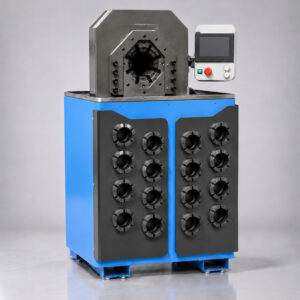
What does it take to crimp 3 inch hydraulic hose without the crimp going oval? More stiffness than force. The HH165 is a 3 inch hydraulic hose crimping machine with a 190 mm maximum opening, 3,600 kN crimping force and a 6-76 mm bore range. The 76 mm ceiling covers 3 inch bore hose and 76 mm tube with long ferrules, and the extra 600 kN over the 3,000 kN frames is what closes a 3 inch ferrule without the ram stalling. HH is the HENGHUA model prefix for hose crimping machines.
Working envelope. Every range figure on this page is hose bore unless it says otherwise.
- Hydraulic hose, one to four-spiral: 1/4 inch to 2-1/2 inch bore.
- Six-spiral: 2 inch to 2-1/2 inch bore.
- 3 inch hydraulic hose: the top of the printed range.
- Industrial suction and discharge hose: 2 inch to 3 inch bore with long ferrules.
- Tube and pipe with crimped sleeves: to 76 mm.
- 4 inch hose and 4 inch industrial tube: the HH190 or the HH300.
1. What does the HH165 crimp?
The HH165 applies 3,600 kN through eight die segments under a 7-inch touch screen control, with manual, semi-automatic and full-automatic modes, 200 stored programs, error compensation, holding time and a pressure curve display. The crimp is a metal-forming operation at this size rather than a simple squeeze: the die has to support a long ferrule along its full length while the ram reaches the set diameter without the frame flexing away.
The range on this page is printed plainly as 6-76 mm, with no construction bracket. That means the machine is sold as a general 3 inch frame rather than a construction-specific one, and the die list is what adapts it to four-spiral, six-spiral or industrial hose.
Where 76 mm lands. Seventy-six millimetres is 3 inch bore, so the frame covers 3 inch hydraulic hose, 3 inch industrial suction and discharge hose, and 76 mm tube with crimped sleeves. It stops short of 4 inch, which is 101.6 mm bore and belongs to the HH190 or the HH300.
Buyers split three ways: an OEM line building 3 inch assemblies, a distributor holding 3 inch dies for several customers, and a plant maintenance shop that rebuilds suction and discharge hose in house.
2. Technical specifications
| Parameter | Value | Unit |
|---|---|---|
| Maximum opening diameter | 190 | mm |
| Crimping force | 3,600 | kN |
| Crimping hose range (bore) | 6-76 | mm |
| Power supply | 380 / 220 | V, optional |
| Motor | 4 | kW |
| System pressure | 31.5 | MPa |
| Overall weight | 1,000 | kg |
| Outline dimension | 850 × 640 × 1500 | mm |
| Hydraulic oil | 46# | — |
| Foot switch | Yes | — |
Range convention: the 6-76 mm figure is the hose bore range this frame is rated for. Maximum crimp diameter depends on the die and the ferrule and is confirmed against the ferrule drawing for each assembly.
Stiffness first, force second
- 3,600 kN through 190 mm. More force than the HH195 in a smaller opening, which is a stiffness argument: a 190 mm frame at 3,600 kN is the stiffest option below the 300 mm class, and stiffness is what keeps a 3 inch crimp round.
- 76 mm bore. The practical limit at the top is the ferrule outside diameter inside a 190 mm head. A 3 inch six-spiral ferrule is a deep ring, so check die depth against the ferrule drawing.
- 1,000 kg on 850 × 640 × 1500 mm. A compact footprint for the force class, and 100 kg lighter than the HH190, which makes it the practical maximum for a shop that has to move a machine with a pallet truck.
3. Which assemblies fit a 190 mm head?
| Assembly | Bore | Fits | Comment |
|---|---|---|---|
| One-wire and two-wire hydraulic hose | 1/4″-2″ | Yes | Comfortably inside range |
| Four-spiral hydraulic hose | 3/4″-2-1/2″ | Yes | Main working band |
| Six-spiral hydraulic hose | 2″-2-1/2″ | Yes | Force is the advantage here |
| Hydraulic hose | 3″ | Yes | Upper end of the printed range; check the ferrule |
| Industrial suction and discharge hose | 2″-3″ | Yes | Long ferrules need a wide-land die |
| Tube and pipe with crimped sleeve | to 76 mm | Yes | Confirm sleeve length |
| Hydraulic hose | 4″ | No | HH190 or HH300 |
| 4 inch industrial tube | 4″ | No | HH190 |
| Composite PE pipe, large OD | 90 mm+ | No | HH300 or HH800 |
4. Die selection and handling
The HH165 holds eight segments in a quick-change ring, with custom shapes and vacuum-furnace hardening. Four die details decide the result at this size:
Land width on a 3 inch ferrule
- Land width against ferrule. A wide land on a short ferrule pinches the radius; a narrow land on a long ferrule leaves the ends unclosed.
- Segment seating. At 3,600 kN a segment that does not seat flat marks the ferrule and goes oval. Check the seat faces each time the ring is fitted.
- Hardness. A 3 inch ferrule is a lot of metal to form; vacuum-hardened dies hold their profile through the cycle count a 3 inch job accumulates.
- Handling. A 3 inch ring is heavy enough to damage a seat if dropped onto the head. Store rings on the rack, not on the machine top.
5. Setting up a 3 inch job
- Take the target from the ferrule drawing. Bore, ferrule part number and crimp diameter come from the supplier’s data; a table of general sizes is not a substitute.
- Pick the die by land and depth together. A deep land on a short ferrule pinches the radius, a shallow land on a long ferrule leaves the ends open.
- Store the cycle under your own part number. Crimp size, opening and hold time belong to the assembly, not to the operator’s memory.
- Run a warm-up assembly in a cold shop. A 1,000 kg frame at 3,600 kN grows as it heats; the first cold part is not the reference part.
- Measure both ends and the middle. Three readings in two directions show taper, which one reading at the middle never will.
- Correct a uniform error with compensation. Move the offset in 0.05 mm steps; change the die only when the result is oval rather than small.
- Keep a curve log per program. A shift in the curve is the earliest sign that a seat or a die is wearing.
6. Maintenance
| Interval | Task |
|---|---|
| Every shift | Clean dies and seats; check the oil level; test the foot switch and emergency stop |
| Every shift | Warm-up part check in cold conditions |
| Weekly | Inspect segments and the ring for chips or cracks; check seat faces |
| Weekly | Compare the pressure curve with the stored reference |
| Monthly | Inspect the hydraulic circuit for seepage; check ram parallelism with a measured part |
| Monthly | Clean the screen dry; inspect the pendant cable |
| Every 2,000 h or annually | Change the 46# oil and the suction filter |
| Annually | Guide and seat inspection; frame bolt torque check |
7. How does the HH165 compare with the HH195 and the HH190?
| Model | Opening | Bore range | Force | Weight | Best fit |
|---|---|---|---|---|---|
| HH145 | 150 mm | 1/4″-2″ 6SP | 3,000 kN | 830 kg | 2″ six-spiral |
| HH195 | 195 mm | 6-64 mm | 3,000 kN | 1,100 kg | 4″ industrial tube |
| HH165 | 190 mm | 6-76 mm | 3,600 kN | 1,000 kg | 3″ hose with heavier ferrules |
| HH190 | 210 mm | 76 mm | 3,600 kN | 1,100 kg | 4″ industrial hose |
| HH300 | 300 mm | 6-102 mm | 4,500 kN | 2,500 kg | 4″ hose and large pipe |
The HH165 and the HH190 hose crimping machine carry identical force and the same 76 mm bore range; they differ by 20 mm of opening and 100 kg. Where 4 inch industrial hose with long ferrules is in the mix, the HH190 earns the extra opening. Where the work is 2 inch to 3 inch hydraulic hose, the HH165 is the tighter, lighter machine. Buyers who crimp 4 inch industrial tube with long, thin-walled sleeves are looking at the HH195 4 inch tube crimping machine instead.
8. Faults, causes and fixes
| Symptom | Cause | Fix |
|---|---|---|
| Crimp tapers along a long ferrule | Ram parallelism or seat wear | Inspect guides and seats; re-check with a measured part |
| Ends not closed at 3″ | Die land too narrow or too short | Fit a wider-land die |
| Oval crimp | Segment not seated, or die worn | Clean and reseat; replace the die |
| Diameter drifts after warm-up | Thermal growth | Warm-up part; adjust compensation once warm |
| Ram stalls at 3″ | Ferrule harder than the setting allows | Two-stage close in manual mode; check the die |
| Metal pick-up on the die face | Contaminated ferrule or dry die | Clean ferrules; inspect the die face |
| Oil temperature high | Continuous large crimps | Fit the oil cooling option |
9. FAQ
Does the HH165 crimp 3 inch hydraulic hose? Yes, 6-76 mm bore is catalogued and 3 inch bore is the top of that band. Check the ferrule outside diameter against the 190 mm opening before quoting.
What is the difference from the HH190? Same 3,600 kN and the same 76 mm bore range. The HH190 has a 210 mm opening and 1,100 kg; the HH165 has 190 mm and 1,000 kg.
Can it crimp 4 inch hose? No. Four inch is 101.6 mm bore; use the HH190 or the HH300.
Is two-stage crimping needed at 3 inch? On hard six-spiral ferrules it gives a more even result. On four-spiral 2-1/2 inch it is usually unnecessary.
What oil does it use? 46# hydraulic oil at 31.5 MPa system pressure.
Does it need a foundation? No foundation; a level floor and a pallet-truck route are enough at 1,000 kg.
Field questions
I crimp 2 inch four-spiral all week and 3 inch six-spiral once a month — do I need two machines or one HH165? One HH165 covers both, because both sit inside the 6-76 mm bore range and the force is sized for the harder 3 inch case. What changes is the die and the hold time: the 3 inch ferrule needs a deeper land and a longer dwell, so keep them as separate programs rather than adjusting one.
My site runs 60 Hz and the ambient is over 40 °C in summer — what should I specify? State both on the order. Frequency changes motor and pump speed, and high ambient reduces the machine’s ability to shed hydraulic heat, so the oil cooling option stops being optional in continuous 3 inch work.
The first two crimps of the morning are undersize and the rest are fine — what is happening? That is a cold-oil effect, not a die problem. Oil viscosity at start-up changes the ram’s response, so the first cycle stops slightly short; run one scrap assembly as a warm-up part each morning and check it against the first production part before accepting the batch.
10. Related models and consumables
- HH190 hose crimping machine — 210 mm opening for 4 inch industrial hose.
- HH195 4 inch tube crimping machine — long 4 inch industrial sleeves.
- HH300 4 inch hose crimping machine — 6-102 mm bore.
- Hydraulic hose crimping machines — the full range and selection table.
- Industrial crimp ferrules — 2 inch to 3 inch ferrules for this frame.
11. Ordering, tooling and support
To quote a HH165, send the hose constructions and sizes, the largest ferrule outside diameter, the ferrule part numbers and the site voltage with frequency. The die list is built from the ferrule list; if the largest ferrule exceeds what a 190 mm head will take, the quotation should move to the HH190 rather than stretch this frame.
Options are quoted per machine: rear-view mirror, mould marking, electronic positioning, custom voltage, oil cooling and a camera. For 3 inch work the cooling system is the one that changes a shift pattern.
Standards this page refers to. Four-spiral and six-spiral hose in this bore band is specified in EN 856 and ISO 3862, braided hose in SAE J517 and ISO 1436, and impulse performance is tested to ISO 6803 with test methods in SAE J343. Industrial suction and discharge hose is specified by its own application standard, which the hose maker supplies with the data sheet.
Request a die-matched quotation. Send the 3 inch constructions and ferrule numbers, and the die set can be confirmed against them before the order. HENGHUA supplies the crimper for export and stocks the hose and ferrules it is bought for, so machine, dies and consumables can be quoted together. Company background is on the HENGHUA engineering and supply page.
Author: HENGHUA machine tool and hose assembly engineering team, Hengshui, Hebei, China. Last updated: 23 November 2026 Catalogue source: HH series hydraulic hose crimping machine catalogue, HH165 spread (catalogue pages 15-16).



 English
 Spanish
 Portuguese
 French
 German
 Arabic
 Russian
 Indonesian
 Japanese
 Korean