

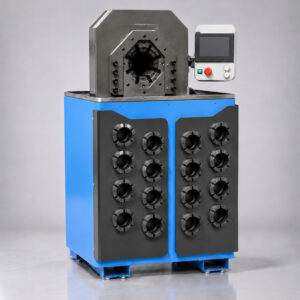
How do you crimp a ferrule onto an AC line that is already bent, with a block fitting at the other end? You load it from the side. The HH250-K is an air conditioning hose crimping machine with a side-opening C-frame, a 60 mm throat, 260 t (about 2,550 kN) crimping force and a 6-38 mm bore range, built for pre-bent AC lines and multi-elbow tube assemblies that cannot pass through a closed ring. HH is the HENGHUA model prefix for hose crimping machines.
Working envelope. Range figures are hose bore.
- Automotive AC hose: 6-19 mm bore, straight or pre-bent.
- Transport refrigeration hose: 10-25 mm bore.
- Power-steering line: 8-16 mm bore.
- Multi-elbow tube assemblies: to 38 mm bore.
- Straight hydraulic hose: to 38 mm bore, though a closed frame runs it faster.
- Hose above 38 mm bore: the HH145F for 1/4″-2″ four-spiral, the HH195 or the HH190 above 2 inch.
1. What does the HH250-K crimp?
An air conditioning hose crimping machine closes aluminium or steel ferrules onto barrier AC hose, and in vehicle work that hose almost always carries a pre-bent pipe section and a block or pad fitting at one end. A closed-ring crimper cannot take those parts: the elbow will not pass through the bore. The HH250-K solves it with a C-frame that opens at the side, so the bent end is presented to the die from the side and the straight end is crimped.
Why the opening is only 60 mm. The figure is a throat dimension, not a bore limit. The part enters from the side, so what matters is the throat depth and the clearance behind the die rather than the diameter. That is why a 60 mm figure sits beside a 38 mm bore range, and why comparing it with the 120 mm opening of the HH120 is a category error.
Why the machine weighs 950 kg. A C-frame carries the crimping load as a bending moment, so it has to be stiffer than a closed ring of the same force. The mass is the price of the side access, and it is also why this frame has a monthly throat inspection that a closed ring does not need.
What the 260 t figure means. The parameter table on this model prints crimping force in tonnes rather than kilonewtons: 260 t is about 2,550 kN. Read it as the same force class as the 2,600 kN HH120, delivered through a frame that opens sideways.
The machine is bought by an automotive tier-one or tier-two AC line builder, a distributor who kits AC ferrules and blocks for independent garages, and a fleet workshop servicing its own vehicle air conditioning.
2. Technical specifications
| Parameter | Value | Unit |
|---|---|---|
| Maximum opening diameter (throat) | 60 | mm |
| Crimping force | 260 t (≈2,550 kN) | tonne-force |
| Crimping hose range (bore) | 6-38 | mm |
| Power supply | 380 / 220 | V, optional |
| Motor | 4 | kW |
| System pressure | 31.5 | MPa |
| Overall weight | 950 | kg |
| Outline dimension | 940 × 700 × 1500 | mm |
| Hydraulic oil | 46# | — |
| Foot switch | Yes | — |
Range convention: the 6-38 mm figure is the hose bore range this frame is rated for. The 60 mm figure is a throat dimension for side loading, not a bore limit. Maximum crimp diameter depends on the die and the ferrule and is confirmed against the ferrule drawing for each assembly.
Reading a throat dimension
3. Which assemblies fit a side-opening head?
| Assembly | Bore | Fits | Comment |
|---|---|---|---|
| Automotive AC hose, straight | 6-19 mm | Yes | Fast, standard work |
| Automotive AC hose, pre-bent | 6-19 mm | Yes | The reason for the side opening |
| AC line with block or pad fitting | 6-19 mm | Yes | Check die clearance for the block body |
| Transport refrigeration hose | 10-25 mm | Yes | Longer ferrules |
| Multi-elbow tube assemblies | to 38 mm | Yes | Support the free end |
| Power-steering line | 8-16 mm | Yes | Common second application |
| Straight hydraulic hose | 6-38 mm | Yes | Possible; a closed frame is faster |
| Hydraulic hose | 2″ and above | No | Out of range |
| Four-spiral and six-spiral production | 1/2″ and above | Not intended | HH145F or HH145 |
4. Which dies clear a block fitting on a bent line?
The head carries a segment set in a quick-change ring, with custom shapes and inner diameters and vacuum-furnace hardening. Side loading adds one requirement to die design:
Dies that clear a block fitting
- Relieved or open dies. For multi-elbow parts, a die with relief at the entry side lets the elbow sit outside the crimp zone while the ferrule closes.
- Short land for short ferrules. AC ferrules are short; a wide land marks the cover or the pipe section next to the ferrule.
- Block clearance. Where the ferrule sits close to a block, the die needs clearance for the block body, which is a drawing question rather than a diameter question.
5. Setting up a bent AC line
- Identify the line variant and recall its program, or create one.
- Fit the die for the ferrule, checking relief clearance for the elbow or block.
- Set opening and hold time; AC ferrules are short, so hold time is usually shorter than on hydraulic work.
- Load the part from the side against the stop, with the bent end supported.
- Trial crimp and measure the ferrule in two directions.
- Check for cover damage at the ferrule edge and for marks on the adjacent pipe.
- Record and run, checking the first part of each batch.
6. Maintenance
| Interval | Task |
|---|---|
| Every shift | Clean the die, seat and side throat; check the oil level; test the foot switch and emergency stop |
| Every shift | Inspect the throat for chips or damage from part handling |
| Weekly | Inspect segments and ring; check the stop block position |
| Weekly | Curve comparison against the stored reference |
| Monthly | Inspect the hydraulic circuit for seepage; check frame bolts at the throat |
| Monthly | Measure roundness on a trial part and look at the throat for fretting or cracks |
| Every 2,000 h or annually | Change the 46# oil and the suction filter |
| Annually | Check the throat and frame for cracks or deformation; torque check |
A C-frame carries an overturning moment that a closed ring does not, so a crack at the throat is a safety issue, not just a maintenance item. Stop using the machine if one appears and have it assessed.
7. How does the HH250-K compare with the HH110 and the HH120?
| Model | Head | Bore range | Force | Weight | Best fit |
|---|---|---|---|---|---|
| HH110 | 110 mm closed ring | 6-19 mm | 1,600 kN | 260 kg | Straight brake and AC lines |
| HH250-K | 60 mm throat, side opening | 6-38 mm | 260 t (≈2,550 kN) | 950 kg | Pre-bent AC lines, multi-elbow parts |
| HH120 | 120 mm closed ring | 6-38 mm | 2,600 kN | 600 kg | Straight hose to 1-1/2″ |
| HH-J-170 | 230 mm axial | 125-175 mm components | 3,550 kN | 650 kg | Air spring sleeves |
The comparison worth making is HH250-K against the HH110 hydraulic hose crimping machine: the HH110 is cheaper, lighter and faster on straight lines, and unable to take a pre-bent line with a block fitting. For straight 6-38 mm work the HH120 hydraulic hose crimping machine is the faster closed-ring option; this frame exists for the parts that will not go through a ring at all.
8. Faults, causes and fixes
| Symptom | Cause | Fix |
|---|---|---|
| Out-of-round crimp | Part not supported; side load on the die | Support the bent end; check the stop |
| Marks on the pipe next to the ferrule | Die land too wide for a short AC ferrule | Use a short-land or relieved die |
| Ferrule not fully closed | Hold time short, or diameter set high | Increase hold by 0.2 s; verify the target |
| Part loads at an angle | No stop, or a worn stop block | Reset the stop; mark the die |
| Cover cut at the ferrule mouth | Die too tight for the barrier cover | Resize the die |
| Ram slow or noisy | Oil temperature or filter condition | Check oil and filter; service the pump |
| Throat fretting or cracks | Overturning load; loose frame bolts | Inspect and torque; stop use if cracked |
9. FAQ
What is a side-opening hose crimping machine for? For parts that cannot pass through a closed ring: pre-bent AC lines, multi-elbow tube assemblies and fittings with blocks or pads close to the ferrule.
Why is the opening only 60 mm? It is a throat figure for side loading, not a bore limit. Throat depth and clearance behind the die matter more than diameter.
What does 260 t mean? It is the printed crimping force in tonnes, about 2,550 kN, and it sits in the same class as the 2,600 kN HH120.
Can it crimp straight hydraulic hose? It can, to 38 mm bore, but a closed-ring frame such as the HH120 is faster and less expensive for straight work.
Does it take the same dies as the HH110? Dies are model-specific in fitment even where the ferrule size overlaps. Specify model and ferrule when ordering dies.
Which oil? 46# hydraulic oil at 31.5 MPa system pressure.
Questions from AC line builders
I build four AC line variants per vehicle platform, each with a different bend — do I need four dies or four programs? Four programs and usually two or three dies. The program holds bore, opening and hold time per variant; the die follows the ferrule and the clearance needed around each block, so variants that share a ferrule share a die. Keep the programs named by OEM part number, or the fourth variant will eventually run on the first one’s setting.
My workshop is at 1,200 m altitude — does the machine need derating? State the altitude at quotation. Altitude affects cooling and the hydraulic circuit’s behaviour, and it is a factory question rather than something to adjust on site; the same applies to ambient temperatures above 40 °C.
The crimp looks perfect but the system leaks at the AC ferrule after a few weeks — what should I check? Check insertion depth and the die land first. A ferrule that crimps to size but sits slightly short grips the barrier layer rather than the reinforcement, which passes a leak test cold and seeps once the system sees pressure and temperature cycling. Section one used line if you can, and compare the ferrule position with the block fitting.
10. Related models and consumables
- HH110 hydraulic hose crimping machine — straight AC and brake lines at 260 kg.
- HH120 hydraulic hose crimping machine — straight 6-38 mm work in a closed ring.
- HH-J-170 air spring crimping machine — axial sleeve work rather than radial ferrules.
- Hydraulic hose crimping machines — the full range and selection table.
- Industrial crimp ferrules — ferrules for the AC and hydraulic sizes this frame runs.
11. Ordering, tooling and support
A HH250-K order should list the AC line families you build — bore, ferrule part number, whether the line is pre-bent, and the block or pad type — plus the site voltage and frequency. The die requirement follows from the fittings, particularly the clearance needed around blocks and elbows, so a sample part or drawing is more useful than a size list.
Options are quoted per order: mirror, mould marking, electronic positioning, custom voltage, oil cooling and a camera. AC line builders usually take marking, because four variants can share one die.
Standards this page refers to. Automotive AC hose assemblies of the type this frame crimps are specified in SAE J2064, and the barrier hose itself in SAE J2064 / ISO 8066 series data supplied by the hose maker. Brake and power-steering assemblies, where the same frame is used, are specified in SAE J1401 and the vehicle maker’s own specification.
Request a die-matched quotation. Send the AC line variants you build, and the die requirement can be confirmed against them before the order. HENGHUA supplies the crimper for export and stocks hose and ferrules, so the line, the ferrule and the machine can come from one specification. Company background is on the HENGHUA engineering and supply page.
Author: HENGHUA machine tool and hose assembly engineering team, Hengshui, Hebei, China. Last updated: 23 November 2026 Catalogue source: HH series hydraulic hose crimping machine catalogue, HH250-K spread (catalogue pages 23-24).



 English
 Spanish
 Portuguese
 French
 German
 Arabic
 Russian
 Indonesian
 Japanese
 Korean