


A bottom loading hose at a road tanker rack must stay light enough for one operator to swing onto the arm all shift, and firm enough to keep its bore at 200 psi. This one is built for that duty: PP and polyester liner, galvanised mild steel helices inside and out, 25 mm to 254 mm (1 in to 10 in) bore, and a service window of -30°C to +100°C (-22°F to +212°F). It carries gasoline, aromatics, MTBE and MEK. It is not a chemical hose.
Product Overview
It is a non-vulcanised, multi-layer thermoplastic hose from the petroleum side of our range. Liner, carcass and cover are compressed between two steel helices rather than bonded by vulcanisation, the definition that separates a composite hose from a rubber hose. It follows the liquid-service logic of EN 13765.
In one sentence: a PP and polyester film and fabric liner, multiple plies of PP fabric, an internal and an external galvanised helix, and an abrasion-resistant PVC-coated fabric cover. The value is in the lay-up and in one factory doing the crimping and the proof test.
Working pressure is 200 psi, about 14 bar, down to 254 mm (10 in), where it steps to 150 psi. Standard length is 18 m (60 ft), 12 m (40 ft) at the largest bore, with runs to 24 m (80 ft). Temperature is -30°C to +100°C (-22°F to +212°F).
Four things make it worth specifying. At 0.74 kg/m (0.5 lb/ft) for 1 in and 20.39 kg/m (13.7 lb/ft) for 10 in it stays manageable. The twin helix holds the bore open, the cover takes abrasion, and the assembly arrives tested.
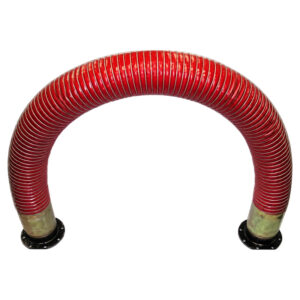
Users are oil terminals, refineries, distribution depots and barge loading points. Around it sit the loading arm, the API adaptor, the drop pipe and the vapor line. Loading from below leaves the hose in a loop under the arm.
The problem is the small, repetitive one that wears out a crew: a heavy hose that kinks, drags and fatigues at the fitting. This build trades wall stiffness for helix support, so the hose follows the arm instead of fighting it.
Quality commitment runs from incoming material inspection to batch marking. We proof test every assembly, keep digital crimping records per serial, and hold ISO 9001. Sampling takes about 48 hours and bulk runs ship in seven days.
Product Advantages of the Bottom Loading Hose
- Light in the hand: 2.98 kg/m at 3 in, one operator handles it.
- Twin helix support: inner and outer galvanised wire hold the bore open.
- Abrasion-resistant cover: PVC-coated fabric takes dragging on concrete.
- Crimped, not clamped: every assembly carries a digital crimping record.
- Static continuity: helix bonded to fittings, resistance checked per assembly.
- Built to length: 18 m standard, 24 m available, fewer joints.
Applicable users: terminal operators, fuel distributors, refinery loading crews, barge loading points and tank truck fleets needing a light 1 in to 10 in distillate hose.
Detailed Technical Specifications
The two 3 in and two 4 in codes differ in wall build, not bore.
| Hose code | Bore mm (in) | OD mm (in) | Bend radius mm (in) | Weight kg/m (lb/ft) | Working pressure psi (bar) | Standard length m (ft) | Available length ft |
|---|---|---|---|---|---|---|---|
| BLCH-01 | 25 (1) | 38 (1.5) | 102 (4) | 0.74 (0.5) | 200 (13.8) | 18 (60) | 80 |
| BLCH-02 | 38 (1.5) | 51 (2) | 140 (5.5) | 1.19 (0.8) | 200 (13.8) | 18 (60) | 80 |
| BLCH-03 | 51 (2) | 64 (2.5) | 178 (7) | 1.93 (1.3) | 200 (13.8) | 18 (60) | 80 |
| BLCH-04 | 64 (2.5) | 76 (3) | 203 (8) | 2.53 (1.7) | 200 (13.8) | 18 (60) | 80 |
| BLCH-05 | 76 (3) | 89 (3.5) | 279 (11) | 2.98 (2.0) | 200 (13.8) | 18 (60) | 80 |
| BLCH-06 | 76 (3) | 114 (4.5) | 279 (11) | 4.46 (3.0) | 200 (13.8) | 18 (60) | 80 |
| BLCH-07 | 102 (4) | 114 (4.5) | 394 (15.5) | 5.21 (3.5) | 200 (13.8) | 18 (60) | 80 |
| BLCH-08 | 102 (4) | 127 (5) | 406 (16) | 6.40 (4.3) | 200 (13.8) | 18 (60) | 80 |
| BLCH-09 | 152 (6) | 178 (7) | 508 (20) | 10.71 (7.2) | 200 (13.8) | 18 (60) | 100 |
| BLCH-10 | 203 (8) | 241 (9.5) | 762 (30) | 14.88 (10.0) | 200 (13.8) | 18 (60) | 80 |
| BLCH-11 | 254 (10) | 292 (11.5) | 914 (36) | 20.39 (13.7) | 150 (10.3) | 12 (40) | 50 |
- Temperature: -30°C to +100°C (-22°F to +212°F). Above that the PP film softens and the plies lose compression.
- Pressure: 200 psi (about 14 bar) to BLCH-10, 150 psi at 254 mm, where the lower rating is a wall-strength decision.
- Design margin: EN 13765 requires a 4:1 burst margin and a 1.5x proof test, applied here to every assembly.
- Lengths: 18 m (60 ft) standard, 12 m (40 ft) at 254 mm, available to 24 m (80 ft), 30 m at 152 mm and 15 m at 254 mm.
- Vacuum: the twin helix supports vacuum service, but the sheet states no vacuum figure. Ask us to confirm it for your bore.
Structure and Materials
Five layers, each carrying a different load, from the bore outward.
- Inner helix: galvanised mild steel wire inside the liner. It resists collapse and keeps the bore round through a bend.
- Liner: PP film with polyester. The wetted surface, the barrier and the layer that decides the media.
- Carcass: multiple plies of PP fabric and film. The fabric takes axial load when the hose is pulled.
- Cover: abrasion-resistant PVC-coated fabric in the standard blue finish. It shields the carcass from concrete and grating.
- Outer helix: galvanised mild steel wire outside the cover. It carries hoop load and takes contact with the ground.
Why the composite build holds up
A composite hose works because two helices and a stack of fabric plies share the load a homogeneous wall would carry alone. The inner helix sits in compression against the liner. When the hose bends, the coil absorbs the change in geometry and the bore stays round, so a 1 in hose works around a 102 mm bend radius at full flow. The outer helix resists hoop stress from pressure, holds the cover down and takes abrasion before the fabric sees it.
Between them sit the plies. Fabric is strong in tension and weak in compression, so the plies are laid at an angle that turns internal pressure into axial load along the reinforcement instead of wall strain. That keeps elongation low and stops the hose growing longer under pressure.
The liner decides chemistry. PP film is a long-chain polyolefin with a tight, non-polar surface, and it resists water and the aliphatic hydrocarbons in gasoline without absorbing them. It is not universal. Aromatic and chlorinated solvents, strong oxidisers and concentrated acids swell it or pass through it, and the wire has its own limits. Hence the same instruction on every page: confirm the medium and temperature with us in writing. The cover is not a fire suit.
Safety factor, proof pressure and burst margin
EN 13765 sets a 4:1 margin between working pressure and burst for liquid service, plus a routine proof test at 1.5 times working pressure. Read that as a ratio, not a reserve for operation. A hose rated 200 psi should pass a 300 psi proof test and burst no lower than about 800 psi, The margin covers pressure spikes, water hammer at the rack and the slow loss of strength that comes with age.
A buyer should ask three questions. What is the burst figure on the certificate for this bore? Was every assembly proof tested, or only a sample? Does the certificate carry the serial number of the hose in the crate? We proof test every assembly and file the record against the serial.
Chemical Compatibility and Media Guide
The ratings describe this hose as supplied: PP and polyester liner, polyester barrier plies, galvanised helices and PVC cover. They are not a statement about PP film in isolation.
| Medium | Rating | Note |
|---|---|---|
| Mineral hydraulic oil | Excellent | Standard petroleum service. |
| Diesel | Excellent | Primary duty, low permeation. |
| Gasoline | Excellent | Confirm ethanol above E10. |
| Kerosene | Excellent | Also Jet A-1 and heating oil. |
| Crude oil | Excellent | Ambient terminal temperature. |
| Lubricating oil | Excellent | Including used oil at depots. |
| MTBE | Excellent | Named duty on the sheet. |
| Toluene | Good | Confirm contact time. |
| Xylene | Good | Avoid soak periods. |
| MEK | Good | Named duty, short contact. |
| Acetone | Limited | Swelling risk, confirm. |
| Dichloromethane | Not recommended | Chlorinated, use PTFE. |
| Trichloroethylene | Not recommended | Chlorinated, use PTFE. |
| Vegetable oil | Good | Flush to clear acid build-up. |
| Biodiesel B100 | Limited | Confirm blend and contact time. |
| Ethanol E100 | Limited | Polar fuel permeates PP. |
| Methanol | Not recommended | Permeates the liner. |
| Ethyl acetate | Limited | Ester permeation, confirm. |
| Ethylene glycol | Good | Coolant transfer. |
| Water | Good | Drain and dry after. |
| Propylene glycol | Good | Ambient duty. |
| Sea water | Not recommended | Chlorides attack the wire. |
| Steam condensate | Limited | Below +100°C, not a steam hose. |
| Sulphuric acid 30% | Not recommended | Corrosive, use chemical build. |
| Sulphuric acid 98% | Not recommended | Concentrated acid. |
| Hydrochloric acid 35% | Not recommended | Acid plus chlorides. |
| Sodium hydroxide 50% | Not recommended | Caustic needs chemical build. |
| Ammonia 10% | Not recommended | Use the chemical range. |
| Sodium hypochlorite 12% | Not recommended | Strong oxidiser. |
| Hydrogen peroxide 30% | Not recommended | Oxidiser, decomposition risk. |
| Phosphoric acid 85% | Not recommended | Acid service. |
| Nitric acid 65% | Not recommended | Oxidising acid, use PTFE. |
| Acetic acid 99% | Not recommended | Glacial acid. |
Three rules govern how to read the chart. Temperature derates everything: a rating earned at +20°C does not hold at +90°C. Concentration matters more than the chemical name, since 5% acid and 98% acid are different problems. Contact time decides the outcome, since a hose left full over a weekend sees hours, not minutes.
Request the full compatibility chart as a PDF, or send the medium and temperature and we will answer in writing.
Applications and Industries
Rack duty is the home of the bottom loading hose, and the composite hose range covers the sister builds for other legs.
- Road tanker loading: loading arms, API adaptors and drop pipes at terminal racks.
- Bulk distribution depots: gasoline, diesel and kerosene into trucks across the apron.
- Refinery product movement: light distillate from tankage to the header.
- Barge and vessel loading: shore-to-barge light product where a 6 in hose beats rubber.
- Aviation and depot fuelling: Jet A-1 and kerosene on refuelling equipment.
Selection Guide for Bottom Loading Hose
Selecting a bottom loading hose for a rack turns on arm geometry, API coupler type and the vapor line. The vapor recovery composite hose handles the return leg, and the tanker composite hose covers smaller bore work.
Size, flow and pressure drop
Choose the bore from flow rate and pressure loss, not from the connection on the arm. A 2 in hose at 200 psi moves a normal truck load quickly. A 4 in hose fills faster but weighs 5.21 kg/m before product, and the operator pays for that at every fill. BLCH-05 and BLCH-07 are the lighter wall builds, BLCH-06 and BLCH-08 the heavier ones, which buy durability for about 1.5 kg/m.
End fittings and hose assembly
Fittings are crimped, not banded. We supply NPT male, BSP male, cam and groove, fixed flange, floating flange, reducing flange, tank coupling and 37 degree flare adapters, in stainless or carbon steel, and every ferrule is swaged with a digital record tied to the assembly serial. Tell us the arm connection and the tank coupling and we will match the pair, since a mismatch at either end is the usual reason a new hose comes back.
How it compares
| Type | Working pressure | Typical duty | Watch out for |
|---|---|---|---|
| Bottom loading hose (this page) | 200 psi, 150 psi at 254 mm | Bottom loading, gasoline to MEK | Not for corrosive chemicals |
| Vapor recovery hose | 10 bar (150 psi) | Vapor return, VRU lines | Vapor only, thin wall |
| Tanker composite hose | 7 to 15 bar | Road and rail tanker loading | Bores 51 mm to 102 mm |
| Petroleum suction and discharge hose | 25 bar to 76 mm | Full-vacuum suction | Heavier, 20 m standard |
| Chemical composite hose | 10 bar | Acids, alkalis, solvents | PP liner limits aromatics |
| Rubber hose to EN 1765 | Depends on build | General oil suction | Heavier per metre, stiffer |
What drives the price
Four things set the cost of a bottom loading hose: bore, length, end fittings and helix material. Fittings move the number more than buyers expect, because a stainless floating flange costs several times a carbon camlock. Helix material is fixed here at galvanised mild steel, one reason the price sits below a stainless chemical build. Volume matters too: a wholesale order is quoted differently from a single sample.
Common selection mistakes
- Sizing from the connection, not the flow. A 2 in arm connection does not suit a 30 m run.
- Using a distillate hose for a chemical. This product is not for corrosive or aggressive media.
- Ignoring the bend at the fitting. The radius covers the body, not a 90 degree pull behind the ferrule.
- Ordering length without the drop. Measure at the lowest working position, then add the loop.
Installation, Operation and Maintenance
Installation
- Support the run so the loop under the arm does not hang from the fittings. A support every 1.5 m to 2 m keeps weight off the crimp.
- Respect the published bend radius: 102 mm at 1 in, 279 mm at 3 in, 508 mm at 6 in, 914 mm at 10 in.
- Never twist the hose to align a flange. Rotate the fitting, not the body, and check the lay line.
- Fit protective sleeves where the hose meets the rack edge or the ground.
Inspection and retirement
Check the cover before every shift for cuts, blisters and exposed helix. Run a hand along the first 300 mm behind each fitting and feel for soft spots. Proof test at 1.5 times working pressure on your terminal schedule. Retire the hose after any leak, any wire showing at a fitting, or any kink that does not recover.
Cleaning, storage and service life
Drain after each transfer and hang the hose straight to dry with both ends open. Flush with clean water only where the product is water-miscible, never with a solvent the liner cannot take. Store coiled on a reel, off the floor, out of sunlight and away from ozone sources such as welding sets and motors, ideally between 0°C and +30°C. We suggest a documented review at six years covering pressure test history and fitting records.
Quality Assurance and Test Data
Production runs in a fixed sequence: incoming material inspection of film thickness, fabric weight and wire diameter; film slitting and helix forming; assembly of liner, plies and cover over the inner helix; then compression and application of the outer helix, with no vulcanisation step. The assembly is fitted, crimped, proof tested and marked with size, working pressure, batch and serial.
Tests follow standards rather than convenience: hydrostatic proof to EN ISO 1402, impulse to EN ISO 6803, continuity to EN ISO 8031, bending to EN ISO 1746 and dimensions to EN ISO 1307. Every assembly is proof tested at 1.5 times working pressure before packing, and the crimping record is filed against the serial. Batch traceability runs from film lot to crate number. Packaging is film wrap with a plywood case for LCL, or bubble wrap and a reel for FCL.
Standards and Certifications
| Standard | Covers | Means for the buyer |
|---|---|---|
| EN 13765:2018 | Thermoplastic multi-layer hoses for hydrocarbons | Source of the 4:1 margin and 1.5x proof test |
| EN ISO 1402 | Hydrostatic pressure testing | Method behind your proof certificate |
| EN ISO 6803 | Impulse testing | Behaviour under pressure cycles |
| EN ISO 8031 | Electrical continuity | Method for static continuity checks |
| EN ISO 1746 | Bend testing | Confirms the published bend radius |
| EN ISO 1307 | Dimensions and tolerances | Basis for bore and OD tolerance |
| IMO IBC, OCIMF, USCG 33 CFR 154.810, ADR/RID | Marine, US facility and road tanker practice | Market requirements, not product certificates |
Company certifications held: ISO 9001, ISO 18752, MSHA, CE, CCS, ABS, DNV, California Proposition 65, RoHS, API, GOST-R and MA China metrology accreditation.
Frequently Asked Questions
What is a bottom loading hose made of?
A PP and polyester liner, multiple plies of PP fabric and film, galvanised mild steel helices inside and outside, and an abrasion-resistant PVC-coated fabric cover. The layers are compressed, not vulcanised.
What does the 200 psi rating actually mean?
It is the maximum working pressure for continuous service, not a burst figure. EN 13765 expects a 4:1 margin, so a 200 psi hose is proof tested at 300 psi and should not burst below roughly 800 psi.
Can this hose handle vacuum?
The twin helix supports vacuum duty and keeps the bore from collapsing, but the sheet states no vacuum rating. Send the suction condition and we will confirm it in writing.
What is the temperature limit?
-30°C to +100°C (-22°F to +212°F). Above +100°C the PP film softens and the hose loses strength before it fails visibly.
Will it carry the chemicals on my list?
It carries light distillates well and it is not a chemical hose. The published limitation is explicit: this bottom loading hose is not for corrosive or aggressive chemicals, and the chemical composite hose is the right product for those.
How is it different from a rubber hose?
The wall is compressed fabric and film between two helices, not a vulcanised rubber body. That makes it lighter at the same bore, and the inner helix, not the wall, resists vacuum collapse.
What is the difference from the next model up?
The vapor recovery hose is a thinner vapor line at 10 bar for VRU duty, not a replacement for a bottom loading hose. For acids or chlorinated solvents, the chemical composite hose or a PTFE-lined build is the step up.
What is the minimum order and lead time?
Minimum order depends on bore, length and fittings, so we state it on the quotation. Custom sampling takes about 48 hours and standard bulk production runs in seven days.
How do I get a quote or the PDF datasheet?
Send the medium and strength, the temperature and pressure, bore, length and connection, quantity and port. We reply with a quotation, the datasheet PDF and the compatibility chart.
Why Source Composite Hose from HENGHUA
Sourcing a bottom loading assembly is a decision about the factory behind it as much as the hose. HENGHUA runs an 18,000 m2 facility in the Hengshui area of Hebei, with a Tianjin export office, 8 high-speed lines and 25 million metres of annual output. That scale matters when a terminal needs forty assemblies in one length, because the line can be dedicated to the order.
The certification set covers the audits buyers actually ask for: ISO 9001, ISO 18752, MSHA, CE, CCS, ABS, DNV, California Proposition 65, RoHS, API, GOST-R and MA China metrology accreditation. Marine class approvals are held by the company, and type approval documents come on request.
Assembly capability is in house. We crimp ferrules on our own presses, keep digital crimping records against every serial, proof test each assembly at 1.5 times working pressure, and mark the batch so a hose traces back to its film lot and wire coil. That is the difference between buying a length of hose and buying an assembly with paperwork.
As a manufacturer and exporter we handle OEM and ODM work: custom labelling, custom packaging, drawing-based assemblies and builds to a customer’s own specification. Sampling takes about 48 hours, bulk turnaround is seven days, and online order tracking covers production status once an order is released.
Technical support is where most suppliers stop. Send a medium, a concentration and a temperature and our sales engineers answer in writing, with the liner recommendation and the limitation stated together. After-sales runs on the same records: a serial number pulls the crimping data, proof test result and material batch.
Request a Quote
Send your medium, concentration, temperature, pressure, bore, length, end connection, quantity and destination port through the contact form, and our sales engineers will price the assembly against your duty rather than a catalogue page. We will confirm the liner and working pressure for the exact bore and quote in your currency. Ask for the datasheet PDF, the full compatibility chart, or a sample. Tell us whether this bottom loading assembly feeds an arm, a standpipe or a barge connection, because that decides the fittings and the length.


 English
 Spanish
 Portuguese
 French
 German
 Arabic
 Russian
 Indonesian
 Japanese
 Korean