


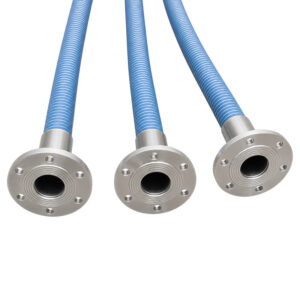
A fire retardant composite hose is a non-vulcanised, multi-layer hose built for transfer duty in places where a spill or a fire nearby can put the line itself in the flame path. This one carries 14 bar (203 psi) working pressure from 25 mm (1 in) to 250 mm (10 in) bore, at -30°C to +80°C (-22°F to +176°F), in 15 m (49 ft) lengths. A PVC-impregnated, abrasion resistant cover sits over a fiberglass fire barrier, so the outer skin insulates the carcass and adds very little fuel of its own. It is fire retardant, not fireproof, and it is specified that way on purpose.
Product Overview
The product is a thermoplastic multi-layer hose of the type covered by EN 13765:2018, the standard for non-vulcanised composite hoses in hydrocarbon, solvent and chemical service. Within that family it is a liquid-service build: the pressure class and bore range of a standard petroleum transfer hose, with a fire-retardant cover system and extra fire resistant layers in the wall.
Construction in one sentence: a hot-dip galvanised steel inner helix, a polypropylene and polyamide liner, PP fabric and film plies plus the fire resistant layers, a fiberglass barrier, an abrasion resistant PVC-impregnated cover, and a galvanised outer helix holding the stack in compression.
Three numbers tell most of the story. Working pressure is 14 bar at every bore from 25 mm to 250 mm, so a terminal does not need a second pressure class for its large lines. The nine bores cover small vapor connections and large suction lines on the same jetty, and the temperature range runs from -30°C to +80°C.
Four advantages carry the case. The fiberglass layer under the cover slows heat transfer to the carcass. The cover has a low fuel load compared with a thick rubber cover. The twin-helix carcass keeps the 200 mm and 250 mm sizes flexible enough for two people to handle. And one fitting programme covers the whole range.
Main users are fuel terminals, refineries, chemical plants, barge and ship operators, rail loading facilities and power stations. Typical equipment includes loading arms, tank truck stands, rail car connections, vapor recovery units, pump suction headers and spill response skids.
The operational problem is simple. A standard hose in a fire adds fuel, loses its cover, exposes the carcass and fails, often while product is still flowing. This hose is designed to hold its structure longer under radiant heat and short flame contact, which buys time to shut a valve, stop a pump and clear the area. It does not replace a fire plan or a deluge system.
Fire retardant does not mean fire proof, and no hose on the market is fire proof. A fire retardant composite hose buys evacuation time: the barrier layer slows flame spread and the cover resists burning long enough to isolate the line and clear the area. It is no substitute for a deluge system or a fire watch, and a hose that has been through a fire is scrapped regardless of how it looks. Quality commitment is documentary. Every assembly is proof tested, crimping is recorded digitally, and each hose carries a batch number tracing back to the liner lot and the helix coil. The factory holds ISO 9001, ISO 18752, MSHA, CE, CCS, ABS, DNV, California Proposition 65, RoHS, API, GOST-R and MA certification, and issues type approval papers on request.
Product Advantages of the Fire Retardant Composite Hose
- Fiberglass barrier under the cover – slows radiant heat transfer to the carcass in a fire.
- Low fuel load outer skin – PVC-impregnated fabric resists burning better than a thick rubber cover.
- 14 bar across all nine bores – one pressure class from 25 mm to 250 mm simplifies terminal stock.
- Flexible at large bore – a 990 mm bend radius at 250 mm keeps the line manageable.
- PP and polyamide liner – suited to fuels, lubricating oils and many chemical fluids.
- Crimped and proof tested in house – every assembly carries a digital crimping record.
Applicable users: fuel terminal operators, refinery maintenance teams, barge and ship crews, rail loading facilities, chemical plants and spill response contractors who need a transfer line that resists fire spread rather than feeding it.
Detailed Technical Specifications
| Hose code | ID (mm) | OD (mm) | Bend radius (mm) | Working pressure (bar) | Weight (kg/m) | Length (m) |
|---|---|---|---|---|---|---|
| FRCH-01 | 25 | 40 | 100 | 14 | 1.00 | 15 |
| FRCH-02 | 38 | 52 | 125 | 14 | 1.50 | 15 |
| FRCH-03 | 50 | 67 | 200 | 14 | 2.10 | 15 |
| FRCH-04 | 65 | 83 | 220 | 14 | 2.80 | 15 |
| FRCH-05 | 75 | 98 | 250 | 14 | 3.90 | 15 |
| FRCH-06 | 100 | 120 | 400 | 14 | 6.80 | 15 |
| FRCH-07 | 150 | 175 | 570 | 14 | 11.50 | 15 |
| FRCH-08 | 200 | 240 | 790 | 14 | 16.80 | 15 |
| FRCH-09 | 250 | 290 | 990 | 14 | 22.00 | 15 |
- Temperature range is -30°C to +80°C for the conveyed medium. The fire barrier protects against an external fire; it does not raise the service temperature.
- Working pressure is 14 bar at every bore. EN 13765 sets a 4:1 burst margin and a 1.5x proof test, and no separate burst figure is published for this item.
- Vacuum duty is not stated. The twin-helix build resists collapse, but confirm the level you need in writing.
- Weight runs from 1.00 kg/m to 22.00 kg/m. Dimensions follow EN ISO 1307, and lengths are 15 m with shorter cuts available.
Structure and Materials
- Inner helix: hot-dip galvanised steel wire, wound as a rigid spiral that keeps the bore open under suction and stops the hose flattening at the bend.
- Liner: polypropylene and polyamide film plies, compressed into a smooth, low-friction bore that resists fuels, lubricating oils and many aqueous chemical solutions.
- Carcass: multiple plies of PP fabric and film carrying the axial load, with additional fire resistant films and fabrics laid in for this build.
- Fire barrier: a fiberglass layer between the carcass and the cover, which is what separates this hose from the standard petroleum build.
- Cover: abrasion resistant PVC-impregnated fabric, pigmented and embossed, formulated to resist burning and to add little fuel if it does burn.
- Outer helix: hot-dip galvanised steel wire, mechanically compressing the layers and taking the wear when the hose is dragged.
No layer is glued and nothing is vulcanised. The stack is held together by the compression of the outer helix, which is why the hose stays flexible instead of curing into a stiff tube.
Why the composite build holds up
The inner helix is a spring that refuses to ovalise. Under full vacuum the pressure difference across the wall is about 1 bar, enough to flatten a soft tube instantly. The steel spiral keeps the bore round and holds the liner in compression instead of letting it peel away from the carcass.
The fabric plies carry axial load. At 14 bar on a 250 mm bore, the end thrust trying to pull the hose off its fitting is close to 6.9 tonnes, and only the fabric, clamped by the ferrule, resists it. That is why crimp length matters more than crimp force on large bore assemblies.
The thermoplastic liner provides chemical resistance. PP and polyamide are stable in fuels, oils and many aqueous solutions at the rated temperature, and the smooth bore resists scale. They are not universal: aromatics and chlorinated solvents soften them, which is a liner question rather than a fire question.
The cover system is where this hose differs. A fire needs fuel, heat and oxygen. The PVC-impregnated fabric has a limited fuel load compared with a heavy rubber cover, and the fiberglass layer beneath it is non-combustible and a poor heat conductor. Together they slow the temperature rise at the carcass and hold the liner and plies below their softening point for longer. That delay is the product, and it is measured in minutes rather than hours. It depends on the fire size, the distance and the airflow, so fire retardant is a tested performance claim, not a warranty against damage.
Safety factor, proof pressure and burst margin
EN 13765:2018 requires a 4:1 margin between working pressure and burst, plus a routine proof test at 1.5 times working pressure. On a 14 bar hose that means a design burst of 56 bar and a proof test at 21 bar. We do not publish a separate measured burst figure for this item, so treat the standard as the reference and ask for the batch report if your procedure needs the number.
Three questions matter more than the ratio. Is the proof test done on every assembly or by sample? Ours is every assembly, with pressure and time recorded against the serial number. Does the margin still hold at the top of the temperature range? Thermoplastic liners soften as they warm, so 4:1 at -30°C is not 4:1 at +80°C, and the temperature limit is a hard limit. Are the fittings rated at least as high as the hose? A 14 bar hose with a 10 bar camlock is a 10 bar assembly.
Ask for the proof certificate, the ferrule pull data and the material certificate as one package.
Chemical Compatibility and Media Guide
The liner is polypropylene with polyamide plies. Ratings assume a clean medium at +20°C to +40°C.
| Medium | Rating | Note |
|---|---|---|
| Mineral hydraulic oil | Excellent | Standard duty |
| Diesel | Excellent | Terminal and tank truck |
| Gasoline | Good | Conductive build recommended |
| Kerosene | Excellent | Light distillate |
| Crude oil | Good | Water cut tolerated |
| Lubricating oil | Excellent | Up to +80°C |
| Vegetable oil | Good | Rinse after transfer |
| Biodiesel B100 | Good | Confirm grade in writing |
| Ethanol E100 | Limited | Water content drives rating |
| Methanol | Limited | High permeation |
| Toluene | Not recommended | Aromatic; use a PTFE liner |
| Xylene | Not recommended | Use a PTFE liner |
| MEK | Limited | Short contact only |
| Acetone | Limited | Short contact only |
| Ethyl acetate | Limited | Ester attack when warm |
| Dichloromethane | Not recommended | Chlorinated, use PTFE |
| Trichloroethylene | Not recommended | Chlorinated, use PTFE |
| Sulphuric acid 30% | Limited | Confirm concentration |
| Sulphuric acid 98% | Not recommended | Oxidising, use PTFE |
| Hydrochloric acid 35% | Limited | Vapor permeates, ventilate |
| Sodium hydroxide 50% | Good | Rinse after use |
| Ammonia 10% | Good | Aqueous, not anhydrous |
| Sodium hypochlorite 12% | Limited | Oxidiser, short contact |
| Hydrogen peroxide 30% | Limited | Oxidiser, confirm in writing |
| Phosphoric acid 85% | Limited | Temperature dependent |
| Nitric acid 65% | Not recommended | Strong oxidiser, use PTFE |
| Acetic acid 99% | Limited | Attacks polyamide |
| Ethylene glycol | Good | Below +80°C |
| Propylene glycol | Good | Rinse between products |
| Water | Excellent | Washdown and utility |
| Sea water | Good | Fresh water rinse after use |
| Steam condensate | Good | Below +80°C, not steam |
Three rules for reading the chart. Temperature comes first: every rating assumes the low end of the range, and a medium rated Good at +20°C may be Limited at +70°C. Concentration comes second, because 30 percent and 98 percent sulphuric acid behave differently on the same liner. Contact time comes third, since a hose drained and rinsed after each transfer sees far less attack than one holding product for weeks. Send the safety data sheet for mixtures and trade-name products, and we will confirm the liner in writing. Ask for the compatibility chart as a PDF.
Applications and Industries
The fire retardant composite hose suits flammable product and vapor service where a fire in the area must not be fed by the line itself.
- Terminal and jetty transfer – loading arms, marine breakaway couplings and dock manifolds.
- Road tanker unloading – tank truck stands, mobile pumps and camlock connections.
- Rail car loading – top loading arms, vapor return lines and grounding clamps.
- Vapor suction and recovery – VRU skids, vapor return headers and tank blanketing lines.
- Fuel and lubricating oil lines in hot plants – refinery pump headers near furnaces and steam tracing.
- Marine emergency transfer – barge to shore, spill response skids and salvage pumps.
Selection Guide for Fire Retardant Composite Hose
Choosing a fire retardant composite hose starts with the fire scenario, not the pressure: where the flame path runs, how long isolation takes, and which standard the site applies.
Start with the medium, the temperature, the flow and the space the hose has to bend in. This hose is chosen for its cover system, not as a substitute for a chemically stronger liner.
Size, flow and pressure drop
Match the bore to the pump, not to the fitting you already have. Liquid velocity of 1 to 3 m/s keeps pressure drop and static build-up reasonable; a 100 mm bore at 2 m/s carries about 56 m3/h (1,980 cu ft/h). Every reduction in bore multiplies the loss, and three bends at the minimum radius cost more head than 15 m of straight hose.
End fittings and hose assembly
We crimp ferrules in house with digital records, so the assembly arrives as one tested unit. Options include NPT male, BSP male, cam and groove, fixed, floating and reducing flanges, tank couplings and 37 degree flare adapters, in stainless or carbon steel. On 200 mm and 250 mm assemblies, specify the flange drilling and the gasket as carefully as the hose.
How it compares
| Build | Pressure | Temperature | Best for |
|---|---|---|---|
| Fire retardant composite hose | 14 bar | -30°C to +80°C | Flammable product near hot plant or in a bund |
| Standard petroleum composite hose | 25 bar to 76 mm | -40°C to +110°C | General fuel transfer, higher pressure |
| PTFE composite hose | 20 bar to 76 mm | -30°C to +120°C | Aromatics, chlorinated solvents, strong acids |
| Rubber suction and discharge hose | Depends on build | Depends on compound | Heavy abrasion, where weight is not a concern |
The trade is visible in the table. The fire-retardant cover costs pressure headroom and temperature range against the standard petroleum build, and it does not change chemical resistance.
What drives the price
Bore and length set the material cost, because weight runs from 1.00 kg/m to 22.00 kg/m. The fire barrier is an extra layer, so a fire-retardant assembly costs more than the same bore in a standard cover. Fittings, flange drilling, test certificates and packaging add the rest. Bulk orders of matched assemblies reduce the unit cost.
Common selection mistakes
- Buying fire retardant for chemical resistance it does not have.
- Using a 14 bar hose on a 25 bar pump because the old rubber hose was oversized.
- Bending tighter than the table allows and kinking the liner at the ferrule.
- Treating the cover as fireproof and routing the hose through a zone it should avoid.
Installation, Operation and Maintenance
Installation
- Support long horizontal runs every 1.5 m to 2 m so the weight does not hang on the fittings.
- Keep the first 300 mm after each ferrule straight; bending inside that zone causes most early failures.
- Respect the published bend radius, 400 mm at 100 mm bore and 990 mm at 250 mm.
- Fit protective sleeves or a nylon rope cover where the line drags over concrete or steel edges.
- Bond the assembly to earth; the helix carries continuity end to end when crimped to the fittings.
Inspection and retirement
- Check the cover for cuts, soft spots and exposed helix before every shift in continuous service.
- Look for bulges, weeping at the ferrule and a permanent set that no longer straightens.
- Proof test at 1.5 times working pressure annually, and after any overpressure event.
- Retire the hose at six years from manufacture, or earlier if the cover is breached to the barrier.
Cleaning, storage and service life
Drain and rinse after each product change, then hang to dry with both ends open. Store coiled on a reel, off the floor, away from sunlight and ozone sources such as welding equipment. Do not soak in solvent, and never use the hose as a tow line. Service life depends on bending at the fitting, dragging and chemical exposure, so a hose that is lifted rather than dragged will last longer.
Quality Assurance and Test Data
Production runs through incoming material inspection, film extrusion, helix forming, layer assembly, cure-free compression, proof testing and marking. Nothing is bonded or vulcanised, so there is no cure step to hide a defect.
- Hydrostatic proof test to EN ISO 1402 on every assembly, at 1.5 times working pressure.
- Electrical continuity check to EN ISO 8031, with the result recorded per serial number.
- Bend and dimensional checks to EN ISO 1746 and EN ISO 1307 on each production batch.
- Batch traceability from the hose marking back to the liner lot, the fabric roll and the helix coil.
- Packaging in plastic film, then a plywood case or pallet for LCL, or bubble wrap and a reel for FCL.
Standards and Certifications
| Standard | What it covers | What it means for the buyer |
|---|---|---|
| EN 13765:2018 | Non-vulcanised thermoplastic multi-layer hoses for hydrocarbons, solvents and chemicals | The design basis for pressure, proof test and marking |
| EN ISO 1402 | Hydrostatic pressure testing | Proof and burst results are comparable across suppliers |
| EN ISO 8031 | Electrical resistance and continuity | Static bonding can be verified, not assumed |
| EN ISO 1746 | Bend testing | The published bend radius is a tested value |
| EN ISO 1307 | Dimensions and tolerances | Fittings and replacements interchange predictably |
Company certifications held: ISO 9001, ISO 18752, MSHA, CE, CCS, ABS, DNV, California Proposition 65, RoHS, API, GOST-R and MA. Type approval documents are available with the quotation.
Frequently Asked Questions
What is the hose made of?
A galvanised inner helix, a PP and polyamide liner, PP plies with fire resistant layers, a fiberglass barrier, a PVC-impregnated cover and an outer helix.
What does 14 bar actually mean?
It is the maximum working pressure at every bore, with a 4:1 burst margin under EN 13765 and a 1.5x proof test. Running above 14 bar shortens life.
Can it handle vacuum?
The twin-helix carcass resists collapse, but the product sheet does not publish a vacuum rating. Tell us the vacuum level and we will confirm the build in writing.
What is the temperature limit?
-30°C to +80°C for the medium. The fire barrier protects against an external fire; it does not extend service temperature and is not a steam rating.
Will it work with my chemical?
Check the media table, then send the safety data sheet. PP and polyamide handle fuels, oils and many aqueous solutions, but aromatics and chlorinated solvents need a PTFE liner.
How is it different from a rubber hose?
A composite hose is compressed, not vulcanised, so it stays flexible at large bore and resists vacuum without a heavy wire carcass. The cover adds a fiberglass barrier rubber lacks.
How does it differ from the standard petroleum composite hose?
Same liner family and fittings, but with a fire barrier and fire-retardant cover, at 14 bar and +80°C instead of 25 bar and +110°C.
What is the minimum order and lead time?
Sampling takes 48 hours and bulk production about 7 days. Minimum quantity depends on bore and fittings, quoted per item.
How do I get a quote or a PDF datasheet?
Give us the medium, strength, temperature, pressure, bore, length and connection. We reply with a drawing and a datasheet PDF.
Why Source Composite Hose from HENGHUA
We build composite hose at a single site near Hengshui, with a Tianjin office handling export. The plant covers 18,000 m2 with 8 high-speed lines. Volume matters here: the barrier layer and coated cover are the parts most often substituted.
Assembly is where most failures start, so we keep it in house. Fittings are crimped on our own machines with digital records, every assembly is proof tested at 1.5 times working pressure, and the serial number traces back to liner lot and helix coil.
Certification is broad: ISO 9001, ISO 18752, MSHA, CE, CCS, ABS, DNV, California Proposition 65, RoHS, API, GOST-R and MA, with type approvals on request.
We support OEM and ODM work, custom labelling and mixed containers. Sampling takes 48 hours and standard specifications ship in about 7 days. Sales engineers read safety data sheets and answer liner questions.
Request a Quote
Tell us the medium and its concentration, the temperature, the working pressure, the bore, the length and the end connection. Add the quantity, destination port and whether you need a proof certificate or a type approval pack. Where no fire case exists, the petroleum suction and discharge composite hose does the same transfer for less, and the tanker composite hose covers smaller bore rack work. Both sit in the composite hose range. Put the fire retardant composite hose on trial in the duty that matters.


 English
 Spanish
 Portuguese
 French
 German
 Arabic
 Russian
 Indonesian
 Japanese
 Korean