


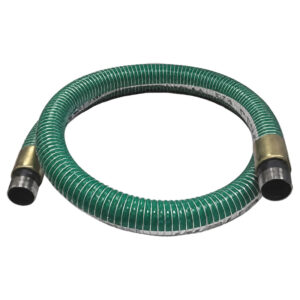
The tanker composite hose is a soft, light hose for loading and unloading road tankers and rail cars, supplied in 51 mm to 102 mm bore (2 in to 4 in). Published working pressure grades are 0.7 MPa, 1.05 MPa and 1.52 MPa (7 bar, 10.5 bar and 15 bar), for service from -30°C to +90°C. It carries gasoline, diesel, crude, lubricating oil, ethanol-blended gasoline and biodiesel, plus corrosive chemical fluids in the lined grades. Every build is anti-static, because a tanker bay is the one place a static spark has nowhere safe to go.
Product Overview
The tanker composite hose belongs to the thermoplastic multi-layer family defined by EN 13765:2018, the standard for non-vulcanised composite hoses handling hydrocarbons, solvents and chemicals. It sits in the liquid-service group rather than the vapor group, and it is specified by bore, pressure grade and helix material, because each grade is a separate build.
In one sentence, it is a thermoplastic film and fabric liner, wrapped in fabric plies and held between an internal and an external steel helix, with a coated fabric cover. Nothing is vulcanised, so the hose stays flexible in cold weather and does not stiffen after a season.
Three numbers define the range. Bore runs from 51 mm to 102 mm, working pressure is published at 0.7 MPa, 1.05 MPa and 1.52 MPa, and the temperature window is -30°C to +90°C. Burst is four times working pressure in every size, so 2.8 MPa, 4.2 MPa and 6.1 MPa.
Four advantages decide whether operators keep the hose on the rack. It lifts with one hand. It turns inside a tight bay, because the smallest 7 bar size bends to a 102 mm radius. It takes full vacuum without collapsing when a pump stops and the line drains back. The helix is bonded to both fittings, so static has a continuous path to ground.
The tanker composite hose serves fuel terminals, road tanker fleets, rail loading racks, refinery dispatch and chemical road tankers. It connects loading arms, bottom loading couplers, positive displacement pumps, meters, strainers and tank truck manifolds, usually as a short flexible section between rigid pipe and a vehicle that never parks in the same place.
The operational problem is misalignment. The arm swings, the truck stops short, and the last metre has to absorb the offset without loading a flange. A rigid pipe cracks at the weld; a rubber hose fights the bend and is heavy enough to drag. A composite hose takes the movement in a short length and keeps a round bore.
Quality is where the range earns repeat orders. We proof test every assembly at 1.5 times working pressure, record crimp data against the batch, and treat the helix-to-fitting bond as part of the tested assembly. The plant holds ISO 9001, ISO 18752, MSHA, CE, CCS, ABS, DNV, API, GOST-R and MA.
Product Advantages of the Tanker Composite Hose
- Light enough to handle one-handed: a 2 in coil starts at 0.9 kg/m.
- Full vacuum without a second hose: the inner helix keeps the bore open.
- Anti-static by construction: helix bonded to both fittings, continuity checked end to end.
- Tight bend radius: 102 mm on the 2 in 7 bar size.
- Three published grades: 7 bar, 10.5 bar and 15 bar across the range.
- Cover built for the yard: resists abrasion from concrete, grating and truck decks.
Applicable users: tanker fleet operators, terminal maintenance teams, rail loading facilities, chemical road tanker operators and fuel distributors who buy in bulk.
Detailed Technical Specifications
| Hose code | ID mm (in) | Working pressure MPa (bar / psi) | Burst pressure MPa (bar / psi) | Bend radius mm | Weight kg/m | Length m |
|---|---|---|---|---|---|---|
| PTCH-01 | 51 (2) | 0.7 (7 / 102) | 2.8 (28 / 406) | 102 | 0.9 | 15 |
| PTCH-02 | 64 (2.5) | 0.7 (7 / 102) | 2.8 (28 / 406) | 115 | 1.51 | 15 |
| PTCH-03 | 76 (3) | 0.7 (7 / 102) | 2.8 (28 / 406) | 151 | 1.9 | 15 |
| PTCH-04 | 64 (2.5) | 1.05 (10.5 / 152) | 4.2 (42 / 609) | 195 | 2.5 | 15 |
| PTCH-05 | 76 (3) | 1.05 (10.5 / 152) | 4.2 (42 / 609) | 228 | 3.2 | 15 |
| PTCH-06 | 102 (4) | 1.05 (10.5 / 152) | 4.2 (42 / 609) | 351 | 4.5 | 15 |
| PTCH-07 | 51 (2) | 1.52 (15 / 220) | 6.1 (61 / 885) | 225 | 1.97 | 15 |
| PTCH-08 | 64 (2.5) | 1.52 (15 / 220) | 6.1 (61 / 885) | 245 | 2.8 | 15 |
| PTCH-09 | 76 (3) | 1.52 (15 / 220) | 6.1 (61 / 885) | 300 | 3.5 | 15 |
| PTCH-10 | 102 (4) | 1.52 (15 / 220) | 6.1 (61 / 885) | 400 | 6.0 | 15 |
- Temperature: -30°C to +90°C continuous; above that the liner softens and the pressure margin narrows.
- Grades are separate builds. A hose ordered at 7 bar is not tested to 15 bar.
- Burst: published at four times working pressure in every size.
- Vacuum: full vacuum service, 0.9 bar. Support the coil when vacuum and heat combine.
- Tolerances: dimensions follow EN ISO 1307 practice, confirmed on the drawing per order.
- Custom lengths: 15 m standard, with cut lengths quoted and fittings crimped.
- Outside diameter: not published per size. We confirm the OD on the approval drawing.
Structure and Materials
- Inner helix: steel wire, PP-coated or hot-dip galvanised, formed as an interlocked spiral against vacuum collapse.
- Liner: multiple plies of PP-based thermoplastic film, the primary barrier against the medium.
- Carcass: woven fabric plies carrying axial load and holding the liner against the helix.
- Cover: abrasion-resistant coated fabric, pigmented for UV exposure.
- Outer helix: steel wire, galvanised or stainless, carrying hoop load and taking wear.
Why the tanker composite hose holds up
Load arrives from three directions, and each component gets one job. Hoop stress tries to expand the bore, and the outer helix resists it as a continuous steel spiral, so the rating is set by wire gauge and pitch rather than wall thickness. Axial stress tries to pull the ends apart, and the fabric plies take it in tension. Vacuum does the opposite of hoop stress, and the inner helix cages the bore open.
That division of labor is why the hose can be both full-vacuum capable and soft. A wire-braided rubber hose gets vacuum resistance from a rigid helix set in a thick wall, and the result is heavy and stiff near the coupling, which is where hoses fail. Here the helix floats in a compressed wall, so the bend radius stays small and the fitting end carries no stress concentration.
The liner does the chemistry. Thermoplastic film is smooth, so wax and biodiesel deposits do not anchor to it, and it does not swell the way rubber does in aromatic fuel. The cover absorbs abrasion and holds the stack in compression, and because the ferrule compresses the wall rather than bonding to it, a correct crimp loads plies and helices together.
Safety factor, proof pressure and burst margin
Published burst is four times working pressure, so a 15 bar hose bursts at 61 bar. That is a margin on a new hose, not a working allowance. EN 13765:2018 sets a 4:1 burst factor and a routine proof test at 1.5 times working pressure for the type, and we test every assembly at that pressure before it ships.
For a 7 bar hose that means 10.5 bar. For a 15 bar hose it means 22.5 bar held on the assembly with fittings in place. The test covers the whole assembly, not just the tube, which buyers forget: a good hose with a fitting crimped on the wrong die looks perfect until the first pressurized transfer.
Ask for the proof record per serial number, the burst report for the batch and the design factor in writing. Ask whether the 4:1 figure holds at the maximum service temperature, because a thermoplastic wall softens with heat and the margin at +90°C is not the margin at +20°C.
Chemical Compatibility and Media Guide
| Medium | Rating | Note |
|---|---|---|
| Mineral hydraulic oil | Excellent | No swelling in service |
| Diesel | Excellent | Primary duty |
| Gasoline | Excellent | State ethanol content |
| Kerosene | Excellent | Covers jet fuel |
| Crude oil | Good | Aromatics vary, send assay |
| Lubricating oil | Excellent | Stay below +90°C |
| Vegetable oil | Good | Fatty acids on long contact |
| Biodiesel B100 | Good | Confirm blend and water |
| Ethanol E100 | Good | Drier blends are harder |
| Methanol | Limited | Short transfer only |
| MTBE | Good | Common additive |
| Toluene | Not recommended | Aromatic, use PTFE |
| Xylene | Not recommended | Aromatic, use PTFE |
| MEK | Limited | Ketone swelling |
| Acetone | Limited | Short contact only |
| Ethyl acetate | Limited | Ester attack on PP |
| Dichloromethane | Not recommended | Chlorinated, PTFE only |
| Trichloroethylene | Not recommended | Chlorinated, PTFE only |
| Sulphuric acid 30% | Limited | Liner grade varies; confirm acid duty |
| Sulphuric acid 98% | Not recommended | Oxidiser, PTFE grade |
| Hydrochloric acid 35% | Limited | Vapor is aggressive; confirm duty |
| Sodium hydroxide 50% | Good | Rinse after transfer |
| Ammonia 10% | Good | Watch vapor space |
| Sodium hypochlorite 12% | Not recommended | Oxidiser |
| Hydrogen peroxide 30% | Not recommended | Oxidiser |
| Phosphoric acid 85% | Limited | Confirm temperature |
| Nitric acid 65% | Not recommended | Oxidiser, PTFE only |
| Acetic acid 99% | Limited | Glacial acid attacks PP |
| Ethylene glycol | Excellent | Coolant transfer |
| Propylene glycol | Excellent | Food grade on request |
| Water | Excellent | Rinse duty |
| Sea water | Good | Rinse cover after use |
| Steam condensate | Good | Below +90°C only |
Three rules for reading the chart. Temperature comes first: a rating that holds at +20°C can fail at +80°C. Concentration comes second, because 30% and 98% sulphuric acid are different problems. Contact time comes third, because a ten-minute transfer and a week of standing product are not the same exposure. Send the actual medium, concentration and temperature for a written answer.
Applications and Industries
Road tanker loading and unloading: loading arms, bottom loading couplers and tank truck manifolds, absorbing offset between arm and vehicle.
Rail car loading racks: top loading spouts and bottom connections, usually with fixed flange or camlock ends.
Refinery dispatch and blending: meter runs, blending headers and additive skids, isolating pump vibration from pipework.
Fuel distribution depots: drum filling, tanker-to-tank transfer and standby pump connections in short cut lengths.
Aviation fuel and kerosene service: depot lines and refueller connections where the medium is kerosene.
Chemical road tankers: lined grades for corrosive fluids, using the same carcass with a matched liner.
Selection Guide for Tanker Composite Hose
Size, flow and pressure drop
Match bore to the pump, not the pipe stub. A 51 mm hose at 60 m3/h runs near 8 m/s, fast enough to generate static and wear the liner at a bend; 64 mm drops that to about 5 m/s and 76 mm to about 3.5 m/s. Long suction runs and viscous product need the larger bore.
End fittings and hose assembly
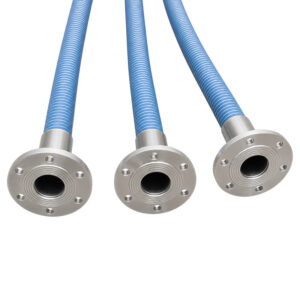
The range is assembled with crimped ferrules, not re-usable clamps. Options include NPT male, BSP male, cam and groove, fixed flange, floating flange, reducing flange, tank coupling and 37 degree flare adapters, in stainless or carbon steel. State the flange standard, bolt pattern and thread type. Fittings are crimped in house with digital records.
How the tanker composite hose compares
| Option | Pressure basis | Vacuum | Weight at 76 mm | Best use |
|---|---|---|---|---|
| Tanker composite hose, 7 bar | 0.7 MPa, 4:1 | Full | 1.9 kg/m | Light delivery, tight bays |
| Tanker composite hose, 15 bar | 1.52 MPa, 4:1 | Full | 3.5 kg/m | Higher pumps, longer runs |
| Chemical composite hose | 10 bar class | Full | Higher | Acids and alkalis |
| Heavy duty chemical composite hose | 2.0 MPa | Not published | 18.5 kg/m at 150 mm | Ship and shore transfer |
| Rubber fuel hose, wire braid | Typically lower | Limited | Heavier | Fixed plant, low movement |
For a tanker hose, the comparison is not about which hose is strongest. It is about which one takes movement without fatiguing at the fitting. The composite build wins on weight and bend radius at equal bore and keeps full vacuum without a second suction hose. Rubber wins only where a very high burst number in a small bore matters more than handling weight.
What drives the price
Four things move cost: the pressure grade, because 15 bar uses more fabric and a heavier helix than 7 bar in the same bore; the bore, because material scales with diameter faster than length; the fittings, because a stainless floating flange costs more than a camlock; and the test regime, because a proof-tested assembly with a serial record is not a cut length. Volume matters most: one size, one fitting and 15 m lengths is the cheapest configuration we build. Ask for a wholesale price break at the quantity you actually forecast.
Common selection mistakes
- Choosing the highest grade by default, then paying for weight the duty never needed.
- Ordering 4 in for a 2 in pump, which slows flow and leaves product standing.
- Specifying a PP liner for toluene, then replacing the hose in a month.
- Assuming a conductive cover gives continuity without a bonded helix.
Installation, Operation and Maintenance
Installation
- Support the hose so its weight does not hang on the fittings, with hangers at 1.5 m to 2 m spacing.
- Keep the first length at the fitting straight for one hose diameter, and never bend tighter than the published radius.
- Do not twist the hose to line up a flange pattern. Use a swivel or floating flange.
- Leave a slack loop for vehicle movement, but avoid a loop that traps product.
- Check continuity with a meter from fitting to fitting before the first transfer.
Inspection and retirement
- Inspect before every shift: cover abrasion, exposed helix, soft spots, bulges and fitting corrosion.
- Pressure-test at 1.5 times working pressure after fitting work, and annually in critical service.
- Retire the hose if the cover is worn to the helix, the bore blisters, or the fitting has moved.
- Retire any hose that has taken a full vacuum collapse, even if it looks round again.
Cleaning, storage and service life
Flush with a compatible solvent or warm water, drain, then cap the ends. Store coiled, off the floor, out of direct sun and away from ozone sources. Never store a hose under load or with a tight bend set into it. Service life depends on bending at the fitting, dragging and chemical exposure, so review every assembly at six years. This is not a steam hose and must not run above +90°C.
Quality Assurance and Test Data
Production runs through incoming inspection, film and fabric slitting, helix forming, layer assembly, compression, crimping, proof test, marking and packing. Each assembly is proof tested at 1.5 times working pressure, with the trace stored against its serial number.
Tests follow the standards for the type: hydrostatic testing to EN ISO 1402, impulse to EN ISO 6803, electrical continuity to EN ISO 8031, bend testing to EN ISO 1746 and dimensions to EN ISO 1307. Batch traceability runs from raw material lot to finished assembly, so a serial number resolves to the film lot, the helix lot, the crimp record and the test chart. Packaging is film wrap then a plywood case for LCL, and bubble wrap on a reel for FCL.
Standards and Certifications
| Standard | What it covers | What it means for the buyer |
|---|---|---|
| EN 13765:2018 | Composite hoses for hydrocarbons, solvents and chemicals | The 4:1 burst factor and 1.5x proof test |
| EN ISO 1402 | Hydrostatic pressure testing | Method behind the proof and burst numbers |
| EN ISO 6803 | Impulse testing | Evidence the assembly survives cycling |
| EN ISO 8031 | Electrical resistance and continuity | The test behind the anti-static claim |
| EN ISO 1746 | Bend testing | Confirms the published bend radius |
| EN ISO 1307 | Dimensions and tolerances | Bore and length tolerances |
| ADR/RID | Road and rail tanker equipment | A market requirement, not our certificate |
Certifications held: ISO 9001 and ISO 18752, plus MSHA, CE, CCS, ABS, DNV, API, GOST-R and MA, with RoHS and California Proposition 65 declarations on request.
Frequently Asked Questions
What is the hose made of?
A thermoplastic film and fabric liner, fabric reinforcing plies, two steel helices and a coated fabric cover. The layers are compressed, not vulcanised, so the hose stays soft and keeps a round bore.
What does the working pressure grade mean?
It is the maximum continuous pressure, and burst is four times that figure. The grades are 0.7 MPa, 1.05 MPa and 1.52 MPa, each a separate build. Choose from pump discharge plus surge, not the highest number on the sheet.
Will it handle full vacuum?
Yes, in the sizes listed. The inner helix cages the bore open at 0.9 bar vacuum. Support the hose when vacuum and heat combine, because a soft wall can flatten if it hangs free.
What is the temperature limit?
-30°C to +90°C. Below -30°C the cover and film stiffen. Above +90°C the liner softens and the margin narrows, so a hot duty needs a different liner and our written confirmation.
Can it carry solvents as well as fuel?
Only within the liner’s limits. Toluene, xylene, chlorinated solvents and strong oxidisers attack a PP liner and need a PTFE composite hose grade. The chart is a starting point; the written answer for your medium is what protects the order.
How is it different from a rubber hose?
A rubber hose holds pressure in a vulcanised wall with wire braid, so it is heavier and stiffer at the same bore. This hose carries hoop load in the outer helix and axial load in fabric plies, which keeps it light and vacuum capable.
How is it different from the next model up?
The heavy duty chemical composite hose is the larger option at 2.0 MPa, built for ship-to-shore and ship-to-ship transfer in exposed conditions. It starts at 100 mm bore and 7.6 kg/m, so it is terminal equipment.
What is the smallest order you ship?
We quote from one assembly. Bulk orders on standard specifications run on a seven-day turnaround, and custom samples take 48 hours. Send the size, grade, length and fittings and we confirm the schedule.
How do I get a quote or a PDF datasheet?
Send the medium, concentration, temperature, pressure, bore, length, end connection, quantity and destination port through the contact form. We reply with a quotation, the datasheet PDF, the compatibility chart and a sample offer.
Why Source Composite Hose from HENGHUA
We build composite hose at an 18,000 m2 plant near Hengshui, with eight high-speed lines and 25 million metres of annual output going to customers in 70+ countries. That scale is why an order in one size and one fitting can be scheduled in days, and why a mixed order with four bores does not derail the plan.
The certification set is what buyers check first: ISO 9001, ISO 18752, and MSHA, CE, CCS, ABS, DNV, API, GOST-R and MA where the destination market or a classification society asks. RoHS and California Proposition 65 declarations ship with the quotation. We do not claim a certificate we cannot produce.
Assembly capability sits in the same building as hose production. We crimp in house, keep digital crimp records against the serial number, and proof test every assembly at 1.5 times working pressure. That matters for a product that fails at the fitting more often than in the bore. OEM and ODM work is routine: your label, packaging, length and fitting schedule, with the drawing approved before production.
Sampling and lead time are the two questions we answer most often. Custom samples ship in 48 hours, bulk production on standard specifications runs seven days, and a new fitting adds drawing time rather than weeks. Packing, marking and documents are tuned to what your port expects.
Technical support is where a composite hose order differs from a commodity purchase. Send the medium and the duty and our sales engineers answer in writing, with the liner, pressure grade and temperature limit stated plainly. After-sales covers replacement of a failed assembly against its test record, and we review a returned hose to establish whether the cause was product, installation or duty.
Request a Quote
Tell us what the tanker hose has to do and we price it against the right grade. Send the medium, concentration, maximum temperature, working and surge pressure, bore, length, end connection and flange standard, quantity and destination port. If the hose goes onto a loading arm, include the flange pattern and the required bend. We reply with a quotation, the datasheet PDF, the compatibility chart and a sample offer where volume supports one. Cut lengths, non-standard assemblies and OEM packaging are quoted on the same request, and the composite hose range covers the sister builds.


 English
 Spanish
 Portuguese
 French
 German
 Arabic
 Russian
 Indonesian
 Japanese
 Korean