


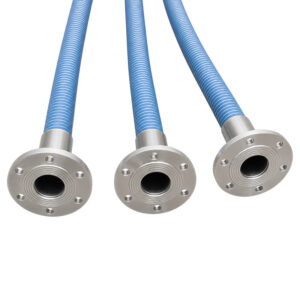
A biodiesel composite hose from HENGHUA is built for B100 biodiesel, B20 and B30 blends, and ethanol fuels from E10 to E100. Every size carries a 14 bar (200 psi) working pressure, bores run from 25 mm to 250 mm (1 in to 10 in), and the assembly is rated from -20°C to +100°C. The liner is polyamide or nylon rather than plain polypropylene, because methyl esters and alcohol blends soften ordinary fuel liners, swell the wall and then weep at the crimp. Send your blend, temperature and end connection to our sales engineers for a written confirmation.
Product Overview
This is a suction and discharge hose for ester-based and oxygenated fuels, built as a non-vulcanised, multi-layer thermoplastic hose rather than a rubber hose. The layers are compressed mechanically, with no cure step. In EN 13765:2018 terms it is a liquid-service hose for hydrocarbons, solvents and chemicals, made to the standard-duty wall of that family.
Construction in one sentence: a polyamide or nylon liner, multiple plies of PP fabric and film, an inner helix of nylon-coated steel, aluminium or SS316, an abrasion-resistant PVC fabric cover and an outer helix of high-tensile galvanised or stainless steel, pressed together without heat bonding.
Three numbers define the range. Working pressure is 14 bar (200 psi) in all nine bores, the bore span is 25 mm to 250 mm with outside diameter from 32 mm to 290 mm, and the temperature window is -20°C to +100°C. That covers cold depots and hot rack lines alike.
Four things make the build worth its cost on a fuel rack. The nylon liner holds back methyl esters better than a standard polypropylene liner, so the wall does not soften over a season of B100. The twin helix keeps the bore open under suction. Every crimp is recorded in-house, so a failed fitting traces back to a machine and a batch.
The main industries are biofuel plants, ethanol blending terminals, fuel distributors and road tanker fleets. Equipment includes blend rack loading arms, rail car connections, barge manifolds and co-op storage with B100 on site.
The operational problem is permeation, not pressure. Methyl esters are heavier and more polar than diesel, so they creep through a liner designed for mineral diesel. Once the liner swells, the bore narrows and the wall softens at the ferrule, and the hose weeps at the crimp instead of bursting in the middle.
Quality runs the same routine on every order. Film and fabric are inspected on receipt, each assembly is proof tested at 1.5 times working pressure, 21 bar here, and crimp data is filed against the serial number. We hold ISO 9001, ISO 18752, MSHA, CE, CCS, ABS, DNV, California Proposition 65, RoHS, API, GOST-R and MA.
Product Advantages of the Biodiesel Composite Hose
- Ester-resistant liner. Polyamide and nylon slow FAME permeation better than plain PP.
- One build, many blends. B100, B20/B30, E10 to E100 and methanol on one carcass.
- Static-safe assembly. Helix bonded to crimped fittings, continuity checked end to end.
- Suction capability. The inner helix resists collapse when a pump pulls the line dry.
- Abrasion-first cover. PVC fabric takes the wear before the carcass sees it.
- Traceable crimps. Every assembly carries a digital record of pressure and die.
Applicable users: fuel distributors, biodiesel producers, blending terminals, tanker fleets and co-op fuel storage.
Detailed Technical Specifications
| Bore (mm) | Bore (in) | OD (mm) | Bend radius (mm) | WP (bar) | Weight (kg/m) | Length (m) |
|---|---|---|---|---|---|---|
| 25 | 1 | 32 | 100 | 14 | 1.00 | 15 |
| 38 | 1-1/2 | 50 | per size | 14 | per size | 15 |
| 50 | 2 | 61 | per size | 14 | per size | 15 |
| 65 | 2-1/2 | 76 | per size | 14 | per size | 15 |
| 75 | 3 | 88 | per size | 14 | per size | 15 |
| 100 | 4 | 112 | per size | 14 | per size | 15 |
| 150 | 6 | 175 | per size | 14 | per size | 15 |
| 200 | 8 | 240 | per size | 14 | per size | 15 |
| 250 | 10 | 290 | 915 | 14 | 20.50 | 15 |
- Temperature: the source sheet publishes no fixed range for this build. Permeation rises as the fuel warms, so send the blend and the service temperature and we confirm the liner in writing.
- Bend radius and weight: 100 mm and 1.00 kg/m at 25 mm bore, 915 mm and 20.50 kg/m at 250 mm bore. Intermediate sizes are on the per-size datasheet.
- Pressure: 14 bar (200 psi) in every bore, with a 4:1 burst ratio, so 56 bar minimum burst.
- Proof test: 1.5 times working pressure, 21 bar, on every assembly before dispatch.
- Tolerances: dimensions and length to EN ISO 1307. Cut lengths and 15 m coils to order.
- Vacuum: full-vacuum duty is available when the helix and end fittings are specified for suction. Confirm the figure for your bore on the order.
Structure and Materials
Every biodiesel composite hose in the range follows the same layer logic: a liner chosen for FAME and ethanol contact, barrier plies that slow water and acid pickup, a fabric carcass for axial load, and two helices for vacuum.
- Inner helix: nylon-coated steel, aluminium or SS316. The coating limits corrosion where condensate sits.
- Liner: polyamide or nylon film, the permeation barrier against methyl esters and alcohols.
- Carcass: multiple plies of PP fabric and film, wound to take axial load and hold the liner.
- Cover: abrasion-resistant PVC fabric, pigmented and embossed for grip on wet steel.
- Outer helix: high-tensile galvanised or stainless steel, carrying hoop load over the cover.
Why the composite build holds up
Load arrives from four directions, and each layer answers one. Internal pressure tries to turn the bore into a balloon, so the outer helix and the fabric plies carry hoop load in tension. Pump suction tries to flatten the bore, so the inner helix acts as a spring cage and keeps the flow path round. Axial pull from a tug on the line is taken by the plies, not the liner, which is why a composite hose does not neck down when it is dragged.
The advantage over a wire-braided rubber hose of the same bore is the split between structure and sealing. In a rubber hose the tube and reinforcement are bonded, so flexing works the bond and permeation softens the tube from inside. In a composite hose the liner slides a little between the plies, the helix defines the shape, and the cover is a wear surface. The nylon barrier also slows absorption of methyl esters, which keeps wall stiffness stable over repeated fills.
Safety factor, proof pressure and burst margin
Every assembly is designed to a 4:1 factor between working pressure and minimum burst, following the EN 13765:2018 approach for liquid service. At 14 bar that is a 56 bar burst floor, so the hose does not work near its limit at the rated pressure. Routine proof testing at 1.5 times working pressure, 21 bar here, catches a bad crimp before the hose leaves the factory.
Ask for three things in writing: the burst ratio and its test standard, here EN ISO 1402; the proof pressure and whether every assembly is tested or only a sample; and the impulse basis under EN ISO 6803 if a positive displacement pump cycles the line.
Chemical Compatibility and Media Guide
Ratings describe the liner at ambient temperature under continuous contact unless the note says otherwise. They are a starting point, not a substitute for a written confirmation against your blend.
| Medium | Rating | Note |
|---|---|---|
| Mineral hydraulic oil | Good | Standard duty, no swelling in service |
| Diesel | Excellent | Reference medium for this build |
| Gasoline | Good | Ethanol content raises permeation |
| Kerosene | Excellent | Common rack medium |
| Crude oil | Good | Check the water cut |
| Lubricating oil | Good | Viscous, so size up |
| Vegetable oil | Excellent | Also the FAME feedstock |
| Biodiesel B100 | Excellent | Core duty of this hose |
| B20 biodiesel blend | Excellent | Most common road blend |
| B30 biodiesel blend | Excellent | Confirm the cold-flow additive |
| Renewable diesel (HVO) | Good | Lower solvency than FAME |
| Ethanol E100 | Excellent | Keep water out of the line |
| Ethanol E10 | Good | Monitor permeation at the crimp |
| Methanol | Good | Confirm the temperature |
| MTBE | Limited | Short transfers only |
| Toluene | Limited | Aromatic, softens the liner |
| Xylene | Limited | Aromatic, short exposure |
| MEK | Limited | Ketone attack on the barrier |
| Acetone | Limited | Drain after transfer |
| Ethyl acetate | Limited | Ester solvent, confirm first |
| Dichloromethane | Not recommended | Chlorinated, use a PTFE liner |
| Trichloroethylene | Not recommended | Chlorinated, use a PTFE liner |
| Sulphuric acid 30% | Limited | Dilute acid, rinse after use |
| Sulphuric acid 98% | Not recommended | Oxidising and dehydrating |
| Hydrochloric acid 35% | Not recommended | Use a PTFE-lined build |
| Sodium hydroxide 50% | Limited | Caustic, rinse and drain |
| Ammonia 10% | Limited | Confirm the seal grade |
| Sodium hypochlorite 12% | Not recommended | Strong oxidiser |
| Hydrogen peroxide 30% | Not recommended | Strong oxidiser |
| Phosphoric acid 85% | Limited | Food grade, short contact |
| Nitric acid 65% | Not recommended | Oxidiser, use a PTFE liner |
| Acetic acid 99% | Limited | Glacial acid attacks the barrier |
| Ethylene glycol | Good | Coolant and de-icer service |
| Propylene glycol | Good | Low toxicity glycol service |
| Water | Good | Drain and dry after use |
| Sea water | Limited | Rinse the bore after transfer |
| Steam condensate | Limited | Not a steam hose |
Three rules govern how you read the chart. Temperature derates every rating, because a medium rated Good at 20 C can act Limited at 70 C. Concentration changes the chemistry, so 30% and 98% sulphuric acid must be quoted separately. Contact time matters too, because a splash rinse and a 12-hour standing fill are not the same duty. Request the full compatibility chart as a PDF.
Applications and Industries
Biodiesel plant transfer. Loading arms and pump skids moving B100 from reactor to storage.
Ethanol blending terminals. Rack hoses dosing E10 to E100 into petrol, with camlock or flange ends.
Road tanker delivery. Compartment unloading at depots, several times a day.
Rail car loading. Top and bottom connections at rail terminals, with lengths supported at the car sill.
Barge and coaster transfer. Manifold lines where 250 mm bore cuts unloading time.
Selection Guide for Biodiesel Composite Hose
Choosing a biodiesel composite hose comes down to four checks: liner compatibility with the blend, barrier plies for permeation, bore for the rack, and ends for the connection. Where a blend carries aggressive additives, the PTFE composite hose is the safer liner.
Size, flow and pressure drop
Match the bore to the pump, not to the old hose. A 25 mm bore passing 20 m3/h of B100 runs near 11 m/s, fast enough to build static and erode the liner at a bend; a 50 mm bore on the same flow runs near 3 m/s. Keep velocity below 4.5 m/s in continuous transfer and 6 m/s for short cycles.
End fittings and hose assembly
Standard ends are crimped swaged ferrules with NPT male, BSP male, cam and groove (camlock), fixed flange, floating flange, reducing flange, tank coupling or 37 degree flare adapters, in stainless or carbon steel. Camlock suits a rack where speed matters, and a floating flange takes up misalignment at a loading arm without stressing the crimp. Fittings are crimped in-house with digital records, and the helix is bonded to the fitting so continuity runs end to end.
How it compares
| Build | Liner | Typical duty | Trade-off |
|---|---|---|---|
| This biofuel build | Polyamide or nylon | B100, B20/B30, E10 to E100 | Limited on aromatics, chlorinated solvents |
| Standard chemical composite | PP | Acids, alkalis, aqueous salts | Swells in FAME over long contact |
| PTFE composite | PTFE | Aromatics, chlorinated solvents, oxidisers | Higher cost per metre |
| Petroleum suction and discharge | PP with PE barrier | Petrol, diesel, aromatics at higher pressure | Not aimed at high FAME content |
| Rubber hose | Rubber tube | General fuel transfer | Heavier and stiffer at the same bore |
Against a standard PP chemical composite hose this build trades acid resistance for ester resistance, which is the right trade on a biodiesel rack.
What drives the price
Four things move the price per metre: bore, liner grade, helix material and end fittings. A 250 mm SS316 assembly with flanges can cost several times a 50 mm PG build with camlocks. Nylon film also costs more than PP film. We quote wholesale and OEM ODM pricing against a firm specification.
Common selection mistakes
- Sizing by the old hose instead of by flow, so the new line runs at twice the velocity.
- Ignoring water in the ethanol line, which turns a good liner into a swelling problem.
- Mixing stainless and galvanised ends on a wet dock, which starts galvanic corrosion.
- Buying on price per metre and forgetting fittings, which are often half the assembly cost.
Installation, Operation and Maintenance
Installation
Support the hose so its weight does not hang on the crimp, with hangers every 1.5 m on horizontal runs, and never start a bend closer than one bore diameter to the ferrule. Respect the table radius, 100 mm at 25 mm bore and 915 mm at 250 mm bore, and fit a protective sleeve or guard where the cover meets a steel edge. A twisted hose walks off the fitting under pressure, so do not store a half turn in the line. Pressure test at 1.5 times working pressure before first transfer.
Inspection and retirement
Check the cover for cuts, blisters and soft spots at every coupling change. A bulge just behind the ferrule signals ply separation, and a tacky or collapsed liner means the fuel has won. Measure continuity quarterly with the hose straight, targeting 1 ohm/m or less below 100 mm bore and 2 ohm/m or less at 100 mm and above. Retire on exposed helix, a leak at the crimp or a bend that stays flat after straightening, and review every assembly at six years.
Cleaning, storage and service life
Drain the bore after every transfer and cap the ends before the hose goes back on the rack. Never leave a B100 line standing full for weeks. Store coils flat or on a reel, dry and shaded, off wet concrete and away from motors that generate ozone. Service life depends on bending at the fitting, dragging and chemical exposure, so the cover and the crimp usually retire a hose before the carcass fails.
Quality Assurance and Test Data
Production runs in a fixed sequence. Film, fabric and wire are inspected on receipt, film is extruded and slit, helices are formed to the bore, and the assembly is laid up layer by layer on the mandrel. The build is then compressed mechanically, with no cure and no vulcanisation, which keeps the liner and plies independent. Each assembly is proof tested, marked with bore, working pressure, batch and date, and photographed before packing.
Tests follow the standards the market asks for: hydrostatic proof at 1.5 times working pressure to EN ISO 1402, impulse testing to EN ISO 6803, electrical resistance to EN ISO 8031, bend testing to EN ISO 1746 and dimensions to EN ISO 1307. Batch traceability links the finished hose to the film lot, the helix coil and the crimp record. Packaging is film wrap with a plywood case or pallet for LCL.
Standards and Certifications
| Standard | What it covers | What it means for the buyer |
|---|---|---|
| EN 13765:2018 | Thermoplastic multi-layer hoses for hydrocarbons, solvents and chemicals | The design and test framework for this family |
| EN ISO 1402 | Hydrostatic pressure testing | Proof and burst results measured the same way anywhere |
| EN ISO 6803 | Impulse testing | Supports pressure-cycling claims for pump duty |
| EN ISO 8031 | Electrical resistance and continuity | Backs the static-conductive assembly |
| EN ISO 1746 | Bend test | Confirms the minimum bend radius |
| EN ISO 1307 | Dimensions and tolerances | Bore, wall and length agree with the drawing |
Company certifications: ISO 9001, ISO 18752, MSHA, CE, CCS, ABS, DNV, California Proposition 65, RoHS, API, GOST-R and MA (China metrology accreditation). Certificates cover the company and the process, not every individual hose, so ask which document applies to your specification.
Frequently Asked Questions
Questions about a biodiesel composite hose usually come down to storage, water pickup and seal material, and the composite hose range covers the sister builds. The vapor recovery composite hose handles the terminal vapor leg of the same operation.
What is a biodiesel composite hose made of?
A polyamide or nylon liner, multiple plies of PP fabric and film, an inner helix of nylon-coated steel, aluminium or SS316, a PVC fabric cover and an outer helix of galvanised or stainless steel. The layers are compressed, not bonded.
What does the 14 bar rating actually mean?
It is the working pressure the hose may see continuously. Minimum burst is four times that, 56 bar, and every assembly is proof tested at 21 bar before shipment.
Can this hose handle vacuum?
Yes, when the helix and end fittings are specified for suction duty. We confirm the vacuum figure per bore in writing rather than assume it.
What is the temperature limit?
The source sheet publishes no fixed range for this build. Give us the blend and the service temperature and we confirm the liner in writing, since permeation accelerates as the fuel warms.
How do I check chemical compatibility?
Start with the table above, then send the exact blend, concentration and temperature. We check it against the liner data and confirm in writing with the quote.
How is this different from a rubber hose?
A rubber hose bonds tube to reinforcement and relies on that bond for strength. A composite hose separates the layers, using helices for shape and fabric for axial load, so it is lighter and bends tighter.
When should I choose a PTFE build instead?
When the medium is aromatic, chlorinated or a strong oxidiser. A PTFE-lined composite hose covers those duties at a higher cost per metre.
What is the minimum order and lead time?
How do I get a quote or the PDF datasheet?
Tell us the medium, pressure, temperature, bore, length, connection, quantity and port of discharge. We reply with a quote, the datasheet PDF and the compatibility chart.
Why Source Composite Hose from HENGHUA
We build composite hose in an 18,000 m2 plant in the Hengshui area of Hebei, with a sales office in Tianjin and eight high-speed production lines running to 25 million metres a year. That scale is why a standard specification ships in 7 days and a custom sample in 48 hours. Customers in more than 70 countries buy from us, most through distributors, wholesalers and OEM ODM programs that put their own label on the cover.
The certification set is broad because our markets are broad: ISO 9001 and ISO 18752 for the management and product system, MSHA, CE, CCS, ABS and DNV for industrial and marine buyers, California Proposition 65 and RoHS for consumer-adjacent supply chains, API, GOST-R and MA for oilfield and metrology requirements. A certificate is an auditable claim, not a sales badge, which is why the proof test record travels with the hose.
Assembly is done in-house. Fittings are crimped on our own machines with digital records, the helix is bonded to the fitting for continuity, and custom labelling, packaging and reel marking run on the same line. A 12 m assembly with a floating flange at one end and a camlock at the other is a normal order.
Technical support is the part buyers use most. Send a medium, a temperature and a flow rate and our sales engineers come back with a bore, a liner recommendation and a pressure drop estimate. Batch traceability also lets a complaint be checked against the film lot and the crimp record instead of a guess.
Request a Quote
Send your medium and blend ratio, any additive concentration, the temperature range, the working pressure, the bore, the length, the end connection, the quantity and the destination port. Our sales engineers reply with a quotation, the datasheet PDF, the full compatibility chart and, where the duty is unusual, a recommendation to test a sample first. Custom sampling takes 48 hours and bulk production on standard specifications takes 7 days. Ask for a sample length if you want to run your own bench test before committing to a wholesale order.


 English
 Spanish
 Portuguese
 French
 German
 Arabic
 Russian
 Indonesian
 Japanese
 Korean