

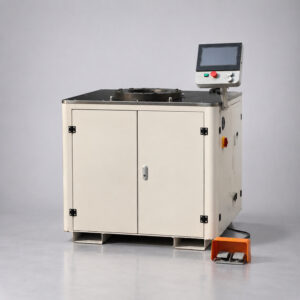
How do you close a long, thin-walled sleeve onto 4 inch industrial tube without the sleeve ends staying proud? With a die long enough to support the whole sleeve. The HH195 is a 4 inch industrial tube crimping machine with a 195 mm maximum opening, 3,000 kN crimping force and a range of 6-64 mm hose plus industrial tube to 4 inch. It is the frame for long sleeves and mixed work: hydraulic hose in the morning, 3 inch suction hose in the afternoon, a 4 inch tube line being rebuilt when the order comes in. HH is the HENGHUA model prefix for hose crimping machines.
Working envelope. The two range figures on this page mean different things, and both are stated with their scope.
- Hose bore: 6 mm to 64 mm. That covers 1/4 inch to 2-1/2 inch hydraulic hose and 2 inch to 2-1/2 inch industrial hose.
- Industrial tube: to 4 inch, with long, thin-walled sleeves. The catalogue’s “Industrial Tube 4 inch” note.
- Long sleeves: the reason for the 195 mm opening; the die has to support the sleeve along its full length.
- 4 inch four-spiral hydraulic hose: the HH300, which has the bore range and the force for it.
- Composite PE pipe above 64 mm outside diameter: the HH300 or the HH800.
1. What does the HH195 crimp?
The HH195 closes a ferrule, sleeve or steel insert onto hose or tube to a set diameter, applying 3,000 kN radially through eight die segments under a 7-inch touch screen control: manual, semi-automatic and full-automatic modes, 200 stored programs, error compensation, holding time and a pressure curve display.
At this size the assembly is often structural rather than purely a fluid joint. A 4 inch tube with a crimped sleeve carries bending and vibration loads as well as pressure, so the acceptance question is not only “is the diameter right” but “has the sleeve closed onto the tube along its full length”.
Why the opening is 195 mm and the force is 3,000 kN. The opening exists for sleeve length, not for hose bore. A long industrial sleeve needs a die with a long land, and the die stack needs depth inside the head. The 3,000 kN is the force class that closes those sleeves; the force is not the constraint, the die geometry is. That is the opposite of the small frames, where the range is the limit and force has margin.
Who buys it. OEM hose assembly shops and maintenance operations with mixed work: hydraulic assemblies up to 2-1/2 inch, industrial hose to 3 inch, and 4 inch tube with crimped sleeves when a line is being rebuilt.
Three buyers recur: an OEM shop that builds both hydraulic assemblies and tube, a distributor holding long tube sleeves for contractors, and a maintenance department that rebuilds 4 inch tube lines on site.
2. Technical specifications
| Parameter | Value | Unit |
|---|---|---|
| Maximum opening diameter | 195 | mm |
| Crimping force | 3,000 | kN |
| Crimping hose range (bore) | 6-64 | mm |
| Industrial tube | to 4 | inch, long sleeves |
| Power supply | 380 / 220 | V, optional |
| Motor | 4 | kW |
| System pressure | 31.5 | MPa |
| Overall weight | 1,100 | kg |
| Outline dimension | 1100 × 900 × 1700 | mm |
| Hydraulic oil | 46# | — |
| Foot switch | Yes | — |
Range convention: the 6-64 mm figure is the hose bore range. The 4 inch figure refers to industrial tube with long, thin-walled sleeves and is not a bore range extension. Maximum crimp diameter depends on the die and the ferrule or sleeve, and is confirmed against the component drawing for each assembly.
Sleeve length before hose bore
- 195 mm opening on 3,000 kN. The ratio is the design statement. Against the HH190 (210 mm on 3,600 kN) this frame gives up opening and force but keeps a narrower head, which suits long sleeves on mixed work.
- 1,100 kg on 1100 × 900 × 1700 mm. A defined bay rather than a corner. The 1,700 mm height puts the head at a comfortable level for a standing operator; the 900 mm depth means it will not sit flush to a wall.
- 4 kW at 31.5 MPa. The same hydraulic class as the rest of the range, so spares and oil are common across a mixed fleet.
3. Which work fits a 195 mm head?
| Workpiece | Size | Fits | Comment |
|---|---|---|---|
| Hydraulic hose, one and two-wire | 1/4″-1-1/2″ | Yes | Well inside range |
| Hydraulic hose, four-spiral | 3/4″-2″ | Yes | Standard work for this frame |
| Hydraulic hose, four-spiral | 2-1/2″ | Yes | Confirm ferrule OD and die depth |
| Industrial hose, suction and discharge | 2″-3″ | Yes | Long ferrules, wide land die |
| Industrial tube with crimped sleeve | to 4″ | Yes | The catalogue’s Tube 4 inch note |
| Tube with a heavy sleeve | over 4″ | No | HH190 or HH300 |
| Four-spiral hydraulic hose | 4″ | No | HH300 |
| Composite PE pipe | above 64 mm OD | No | HH300 or HH800 |
4. Die system at sleeve length
The frame holds eight segments in a quick-change ring, with custom shape and inner diameter available, and special dies vacuum-furnace hardened.
Three things change as the sleeve grows:
Dies for tube sleeves
- Die mass. A 4 inch ring is heavy. The quick-change design removes the bolts, not the mass, so handle it with both hands and store it on a rack.
- Segment contact area. A long sleeve needs a long land. A short die on a 3 inch sleeve produces flared ends even when the diameter is right.
- Heat. More metal deformation per cycle means more heat in the die. On continuous 3 inch work the oil cooling system is a practical option rather than an upgrade for its own sake.
5. Setting up a 3 inch or 4 inch job
- Read the sleeve drawing. Diameter, length, land position, insertion depth, and whether the joint is round or profiled.
- Select the die by sleeve length first, diameter second. A die that is too short cannot be rescued by adjusting the diameter.
- Fit the ring and check seating. A chip under a segment shows up as an eccentric crimp on a 3 inch sleeve.
- Program diameter, opening and hold time, and store under the part number.
- Trial crimp a scrap assembly and measure at both ends and the middle.
- Section a sample where the joint is structural. For tube sleeves, a section is the only way to confirm the sleeve closed onto the tube, not just around it.
- Record and run, checking one part per hour.
6. Maintenance
| Interval | Task |
|---|---|
| Every shift | Clean die seats and segments; check the oil level; test the foot switch and emergency stop |
| Every shift | Inspect the die ring for chips or cracks before fitting |
| Weekly | Check concentricity with a measured part in two directions |
| Weekly | Clean the touch screen dry; inspect the pendant cable at the strain relief |
| Monthly | Inspect hydraulic hoses, pump seals and fittings for seepage |
| Monthly | Check die-seat wear and ram guide play; the frame shows guide wear as taper on long sleeves |
| Every 2,000 h or annually | Change the 46# oil and the suction filter |
| Annually | Re-check calibration against a measured part; inspect frame welds and mounting bolts |
On a large-opening frame, guide and seat wear matter more than on a compact one, because any play is multiplied by the opening. Measure a long sleeve at both ends: a difference above the sleeve tolerance means guides and seats, not the program.
7. How does the HH195 compare with the HH165 and the HH190?
| Model | Opening | Hose bore | Tube | Force | Weight |
|---|---|---|---|---|---|
| HH145F | 145 mm | 1/4″-2″ 4SP | — | 3,000 kN | 1,000 kg |
| HH195 | 195 mm | 6-64 mm | to 4″ | 3,000 kN | 1,100 kg |
| HH165 | 190 mm | 6-76 mm | to 76 mm | 3,600 kN | 1,000 kg |
| HH190 | 210 mm | 6-76 mm | to 76 mm | 3,600 kN | 1,100 kg |
| HH300 | 300 mm | 6-102 mm | to 102 mm | 4,500 kN | 2,500 kg |
Two frames here look like near-duplicates and are not. The HH165 3 inch hydraulic hose crimping machine has more force and a slightly smaller opening, and is the better frame for 3 inch hose with heavy ferrules. This frame has more opening and less force, and is the better frame for long 4 inch tube sleeves. Where the work is 4 inch four-spiral hydraulic hose rather than tube, the HH300 4 inch hose crimping machine is the correct frame and no die change makes this one equivalent.
8. Faults, causes and fixes
| Symptom | Cause | Fix |
|---|---|---|
| Tapered crimp on long sleeves | Ram guide play or a worn die seat | Inspect guides and seats; replace worn parts |
| Sleeve ends not closed | Die shorter than the sleeve | Fit a longer die profile |
| Eccentric crimp, one side flat | Chip or dirt under a segment; ring not seated | Clean the seat; refit the ring; re-trial |
| Ram slows near full closure | Pressure bypass or hot oil | Check the relief setting; add cooling; check oil condition |
| Diameter drifts across a shift | Thermal growth in a large frame | Warm-up part each shift; check the first two parts |
| Tube slips during crimp | Insert not seated, or crimp too shallow | Check insert position; verify the target from the sleeve drawing |
| Head will not hold pressure | Internal leakage in valve or cylinder seals | Pressure test; reseal the cylinder |
9. FAQ
What does “Industrial Tube 4 inch” mean on this machine? It means industrial tube to 4 inch with long, thin-walled sleeves. It is not a claim on 4 inch four-spiral hydraulic hose, which needs the HH300.
Can it crimp 2-1/2 inch four-spiral hose? Yes, with a die deep enough for the ferrule. Check the ferrule outside diameter and die length before quoting.
Why does a 3,000 kN machine weigh 1,100 kg? Because the frame has to stay stiff across a 195 mm opening. Stiffness, not force, drives the mass at this size.
Do I need the oil cooling option? For continuous 3 inch work, yes in practice. For mixed sizes and short runs the standard air cooling is usually adequate.
What is the difference from the HH190? The HH190 has a 210 mm opening and 3,600 kN; this frame has 195 mm and 3,000 kN, and is positioned for long tube sleeves rather than 4 inch industrial hose.
Which oil? 46# hydraulic oil, with the oil and filter interval in section 6.
Questions from tube and hose shops
I rebuild 4 inch tube lines and also crimp 1 inch hydraulic hose for the same customer — is one HH195 sensible? Sensible, and common. The hydraulic hose is a die and program change from the tube work, and the 195 mm opening is what you are paying for on the tube side. Keep the tube dies on a rack at working height so the hose job does not start with a lift.
My tube sleeves are 120 mm long and the crimp marks only the middle — what is wrong? The die land is shorter than the sleeve’s cylindrical section. On a sleeve that long you need a die whose land covers the full length, not a wider diameter setting; adjusting the program cannot extend the die.
The sleeve measures correct but the joint fails a hydrostatic test — what do I check? Section one sample and look at the sleeve-to-tube contact along the length. A joint that measures right but leaks usually has the tube not fully inserted, or a sleeve that closed at the middle and stayed open at the ends; both are visible in section, neither is visible with a calliper.
10. Related models and consumables
- HH165 3 inch hydraulic hose crimping machine — more force for 3 inch hose.
- HH190 hose crimping machine — 210 mm opening for 4 inch industrial hose.
- HH300 4 inch hose crimping machine — 6-102 mm bore for 4 inch hydraulic hose.
- Hydraulic hose crimping machines — the full range and selection table.
- Industrial crimp ferrules — ferrules, sleeves and tails for the sizes this frame runs.
11. Ordering, tooling and support
Quote inputs for a HH195: the hose and tube sizes you run, the ferrule or sleeve part numbers, the largest outside diameter in the mix, the site voltage with frequency, and whether the machine runs one or two shifts. The largest outside diameter decides whether this frame is right at all; if it exceeds what a 195 mm head accepts, the honest answer is the HH300 rather than a custom die on a 195.
Options ship with the machine on request: rear-view mirror, mould marking, electronic positioning, custom voltage, oil cooling and a camera. Tube shops tend to add marking, to keep similar die sets apart.
Standards this page refers to. Hydraulic hose in this bore band is specified in SAE J517, ISO 1436 and ISO 3862 / EN 856, with impulse testing to ISO 6803 and test methods in SAE J343. Tube and pipe joints are specified by the component drawing and the application standard the customer works to; the sleeve maker’s drawing governs the crimp diameter.
Request a die-matched quotation. Send the hose and sleeve part numbers, and the die list can be confirmed against them before the order. HENGHUA supplies the crimper for export and stocks industrial hose and the long ferrules this frame is bought for, so machine, dies and consumables can be confirmed together. Company background is on the HENGHUA engineering and supply page.
Author: HENGHUA machine tool and hose assembly engineering team, Hengshui, Hebei, China. Last updated: 23 November 2026 Catalogue source: HH series hydraulic hose crimping machine catalogue, HH195 spread (catalogue pages 11-12).


 English
 Spanish
 Portuguese
 French
 German
 Arabic
 Russian
 Indonesian
 Japanese
 Korean