
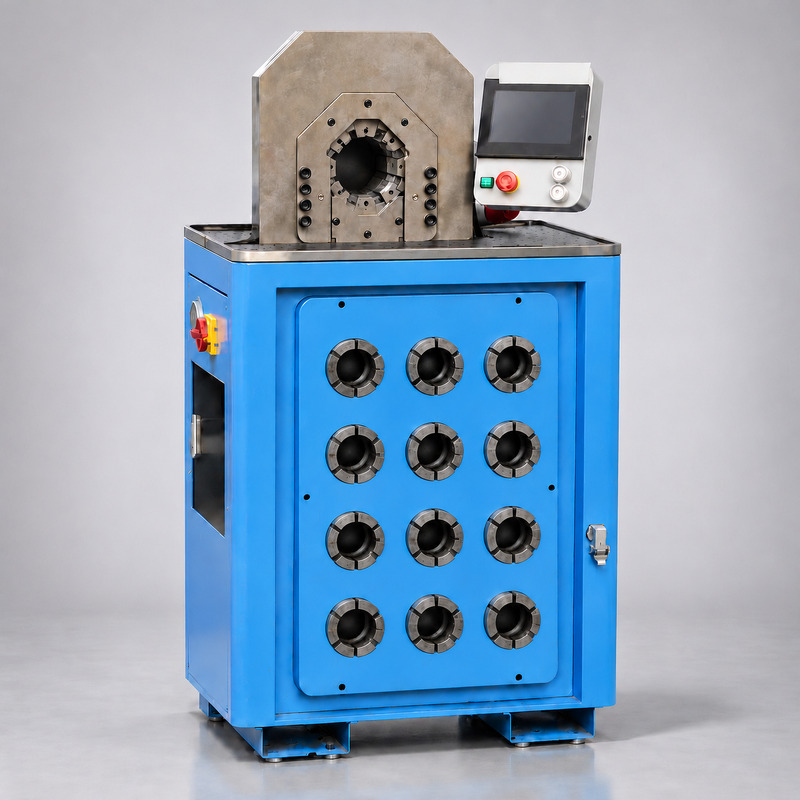
Is a 110 mm crimper enough for brake and AC lines? Yes — if every assembly you run is 19 mm bore or smaller. The HH110 closes ferrules on 6-19 mm hose at 1,600 kN, covering brake, fuel, power-steering, automotive AC and gauge tubing, and it stops at 19 mm. Four-spiral hose, two-wire above 19 mm and 4 inch industrial tube need the HH145F, the HH195 or the HH300. HH is the HENGHUA model prefix for hose crimping machines, and the HH110 is the smallest frame in that range.
Working envelope. The HH110 is a small-bore machine, and every figure on this page is hose bore unless it says otherwise.
- Brake, fuel, power-steering and gauge line: 6-10 mm bore on standard dies; 3.2-6 mm brake line only with a custom small-die set.
- Automotive AC line: 6-19 mm bore, barrier hose with aluminium ferrules.
- Small industrial air or water hose: to 19 mm bore.
- Two-wire hydraulic hose: to 5/8 inch bore, with dies matched to the ferrule.
- Four-spiral hose: not catalogued on this frame; the range starts at the HH145F.
- Hose above 19 mm bore: the HH120 covers 6-38 mm.
1. What does the HH110 crimp?
The HH110 presses a metal ferrule onto a hose end that already carries its insert, closing eight die segments radially to a programmed diameter. The joint holds because the ferrule is compressed onto the hose cover and its reinforcement; the diameter is a number on the screen rather than a shim stack.
Three settings do most of the daily work on a machine this size. Crimp size is the target diameter. Opening amount is how far the head reopens, which is what lets a bent fitting clear the dies. Error compensation is a single offset applied to the stored size, used when a ferrule lot measures consistently over or under target without rewriting the program.
Where the 110 mm frame fits. A tight head, small light dies and 260 kg of machine: it goes on a bench line, into a repair bay or into a service van without a foundation. That compactness is also the limit. Nineteen millimetres of bore covers brake, fuel, power-steering, AC and gauge work, and nothing above it.
What the machine is bought for. Shops that build brake lines, automotive AC lines, fuel and oil lines, power-steering hoses, gauge tubing and small-bore industrial hose, usually in small batches with frequent size changes. The quick die change and 200 stored programs are the reason it suits that pattern.
In practice three buyers order this frame: an OEM brake-line shop running eight part numbers a day, a distributor holding dies and ferrules for several local workshops, and a fleet workshop rebuilding the same six brake and AC lines every season.
2. Technical specifications
| Parameter | Value | Unit |
|---|---|---|
| Maximum opening diameter | 110 | mm |
| Crimping force | 1,600 | kN |
| Crimping hose range (bore) | 6-19 | mm |
| Power supply | 380 / 220 | V, optional |
| Motor | 4 | kW |
| System pressure | 31.5 | MPa |
| Overall weight | 260 | kg |
| Outline dimension | 630 × 480 × 1300 | mm |
| Hydraulic oil | 46# | — |
| Foot switch | Yes | — |
Range convention: the 6-19 mm figure is the hose bore range this frame is rated for. Maximum crimp diameter depends on the die and the ferrule and is confirmed against the ferrule drawing for each assembly.
How the 110 mm opening and 1,600 kN interact
Three specifications decide whether a 110 mm crimper fits a job: opening (110 mm), force (1,600 kN) and hose range (6-19 mm bore). Of the three, the range is the one that rules machines out.
- 1,600 kN against a 19 mm ceiling. Force is not the constraint on this frame. 1,600 kN closes two-wire braid and thin-wall ferrules at 19 mm with margin, and it keeps the head small enough to stay portable.
- 260 kg on 630 × 480 × 1300 mm. Roughly a pallet footprint, which is what makes the model practical for a service van, a container shipment or a bench position beside an existing assembly table.
- 4 kW at 31.5 MPa. A standard hydraulic class, so seals, valves and gauges are easy to source locally rather than through the machine builder.
3. Which hoses and fittings fit a 110 mm frame?
| Assembly | Bore | Fits | Note |
|---|---|---|---|
| Brake line, steel or copper-nickel | 6-10 mm standard; below 6 mm custom small-die set | Yes at 6 mm and above; below 6 mm only with a custom small-die set | The main application. Below 6 mm bore the dedicated small-die set is required; confirm the ferrule against the fitting drawing |
| Automotive AC line | 6-16 mm | Yes | Barrier hose with aluminium ferrules; use hold time for thick covers |
| Fuel, oil and power-steering line | 6-13 mm | Yes | Low-pressure ferrule profiles |
| Gauge and instrument tubing | 6-10 mm | Yes | Small fittings, short crimp length |
| Small industrial air or water hose | 10-19 mm | Yes | Check the ferrule OD against the opening |
| Two-wire hydraulic hose | 6-16 mm | Yes, with matching dies | Confirm ferrule and crimp diameter per assembly |
| Four-spiral hydraulic hose | 1/4″ and above | No | HH145F, HH145 or HH195 |
| Industrial tube | 25-102 mm | No | HH195, HH190 or HH300 |
The boundary is set by the ferrule outside diameter, not by the hose bore. A 19 mm hose with a heavy ferrule can exceed what the 110 mm head accepts once the dies are fitted, so check the ferrule OD plus the die wall before committing a job to this frame.
4. Die system and changeover
The HH110 uses eight die segments in a quick-change ring. The catalogue states a change in about one second for the ring; plan under a minute for a real size change, including the program recall and the opening adjustment.
Dies for brake and AC ferrules
- Custom shape and inner diameter. Dies can be cut to the ferrule profile, including hex crimps on brake and AC fittings.
- Vacuum-furnace hardening. Special dies are quenched in a high-temperature vacuum furnace, giving through-section hardness rather than a surface case. On stainless brake ferrules and high-volume work that is the difference between a die that lasts and a die that polishes away.
- Die ordering. Dies are ordered by hose size and ferrule profile, not by model alone: dash size, ferrule part number, target crimp diameter and whether the crimp is hex or round.
5. Setting up and running a crimp
- Match the die to the ferrule. Fit the ring for the ferrule outside diameter and check the marking against the job card.
- Select or create the program. Recall the part number, or enter crimp size, opening amount and holding time.
- Set the opening amount. Enough to clear the fitting on return, not more; excess opening costs cycle time and loads the return stroke.
- Trial crimp one piece. Measure the crimped diameter at the middle of the ferrule, in two directions at 90 degrees.
- Adjust the offset if the trial is off. Change error compensation in 0.05-0.1 mm steps rather than rewriting the target, so the program stays comparable between operators.
- Check the pressure curve. A curve that differs from the trial is a signal to stop and inspect the die and ferrule.
- Log the setting. Program number, crimp diameter, opening and hold time on the job card, so the next run starts from data.
What a good crimp looks like. The ferrule sits square to the insert, the cover is not cut or forced back past the ferrule edge, and the crimped diameter is inside the ferrule maker’s band. A crimp that is visibly barrel-shaped usually means the die is too short for the ferrule or the hold time is too long.
6. Maintenance schedule
| Interval | Task | Why it matters |
|---|---|---|
| Every shift | Wipe dies and die seats; check the oil level in the sight glass | Chips and dirt alter the crimp diameter |
| Every shift | Check the foot switch cable and the emergency stop | Both are the operator’s primary controls |
| Weekly | Inspect the die ring and segments for wear marks or cracks | A worn die drifts out of tolerance before it fails |
| Weekly | Clean the touch screen with a soft dry cloth | Solvent damages the panel surface |
| Monthly | Check hydraulic hoses and fittings for seepage | A slow leak changes pressure and repeatability |
| Monthly | Verify one stored program against a measured part | Catches drift before a production batch runs |
| Every 2,000 h or annually | Replace the 46# oil and the suction filter | Oil degradation changes pressure response |
| Annually | Check calibration against a measured part and re-zero if needed | Keeps the one-key zero function meaningful |
7. How does the HH110 compare with the HH120 and the HH145F?
| Model | Opening | Bore range | Force | Weight | Choose it when |
|---|---|---|---|---|---|
| HH110 | 110 mm | 6-19 mm | 1,600 kN | 260 kg | Brake, AC, fuel and gauge lines; small batches; tight floor space |
| HH120 | 120 mm | 6-38 mm | 2,600 kN | 600 kg | Two-wire to 1-1/2″, four-spiral to 1″ |
| HH145F | 145 mm | 1/4″-2″ 4SP | 3,000 kN | 1,000 kg | Four-spiral production, including 2″ |
| HH165 | 190 mm | 6-76 mm | 3,600 kN | 1,000 kg | 3″ hose with heavy ferrules |
| HH300 | 300 mm | 6-102 mm | 4,500 kN | 2,500 kg | 4″ hose and large pipe |
The frame grows with the range, and force grows more slowly than opening. A buyer who only crimps brake and AC lines pays for weight and floor space with anything above the HH120 hydraulic hose crimping machine, and a buyer who crimps 2 inch four-spiral hose cannot work on a 110 mm head however the dies are made — that is the HH145F 4SP hose crimping machine.
8. Faults, causes and fixes
| Symptom | Likely cause | Check and fix |
|---|---|---|
| Crimp diameter drifts over a batch | Die wear, oil temperature rise, or ferrule lot variation | Measure three parts, compare with the first-off, adjust the offset; replace a worn die |
| Ferrule not fully closed at the ends | Die too short for the ferrule, or hold time too low | Use a longer die profile; add 0.2-0.5 s holding time |
| Hose cover cut at the ferrule edge | Die too tight for the cover, or hose not fully inserted | Check insertion depth against the insert mark; resize the die |
| Head does not reopen fully | Opening amount too low, or the return valve sticks | Increase the opening amount; inspect the valve and oil cleanliness |
| Pressure curve spikes early | Wrong die size or a hard ferrule | Confirm die and ferrule match; trial on a scrap piece |
| Oil overheating in continuous use | Duty cycle above air-cooled capacity | Add an oil cooling system, or run semi-automatic with short pauses |
| Screen unresponsive | Surface contamination or a damaged cable | Clean with a dry cloth; check the pendant cable |
Most of these come back to one discipline: measure the first piece and one part per hour, not just the first piece of the shift.
9. FAQ
What is the smallest hose the HH110 crimps? The catalogued range starts at 6 mm bore. A 1/8-inch (3.2 mm) brake line sits below that catalogue floor and runs only with a custom small-die set, so the die and ferrule are confirmed against the fitting drawing before ordering rather than taken from the range figure.
Can it crimp 1/2-inch two-wire hydraulic hose? Yes, at the top of its range, provided the ferrule outside diameter and die wall still fit inside a 110 mm opening. Four-spiral hose is not catalogued on this frame; the range starts at the HH145F. Send the ferrule drawing and the die fit is confirmed per assembly.
Is 220 V available? Yes. The machine is catalogued with 380 / 220 V as an option, and other voltages are quoted as a custom special voltage.
How many programs can be stored? 200, each with crimp size, opening amount and holding time.
Does it need a foundation? No. It is a 260 kg floor-standing unit on its own feet; a level floor and clearance around the head are enough.
What oil does it use? 46# anti-wear hydraulic oil, changed at the interval in section 6 or per the oil supplier’s recommendation in the local climate.
Shop-floor questions
I run 1/2 inch two-wire hose and 3/8 inch brake line on the same bench — will one machine cover both? Yes. The 6-19 mm bore range covers 3/8 inch brake line and 1/2 inch two-wire hose on the same frame; what changes is the die ring and the program. The catch is the ferrule: a 1/2 inch two-wire ferrule is a heavier ring than a brake ferrule, so check its outside diameter against the 110 mm opening before quoting.
My shop is on 220 V 60 Hz — what changes on the order and on the motor? 220 V is inside the printed 380 / 220 V option, so the supply itself is not a problem. The 60 Hz must be stated on the order because it changes the motor and pump speed; a 50 Hz machine run on 60 Hz will cycle faster and heat the oil sooner.
The crimp looks even but the assembly pulls off below burst pressure — what do I check first? Check insertion depth before anything else: a nipple that sits short of its mark leaves the ferrule gripping hose cover rather than reinforcement. Then check the crimp diameter at mid-ferrule against the ferrule maker’s value, and section one sample to confirm the ferrule has closed onto the wire layers.
10. Related models and consumables
- HH120 hydraulic hose crimping machine — 6-38 mm bore when brake and AC work grows into 1-1/2 inch two-wire.
- HH145F 4SP hose crimping machine — four-spiral production to 2 inch.
- Hydraulic hose crimping machines — the full eleven-model range and the selection table.
- Industrial crimp ferrules — the consumable that sets the die list.
- Hydraulic hose assemblies are quoted separately if you would rather buy the joint than make it.
11. Ordering, tooling and support
Every HH110 is quoted with the die set for the buyer’s first hose sizes, the voltage for the destination market and the options that matter for the intended work. Three inputs make a quotation accurate: the hose sizes and ferrule part numbers you run, the voltage and frequency at the installation site, and whether the machine works in a repair bay or in continuous production.
Options are quoted build by build: rear-view mirror, mould marking, electronic positioning, custom voltage, oil cooling, camera. A van installer usually wants the mirror; a bench shop usually wants none of them.
Standards this page refers to. Brake hose assemblies of the kind this frame crimps are specified in SAE J1401, automotive AC hose assemblies in SAE J2064, and hydraulic hose in SAE J517 and ISO 1436, with impulse testing to ISO 6803. Those are the reference points against which a buyer can check hose data; the crimp diameter always comes from the ferrule maker’s published chart for the part number in use.
Request a die-matched quotation. Send the hose sizes, ferrule numbers and site voltage, and the die list can be confirmed against them before the order. HENGHUA supplies the crimper for export orders and stocks the hose and ferrules it is bought for, so machine, dies and consumables can be quoted on one document. Company background is on the HENGHUA engineering and supply page.
Author: HENGHUA machine tool and hose assembly engineering team, Hengshui, Hebei, China. The team specifies crimping equipment for OEM hose assembly shops and maintains the assembly data used on this page. Last updated: 23 November 2026 Catalogue source: HH series hydraulic hose crimping machine catalogue, HH110 spread (catalogue pages 5-6).


 English
 Spanish
 Portuguese
 French
 German
 Arabic
 Russian
 Indonesian
 Japanese
 Korean