
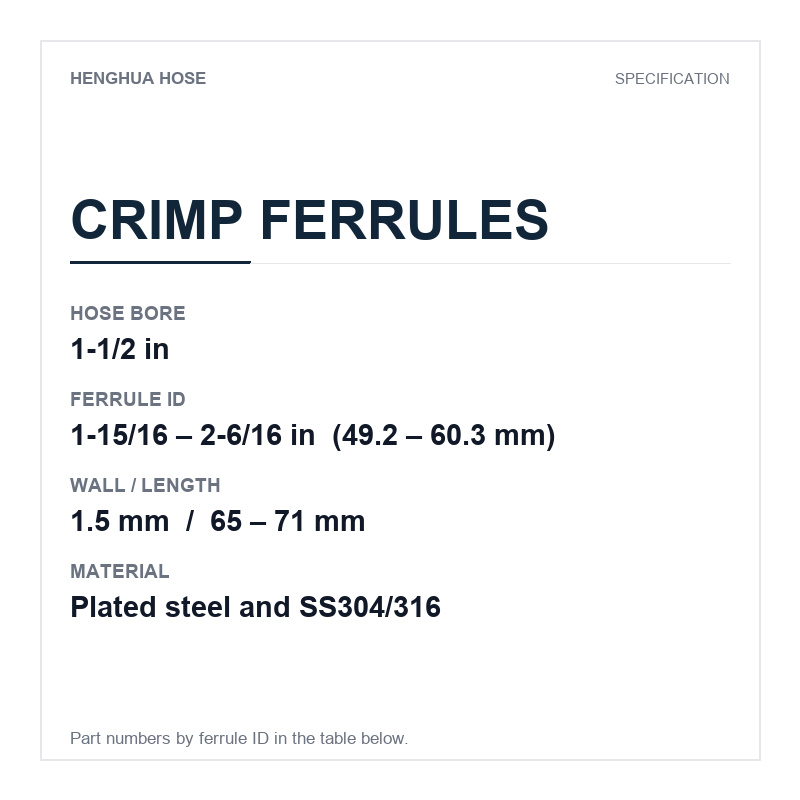
Crimp ferrules are the outer sleeves pressed over a hose end to lock an insert onto the hose. The ferrule compresses the cover and the reinforcement onto the insert shank, so the joint holds without a clamp. They are supplied in carbon steel and stainless, and they are sized by the insert they mate with, the hose bore and the crimp diameter, not by bore alone.
Crimp ferrules: what the size is made of
| Dimension | What it fixes | If it is wrong |
|---|---|---|
| Hose bore | The insert and the hose it fits | Ferrule will not pass over the cover, or will not compress it |
| Insert series | The shank profile the ferrule is crimped onto | Crimp lands off the shank and the joint pulls out |
| Crimp diameter | The finished crimp size on the machine | Under-crimp leaks, over-crimp cuts the reinforcement |
Bore alone does not identify a ferrule. Two ferrules for the same bore can differ in length, wall and shank profile, and the crimp diameter is what the machine actually closes to. That is why a ferrule is ordered against the insert series and the hose, not against a bore.
How a crimp ferrule number is built
The number carries four things: the ferrule inside diameter in sixteenths, the letter F for ferrule, the hose bore in tenths of an inch, and the material. 208F20P is a ferrule with a 2-8/16 in inside diameter for a 2 in hose, in plated steel; the same part in 304/316 stainless is 208F20S.
| Plated | Stainless | Ferrule ID | ID (mm) | Wall (mm) | Length |
|---|---|---|---|---|---|
| 115F15P | 115F15S | 1-15/16 in | 49.2 mm | 1.5 | 65 mm |
| 200F15P | 200F15S | 2 in | 50.8 mm | 1.5 | 65 mm |
| 201F15P | 201F15S | 2-1/16 in | 52.4 mm | 1.5 | 65 mm |
| 202F15P | 202F15S | 2-2/16 in | 54.0 mm | 1.5 | 65 mm |
| 203F15P | 203F15S | 2-3/16 in | 55.6 mm | 1.5 | 65 mm |
| 204F15P | 204F15S | 2-4/16 in | 57.2 mm | 1.5 | 65 mm |
| 205F20P | 205F20S | 2-5/16 in | 58.8 mm | 1.5 | 71 mm |
| 206F20P | 206F20S | 2-6/16 in | 60.3 mm | 1.5 | 71 mm |
The same code runs across the other hose sizes with their own inside diameter, which is why the ferrule is chosen on the ID and the hose bore together rather than on the bore alone: adjacent IDs in the table above are 1.6 mm apart, and picking the next one up is how an over-crimp happens.
The range is plated steel or SS304/316 and is not for steam service.
Carbon steel or stainless
Carbon steel with a plated finish is the standard for hydraulic and industrial assemblies, and it is what most crimping shops hold. Stainless is for chemical, food-adjacent and washdown service, and for hose that is stored outdoors; it costs more and crimps differently, because the material work-hardens and needs a different die setting.
Neither is a pressure rating in itself: the rating of a crimped assembly belongs to the hose and insert combination as tested, not to the ferrule alone.
Why crimping is not clamping
A clamp presses the hose onto a tail and can be re-tensioned; a crimp is permanent. That is the whole trade: a crimped assembly is more compact and more resistant to pull-out, and it cannot be re-made when the hose is shortened. On site, a crimped assembly that fails means a new assembly, which is why the crimp diameter has to be right the first time.
Crimp ferrules also differ from sleeves in what they hold: a ferrule is crimped over the cover onto an insert, while a sleeve is a thinner part used on its own family of fittings. The two are not interchangeable and are not sized by the same rule.
Against sleeves and clamps
A crimp ferrule is not a clamp and not a sleeve. A clamp presses the hose onto a tail and can be re-tensioned; a sleeve is a thinner band sized on the shank; a ferrule is crimped over the cover onto an insert and is permanent. They are the only one of the three that fixes the assembly for the life of the hose, which is why the insert series has to be known before the ferrule is chosen.
What a crimp record should hold
A crimped assembly is only as good as its record: hose make and batch, insert series, ferrule part, crimp diameter and the machine setting used. Without those five, a repeat assembly cannot be reproduced, and a failure cannot be traced to the crimp or to the hose.
Crimp ferrules do not forgive a wrong setting. An under-crimp creeps and weeps at the collar; an over-crimp cuts the reinforcement and the assembly fails at the first pressure spike. Both look identical from the outside, which is why the crimp diameter is measured rather than judged by eye.
Ordering information
- Hose bore and cover diameter
- Insert series the ferrule is crimped onto
- Crimp diameter, from the assembly drawing
- Material: carbon steel or stainless
- Length, if a long ferrule is specified
- Quantity per size
Frequently asked questions
Can I crimp ferrules with a hand tool?
Only with the correct die and a machine rated for the ferrule series. A vice or a hammer will deform the ferrule without developing the crimp.
Is a crimp stronger than a clamp?
It resists pull-out better and is more compact, and it cannot be re-tensioned. Which matters more depends on whether the assembly will be re-made.
What pressure does a crimped assembly hold?
The rating belongs to the tested hose and insert combination, not to the ferrule. Quote the hose and insert when the assembly rating matters.
Steel or stainless ferrule?
Steel for general hydraulic and industrial work, stainless for chemical, washdown and outdoor storage.
What is the minimum order, and can I get samples?
MOQ, samples and lead time are confirmed per line with the price, because each size is a separate run.
Related reading
- Ferrules and hose tails
- Crimp sleeves and concrete couplings
- Serrated hose tails
- Industrial hose couplings
Crimp ferrules are quoted by bore, insert series and crimp diameter, and the insert is what fixes the ferrule.
Send the six fields and we come back with the price.


 English
 Spanish
 Portuguese
 French
 German
 Arabic
 Russian
 Indonesian
 Japanese
 Korean