
A food grade vs chemical hose comparison comes down to one layer. The food version carries a liner approved for food contact with migration data behind it. The standard chemical version carries a liner chosen for resistance and cost. Both may look identical from outside, and both may handle the same product for a week. Only one of them can be defended in a hygiene audit.
This comparison sets out the four real differences, shows where an ordinary chemical hose is the correct and cheaper answer, and gives the wording that puts the distinction into a purchase order rather than a conversation with a salesperson.
The four differences are the liner grade, the migration evidence, the cleaning validation and the marking that ties each delivery to a test report.
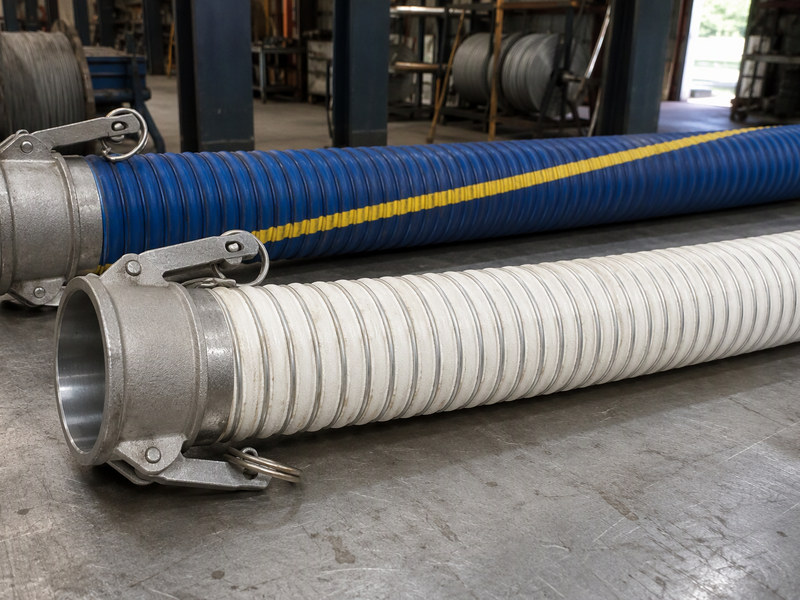
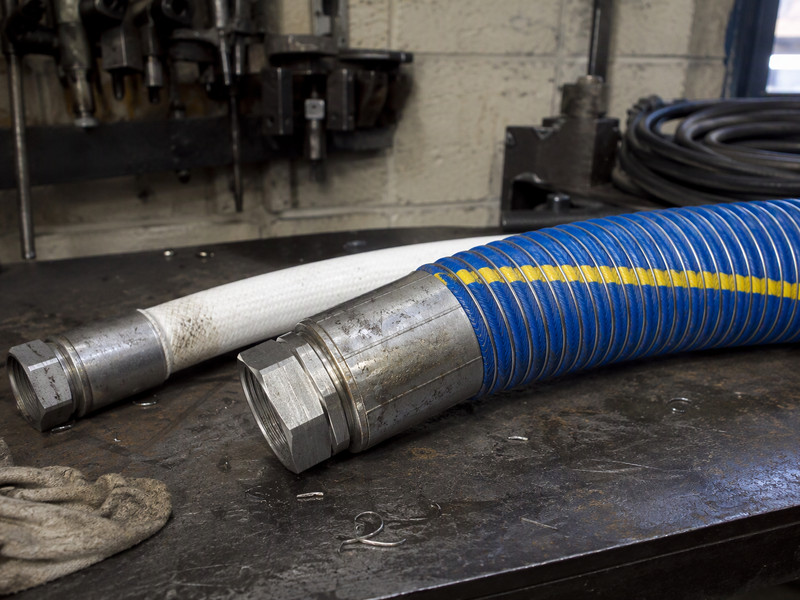
Figure 1. Two composite hoses of the same bore. The white cover marks the food line for operators; the compliance difference sits in the liner behind it.
Is the Difference in the Liner or the Cover?
The liner. The product-contact hose is defined by the polymer that touches product and by the documents that prove it. The cover is a hygiene convention: white or blue tells a plant worker which hose belongs on a product line and which belongs on the drain.
A colour convention has value on the shop floor. It is not compliance. A blue hose with an approved PP liner is food compliant. A white hose with an industrial liner is not, whatever the datasheet headline says.
Where buyers get caught is the middle case. A supplier offers a standard chemical hose and adds the words food grade to the quotation because the liner happens to be PP. The material may even be approved, but without the grade name and the declaration it cannot be verified.
There is a second layer to the distinction that rarely appears in marketing material: the additive package. Two polypropylene liners can share a family name and differ in stabilisers and slip agents, and those differences are exactly what migration testing measures.

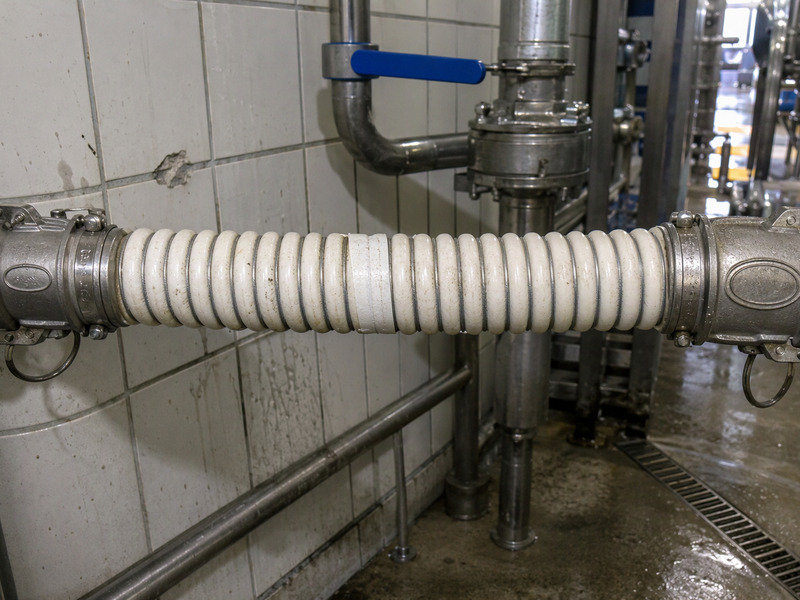
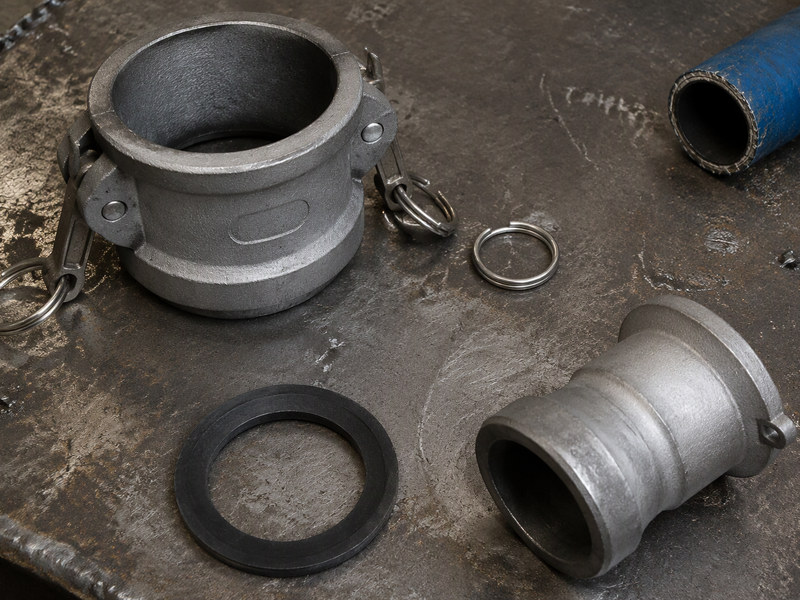
Figure 2. The same bore in two covers. The white hose is the one an operator reaches for on a product line.
What Changes in Cleaning and Validation?
A chemical hose is cleaned to remove product before the next duty. A food hose is cleaned to a validated routine that a third party may inspect, and the liner has to survive that routine repeatedly.
Three properties matter more on the food side. Surface finish, because a smooth liner releases soil. Swelling resistance in caustic, because CIP runs hot and concentrated. And low extractables, because anything the liner gives up ends up in product.
The chemical hose is not worse at these; it is simply not specified for them. That is the whole difference in one sentence, and it explains why the same factory can build both products on the same line.
| Attribute | Food grade hose | Standard chemical hose |
|---|---|---|
| Lining approval | Food-contact grade, named on the declaration | Industrial grade, chosen for resistance |
| Migration data | Finished-article test report expected | Rarely supplied |
| Cleaning | Validated CIP or SIP routine | Cleaned to remove residue |
| Marking | Batch traceable to the test report | Batch or production code only |
| Documentation | Declaration of compliance plus certificates | Datasheet and material certificate |
| Cost | Higher, driven by approval and testing | Lower at equal bore |
Table 1. Where a food grade vs chemical hose comparison actually separates. Everything else is presentation.
Where Is a Standard Chemical Hose the Right Answer?
Most of the hose metres in a food plant are not product-contact. Caustic and acid dosing lines, waste transfer, glycol cooling, compressed air, wash-down supply and tanker unloading of cleaning chemicals all sit outside the food-contact question.
Specifying food grade everywhere is a common and expensive habit. It adds cost, narrows the liner range and can push a duty onto a polymer that is approved but less resistant than the industrial alternative.
The line to draw is contact. If the medium goes into product, into a product-contact vessel, or into a line that is not cleaned between duties, the hose is product-contact. If it never touches product and drains to waste, a chemical hose with the right resistance is correct.
Two grey areas cause most arguments. A line that carries product only during a changeover, such as a flavour dosing skid, is product-contact despite the short exposure. A line that carries filtered water for rinsing is non-contact where that water drains to waste. It is product-contact where the water becomes an ingredient.
What Does Migration Testing Actually Measure?
Migration testing measures what leaves the material, not what the material resists. A sample of the finished article is exposed to a food simulant under set conditions, and the mass transferred is compared with a limit.
The resistance/migration distinction matters because buyers often read a resistance table and assume it covers food safety. Resistance asks whether the product attacks the hose. Migration asks whether the hose contaminates the product. A liner can be highly resistant and still fail a migration test.
The practical consequence is that the test must be run on the finished article, at the wall thickness you buy, with the simulant that matches your food type. Aqueous, acidic, fatty and alcoholic foods use different simulants, which is why one approval rarely covers a whole factory.
When a supplier cannot produce a finished-article report, the honest position is that the resin is approved and the hose is unproven. Some projects accept that; a hygiene audit usually does not.
Which Liner Suits Which Product?
Lining choice for food duty follows chemistry, cleaning and temperature in that order. The table below summarises the usual answer, with the qualifier that decides it.
| Product family | Usual lining | Qualifier |
|---|---|---|
| Milk, beer, soft drinks, juice | PP | Keep service temperature inside the PP ceiling |
| High-fat sauces, chocolate, oils | UHMWPE or PTFE | Fat drives migration; confirm the simulant tested |
| Acidic products, fruit concentrates | PP or PTFE | Check pH and cleaning caustic together |
| Aroma-sensitive spirits | PTFE | PP can retain flavour notes between batches |
| Steam-sterilised lines | PTFE | Saturated steam exceeds polyolefin limits |
| Wash-down water, CIP supply | Industrial PP | Not product-contact if it drains to waste |
Table 2. Lining starting points for food duties. Confirm each against the supplier’s declaration and compatibility data.
A sanitary hose vs chemical hose decision at this level is rarely about the polymer name. Read it against the liner compatibility data before the table is trusted. PP appears on both sides of the table, and what separates the rows is the grade, the documentation and the cleaning envelope.
Is the Food Grade vs Chemical Hose Decision Really About Cost?
Partly. The premium on a food grade hose pays for three things: an approved resin grade, finished-article testing, and the documentation that ties them to a batch. None of them are visible in the product, which is why cheap offers exist.
Testing is usually the largest of the three, because one migration report covers one simulant at one set of conditions.
Over a five-year horizon the premium usually narrows. A validated hose that survives CIP cycles replaces less often than an industrial liner pushed beyond its cleaning limits. Do not expect the food hose to be cheaper; expect fewer surprises.
A food grade vs chemical hose decision looks like a cost question on a spreadsheet because the two offers sit in adjacent rows. The calculation changes completely on non-contact duty. There the premium buys nothing, and paying it on every metre is how a plant ends up with a hose store full of over-specified assemblies and a budget conversation at year end.
How Do You Put the Difference in a Tender?
Write contact status first, then the evidence. A line that says food grade invites a brochure; a line that names the regulation invites a document.
- State whether the duty is product-contact or non-contact.
- For contact duty, name the framework: FDA, EU 10/2011 or 3-A, as set out in the food grade compliance guide.
- Require the liner grade by name in the offer.
- Require a declaration of compliance at delivery, not at quotation.
- Require batch marking that matches the declaration.
- Ask what the declaration does not cover.
Two clauses close the remaining gaps. Ask for the cleaning envelope in numbers rather than a compatibility tick, and ask for the name of the resin supplier. A product-contact hose built from an unnamed resin is a claim without a chain.
How Does a Food Hose Fail an Audit?
Failures are rarely about the hose bursting. They are documentary, and they repeat across sites, including the batch marking that ties a delivery to a test report.
- A declaration covering the resin but not the finished article.
- A liner grade on the certificate that does not match the hose on the rack.
- No batch marking, so the test report cannot be tied to the delivery.
- A cleaning routine written for rigid pipe and applied unchanged to a coiled hose.
- A colour-coded hose with an industrial liner behind it.
- A declaration dated after the hose was installed.
Each of these is cheap to prevent at order stage and expensive to resolve during an audit, which is why the specification work belongs with quality rather than purchasing. The list is worth printing and pinning up before the next order goes out, because every item on it is a line of text that could have been added to the purchase order at no cost.
What Should the Datasheet Say?
A food grade composite hose datasheet should let a reader answer three questions without calling anyone. What touches product, what proves it, and what the hose will not do.
The first answer is the liner grade, written as a polymer plus a grade reference. The second is the regulation cited and the test behind it. The third is the honest limit: maximum service temperature, cleaning envelope and the products the liner is not intended for.
Most datasheets stop at the first. A table of bores, pressures and temperatures looks complete and says nothing about approval. When a buyer compares two offers on that table alone, the cheaper hose wins by default.
Two fields separate a serious datasheet from a sales sheet. A cleaning envelope in numbers, and a statement of limitations. The second is uncomfortable to publish, which is why it is a reliable signal of a supplier who has tested rather than copied.
Who Owns the Decision Inside the Plant?
The food grade vs chemical hose question usually lands with purchasing, and it should not. Three functions have a stake and each asks a different question.
Quality asks whether the material is approved and whether the declaration is current. Production asks whether the hose survives the cleaning window and drains properly. Maintenance asks whether the ends fit the pump and whether the assembly can be lifted by two people.
A specification written by any one of them alone will miss something. Purchasing alone buys the cheapest compliant-looking offer. Quality alone can specify a liner that cannot be cleaned in the time available. Maintenance alone solves the fitting and ignores the paperwork.
A single-site dairy, a multi-site beverage group and a contract packer need different documents from the same hose. The dairy needs the cleaning envelope, the group needs one declaration that covers every site, and the packer needs a batch record per customer.
The practical fix for a food grade vs chemical hose disagreement is a one-page approval sheet signed by all three before the first order. It takes an hour and prevents the most expensive failure mode in this category: a hose that is technically compliant and operationally wrong.
What About Hoses Already in Service?
A plant that switches to a stricter food standard inherits a store of hoses bought under the old rule. The question is not whether to replace them all at once, but which ones sit on product-contact duty today.
Split the store by duty rather than by age. Hoses on product lines move first. Hoses on CIP supply, waste and cooling can stay until they fail inspection. That split usually cuts the replacement list by half and avoids a budget fight.
For the hoses that stay, record what they are. A grey hose with no marking and no declaration will be questioned at the next audit even if it never touches product, because the auditor cannot tell which line it serves.
Replace on inspection triggers rather than dates: liner swelling, staining that will not clean, cover cracks at the helix, and end fittings that no longer seat. Record the trigger in the maintenance log, because a pattern across three hoses points to a duty problem rather than a batch problem.
A replacement plan is also a specification review. If the same bore keeps failing on the same line, the liner was the wrong choice for that cleaning regime, and replacing it with an identical hose simply restarts the clock. A hose retired for one of those reasons is a maintenance event. A hose retired because nobody could document it is an audit event.
What Does a Replacement Plan Look Like?
A plant replacing a mixed hose store usually runs three waves. The first covers product-contact hoses on finished-goods lines, because those carry the audit risk. The second covers product-contact hoses on utilities and changeover skids. The third covers everything else, replaced as it fails.
Each wave needs the same three inputs: the duty list, the liner grade already approved in the plant, and a delivery schedule that matches shutdowns. Ordering the whole store at once creates a storage problem and a cash problem, and it usually means the wrong bores are bought.
Keep the old hoses tagged and dated as they come off duty. When an auditor asks why a grey hose is still on site, a tag that says waste transfer is a better answer than a memory. The order checklist is a useful model for the tag fields, and it takes a minute per hose to fill in.
Frequently Asked Questions
Is a sanitary hose vs chemical hose comparison the same question?
No. A sanitary hose vs chemical hose comparison is about cleanable design; this page is about material approval. Dairy work usually needs both answers, and the two are assessed by different people.
Is a white cover required for food contact?
No. Colour is a plant convention for identifying hoses. Compliance comes from the liner and its documentation, although many audits expect colour coding as good practice.
Does the comparison change at small bore?
Barely. The documentation burden is the same, so the percentage premium is higher on a small, cheap hose than on a large one.
Can one hose serve product and CIP caustic?
Often yes with a PP or UHMWPE liner, provided the caustic concentration and temperature sit inside the liner envelope. Confirm both figures with the supplier.
What happens if an industrial hose is found on a food line?
Typically a non-conformance, a repeated cleaning validation and a possible product hold. The cost lands well above the price difference between the two hoses.
Does a food grade composite hose cost more at large bore?
Less in percentage terms, more in absolute terms. A food grade composite hose carries the same testing and documentation cost whatever the bore, so the premium thins as the hose gets larger.
How long does a declaration stay valid?
It follows the material and the process, not the calendar. A change of liner supplier or film grade should trigger a new declaration, so keep the version you received.
About HENGHUA
HENGHUA builds both sides of this food grade vs chemical hose comparison. Our PP and UHMWPE liners can be supplied in food-contact grades with the declaration and batch marking a hygiene audit expects. Our standard chemical builds cover the non-contact duties where approval adds cost without benefit.
Send the duty, the cleaning routine and the target market, and we will say which of the two the line needs, including the cases where the cheaper hose is the correct specification.

 English
 Spanish
 Portuguese
 French
 German
 Arabic
 Russian
 Indonesian
 Japanese
 Korean