
Camlock fittings are the quick-disconnect couplings that let an operator connect or release a hose in seconds without tools. The family of camlock fittings has six working types, and each one exists to solve a specific connection problem: thread to hose, hose to hose, or hose to a mating half on a tank. Choosing the wrong type is the most common reason a hose arrives at site and cannot be connected.
This guide sets out what each camlock type does, which halves mate with which, how the fittings are attached to a composite hose, and where the coupling rather than the hose becomes the limiting part of the assembly.
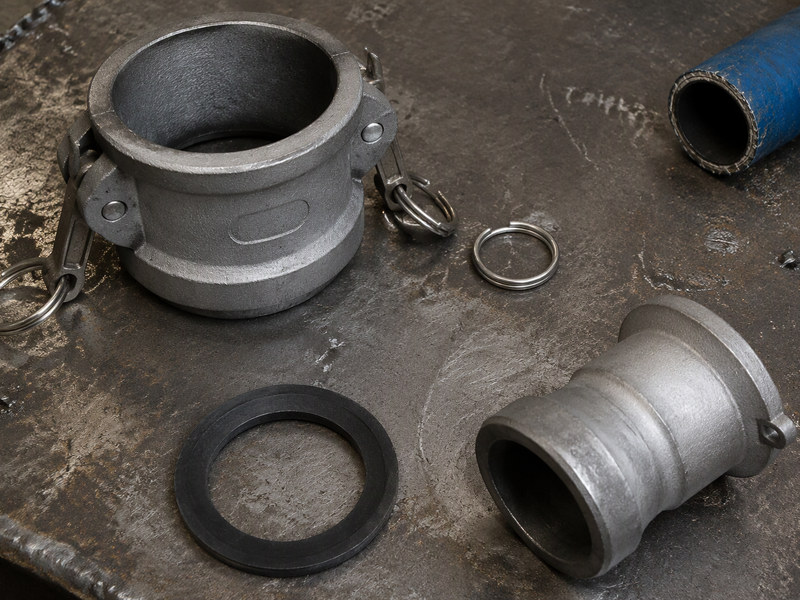
Figure 1. A female coupler, a male adapter and the gasket that sits between them. The two cams and the pins do the locking; the gasket does the sealing.
What Are Camlock Fittings and Where Do They Fit?
A camlock coupling, in the cam and groove family, has two halves. The female coupler carries two cam arms that fold down over a groove on the male adapter, pulling the two faces together against a gasket. Nothing is threaded, so the joint is made and broken by hand.
The family is standardised, which is why parts from different makers mate. The US federal specification A-A-59326, which replaced the older MIL-C-27487, defines the dimensions. In Europe the equivalent is EN 14420-7. A type C from one supplier will mate with a type E from another, provided the size and standard match.
For a composite hose, the camlock is almost always the site connection rather than the factory end. The hose leaves the factory with a hose shank, and the camlock half is chosen to match whatever the plant has on its pumps, tanks and transfer points.
What Do the Six Types Do?
The six types in common use are defined by two variables: whether the half is male or female, and what is on the other end.
| Type | Half | Other end | Typical use |
|---|---|---|---|
| A | Male adapter | Female thread | Connect to a male pipe thread |
| B | Female coupler | Male thread | Connect to a female pipe thread |
| C | Female coupler | Hose shank | Hose to hose, or hose to adapter |
| D | Female coupler | Female thread | Connect to a male pipe thread |
| E | Male adapter | Hose shank | Hose to coupler |
| F | Male adapter | Male thread | Connect to a female pipe thread |
Table 1. The six camlock types in common industrial use. Dust caps and plugs are separate items with their own designations.
Read the table as a set of answers rather than a sequence. A and D both terminate in a female thread, and they are used in different positions: A is the adapter half, D is the coupler half. B and F carry male threads on opposite halves. C and E are the two hose-shank options.
That symmetry is what makes the family useful, and it is why a store can cover most duty with two camlock types per size. A plant that standardises on camlocks can connect a hose to a pump with a threaded port, to a tank with a flange adapter, and to another hose, using three parts from the same box.

Figure 2. Six camlock halves in two rows. Three carry a male face, three a female face, and the back ends differ.
How Do the Halves Mate?
Any male adapter mates with any female coupler of the same size and standard. The type letter describes the back end, not the camlock face.
| Combination | Connects | Common assembly |
|---|---|---|
| A plus D | Two male pipe threads | Pump outlet to tank inlet |
| B plus E | Female thread to hose | Hose end to a threaded port |
| C plus E | Hose to hose | Two hose lengths joined |
| D plus F | Male thread to female thread | Adapter between two ports |
Table 2. The four pairings that cover most industrial assemblies. Size and standard must match; the letter alone does not guarantee a fit.
The practical consequence is that a buyer only needs to know two things about the plant: what thread or connection exists at each end, and what size the camlock is. Everything else follows.
A common error is ordering two couplers or two adapters and discovering the mistake at the tank. A quick check before the order: one half must be male, the other female.
Which Type Belongs on a Composite Hose?
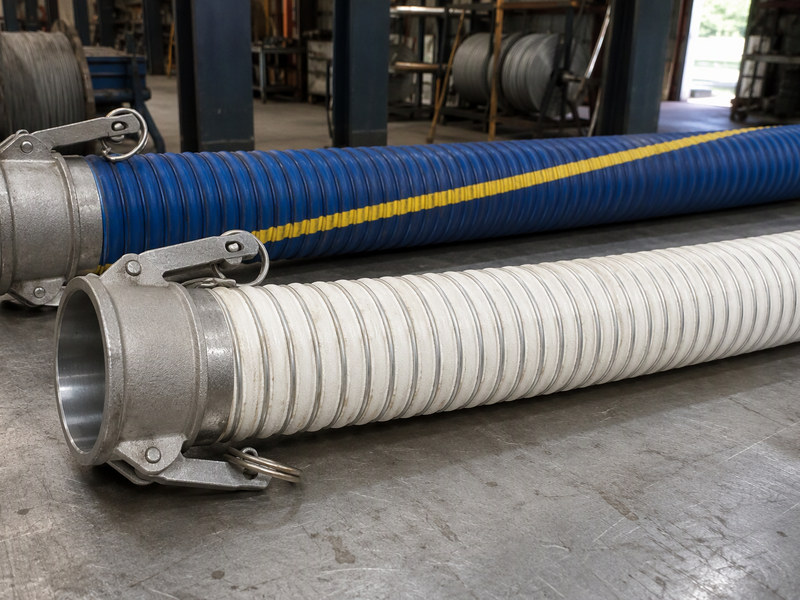
Type C and type E are the hose-shank halves, and they are what a composite hose assembly normally carries. Type C is a female coupler with a shank, type E is a male adapter with a shank.
A Type C camlock is the safer default on the tank side of a transfer, because most plants present a male adapter rather than a coupler. Which one goes on which end still depends on the plant. A terminal that has male adapters on its tanks will want type C on the hose. A terminal with female couplers will want type E. Many assemblies carry one of each, which allows the hose to be reversed and extends its service life.
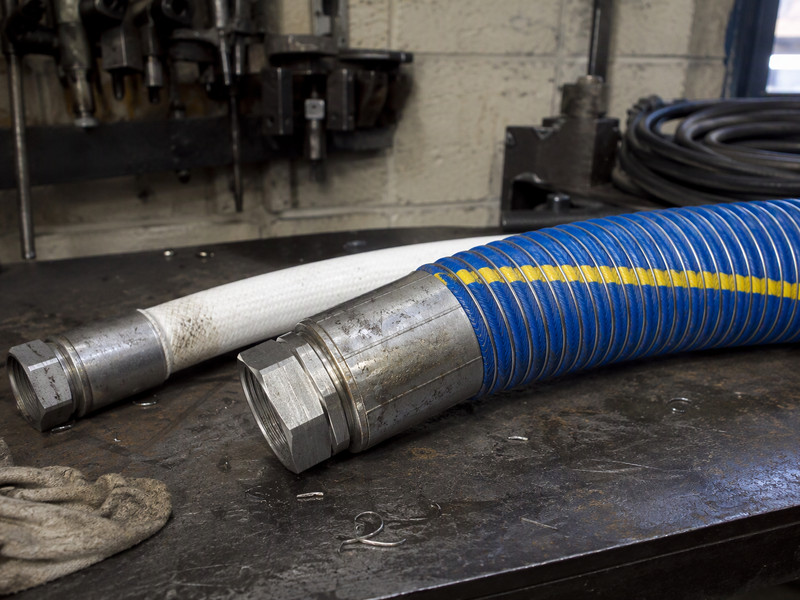
The shank itself is not a trivial detail on a composite hose, and the fitting material choice decides how long it survives. The wall is a stack of film, fabric and wire, and the shank has to compress that stack without cutting the inner film or crushing the helix. That is why composite hose shanks are longer than the rubber hose equivalent and why the ferrule is matched to the shank rather than chosen from a catalogue.
Why Is the Gasket the Weak Point?
The gasket is the only sealing element and the only part that the operator can lose, fit wrong or damage without noticing.
Five materials cover most duty. Buna-N for hydrocarbons and water, EPDM for water, steam and many chemicals, Viton for aromatic and aggressive streams, PTFE for the widest chemical range, and silicone for high temperature where nothing else works. The gasket must match the product, not the hose liner.
Two habits prevent most leaks. Keep a small stock of the correct gasket at the point of use, since a missing gasket is often replaced with whatever is in the drawer. And inspect the gasket seat, because a gasket that has been run dry or over-compressed will not seal again even if it looks intact.
A camlock that drips is almost never a worn cam arm. It is a gasket problem, a damaged seat, or a coupling that is not fully closed, and the gasket selection guide covers the material match in detail.
What About Pressure Ratings and Size Limits?
Camlock ratings fall as the size rises, and they are set by the coupling maker rather than by the hose. That makes the coupling the limiting component on most composite hose assemblies.
A 2 inch (DN 50) stainless camlock and a 6 inch (DN 150) aluminium camlock are not interchangeable in pressure terms even though both are “camlock”. The larger fitting has more area for the same cam force, and the arms do the same work over a bigger seal.
Two rules follow. Never rate an assembly above its weakest component, which is usually the coupling, and record the assembly rating on the datasheet rather than the hose rating alone. Use a flanged or threaded connection where the duty is specified for pressure. Camlocks suit quick-change duty below the coupling rating.
For composite hose, the hose itself is often rated well above the camlock. That gap is normal and should be stated on the assembly datasheet, so nobody assumes the hose rating applies to the joint.
How Do I Stop a Camlock Opening Under Load on a Moving Hose?
Cam arms can be knocked open by a hose dragged across a kerb, a vibrating arm or a vehicle. The consequences range from a spill to a whipping hose.
Three measures reduce the risk. Fit safety pins or clips through the cam arm holes, which is standard practice on mobile equipment. Route the hose so the arms are not against a surface that can catch them. And train operators to check both arms before opening the valve, not after.
A fourth measure is administrative: mark the assembly with its pressure rating and the product group it serves. A camlock that is visually identical to its neighbour but rated differently is a trap.
What Does a Correct Assembly Look Like?
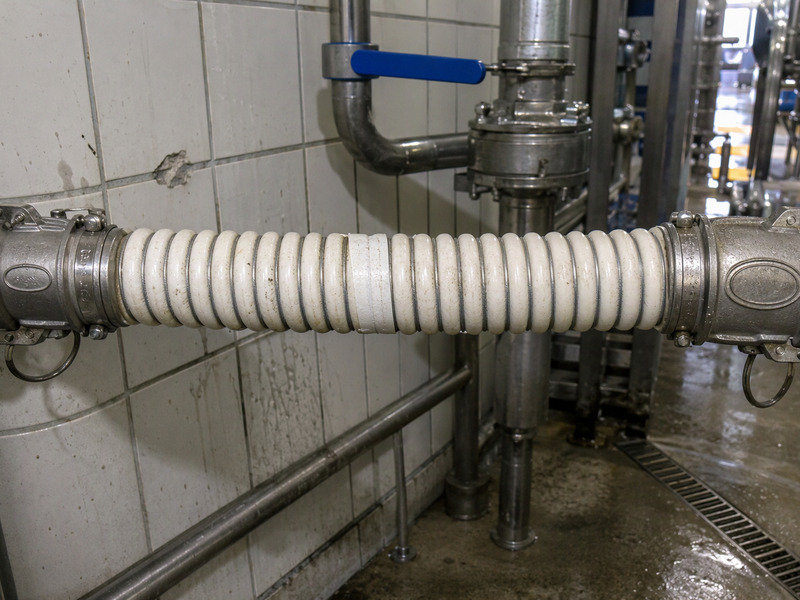
A properly built composite hose assembly with camlock ends has five visible features:
- A shank long enough to engage the full ferrule
- A ferrule that compresses evenly, with no gap at the cover
- The helix visible and intact at the shank, not cut back
- A gasket of the correct material, seated flat
- Both cam arms closing with similar resistance
That last point is diagnostic. If one arm closes easily and the other needs force, the coupling is not square to the adapter or the gasket is misaligned.
What Mistakes Should You Avoid?
The recurring errors are worth listing because each one is cheap to prevent and expensive to discover at the tank. Most arise from ordering a flanged assembly habit against a camlock port.
- Ordering a female coupler to mate with a female coupler.
- Mixing sizes by using an adapter that “almost fits”.
- Fitting a hydrocarbon gasket on a solvent line because it was in the box.
- Reusing a ferrule on a new shank.
- Leaving a dust plug in the hose during a pressure test.
- Assuming the assembly rating equals the hose rating.
None of these require new equipment to fix. They require the order to name the type, size, material and gasket, and the assembly to be checked before it leaves the factory.
Which Camlock Fittings Should a Terminal Standardise On?
A plant that uses camlock fittings across a site eventually faces a stock question. Keeping every type in every size is expensive; keeping too few means adapters appear at the tank.
The usual compromise is two types per size. One female coupler with a hose shank and one male adapter with a hose shank cover hose-to-hose and hose-to-coupler work. For threaded ports, one male and one female threaded half complete the set.
Standardising on material matters as much as type. Mixing stainless and aluminium in one store leads to galvanic corrosion at the joint when the two are used together in a wet environment, and to unclear pressure ratings on paper.
Size discipline is the third leg. A site that stocks 1 inch, 2 inch and 3 inch and uses reducing adapters for everything else will eventually run a 3 inch hose through a 2 inch fitting. Marking the hose with its size, and keeping adapters under the stores system rather than in the operator’s pocket, prevents that.
Finally, record which standard the site follows. If the plant imports equipment from both North America and Europe, the camlock faces are usually compatible but the threads are not. A note on the store board saves a shift.
A single-site plant, a mobile tanker fleet and a drum-decanting bay need different stock lists. The plant can standardise on two types per size, the fleet needs a spare of each type on the vehicle, and the decanting bay needs one type in three sizes.
Frequently Asked Questions
Is a camlock the same as a cam and groove coupling?
Nothing. Cam and groove is the descriptive name for the same product: two cam arms locking into a groove. It is the term most often used in North American purchase orders. Type letters and sizes are the same.
Which camlock types mate with each other?
A male adapter and a female coupler of the same size always mate, whichever letters they carry. In practice the four common pairings are A with D, B with E, C with E, and D with F.
What is a type C camlock used for?
A type C camlock is a female coupler with a hose shank, so it connects a hose to a male adapter. It is the most common hose-end fitting in industrial transfer.
Can camlock fittings be used on a composite hose?
Yes, and they are the usual site connection. The shank and ferrule have to suit the multilayer wall and the helix, which is why composite hose shanks differ from rubber hose shanks.
Which gasket material should I choose?
Match the product: Buna-N for hydrocarbons, EPDM for water and many chemicals, Viton for aromatics, PTFE for the widest range. Confirm against the chemical resistance data for the specific grade.
Are camlocks suitable for high pressure?
Only within the coupling maker’s rating, which falls with size. Above that rating the assembly needs flanges or another connection type, regardless of the hose rating.
Why does my camlock leak at the joint?
Usually a missing, wrong or damaged gasket, or a coupling not fully closed. A worn cam arm is possible but far less common than a gasket problem.
About HENGHUA
HENGHUA builds composite hose assemblies with camlock, flanged, threaded or API ends, and matches the shank and ferrule to the wall and helix of the hose rather than to a generic table. Stainless, aluminium and polypropylene camlocks are available, with the gasket specified to the product.
Send the connection at each end, the product and the required pressure, and we will set out the type letter, size, material and gasket, so the hose arrives able to connect rather than needing an adapter.

 English
 Spanish
 Portuguese
 French
 German
 Arabic
 Russian
 Indonesian
 Japanese
 Korean