
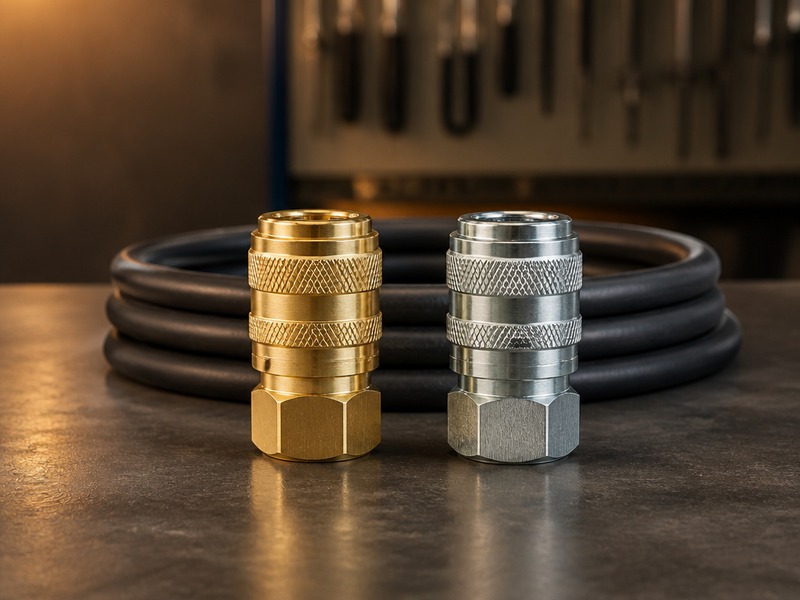
For most workshops the brass vs steel air fittings decision is settled by environment, not price. Brass is the default because it resists corrosion without any coating. Zinc plated steel couplers win where the body must survive higher pressure, abrasion and shock, and stainless steel covers wash-down, food and cleanroom work.
This page compares the three body materials mechanism by mechanism: what each alloy really is, how it corrodes, wears, galls and fatigues, which shops each one suits, and what the choice costs across a service life. It closes with the sourcing points to check and the failures no material can prevent.
Flow figures are our bench measurements at 100 PSI inlet and 23 °C ambient; tool demand figures are manufacturer ratings at 90 PSI. About 12 min read.
What Brass, Zinc Plated Steel and Stainless Steel Actually Are
A coupler body has three jobs: hold a thread, hold a seal and hold a locking mechanism under pressure. Material chemistry matters only because it predicts how those three jobs age. Three families cover almost every coupler sold, and each one carries a known weak point.
Most brass air fittings are machined from free-cutting brass such as C36000, a copper-zinc alloy with a small lead addition that breaks chips and lets a lathe cut clean threads quickly. Lead-free grades substitute bismuth or silicon where potable-water or food-contact rules apply. Brass also has natural lubricity, so its threads resist galling.
Zinc plated steel begins as low or medium-carbon steel, machined and then electroplated. The zinc is sacrificial: it corrodes in place of the steel underneath. That is also its limit, because the coating is thin and protects only while it is continuous. Thickness is set by service-condition class, such as those in ASTM B633.
Stainless steel, usually grade 304 or 316, is the family used in food equipment. Type 316 adds molybdenum for chlorides and wash-down chemicals. Stainless needs no coating, which deletes the plating-wear failure mode, and it costs more in material and machining time.
Table 1. What each coupler body material is, why it is used, and where its limit sits.
| Body material | What it is, in plain terms | Why it is used in couplers | Built-in limit |
|---|---|---|---|
| Leaded free-cutting brass (for example C36000) | Copper-zinc alloy with a small lead addition for chip control | Machines fast into accurate threads, feels slippery against mating threads, no coating to rub off | Softer than steel, and can dezincify in aggressive water or ammonia |
| Lead-free brass | Same copper-zinc base with bismuth or silicon replacing the lead | Meets lead-restriction rules for potable water and food-contact areas | Slightly harder to machine, so tooling cost and unit price reflect that |
| Zinc plated carbon steel | Low or medium-carbon steel body, machined then zinc electroplated | Higher body strength and a higher pressure rating than brass, at lower unit cost | Zinc is sacrificial and thin; once rubbed or eaten away, red rust begins |
| Stainless steel 304 / 316 | Iron-chromium-nickel alloy; 316 adds molybdenum | Coating-free, non-magnetic, suited to wash-down and food areas | Highest cost, slower machining, galling risk on stainless-to-stainless threads |
Corrosion: Brass Patina, Zinc Loss and Galvanic Risk
Brass corrodes slowly and then largely stops. The green-brown patina on a damp brass coupler is a copper oxide and carbonate layer that blocks further attack, which is why an old brass valve still unthreads cleanly. In dry shop air with light oil carryover, brass is close to inert. The exception is ammonia-rich or aggressive water, where some brasses dezincify and turn porous.
Zinc behaves in the opposite way, and its decline is predictable enough to read on any steel vs brass air coupler sitting on your shelf. It runs in four visible stages:
- Stage 1 — dull grey film. The bright zinc surface oxidizes to matte grey; performance is unchanged.
- Stage 2 — white to grey powder. Corrosion product builds at the collar, the nose and any scratched area.
- Stage 3 — red rust. Plating has been consumed or rubbed through, exposing the steel beneath.
- Stage 4 — seizure and pitting. Rust expands inside the collar track, locking the collar.
Zinc plated steel fittings are also attacked by acids and by strong alkalis, which is why a plated coupler dies quickly in an alkaline wash-down bay. Abrasion is faster still: every connect drags the locking balls and collar across plated surfaces and burnishes the coating away at the exact points that carry load.
Galvanic corrosion appears whenever steel meets aluminium, which is common because many air tools have aluminium bodies. Aluminium sits near the anodic end of the series, so where moisture is present it becomes the anode. Stainless, being further from aluminium in that series, drives the attack harder than brass or zinc does. Break the couple with a non-metallic nipple or an isolating washer.
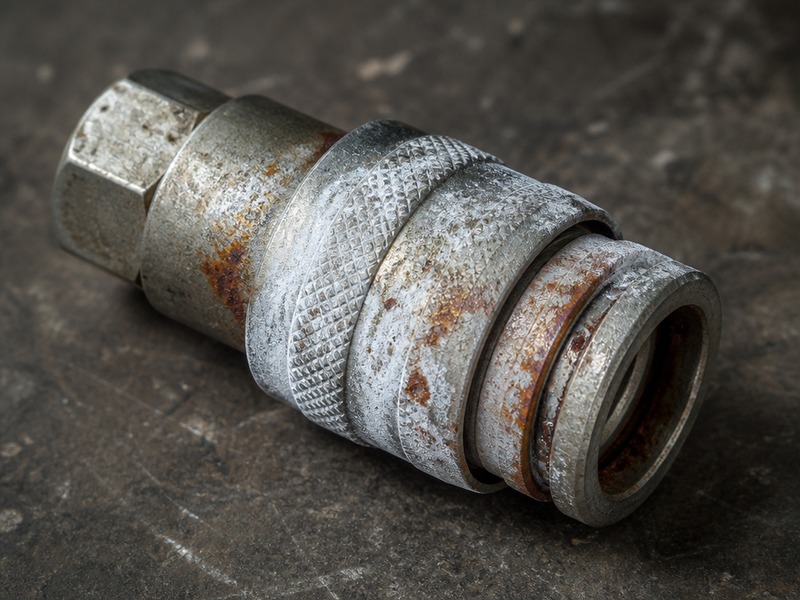
Figure 2. Zinc loss at the collar of a plated steel coupler. White corrosion product marks the end of the coating, and red rust at the same point marks the start of seizure in the collar track.
Brass vs Steel Air Fittings Under Wear, Galling and Shock
Only four surfaces move on a quick connect coupler: the plug nose and groove, the locking balls, the collar, and the spring behind it. The threaded end sees no movement until somebody unscrews it. Material choice is therefore a question about the moving end, and the wear items are the same in every material.
Abrasion resistance follows hardness. A brass plug groove can be notched by hardened steel balls or by a dropped tool, and a notched groove seats unevenly and eventually will not lock cleanly. Zinc plated steel resists that denting better, but the same contact that spares the metal removes the plating.
Thread galling is where the choice becomes obvious at the bench. Two stainless threads run together under pressure can cold-weld and seize, so stainless-to-stainless joints want a compatible anti-seize or a deliberate grade mismatch. Brass is naturally slippery and rarely galls. Zinc plating acts as a dry film on steel threads, which is one reason to reject a coupler whose plating is patchy.
Fatigue and shock loading are side-load problems, not pressure problems. Brass is ductile: a hose hung off a coupler nose bends the nose and loses concentricity before it ever cracks. A steel body takes more side load before it deforms, which is why mobile and high-vibration equipment usually runs steel.
Our factory crimp and pressure test records show the same ranking. Bodies are almost never the first failed part, because a collar that stopped travelling or a nose that stopped seating gets there first.
Temperature, Magnetism and Clean-Environment Rules
The coupler body is rarely the temperature limit; the elastomer seal is, so the O-ring compound should be matched to the application rather than assumed. Hoses usually set the practical band first: rubber to ISO 2398:2024 covers about −40 to +70 °C, while PVC and PU to ISO 5774:2023 cover about −10 to +60 °C. Our guide to the types of flexible hose materials sets out that comparison.
Within that band the three materials differ at the edges. Brass stays ductile in cold shops, where a plated part can chip and rust through the season. Stainless is the only one of the three suited to hot, wet or chemically aggressive service. Zinc plated steel has no place in a hot wet line, because the coating is the first thing the environment removes.
Magnetism separates them in a way buyers overlook. Zinc plated steel bodies are ferromagnetic, so they hold ferrous swarf near grinders and welding stations, and they respond to the magnet separators used for foreign-object rejection in food plants. Brass and austenitic stainless are non-magnetic, which suits any line where a magnet is part of the quality system.
Dust behavior is a shape problem more than a material problem. Every coupler has a recessed collar track that traps debris, and any plated part can shed flakes once the coating fails. A smooth stainless or brass body wipes down more easily and does not shed, but it still needs a cap when idle.
Brass vs Steel Air Fittings by Environment: Where Each Material Wins
Choose the environment first and let it pick the material. For most workshops the answer is brass air fittings on every wall drop and hand tool, with steel reserved for a specific demand. The table below reflects what we see across distributor programs and warranty returns rather than a laboratory ranking.
Table 2. Where each body material wins, by working environment.
| Environment | Material that usually wins | Reason | What to check |
|---|---|---|---|
| General workshop, dry air, hand tools | Brass | No coating to lose, stable under light condensation and oil carryover | O-ring condition after the first year; keep spare seals |
| Automotive shop, wet lines, oil and moisture | Brass | Condensate and oil emulsions strip zinc rather than brass; rust jacking in the collar track is the usual failure | Water traps and filter maintenance upstream |
| High-vibration mobile equipment | Steel, or a steel plug in a brass socket | Side load and shock bend a brass nose; steel holds concentricity and carries higher ratings | Thread sealant, mounting brackets, hose strain relief |
| Wash-down bays and outdoor sites | Brass or 316 stainless | Alkaline detergents and rain attack zinc directly; brass patina and the stainless passive film resist them | Seal compound, drainage, caps on idle fittings |
| Food-grade and cleanroom areas | 304 or 316 stainless, brass second | Non-magnetic bodies suit magnet separators; no coating means no flaking into product | Collar track cleanability and documented grade |
| High-cycle automated machines | Hardened zinc plated steel | Rated cycles matter more than corrosion here, and hardened steel outlasts brass in abrasion | Cycle rating, seal kit, scheduled rebuild interval |
Material and pressure rating also travel together. Standard-duty brass couplers are typically rated around 150 to 300 PSI, while heavy-duty steel bodies reach about 500 PSI, with burst pressure running three to four times the working figure. Ordinary shop line pressure sits far below that, since most air tools are rated 90 PSI at the tool and the compressor cuts out between 120 and 150 PSI.
Brass vs Stainless Steel Fittings: The Third Option
Most two-way material questions here are really three-way. Brass vs stainless steel fittings is the choice to make where corrosion dominates and plated steel is not worth considering: food plants, chemical wash-down, marine and outdoor sites, or any line where a rust stain would be unacceptable on the product.
Stainless wins those cases on chemistry and loses on handling. It will not rust through, and grade 316 tolerates chlorides that would pit a lesser alloy. Against that, it machines slowly, costs the most of the three, and galling appears when two stainless parts are run together dry.
A compromise appears regularly in the field: a brass body with a stainless plug, or the reverse, keeps the corrosion-critical surface in the right metal while avoiding the worst galling pair. The trade-off is an added galvanic couple, so keep mixed pairs dry and isolate them from aluminium.
Cost per Service Life
Brass costs more per unit than zinc plated steel, so the brass vs steel air fittings comparison has to run across a service life rather than across an invoice. Judged on the invoice alone, steel wins. Judged on cost per year of service, the outcome depends on how often the part is replaced.
Labour dominates that figure, and it is where the steel vs brass air coupler maths usually turns. A coupler is cheap relative to the minutes needed to depressurize a line, fit a replacement, re-pressurize and leak test. A second swap erases the purchase saving, and the unplanned downtime sits on top of it.
The wear items are identical in every material, too. The O-ring and the collar or sleeve carry the service life and fail long before any body does. Zinc plated steel fittings and brass ones are therefore closer than their unit prices suggest, provided seals can be replaced in place.
Table 3. Cost per service life: what actually drives the total, by material.
| Cost element | Brass body | Zinc plated steel body | How to control it |
|---|---|---|---|
| Purchase price per unit | Higher | Lower | Standardize sizes and profiles to buy in bulk |
| Replacement interval | Long in damp or wet shops | Short once plating is gone | Match material to environment, not to the invoice |
| O-ring | Consumable | Consumable | Stock the correct compound; replace on a schedule |
| Collar and spring | Consumable | Consumable | Prefer replaceable sleeves; keep a rebuild kit |
| Labour to swap | Fewer swaps over the life | More swaps over the life | Count technician minutes, not part dollars |
| Downtime | Lower if intervals are longer | Higher if failures are unplanned | Replace seals before the collar sticks |
Stated plainly, brass remains the default for most shops for a reason unrelated to strength: it survives the way real shops treat hardware. Steel earns its place where the demand is genuinely higher, and it wins nothing indoors in a dry, filtered line.
What to Check in a Material Specification When Sourcing
A purchase order needs more than the word brass, or steel. Zinc plated steel fittings vary more between suppliers than brass ones do, because plating is a separate process step that can be run to several thickness classes. Two couplers that look identical can be years apart in service life.
Brass divides the same way. A free-cutting leaded brass and a lead-free grade machine differently, wear differently and cost differently, and both are legitimately sold as brass. Unless the specification names the grade family and the lead status, a supplier may substitute whichever is cheapest that month.
Interchange geometry is the other silent variable. Two couplers can share a material and still not connect, because profile dimensions govern. Our industrial pneumatic couplers article covers the M, V and A profiles, and the quick connect coupler profile chart shows how to identify an unmarked one. Both are planned pages in this series.
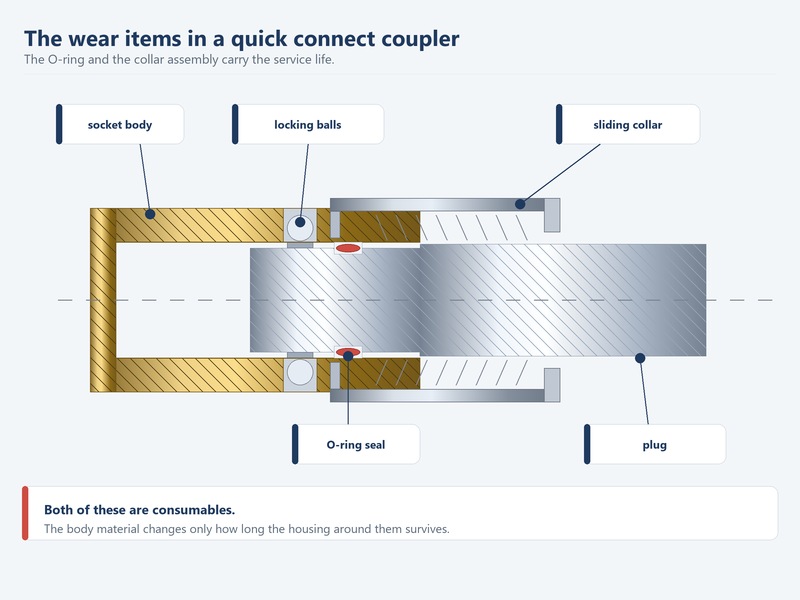
Figure 3. The wear items in a quick connect coupler: the O-ring and the collar assembly. Body material changes only how long the housing around them survives.
Table 4. Specification checklist for a coupler material order, and how to verify each point.
| Specify this | Why it matters | How to verify it |
|---|---|---|
| Material grade and lead status | Leaded and lead-free brasses differ in machining, cost and food-contact suitability | Ask for the grade designation in writing; match it to the shipment certificate |
| Plating thickness class | Zinc life is proportional to coating thickness, and the class affects thread fit | Name the service-condition class, such as those in ASTM B633 |
| Rated working pressure | Standard-duty brass sits near 150 to 300 PSI; heavy-duty steel reaches about 500 PSI | Compare the rating against line pressure plus surge, with margin |
| Interchange profile | A wrong profile will not mate, in either direction, whatever the material | Cross-check against ISO 6150 series dimensions, A-A-59439 or MIL-C-4109 |
| Thread standard | NPT to ASME B1.20.1 and BSP to ISO 7-1 or ISO 228-1 do not interchange | Require thread-gauge inspection and ask for the gauge report |
| Seal compound | The O-ring, not the body, sets the temperature and chemical limit | Get the compound named, with its range in the data sheet |
| Serviceability | Replaceable seals and collars decide the rebuild cost in any material | Order one sample, strip and rebuild it before the bulk order |
Flow is the one point a specification can ignore. At the same profile and bore, brass, steel and stainless pass essentially the same air. Flow is set by the internal passage and the seal geometry, not by the housing alloy. On our flow bench at 100 PSI inlet, 1/4 inch runs about 40 SCFM, 3/8 inch about 80 SCFM and 1/2 inch about 140 SCFM. The 1/4 inch styles resolve to roughly 40 SCFM for M-style and 35 SCFM for A-style and E-style.
What to Diagnose Before Changing Material
Material is the third question in the brass vs steel air fittings debate. A stainless coupler on the wrong profile is still the wrong coupler, and a premium brass body one size too small still starves a tool. Buyers often reach for the better metal to solve a problem that lives elsewhere in the system.
The failures that material cannot touch are a short, familiar list, and it applies to brass vs stainless steel fittings as much as to the cheapest plated steel on the shelf:
- A wrong interchange profile. M, A and E plugs are not interchangeable, and forcing them damages both halves.
- An undersized coupler. A 1/4 inch body cannot deliver 3/8 inch flow, whatever it is made of.
- A failed or hardened O-ring. The most common cause of a leak and the cheapest part in the assembly.
- A worn or sticking collar. Usually debris or rust in the track, not the body alloy.
- Wet or dirty air, or a damaged hose end. Neither is a coupler-material problem.
Diagnose in that order: profile, size against the tool’s rated demand, O-ring, collar, and only then the body material. Our air hose leak repair guide follows the same sequence through the joint, the coupler and the hose end.
Keep the comparison in proportion as well. Air-line couplers run at 90 PSI at the tool and top out near 500 PSI in heavy-duty ratings. Hydraulic assemblies live in a different pressure world, where fitting material follows pressure and safety consequences, as the contrast in hydraulic hose vs air hose shows. The matching rules for plug, thread and hose end are collected in our air hose fittings guide.
Brass vs Steel Air Fittings and Coupler Material FAQs
Is brass or steel better for air fittings?
Neither is universally better, because environment decides every brass vs steel air fittings question. Brass wins the default case of dry shop air, occasional condensation, hand tools and wall drops, since it needs no coating and does not rust when a line sits idle. Zinc plated steel wins where a body must carry higher pressure, absorb shock and side load, or survive high cycle counts.
Why do brass air fittings cost more than zinc plated steel?
Brass is a copper alloy and copper prices run far above steel, so raw material sets most of the gap. Brass is also machined from solid stock, while plating a steel body is a comparatively cheap finishing step. Zinc plated steel wins on the invoice, which is why the honest comparison is cost per service life.
I am mixing an inherited tool set with new sockets: can I join a brass coupler to a steel plug?
Yes. Brass and zinc plated steel share the same interchange profiles and thread standards, so this steel vs brass air coupler pairing is normal in a mixed inventory. Keep the joint dry where possible, because two dissimilar metals form a galvanic couple in the presence of moisture. Steel plugs in brass sockets are common on mobile equipment.
My line is leaking after two years of use: what wears out first on a quick connect coupler?
The O-ring, followed by the collar assembly, in every body material. The O-ring hardens and takes a set, then leaks. The collar and its spring wear with every connect and disconnect, and debris or rust in the track makes one stick before it breaks. Bodies fail much later, after long exposure to plating loss or side load.
Which material is best for an impact wrench?
For a 1/2 inch impact wrench drawing 4 to 8 SCFM, prioritize bore and profile over material and use 3/8 inch or larger. A hardened steel plug and socket handle shock and repeated coupling better than soft brass, and steel bodies carry the higher ratings heavy-duty use wants. Keep the seals serviceable.
Can I connect stainless steel fittings to brass ones?
Yes, and the pair is mechanically sound. Stainless threads against brass threads are also less likely to gall than stainless against stainless. The caveat is corrosion: stainless beside brass in a wet environment forms a galvanic couple, and stainless is the more noble metal, so the brass side suffers. Keep wet joints to one material family.
Are brass fittings lead-free?
Not all of them. Common free-cutting brass contains a small lead addition that improves machinability, and lead-free grades replace it with bismuth or silicon. Lead content matters only for potable water and food-contact use, not for compressed-air lines. If your application needs lead-free material, ask for the grade designation in writing.
How do I choose between brass and stainless steel?
Choose brass when corrosion is normal and the environment is dry or mildly damp. Choose stainless when corrosion is severe, when wash-down chemicals are present, when the area is a food or cleanroom zone, or when a rust stain would be unacceptable. Stainless costs more and machines more slowly, so it rarely suits an entire shop as a default.
Final Verdict: Brass vs Steel Air Fittings in Your Shop
The rule we give distributors is short. Make brass the shop default for wall drops, hand tools and anything in a damp or oil-contaminated environment, because it survives neglect without a coating. Use zinc plated steel where a specific demand justifies it: higher pressure ratings, high cycle counts, and abrasion, shock or side load on mobile equipment. Reserve stainless for wash-down, outdoor, food and cleanroom areas. The couplers and spares behind that rule are listed in our air hose and coupler collection.
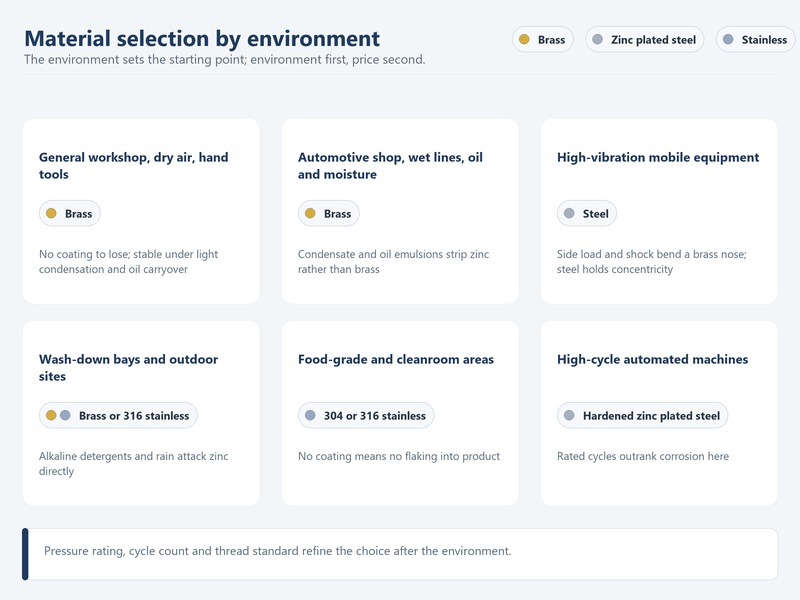
Figure 4. A material selection path for air-line couplers. The environment sets the starting point, and pressure rating, cycle count and thread standard refine the choice.
Before the next order, work through this short checklist:
- Name the environment for each coupler location: dry, damp, wash-down, outdoor, food-grade or high-cycle.
- Confirm profile and size first, because geometry beats chemistry every time.
- Fix the specification points you will hold: grade, plating class, pressure rating, thread standard, seal compound.
- Count service life: technician minutes and downtime rather than part dollars.
- Stock the consumables that actually fail: O-rings, collars and sleeves.
- Standardize one profile family so spares fit and mixed materials stay interchangeable.
HENGHUA is a professional manufacturer of air hose fittings, quick connect couplers, air hoses and hose assemblies, supplying distributors, retailers and OEM brands worldwide. Coupler bodies are machined from brass, zinc plated steel or stainless steel, thread-checked against NPT and BSP gauges, and pressure-tested to rated working pressure before shipment. The range covers 1/4, 3/8 and 1/2 inch plugs and sockets in M-style, A-style and E-style profiles, hose barbs, adapters, reducers, kits and spare O-rings.
If you are sourcing couplers for retail, distribution or an OEM program and need to settle a brass versus steel specification with test data behind it, contact our team for a quote and samples. We will help you match material, grade, plating class, pressure rating and interchange profile to the markets you serve.
About the author. This article was prepared by the HENGHUA engineering team, which designs and manufactures air hose fittings, quick connect couplers and hose assemblies for industrial, automotive and OEM customers. The team works with material selection, thread gauging, flow measurement and pressure testing daily, and writes from bench measurements and factory test records.






 English
  Spanish
  Portuguese
  French
  German
  Arabic
  Russian
  Indonesian
  Japanese
  Korean