
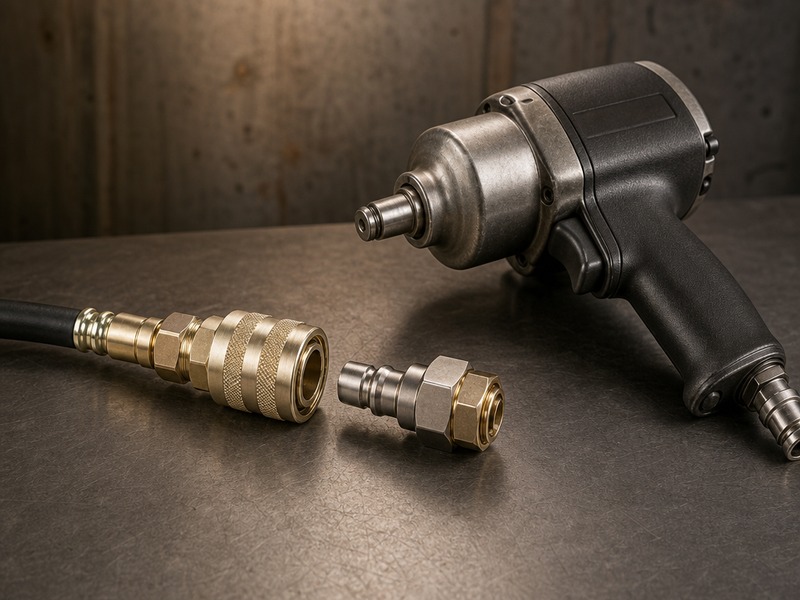
High flow quick connect couplers are the couplings that let a heavy-duty impact wrench draw its rated air without starving. The best ones share three traits: a larger internal bore, a shorter through-path, and a plug and socket cut to the same interchange profile.
This is a selection page for buyers, not a brand roundup. It explains why a 1/2 in impact wrench rated 4 to 8 SCFM at 90 PSI feels weak behind an ordinary 1/4 in coupling. It also shows how to measure that loss with a gauge, what “high flow” changes inside the profile, and how to choose a coupling by wrench size and duty.
All flow figures are our bench measurements at 100 PSI inlet and 23 °C ambient; tool demand figures are manufacturer ratings at 90 PSI. About 17 min read.
Why High Flow Quick Connect Couplers Decide an Impact Wrench’s Real Power
An impact wrench does not sip air. A 1/2 in model draws roughly 4 to 8 SCFM, and a 3/4 in model reaches 8 to 10 SCFM, but those averages hide the real behavior. The tool gulps in short bursts at the instant of impact, and the supply has to keep up during those bursts, not across the whole minute.
Every air tool in this class is rated for 90 PSI at its inlet. The compressor typically cuts out between 120 and 150 PSI, so there should be pressure to spare at the tank. What arrives at the tool is a different number, because pressure falls as air moves through every narrow point between the tank and the wrench.
Restriction shows up in three places on that path, as Figure 2 and Table 1 set out. A standard 1/4 in coupling narrows a 3/8 in line at both ends of the hose, and the tool feels it as lost torque.
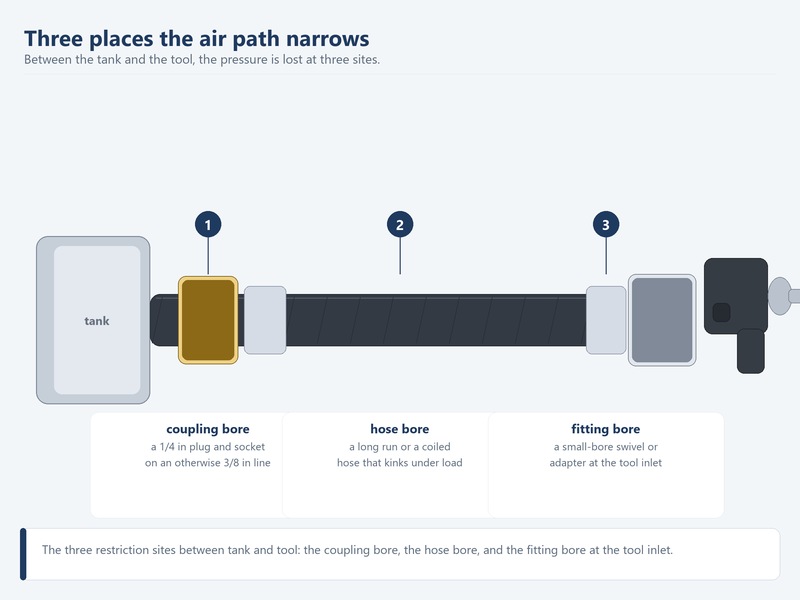
Figure 2. The three restriction sites between tank and tool: the coupling bore, the hose bore, and the fitting bore at the tool inlet.
Table 1. Where air pressure is lost between the regulator and a heavy-duty impact wrench
| Restriction site | What narrows the path | Symptom at the tool |
|---|---|---|
| Coupling bore | A 1/4 in plug and socket on a line that is otherwise 3/8 in | Weak burst torque, a wrench that stalls on a rusted fastener |
| Hose bore | A long run of undersized hose, or a coiled hose that kinks under load | Tool slows the further it sits from the compressor |
| Fitting bore | A small-bore swivel or adapter screwed into the tool inlet | Pressure drop that no regulator adjustment can recover |
The point of a high-flow coupling is not to make the hose bigger. It is to stop the coupling from giving back capacity the hose already has. Once the coupling bore matches the hose bore, the remaining restriction moves to the hose and the tool inlet, where it belongs.
How to Measure Pressure Drop Across a Coupling Honestly
You cannot judge a coupling by the size printed on the package, because that size describes the thread end, not the air path. You have to measure the pressure that reaches the tool while the tool is working.
The method is simple and needs one gauge, and it only works at the end of the hose you actually use; Table 2 sets out the four steps. A 10 PSI drop at the tool is a diagnosis, not a tolerance, and it tells you the path is robbing the wrench.
Our bench figures come from a fixed method so they can be compared to each other. We feed the coupling at 100 PSI inlet and record flow at 23 °C ambient. Under those conditions a 1/4 in line passes about 40 SCFM, a 3/8 in line about 80 SCFM, and a 1/2 in line about 140 SCFM. At 1/4 in nominal size, the M-style coupler passes about 40 SCFM, and the A-style and E-style couplers sit near 35 SCFM.
The caution matters more than the numbers themselves: compare high flow quick connect fittings only on a note that lists the inlet pressure, the temperature, and the downstream device. Two SCFM figures measured under different conditions are not comparable, because a catalog value taken at a different inlet pressure is a different test. Treating unlike tests as equals is how a buyer picks a coupling that underperforms the spec sheet.
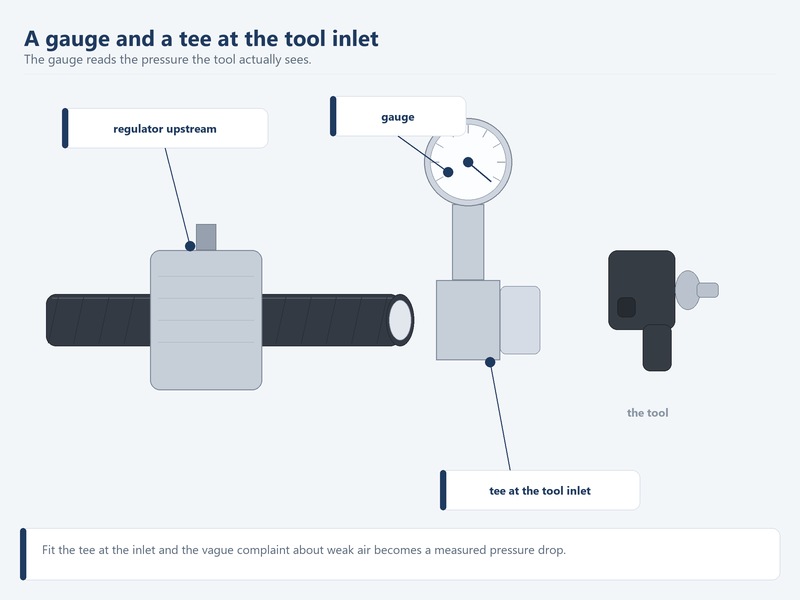
Figure 3. A gauge and tee at the tool inlet turn a vague complaint about weak air into a measured pressure drop.
Table 2. A repeatable bench and field method for judging a high flow coupler
| Step | What to do | What a good result looks like |
|---|---|---|
| 1 | Set the regulator and record the static setting | A stable reading at the working pressure you use |
| 2 | Fit a gauge and tee at the tool inlet | Gauge reads the pressure the tool actually sees |
| 3 | Run the tool through several bursts at the end of the real hose | Drop stays small and recovers quickly between bursts |
| 4 | Repeat with the candidate coupling fitted | A smaller drop confirms the coupling was the constraint |
If the gauge at the tool tracks the regulator closely with the tool running, the coupling is not your problem, and a high-flow part will not add torque. If the gauge sags by roughly 10 PSI or more on every burst, the path is the problem, and the coupling is the cheapest place to start.
What High Flow Quick Connect Couplers Change in the Profile
“High flow” is a description of the air path, not a brand promise. Two couplers with the same thread can differ entirely in bore and in the shape of the plug nose, and the nose is what sets how much air can pass through the socket.
These couplings come from profile families rather than from a single design. The V-style high-flow profile is built with a larger internal bore for a given nominal size and a shorter restrictive path through the socket. The standard industrial interchange profile, sold as M-style, is the North American default and passes about 40 SCFM at 1/4 in on our bench. The A-style automotive profile and the E-style profile sit near 35 SCFM at the same size. The V-style exists because none of those three was designed to feed a hungry tool on a long run.
Three dimensions decide how a high-flow coupling behaves. The bore is the open diameter the air passes through, the plug nose sets how the socket grips and seals, and the socket through-path is the internal channel behind the lock. A large bore with a narrow through-path gains nothing, which is why the parts must be judged as a pair.
Interchange is governed by published specifications, not by appearance. The ISO 6150 series fixes plug connecting dimensions for pneumatic quick-action couplings, while A-A-59439 and MIL-C-4109 cover the common industrial and automotive interchange families in US trade. Those documents are what make a plug from one factory lock into a socket from another, provided both follow the same series.
High flow quick connect fittings are judged on exactly these three dimensions, and high flow air fittings sold for shop use follow the same family rules. The safest purchase names the family before it names the size, because two parts that carry the same thread can still refuse to mate.
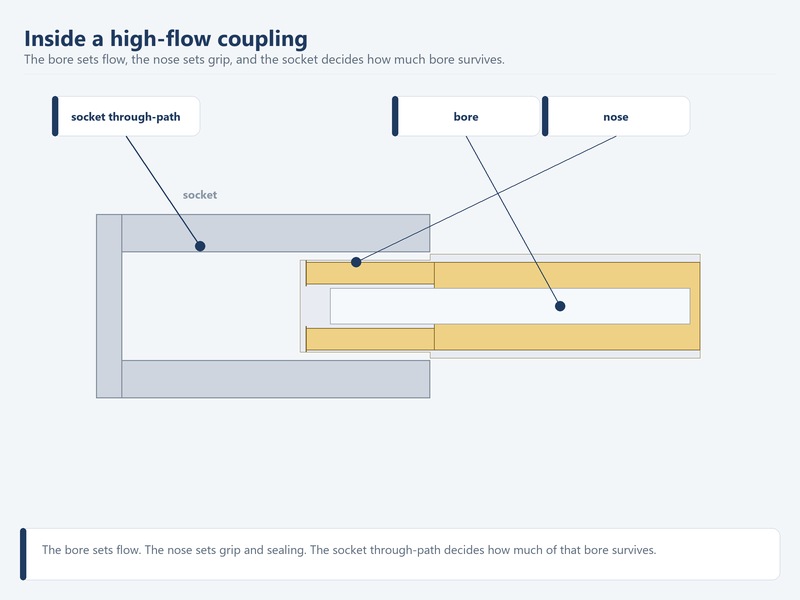
Figure 4. Inside a high-flow coupling: the bore sets flow, the nose sets grip and sealing, and the socket through-path decides how much of that bore survives.
Table 3. Profile families a high flow coupler is drawn from, and what each one is built for
| Profile family | Flow character | Best fit |
|---|---|---|
| V-style high flow | Largest internal bore for the nominal size, short restrictive path | Impact wrenches, sanders, and any tool that bursts hard |
| M-style industrial interchange | About 40 SCFM at 1/4 in on our bench; the shop default | General shop air where tools arrive with M-style plugs |
| A-style automotive | About 35 SCFM at 1/4 in on our bench | Legacy automotive bays and existing automotive fleets |
| E-style | About 35 SCFM at 1/4 in on our bench | European-pattern shops and export machinery |
Material and seal choices matter as much as bore on a tool that is disconnected many times a day. Brass bodies resist corrosion in damp shops and hold up to standard-duty pressures in the 150 to 300 PSI range. Steel bodies, often zinc-plated, suit heavy-duty service up to about 500 PSI and take more abuse at the collar. The seal, usually an O-ring in the socket, decides whether the coupling leaks after a thousand cycles.
The non-negotiable rule is that plug, socket, and thread must all match. A high-flow plug in a standard socket will not lock, and a standard plug in a high-flow socket will not seal, even if both are labeled 1/4 in. If you need to confirm which profile you already own before ordering, the quick connect profile chart walks through identification, and the mating rules for adapters are covered in the air hose fittings guide.
Choosing High Flow Quick Connect Couplers by Wrench Size and Duty
Selection follows the wrench first and the shop second. A coupling that is right for a compact 1/2 in wrench is wasteful on a brad nailer and barely adequate for a 1 in high-torque tool.
Match the coupling to the tool’s burst demand, then make sure the hose and the fitting at the tool inlet can carry the same air. A high-flow coupling on a 1/4 in hose is like a wide doorway into a narrow hallway; the hose still sets the ceiling. For a 1/2 in impact wrench, a 3/8 in hose with matching high-flow couplings is the usual minimum, and a 1/2 in hose is the safer choice on runs over 50 ft.

Figure 5. Coupling size should step up with wrench size: the air path has to carry the burst demand of the tool it feeds.
Table 4. Selecting a high flow coupler by impact wrench size and duty
| Wrench and duty | Typical demand | Coupling and hose to match |
|---|---|---|
| 1/2 in compact, light assembly | About 4 SCFM | High-flow 1/4 or 3/8 in coupler on a short 3/8 in hose |
| 1/2 in standard, general repair | About 6 to 8 SCFM | High flow 1/2 inch coupler on a 3/8 in hose, stepped up on long runs |
| 3/4 in high torque, truck and plant | About 8 to 10 SCFM | High flow 1/2 inch coupler on a 1/2 in hose or larger |
| 1 in high torque, heavy industry | At or above 10 SCFM | Half-inch or larger high-flow coupling, short hose, minimal adapters |
Notice that the half-inch size appears on three of the four rows. The half-inch body size covers the majority of heavy-duty impact duty, and it is the size most buyers should plan around. When a buyer asks for an air coupler for impact wrench duty, this half-inch body is usually the answer, and the coupling bore should match or exceed the hose bore. Step to a larger bore only when the tool demand and the hose both justify it.
The hose and fitting combination has to keep up, or the upgrade is wasted. Use the air hose size chart to check the bore against run length, and see the live guidance on the right air hose size for your tool for how hose sizing and impact tools interact. If your compressor is at the edge of its output, the coupling is not the first place to look, and the checks in air regulator troubleshooting come first.
If the gauge shows a real drop at the wrench, send us the wrench size, the hose bore and the run length, and we will return a matched pair from the air hose collection.
What to Look For in a High Flow Air Coupler Listing, and What to Avoid
A product listing should let you verify four things before you buy: the profile, the bore, the pressure rating, and the seal material. If a listing leaves any of them vague, treat that as a warning rather than a bargain, because a coupling that cannot be identified cannot be matched.
The profile is the one that trips up most buyers. Look for a named interchange family, not a vague promise of compatibility. A listing that says the part fits “most air tools” tells you nothing about whether it will lock into your socket, and mixing profiles is the fastest route to a coupling that leaks or will not seat.
Pressure rating is the second check, and it has to be read against your line pressure. Standard-duty brass couplers are typically rated 150 to 300 PSI, and heavy-duty steel bodies reach about 500 PSI. Whether you are comparing high flow air fittings or a single air coupler for impact wrench use, the rule is the same: no rating, no purchase. A part rated below your working pressure is the wrong part no matter how wide its bore.

Figure 6. A listing you can trust states the profile, the bore, the pressure rating, and the seal material in plain terms.
Table 5. What a high flow air coupler listing should state, and the red flags beside it
| Specification | Good listing | Red flag |
|---|---|---|
| Profile family | Names the interchange series or style letter | Unstated profile, or a claim that it fits every tool |
| Bore and body size | States nominal size and the air-path bore | Only a thread size, with no mention of internal bore |
| Pressure rating | Gives a working pressure above your line pressure | A rating below the tool’s rated 90 PSI supply |
| Seal material | Names the O-ring material and lists spares | Unknown seal material, no replacement O-rings offered |
| Style claims | One profile, stated once, consistently | Mixed or “universal” plug claims in the same listing |
Two more habits separate a good purchase from a return. Buy the plug and the socket as a matched pair whenever possible, so the through-path is designed as one unit. And confirm that replacement O-rings are available, because the seal inside the socket wears long before the metal body does.
Installation and Maintenance Checklist for High Flow Couplers
A coupling is a wear part, and treating it like permanent plumbing is how a well-chosen high-flow pair starts leaking within a year. The habits below cost almost nothing and prevent most returns.
Start with the thread, not the quick-connect end. Sealing practice depends on the thread standard: NPT threads such as those defined by ASME B1.20.1 seal on the thread, while parallel threads such as those in ISO 228-1 seal on a washer or an O-ring. Using the wrong sealant on the wrong thread either leaks or contaminates the air path, so match the method to the standard rather than defaulting to tape on everything.
Apply thread sealant to the male thread in the direction of assembly, and keep it clear of the air path. A wrap that crosses the first thread sends tape fragments downstream, where they lodge in a tool inlet or a valve. Keep the first thread bare, and apply the sealant to the threads that actually engage.
Once the coupling is fitted, the maintenance routine is short and should be written down:
- Check the collar action at each tool change, since a stiff collar is the first sign of wear.
- Inspect the plug nose for scoring, which is what starts a slow leak at the seal.
- Replace the O-ring on a schedule, not only after a leak appears.
- Depressurize the line before every disconnect, so a pressurized hose end cannot whip.
- Wipe grit from the plug before coupling, since abrasive dust shortens seal life.
Replacement of the collar and the seal is the two-part service that keeps a high-flow coupling working. A worn collar lets the plug sit slightly off-center, and an off-center plug leaks even with a fresh O-ring. On couplings that are disconnected dozens of times a shift, plan on seal replacement well before the body shows wear. Bench flow testing is how we verify a coupler holds its rated flow after service, and it is the same idea on our air hose collection fittings, where every part is pressure-tested to its rated working pressure before it ships.
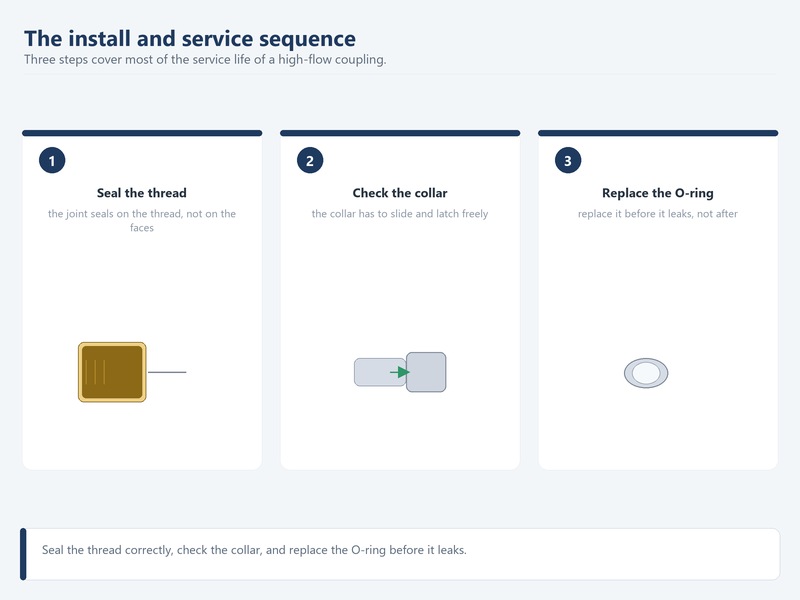
Figure 7. The install and service sequence: seal the thread correctly, check the collar, and replace the O-ring before it leaks.
Since a coupling is only one part of a larger decision, two related pages are worth reading rather than repeating here. The M-style, V-style and A-style comparison covers how to standardize a shop once a profile is chosen. The garden hose flow rate explanation shows the same pressure-and-flow measurement logic applied to a very different hose, which is useful for checking your own gauge method.
High Flow Quick Connect Couplers FAQs
Do high flow quick connect couplers really make an impact wrench stronger?
They cannot add torque the air supply never delivered. What they can do is stop the coupling from robbing pressure the hose was already able to carry. On a 1/2 in wrench that drops 10 PSI or more at the tool inlet, a wider bore often restores the burst the tool was rated to produce. If your gauge shows little drop, a high-flow part buys nothing.
My wrench feels weak but the regulator gauge holds: how do I know if my coupling is the bottleneck?
Fit a gauge and tee at the tool inlet and run the tool at the end of the real hose. Compare that reading with the regulator setting at the same flow. A small drop means the coupling is fine. A drop of roughly 10 PSI or more on each burst points to the path, and the coupling, hose, and fittings are the suspects in order of cost.
What makes a coupling “high flow” compared with a standard one?
Three things work together. The internal bore is larger for the same nominal size, the through-path behind the lock is shorter, and the plug nose is shaped to let air pass with less turbulence. A coupler with a wide bore but a narrow channel behind the lock will not flow like a true high-flow design, so judge the part as a matched plug and socket pair.
Is a high flow 1/2 inch coupler too large for a compact impact wrench?
It will not hurt, but it may be more than you need. A compact 1/2 in wrench drawing about 4 SCFM is well served by a high-flow 1/4 or 3/8 in coupling on a short hose. Save the 1/2 in body for standard and high-torque wrenches where the burst demand is higher and the hose is longer. Oversizing a coupling does not reduce flow.
I already own M-style sockets and hoses: will a V-style plug fit my existing M-style socket?
No. The V-style and M-style profiles are different families, and their plug noses do not interchange. A V-style plug will not lock in an M-style socket, and an M-style plug will not seal in a V-style socket, even when both are labeled 1/4 in. Match the whole chain: plug, socket, and thread standard must agree before the parts will work together.
My impact wrench only feels weak at the far end of the shop: why does the tool feel weaker at the end of a long hose?
Every restriction along the path compounds with distance, so a coupling that is only slightly narrow at 10 ft becomes a real loss at 50 ft. The hose bore, the coupling bore, and the tool inlet all drop pressure in series. On long runs, the fix is usually a larger hose and a matched high-flow coupling at the tool end, not a bigger compressor.
Can I use a high flow air coupler on a standard 1/4 in hose?
You can fit it, but the hose still sets the limit. A wide coupling on a 1/4 in hose is a wide doorway into a narrow hallway, and the air path stays constrained downstream. Use a high-flow coupling where the hose bore can support it, and treat the coupling, hose, and tool inlet as one continuous path when you size any of them. The same rule applies to high flow air fittings of every size.
My line runs at 130 PSI: what pressure rating should I look for?
Start from your line pressure, not from the lowest number you can find. Standard-duty brass couplers are typically rated 150 to 300 PSI, and heavy-duty steel bodies reach about 500 PSI. Air tools are rated at 90 PSI at the tool, and compressors cut out between 120 and 150 PSI, so pick an air coupler for impact wrench use that is rated comfortably above the pressure your system actually reaches.
I change tools all day on the same drop: does the O-ring material matter for an impact wrench coupling?
It matters a great deal in a shop where tools are disconnected many times a day. The O-ring is the part that seals, and it wears faster than the metal body. Choose a coupling whose seal material is stated and whose spare O-rings are available, then replace the seal on a schedule. An unknown seal in a high-cycle coupling is a leak waiting for a busy shift.
How often should I replace coupler seals and collars?
Base it on cycles, not on the calendar. A coupling disconnected dozens of times a shift will need a seal well before one that sits on a dedicated tool. Watch the collar for stiffness and the plug nose for scoring, and replace the O-ring when either sign appears. A worn collar lets the plug sit off-center and will leak even with a fresh seal.
My compressor already sits near its output limit: are wider couplings worth it on a small compressor?
Only if the compressor can actually supply the demand. A small compressor near its output limit will not be rescued by a wider coupling, because the shortfall starts at the tank. Measure first: if the gauge at the tool sags at the start of a burst with a fully charged tank, the compressor is the limit. Fix supply pressure before spending on couplings.
Next Steps: Size the Coupling to the Wrench, Then Prove It With a Gauge
The right high flow quick connect couplers are the ones matched to a measured problem. Do not buy by habit, and do not buy the widest body you can find without checking the hose behind it.
Work through this short checklist before you order:
- Measure the pressure at the tool inlet with the tool running, and note the drop.
- Match the profile in the tool and hose so plug, socket, and thread agree.
- Choose a bore the hose can support, stepping up on runs over 50 ft.
- Confirm the pressure rating sits above your system’s highest working pressure.
- Buy the plug and socket as a matched pair, with spare O-rings available.
If the gauge shows your path is sound, spend nothing and keep the couplings you have. Fit high flow quick connect fittings only where the gauge shows a real drop, because an oversized coupling on an adequate path changes nothing. If the gauge shows a real drop, a matched high-flow pair is the cheapest torque you will buy this quarter.
HENGHUA manufactures air hose fittings, quick connect couplers, air hoses, and hose assemblies for distributors, retailers, and OEM brands worldwide. Couplers and plugs are machined from brass, zinc-plated steel, or stainless steel, thread-checked against NPT and BSP gauges, and pressure-tested to their rated working pressure before shipment, so the profile, size, and thread you order is the one that arrives.
The range covers 1/4, 3/8, and 1/2 in plugs and sockets in the M-, A-, and E-style interchange profiles, including high-flow bodies, plus hose barbs, adapters, reducers, complete kits, spare O-rings, and regulator and filter units. Because the process runs from raw material to final pressure test under one roof, we hold factory-direct pricing, short lead times on bulk orders, and support for private labeling, custom packaging, and OEM or ODM branding.
If you are sourcing high-flow couplings for impact tools, contact our team for a quote and samples, and we will help you match the bore, profile, and thread to your market.
About the author. This article was prepared by the HENGHUA engineering and product-testing team, which works daily with pneumatic couplings, hose assemblies, and flow-bench testing for industrial and automotive customers. The team supports distributors and OEM buyers with coupler selection, thread identification, and pressure-rating checks drawn from factory testing and warranty-return data from distributor programs.






 English
  Spanish
  Portuguese
  French
  German
  Arabic
  Russian
  Indonesian
  Japanese
  Korean