
Fuel Oil Rubber Hose Smooth Surface 300 PSI
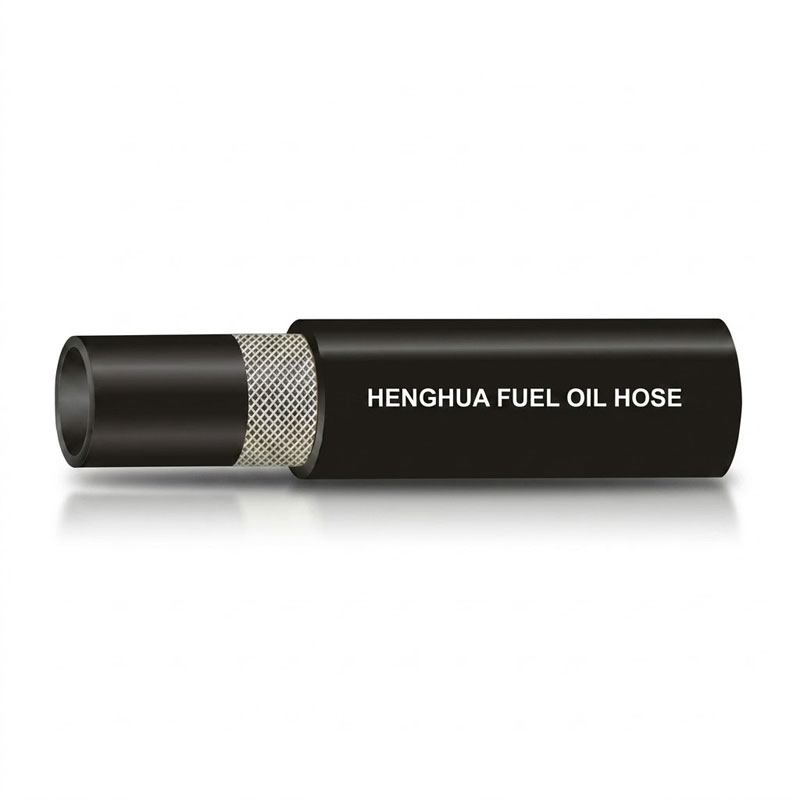
What Is a Fuel Oil Hose?
A fuel oil hose is a flexible rubber hose specifically engineered for the safe transfer of diesel, biodiesel, fuel oil, and other petroleum-based fluids in industrial, agricultural, marine, and commercial applications. Unlike general-purpose air or water hoses, a proper fuel transfer hose features an oil-resistant tube compound that resists swelling, hardening, and cracking when in continuous contact with hydrocarbons.
The Fuel Oil Rubber Hose Smooth Surface 300 PSI represents a medium-pressure fuel delivery solution. “300 PSI” refers to its maximum working pressure (20 bar), making it suitable for both pump discharge and suction applications. The “smooth surface” reduces flow resistance and prevents dirt accumulation, while an internal helix steel wire provides kink resistance and vacuum collapse protection.
What Is a 300 PSI Fuel Hose Used For?
A 300 PSI fuel hose is used for diesel transfer, fuel delivery, generator supply, burner feed lines, and bulk fuel loading/unloading. The 300 PSI rating indicates a 4:1 safety factor (burst pressure of 900 PSI for smaller diameters), providing a substantial safety margin for mobile equipment, refueling stations, and industrial fuel systems.
Key Specifications at a Glance
| Parameter | Value |
|---|---|
| Working Pressure | 20 bar (300 PSI) for ID 5-25mm; 10 bar (150 PSI) for ID 32-51mm |
| Bursting Pressure | 60 bar (900 PSI) or 30 bar (450 PSI) – 3x working pressure |
| Temperature Range | -30°C (-22°F) to +80°C (+176°F) |
| Tube Material | Black, smooth NR + SBR rubber compound |
| Reinforcement | Multi-plies high-strength synthetic fiber + helix steel wire |
| Cover Material | Black, smooth, cloth-impression SBR rubber |
| Available Lengths | 50m or 100m per roll |
Diesel Fuel Hose vs Hydraulic Hose: Key Differences
| Feature | Diesel Fuel Hose (300 PSI) | Hydraulic Hose (High Pressure) |
|---|---|---|
| Primary Fluid | Diesel, biodiesel, fuel oil | Hydraulic oil, mineral oil |
| Pressure Rating | 150-300 PSI | 3000-6000 PSI |
| Tube Compound | NR/SBR (fuel-resistant) | NBR (oil-resistant) |
| Reinforcement | Fiber + helix wire | Steel wire braid or spiral |
| Flexibility | High (for easy handling) | Medium to stiff |
| Kink Resistance | Excellent (helix wire) | Good |
| Cost | Lower | Higher |
Can you use a hydraulic hose for diesel? Generally not recommended. Hydraulic hoses use NBR tubes which are excellent for mineral oils but may swell excessively with diesel or biodiesel. Always use a dedicated diesel fuel transfer hose.
How to Choose the Right Fuel Transfer Hose
Selecting the correct fuel oil rubber hose requires answering four questions:
- What fluid? Diesel, biodiesel (up to B100), fuel oil, or gasoline? (Gasoline requires a different tube compound – consult us)
- What pressure? For pump discharge up to 300 PSI, this hose works. For suction/vacuum applications, the helix wire prevents collapse.
- What temperature? This hose operates from -30°C to +80°C, suitable for most climates.
- What environment? Outdoor UV exposure? Abrasion from dragging on concrete? The SBR cover with cloth impression resists both.
Typical Use Case Example
A construction company uses a 3/4″ (19mm) 300 PSI fuel hose to transfer diesel from a 500-gallon storage tank to excavators and loaders on an active jobsite. The helix steel wire prevents hose collapse during suction when the pump draws fuel from the tank. The smooth inner tube maintains consistent flow, while the cloth-impression cover resists abrasion from dragging across gravel and concrete. One 50-meter roll supplies five machines for a full work week.
Can You Use a Rubber Hose for Diesel Fuel?
Yes, but only if the rubber hose is specifically formulated for diesel fuel. A standard air or water hose will swell internally, delaminate, and eventually rupture when exposed to diesel. The Fuel Oil Rubber Hose Smooth Surface 300 PSI uses an NR/SBR compound tested for diesel and biodiesel resistance. Key indicators of a proper diesel rubber hose:
- Black, smooth inner tube (no discoloration or softening after fuel contact)
- Reinforcement layer that resists swelling pressure
- Cover that does not blister or crack
Structure and Materials
- Tube (Inner Layer): Black, smooth NR (Natural Rubber) and SBR (Styrene-Butadiene Rubber) compound. Provides excellent resistance to fuel oils and aromatic hydrocarbons up to 50%. Swelling is limited to less than 15% volume increase – critical for maintaining flow rate.
- Reinforcement Layer: Multi-plies of high-strength synthetic fiber plus a helix steel wire. The fiber plies contain pressure. The helix steel wire acts as a rigid spine, preventing kinking and collapse under vacuum. It can also be grounded for static electricity dissipation.
- Cover (Outer Layer): Black, smooth, cloth-impression SBR rubber. The cloth impression adds abrasion resistance and slip resistance. The SBR compound resists ozone, UV radiation, and weathering for outdoor service.
Why Helix Steel Wire? Engineering Principle
In a fuel suction application, a non-reinforced hose can collapse internally, stopping flow completely. The helix wire maintains a circular cross-section under negative pressure, allowing continuous fuel delivery even when the pump is drawing from a distant tank.
Application Industries for Fuel Oil Hose
- Construction: Refueling excavators, bulldozers, loaders, dump trucks
- Agriculture: Diesel transfer to tractors, combines, sprayers, irrigation pumps
- Marine: Deck fueling, bunkering, generator fuel lines
- Industrial: Burner feed lines, boiler fuel supply, backup generator systems
- Mining: Fuel delivery to haul trucks, drills, underground equipment
- Transportation: Bulk fuel depots, tanker truck loading/unloading
Hose Assembly: Fittings and Installation
A complete hose assembly requires correct fittings. For permanent installations, crimped fittings provide the most reliable seal. For field repairs or custom lengths, reusable fittings (barbed or screw-on) offer flexibility. Common connection types include NPT, BSP, JIC threads, and flanges for larger diameters.
Protective sleeves and guards are recommended wherever the hose contacts sharp edges, hot surfaces, or heavy foot traffic. They can extend hose life by 3-5x in abrasive environments.
How to Install Fuel Hose: Quick Guide
- Cut cleanly – Use a sharp hose cutter or fine-tooth saw. Avoid ragged edges.
- Insert fitting – Lubricate the fitting stem with a small amount of compatible oil.
- Crimp or clamp – For crimped fittings, use the manufacturer’s specified crimp diameter. For reusable fittings, tighten to spec.
- Avoid tight bends – Minimum bend radius is approximately 6x the outside diameter.
- Protect from abrasion – Use guards or sleeves where the hose contacts metal edges.
Fuel Hose Safety Standards
This hose is manufactured to a 4:1 safety factor (minimum burst pressure = 4x working pressure for smaller diameters, 3x for larger). The factory holds ISO 9001:2015 certification. While not formally certified to SAE J30 or ISO 19013, performance matches or exceeds these standards. Test certificates are available upon request.
How Long Does a Fuel Hose Last?
Service life depends on application conditions. Typical expectations:
| Condition | Expected Life |
|---|---|
| Intermittent diesel transfer, indoor storage | 5-8 years |
| Daily outdoor use, mild climate | 3-5 years |
| Heavy abrasion, extreme temperatures | 1-3 years |
| Continuous biodiesel (B20+) exposure | 2-4 years |
Replace immediately if you see: surface cracks (weathering), bulges (layer separation), soft spots (tube degradation), or end fitting corrosion.
Common Failures and Troubleshooting
| Failure Mode | Likely Cause | Solution |
|---|---|---|
| Cover cracking | Ozone or UV exposure | Replace; use hose with better cover compound |
| Hose collapses under suction | Helix wire damaged or missing | Use only helix-reinforced hose for suction |
| Fitting leaks | Wrong fitting type or crimp diameter | Use correct fuel-rated fittings |
| Inner tube swollen | Wrong fluid (gasoline?) | Replace with compatible hose |
Frequently Asked Questions (FAQ)
What hose is best for diesel fuel?
A rubber hose with an NR/SBR or NBR tube compound, helix wire reinforcement for kink resistance, and a weather-resistant cover. The Fuel Oil Rubber Hose Smooth Surface 300 PSI meets all these requirements.
Can fuel hose handle gasoline?
This specific hose is optimized for diesel and fuel oil. Gasoline has higher solvency and may cause excessive swelling. Contact us for a dedicated gasoline hose.
What is the difference between fuel hose and hydraulic hose?
Fuel hose is medium-pressure (300 PSI max) with a helix wire for kink resistance and flexibility. Hydraulic hose is high-pressure (3000-6000 PSI) with steel wire braid or spiral reinforcement but less flexibility.
Is rubber hose safe for fuel transfer?
Yes, when the rubber compound is specifically formulated for fuel contact. General-purpose rubber hoses are NOT safe for fuel.
What size fuel hose do I need?
Match the hose inner diameter to your pump or fitting size. Common sizes: 1/2″ (13mm) for small generators, 3/4″ (19mm) for construction equipment refueling, 1″ (25mm) and above for bulk transfer.
Do you offer custom hose assemblies?
Yes. We provide OEM ODM services including custom lengths, printed branding on the hose cover, and pre-attached crimped fittings. Request a quote.
Technical Support and Service
We are not just a supplier – we are a solution provider. Our team offers:
- Pre-sale support: Help selecting the correct hose, fittings, and protective accessories
- During sale: Custom hose assembly, packaging, and drop shipping
- After-sale: Installation guidance, troubleshooting, and warranty support
Download the pdf specification sheet from our website or contact us to request a copy.
Get a Quote for Fuel Oil Hose
Ready to source a reliable supply of fuel oil rubber hose? Contact us today. We are a direct factory and exporter from China, offering wholesale pricing, bulk discounts, and complete hose assembly services.
Send your inquiry with the following information:
- Required inner diameter (inch or mm)
- Length per piece and total quantity
- Fitting type needed (if any)
- Destination port for shipping
We will respond within 24 hours with our best price and cost-effective solution.
Inquiry for Our Product
We are a global supplier of hydraulic fittings and equipment, serving a wide range of sectors with a one-stop sourcing solution. Our products include hydraulic hoses, fittings, adapters, quick couplers, connectors, hose guard, hydraulic equipment and more-everything you need to keep your operations running smoothly and efficiently.
Tell us your requirements using the form below. Our team will respond with expert guidance and a customized quote to keep your operations running smoothly.
- Hydraulic Hose2727 products
- Steel Wire Spiraled Hydraulic Hose66 products
- Steel Wire braided Hydraulic Hose1010 products
- Textile Reinforced Hydraulic Hose33 products
- Thermoplastic Hydraulic Hose33 products
- Industrial Hose5959 products
- Air Hose99 products
- Water Hose1111 products
- Oil Hose1616 products
- Chemical Hose66 products
- Steam Hose33 products
- Multipurpose Hose22 products
- Food & Beverage Hoses44 products
- Concrete Hose44 products
- Cement Hose22 products
- Material Handling Hose1111 products
- Dredge Hose44 products
- Hydraulic Fittings162162 products
- Reusable Hose Fittings66 products
- Socketless Hose Fittings88 products
- JIC Hydraulic Fittings1515 products
- Metric Hydraulic Fittings3838 products
- NPT Hydraulic Fittings66 products
- BSP Hydraulic Fittings2626 products
- SAE Hydraulic Fittings3030 products
- Banjo Hydraulic Fittings44 products
- ORFS Hydraulic Fittings1111 products
- Ferrule1111 products
- Flange Fittings2626 products
- One Piece Fittings2323 products
- Hydraulic Adapters9494 products
-300x300.jpg)
 English
  Spanish
  Portuguese
  French
  German