
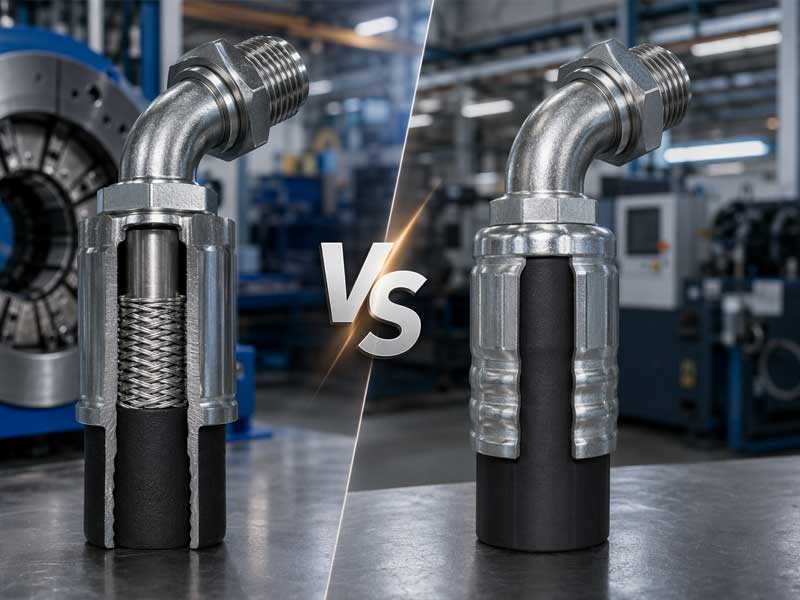
Skive vs. No-Skive Hydraulic Hoses
Skive and no-skive hydraulic hoses differ mainly in how the fitting grips the hose reinforcement. No-skive fittings are faster to assemble because the hose cover remains intact and no skiving step is required. They are ideal for low and medium-pressure applications. Skive fittings remove part of the hose cover to expose the reinforcement wire, creating a stronger metal-to-metal grip. They are preferred for high-pressure and heavy-duty hydraulic systems. For most high-volume manufacturers, no-skive provides better production efficiency, while skive remains the preferred choice for maximum pressure holding strength in extreme applications.
Skive vs No-Skive Hydraulic Hose Fittings Comparison
| Feature | Skive | No-Skive |
|---|---|---|
| Cover removal | Required | Not required |
| Connection type | Direct reinforcement grip | Compression through cover |
| Assembly steps | More steps | Fewer steps |
| Production speed | Slower | Faster |
| Application range | Extreme pressure, heavy duty | Medium pressure, high volume |
| Main advantage | Maximum holding strength | Lower assembly cost & higher efficiency |
1. What Is a Skive Hydraulic Hose Fitting?
Skiving is the process of removing a precise layer of the hose’s outer rubber cover—and in some cases, part of the inner tube—to expose the steel wire reinforcement before attaching the fitting. This preparation step allows the fitting’s ferrule to engage directly with the reinforcement layer, creating a metal-to-metal connection that delivers exceptional holding strength.
The skiving depth must be precisely controlled. If too much material is removed, the reinforcement can be damaged; too little prevents proper fitting engagement. Specialized hydraulic skiving machines set and control this depth automatically, reducing human error.
Two primary skiving methods exist:
- Single skive: External cover removal only, used for medium-pressure braided hose applications (e.g., SAE 100R1, SAE 100R2).
- Double skive: Removal of both outer cover and inner tube, required for high-pressure spiral hose systems (e.g., SAE 100R15) where the fitting must grip the wire reinforcement on both sides.
Manufacturer insight: Our factory tests show that properly skived assemblies can achieve the specified pull-off strength requirements when assembled according to manufacturer specifications. Improper skiving, however, can significantly reduce connection performance.
2. What Is a No-Skive Hydraulic Hose Fitting?
The no-skive hydraulic hose assembly process eliminates the cover removal step entirely. The fitting is designed to be crimped directly over the intact hose cover. Rather than relying on direct reinforcement contact, the ferrule compresses through the rubber cover to grip the underlying wires, creating the connection.
This approach significantly simplifies assembly workflow. Operators skip the skiving station entirely, moving directly from hose cutting to fitting insertion and crimping. Major hydraulic manufacturers have developed optimized no-skive systems, with some reporting assembly speeds up to five times faster than traditional skive methods.
No-skive technology also reduces contamination risk. Skiving generates rubber particles that require cleaning; no-skive eliminates this step entirely, leading to a cleaner assembly area and reduced risk of system contamination.
Key advantage: The intact rubber cover provides additional mechanical protection to the steel reinforcement during assembly, reducing the risk of wire damage from the crimping process.
3. Skive vs No-Skive Hydraulic Hose Fittings: Key Differences
The fundamental difference lies in connection mechanism and assembly requirements. The table below summarizes key comparison points for manufacturers evaluating hydraulic hose fitting types.
| Parameter | Skive Fittings | No-Skive Fittings |
|---|---|---|
| Connection mechanism | Direct metal-to-metal with reinforcement | Compression through rubber cover |
| Assembly steps | Cut → Skive → Clean → Insert → Crimp | Cut → Insert → Crimp |
| Equipment required | Skiving machine + crimper | Crimper only |
| Operator skill level | High (skive depth critical) | Lower (less process variability) |
| Pull-off strength | Superior (maximum reinforcement grip) | Good (reduced by rubber damping) |
| Pressure rating suitability | High and extreme pressure | Low to medium-high pressure |
| Connection integrity verification | Post-crimp inspection required | Generally more consistent |
| Initial investment | Higher (additional skiving equipment) | Lower |
| Assembly speed | Slower | Faster (up to 5×) |
| Risk factors | Under/over-skiving damage | Ferrule deformation into rubber only |
Technical note: No-skive fittings can support many medium and high-pressure hydraulic applications when matched with compatible hose designs (e.g., SAE 100R16, SAE 100R17). However, skive fittings remain widely preferred for extreme-pressure, high-impulse, and heavy-duty applications where maximum reinforcement engagement is required.
4. Skive vs No-Skive Hydraulic Hose Cost Comparison
For manufacturers, the total cost of ownership involves more than just fitting price. The table below provides a skive vs no-skive hydraulic hose cost comparison to support procurement decisions.
| Cost Factor | Skive | No-Skive |
|---|---|---|
| Equipment investment | Higher (skiver + crimper) | Lower (crimper only) |
| Labor cost per assembly | Higher (more steps, slower) | Lower (fewer steps, faster) |
| Fitting unit cost | Lower | Higher |
| Operator training | Higher (skiving skill required) | Lower (crimping only) |
| Production speed | Slower | Faster (up to 5x) |
| Scrap/rework rate | Higher (skiving errors) | Lower (process consistency) |
Example: Cost Impact for 10,000 Assemblies per Year
| Cost Item | Skive | No-Skive |
|---|---|---|
| Equipment investment | Higher | Lower |
| Labor requirement | Higher | Lower |
| Training cost | Higher | Lower |
| Fitting cost | Lower | Higher |
| Total production efficiency | Lower | Higher |
Note: Actual cost differences vary by region, labor rates, and production volume. Manufacturers should calculate based on their specific operational costs.
Manufacturer perspective: For high-volume production of low to medium-pressure assemblies, no-skive typically provides superior cost efficiency. For specialized high-pressure applications where safety and performance are paramount, the additional cost of skive assembly is justified.
5. Performance Comparison: Impulse Cycle Testing Validation
Industry standards require hydraulic hose assemblies to pass impulse testing—typically 200,000 cycles per SAE J343/ISO 6803 requirements. Leading manufacturers test far beyond minimum requirements, with premium assemblies validated to 300,000, 500,000, or even 1,000,000 cycles.
What impulse testing validates:
- Connection integrity under sustained pressure cycling
- Resistance to leakage at maximum rated temperature
- Fatigue life of the hose-reinforcement-to-fitting interface
Manufacturer data point: At HENGHUA, we routinely impulse-test assemblies to 1,000,000 cycles at 133% working pressure and elevated temperature, verifying performance that meets or exceeds major international brand specifications.
6. When Should Manufacturers Choose Skive Fittings?
Skive fittings are the preferred choice for:
- High-pressure systems (over 5,000 psi / 345 bar) where maximum connection integrity is required.
- Heavy-duty mobile equipment (construction, mining, forestry) subject to high impulse loads.
- Spiral-wire reinforced hoses (e.g., SAE 100R15) where double-skive connections provide superior holding strength.
- Applications with extreme temperature fluctuations where metal-to-metal engagement reduces the risk of connection loosening.
Application examples: Mining excavators, offshore drilling equipment, high-pressure hydraulic cylinders.
7. When Should Manufacturers Choose No-Skive Fittings?
No-skive fittings are the preferred choice for:
- Low to medium-pressure systems (under 5,000 psi / 345 bar) where performance requirements are less demanding.
- High-volume production environments where assembly speed and labor cost are critical.
- Facilities with less experienced operators where process variability must be minimized.
- Agricultural equipment and factory hydraulic systems where cost efficiency is a primary driver.
Application examples: Agricultural tractors, material handling equipment, factory automation systems, medium-pressure hydraulic circuits.
8. How to Select the Correct Hydraulic Hose Fitting?
Manufacturers should evaluate five factors before selecting between skive and no-skive fittings:
- Working pressure: Higher pressures favor skive connections for maximum reinforcement engagement.
- Hose construction: Braided hoses (SAE 100R1/R2) are compatible with both; spiral hoses (SAE 100R15) generally require skive.
- Production volume: High volume favors no-skive for labor and equipment cost efficiency.
- Assembly equipment: Existing equipment availability may influence the decision.
- Required service life: Skive generally provides superior fatigue resistance for long-life applications.
Application-based selection guide:
| Application | Recommended Fitting | Reason |
|---|---|---|
| Agricultural equipment | No-Skive | Cost-effective, moderate pressure |
| Construction machinery | Skive | High pressure, high impulse loads |
| Mining equipment | Skive | Extreme pressure, safety critical |
| Factory hydraulic systems | No-Skive | High volume, cost-driven |
| High-pressure hydraulic cylinders | Skive | Maximum holding strength required |
| OEM production (general) | No-Skive | Efficiency, consistency, lower training |
9. Hydraulic Hose Assembly Testing Requirements
To ensure quality and safety, hydraulic hose assemblies should undergo the following tests:
- Proof pressure testing: Verifies assembly integrity at a specified pressure (typically 1.5x working pressure) without leakage or failure.
- Burst pressure testing: Determines the ultimate strength of the assembly (typically 4x working pressure minimum).
- Impulse cycle testing: Validates fatigue life under cyclic pressure loading (200,000 cycles minimum per SAE J343/ISO 6803).
- Dimensional inspection: Confirms fitting crimp diameter and length meet manufacturer specifications.
- Material traceability verification: Ensures hose, fitting, and crimping records are maintained for quality control.
Manufacturer insight: At HENGHUA, every hydraulic hose assembly undergoes these quality checks to ensure consistent performance for OEM and industrial applications worldwide.
10. Common Hydraulic Hose Assembly Failure Causes
Understanding failure modes helps manufacturers select the correct fitting and assembly process. Common hydraulic hose assembly failures are usually caused by:
- Incorrect hose and fitting matching: Using incompatible components reduces connection integrity and can lead to premature failure.
- Wrong crimp diameter: Over-crimping damages the reinforcement; under-crimping results in insufficient holding strength.
- Improper skiving depth: Removing too much or too little material compromises the metal-to-metal connection.
- Excessive working pressure: Operating above the assembly’s rated pressure accelerates fatigue and increases failure risk.
- Poor impulse resistance: Inadequate testing validation may result in connection failure under cyclic loading.
- Contamination during assembly: Skiving debris or other particles entering the hose can damage system components.
- Incorrect installation radius: Bending the hose beyond its minimum bend radius stresses the reinforcement and fitting connection.
Manufacturer perspective: Most failures are preventable through proper component selection, validated assembly processes, and in-house quality testing.
11. Hydraulic Hose Standards
Hydraulic hose assemblies must meet international standards to ensure safety and interchangeability. Key specifications include:
- SAE J1273 / ISO 17165-2: Installation and assembly guidelines emphasizing hose-to-fitting matching.
- SAE J343 / ISO 6803: Impulse test requirements for hydraulic hose assemblies.
- ISO 6162: 4-bolt flange connection specifications.
- DIN EN 853 / SAE 100R series: Braided hose construction standards.
- DIN EN 856 / SAE 100R15: Spiral hose construction standards.
12. Frequently Asked Questions (FAQ)
Q1: What is the difference between skive and no-skive hydraulic hose fittings?
Skive fittings remove the outer cover to engage directly with reinforcement wire, providing maximum holding strength. No-skive fittings crimp over the intact cover, offering faster assembly and lower cost for moderate pressure applications.
Q2: Are no-skive hydraulic fittings reusable?
Generally, no. Both skive and no-skive fittings are designed for single-use crimping. Reusing fittings compromises connection integrity and voids manufacturer warranties.
Q3: Do skive fittings have higher pressure ratings?
Yes, skive fittings typically support higher pressure ratings because the ferrule engages directly with the steel reinforcement, providing a stronger mechanical connection.
Q4: Can I replace skive fittings with no-skive fittings?
Only if the hose assembly and application are compatible. Replacing skive with no-skive without verifying pressure ratings and hose compatibility is not recommended. Always consult the manufacturer.
Q5: How long does hydraulic hose assembly take?
No-skive assembly is significantly faster, up to 5x quicker than skive methods, due to fewer process steps and reduced operator skill requirements.
Q6: What equipment is required for skiving?
A hydraulic skiving machine is required to remove the outer cover and, in some cases, the inner tube to the correct depth before fitting installation.
Q7: Which hydraulic hose fitting is better for OEM production?
For most OEM applications, no-skive fittings provide superior production efficiency, consistency, and lower training costs. For high-pressure OEM applications, skive remains the standard.
Q8: How are hydraulic hose assemblies tested?
Assemblies are tested using proof pressure, burst pressure, and impulse cycle tests to validate performance and safety per SAE and ISO standards.
Q9: What SAE standards apply to hydraulic hose assemblies?
SAE J1273 (installation), SAE J343 (impulse testing), and SAE 100R series (hose construction) are the primary standards.
Q10: How do manufacturers reduce hydraulic hose assembly failure?
By using validated production processes, trained operators, consistent raw materials, and in-house testing to verify quality before shipment.
Q11: Can no-skive fittings be used for high-pressure hydraulic hoses?
Yes, some engineered no-skive systems support high-pressure applications. However, skive fittings remain preferred for extreme-pressure and high-impulse applications where maximum reinforcement engagement is required.
Q12: Are skive and no-skive fittings interchangeable?
No. Skive and no-skive fittings require compatible hose constructions and should only be used according to manufacturer specifications.
Q13: Which fitting is better for hydraulic hose manufacturers?
No-skive fittings are usually better for high-volume production efficiency, while skive fittings are preferred for maximum pressure capability and heavy-duty applications.
13. Why Choose HENGHUA Hydraulic Hose Manufacturing?
HENGHUA specializes in the production of high-performance hydraulic hose assemblies, delivering reliability validated through rigorous testing protocols. Our facility features in-house impulse test stands capable of validating assemblies to 1,000,000 cycles at elevated temperatures and pressures.
Unlike trading companies, HENGHUA manages hose production, fitting matching, assembly, crimping, and testing under one quality control system. This integrated approach ensures full traceability and consistent quality for every assembly.
Our manufacturing advantages include:
- ISO and SAE compliance: All products manufactured to international standards including SAE 100R series and DIN EN specifications.
- In-house testing capability: Full impulse, proof, and burst testing per SAE J343 and ISO 6803.
- OEM and ODM capabilities: Custom configurations available to meet specific application requirements.
- Quality control: Each assembly inspected before shipment, with material traceability maintained throughout production.
- Global export experience: Serving manufacturers across the UK, USA, Germany, and other major industrial markets.
Request Hydraulic Hose Assembly Samples
Need help selecting skive or no-skive hydraulic hose fittings? Send us:
- Hose model or specification
- Working pressure requirements
- Intended application
- Required quantity
Our engineers will recommend the correct hose and fitting combination for your needs.
Contact HENGHUA for product specifications, quotations, free samples, or technical consultation.

 English
  Spanish
  Portuguese
  French
  German