
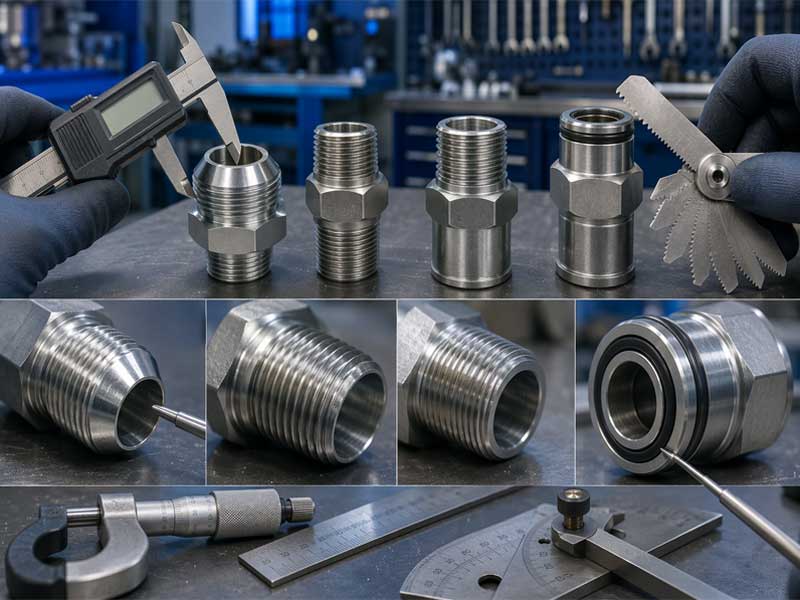
How Do You Identify Hydraulic Fitting Threads?
Hydraulic fitting threads are identified by checking four factors: the sealing method (flare, O-ring face seal, or thread seal), the thread shape (tapered or parallel), the thread diameter, and the thread pitch. JIC fittings use a 37° flare, NPT uses tapered 60° threads, BSPP uses parallel 55° threads with an O-ring, bonded seal washer, or face sealing method depending on the fitting design, and ORFS uses a flat face with a captured O-ring. Correct hydraulic fitting identification is essential for selecting compatible hydraulic hose assemblies, adapters, valves, pumps, and industrial hydraulic components. This guide provides a step-by-step process to accurately identify each type and avoid costly system failures.
1. Why Correct Thread Identification Matters
Installing a mismatched hydraulic fitting is not a minor error; it is a critical failure in system design. While threads from different standards may appear visually similar, they are mechanically incompatible. Forcing a connection between incompatible threads can damage both the fitting and the port, leading to immediate or eventual leakage, component failure, and significant safety hazards.
The cost of misidentification extends far beyond the fitting itself. A damaged port on an expensive hydraulic pump or valve body often requires costly replacement, and system downtime during troubleshooting adds significant operational expense. As one industry expert noted, thread standards can look “almost identical from one standard to another,” yet they “will not properly engage” when mismated. Hydraulic fitting thread compatibility is critical when selecting hydraulic hose assemblies, adapters, valves, pumps, and industrial hydraulic components.
2. How to Identify Hydraulic Fitting Threads: 4-Step Inspection Process
Field identification of hydraulic threads follows a systematic process using basic measuring tools. The industry-standard approach combines visual inspection with precise measurements.
Step 1: Perform Visual Inspection of the Sealing Surface
Start by examining the fitting’s sealing surface and overall geometry. This initial observation provides immediate clues about the thread type.
Look for these visual markers:
- Flared surface (37° or 45° angle): Indicates a JIC or similar flare fitting.
- Flat face with a visible O-ring: Suggests ORFS (O-Ring Face Seal).
- Tapered appearance (visibly wider at one end): Points to NPT or BSPT.
- Straight (parallel) threads with a flat sealing face or bonded washer: Indicates BSPP.
Check for manufacturer markings. Many fittings have stamped part numbers or brand identifiers that can be cross-referenced with manufacturer catalogs.
Step 2: Determine Taper vs. Parallel Threads
Use visual examination or a caliper to measure the thread diameter at the beginning and end of the threaded portion.
- Tapered threads (NPT, BSPT): The outer diameter at the end of the fitting is visibly smaller than the diameter near the base.
- Parallel threads (JIC, BSPP, ORFS): The diameter remains consistent along the entire thread length.
This distinction eliminates half the possibilities immediately.
Step 3: Measure Thread Diameter
Using an OD/ID caliper, measure the outer diameter of male threads or the inner diameter of female threads. Record this measurement in either inches or millimeters. Note that worn threads from previous use may produce slightly inaccurate readings.
Compare your measurement to standard sizes:
- JIC threads typically range from 7/16″ to 2″.
- NPT sizes are designated by trade size (e.g., 1/4″ NPT measures approximately 0.540″ OD).
- BSPP sizes correspond to nominal pipe size.
- Metric threads are specified in millimeters.
Step 4: Measure Thread Pitch
Use a thread pitch gauge to determine the number of threads per inch (for imperial threads) or the distance between threads (for metric threads).
Critical distinction:
- TPI (Threads Per Inch): Used for JIC, NPT, and BSPP.
- Metric pitch (mm): Used for metric threads.
Place the gauge against the threads until it fits snugly, then match your measurement to standard thread charts. If a pitch gauge is unavailable, you can count threads over a 1-inch span (for TPI) or a 10-mm span (for metric) as a field alternative.
3. Hydraulic Fitting Thread Size and Dash Size Reference Chart
The following hydraulic fitting thread size and dash size reference chart helps technicians quickly identify common thread sizes and pitches for each standard.
| Thread Type | Common Trade Sizes | Dash Sizes | Thread Pitch (TPI) | Thread Angle |
|---|---|---|---|---|
| JIC | 7/16″ – 2″ | -4, -6, -8, -10, -12 | 20, 18, 16 | 37° flare |
| NPT | 1/8″, 1/4″, 3/8″, 1/2″ | N/A | 27, 18, 14 | 60° |
| BSPP | G1/8 – G1/2 | N/A | 28, 19, 19, 14 | 55° |
| ORFS | SAE -4 to -32 | -4, -6, -8, -10, -12 | Varies by size | N/A (O-ring seal) |
4. How to Identify JIC (37° Flare) Fittings
JIC (Joint Industry Council) fittings are defined by the SAE J514 standard and feature a 37° flared sealing surface. JIC fittings are sometimes confused with SAE 45° flare fittings because both use flare sealing designs.
Key identification markers:
- 37° flare angle on the sealing surface (visually steeper than SAE 45° flares).
- Straight (parallel) threads.
- Male and female threads create a metal-to-metal seal.
- Thread sizes follow SAE (inch) standards.
- No sealing compound or O-ring required.
How to confirm JIC identification:
- Visually identify the 37° flare angle using a seat angle gauge.
- Measure OD of male threads—sizes include 7/16″-20, 1/2″-20, 9/16″-18, 3/4″-16, etc.
- Count 20 TPI (for 7/16″ size) or verify using a pitch gauge.
- Confirm threads are parallel (no taper).
Common applications: JIC fittings are widely used in high-pressure hydraulic systems, construction equipment, agricultural machinery, and mobile hydraulic applications where vibration resistance and reusability are essential.
5. How to Identify NPT (National Pipe Tapered) Fittings
NPT (National Pipe Tapered) fittings use tapered threads at a 60° included angle, based on the American National Pipe Thread standard. NPT is commonly found on hydraulic ports, pumps, valves, and industrial fluid connections in North American equipment.
Key identification markers:
- Tapered male and female threads (the seal is created by thread interference).
- 60° thread angle (Sellers thread form).
- Requires thread sealant tape or compound for reliable sealing.
- Designated by trade size, not actual OD measurement.
How to confirm NPT identification:
- Visual inspection reveals visible taper in male threads.
- Measure OD and compare to trade size (e.g., 1/4″ NPT OD ≈ 0.540″).
- Use pitch gauge—common sizes include 14 TPI for 1/4″ and 3/8″, 11-1/2 TPI for 1/2″.
- Confirm tapered profile with caliper measurement at two points.
Important limitation: NPT threads rely on thread deformation for sealing. NPT connections generally have lower reuse capability compared with flare or O-ring sealing systems. Additionally, thread sealant tape can introduce contamination into hydraulic systems.
Common applications: NPT fittings are found in general industrial plumbing, low-to-medium pressure systems, and older hydraulic equipment, especially in North America.
6. How to Identify BSPP (British Standard Pipe Parallel) Fittings
BSPP (British Standard Pipe Parallel) threads feature parallel (straight) threads with a 55° thread angle, following the British Standard Pipe specification. BSPP fittings are widely used in European hydraulic equipment and are often specified as “G threads” in international catalogs.
Key identification markers:
- Parallel (non-tapered) threads.
- 55° thread angle (visually different from 60° NPT/JIC).
- Seal is achieved through an O-ring or bonded washer at the end face—not the threads themselves.
- Male and female threads are both straight.
How to confirm BSPP identification:
- Visually inspect—threads appear parallel, not tapered.
- Measure thread diameter—common sizes include 1/4″-19, 3/8″-19, 1/2″-14, 3/4″-14.
- Use pitch gauge—note 19 TPI for 1/4″ and 3/8″ sizes.
- Look for a flat sealing face or O-ring groove at the shoulder.
Critical distinction: Do not confuse BSPP with BSPT (tapered). While both have a 55° thread angle, BSPT threads are tapered and seal through thread interference like NPT.
Common applications: BSPP is the predominant standard in Europe, Asia, and many internationally sourced hydraulic components. It is found in industrial equipment, machine tools, and hydraulic systems from European manufacturers.
7. How to Identify ORFS (O-Ring Face Seal) Fittings
ORFS (O-Ring Face Seal) fittings, governed by SAE J1453, are designed for highly reliable leak prevention in high-pressure hydraulic systems.
Key identification markers:
- Flat sealing face on both male and female components.
- Captive O-ring in a groove on the male face.
- Straight (parallel) threads.
- Seal is created by O-ring compression against the flat face—threads are not the sealing element.
- Generally requires higher torque than other types.
How to confirm ORFS identification:
- Visually identify the flat face and O-ring on the male end.
- Threads appear parallel, not tapered.
- Measure OD—sizes follow SAE inch standards.
- ORFS fittings often have a visibly thicker shoulder than JIC fittings.
Key advantage: ORFS significantly reduces leakage risk under high pressure and vibration conditions because the O-ring absorbs shock and movement. This design also eliminates the contamination risk associated with thread sealants.
Common applications: ORFS fittings are specified in demanding applications: heavy construction equipment, aerospace, high-pressure pump stations, marine systems, and any environment where leak-free performance is critical.
8. Hydraulic Thread Identification Chart
The following hydraulic thread identification chart below helps technicians quickly compare JIC, NPT, BSPP, and ORFS.
| Feature | JIC | NPT | BSPP | ORFS |
|---|---|---|---|---|
| Thread Profile | Parallel | Tapered | Parallel | Parallel |
| Thread Angle | 37° flare seat | 60° | 55° | Straight (O-ring seal) |
| Sealing Method | Metal-to-metal flare | Thread interference + sealant | O-ring or washer at face | O-ring compression on flat face |
| Sealant Required? | No | Yes (tape or compound) | No (if using O-ring) | No |
| Reusable? | Yes | Limited | Yes (replace O-ring) | Yes (replace O-ring) |
| Visual Feature | Cone seat | Narrowing threads | Parallel threads | Flat face + O-ring |
| Common Identification Mark | 37° cone | Tapered thread | G thread marking | O-ring face |
| Common Region | Americas | Americas | Europe/Asia | Global |
| Primary Applications | High-pressure hydraulics | Low/medium pressure plumbing | Industrial equipment | High-vibration, high-pressure |
9. Hydraulic Fitting Thread Identification Flowchart (JIC vs NPT vs BSPP vs ORFS)
For quick field identification, follow this decision tree:
Start → Is there an O-ring on the sealing face?
- Yes → Is the face flat? → Yes: ORFS
- No → Is there a 37° flare? → Yes: JIC
- No → Is the thread tapered? → Yes: NPT / BSPT (check angle: 60° = NPT, 55° = BSPT)
- No → BSPP
10. Tools for Accurate Thread Identification
Professional-grade thread identification tools significantly reduce errors. Parker’s Thread Identification Kit (MIK-1) contains thread gauges, calipers, thread profiles, and an instruction booklet covering most thread forms used in fluid power systems worldwide.
Essential tools every technician should have:
- OD/ID caliper: Measures external and internal thread diameters.
- Thread pitch gauge (inch): Identifies TPI for JIC, NPT, and BSPP.
- Thread pitch gauge (metric): Identifies pitch for metric threads.
- Seat angle gauge: Identifies flare angles (37° vs. 45°).
- Thread profile comparator: Provides visual matching against standard profiles.
Modern digital tools: Parker’s FittingFinder™ app allows users to identify fittings through a visual selection process, configure custom fittings, and access detailed specifications and pressure ratings.
11. Common Identification Mistakes to Avoid
Mistake #1: Confusing NPT and BSPT. Both are tapered, but NPT uses a 60° thread angle while BSPT uses 55°. They are not interchangeable.
Mistake #2: Assuming BSPP and NPT have the same thread sizes. A 1/4″ BSPP is not the same as 1/4″ NPT. The pitch and diameter differ despite similar trade designations.
Mistake #3: Overlooking the O-ring on ORFS. Some technicians mistake ORFS for a standard face seal fitting. The captive O-ring is the key differentiator.
Mistake #4: Using thread sealant on JIC or ORFS. These fittings are designed to seal without sealants. Applying tape or compound can contaminate the system and compromise the seal.
Mistake #5: Forcing mismatched threads. “If it doesn’t thread easily, it’s the wrong standard.” Forcing a connection damages threads and creates an unreliable seal.
12. JIC vs NPT vs BSPP vs ORFS: Making the Right Choice
Selecting the correct hydraulic fitting thread type involves considering multiple factors:
- Assess your system pressure: ORFS and JIC are preferred for high-pressure applications. NPT is generally limited to lower pressure systems.
- Evaluate vibration and shock: ORFS offers the best resistance to vibration and pressure surges due to the elastomeric O-ring seal.
- Consider maintenance requirements: JIC and ORFS offer better reusability than NPT. Disconnecting and reconnecting a JIC fitting multiple times does not degrade the seal.
- Factor in contamination risks: ORFS and JIC eliminate the contamination risk associated with thread sealants. NPT installation introduces sealant particles into the system, which can damage precision hydraulic components.
- Regional compatibility matters: North American equipment tends to use NPT and JIC. European and Asian equipment often use BSPP and metric threads. ORFS is widely adopted globally in high-performance applications.
13. Hydraulic Fitting Identification Summary
This quick-reference summary provides a fast field guide to the four main thread types:
- JIC: 37° flare + straight thread + metal-to-metal seal
- NPT: 60° tapered thread + thread sealant required
- BSPP: 55° parallel thread + O-ring/bonded washer seal
- ORFS: Flat face + captive O-ring + straight thread
14. Frequently Asked Questions (FAQ)
1. How can I tell if my hydraulic fitting is JIC or NPT?
JIC has a 37° flare sealing surface and straight threads, while NPT has tapered threads and seals through thread interference. Visually inspect for a flare (JIC) vs. a tapered profile (NPT).
2. Can BSPP and NPT fittings be connected together?
No. Although they may appear similar, BSPP uses a 55° thread angle while NPT uses a 60° angle. They are mechanically incompatible.
3. How do I measure hydraulic fitting thread size?
Measure the outside diameter, thread pitch, and sealing surface angle, and confirm whether the threads are tapered or parallel.
4. What is the difference between JIC and ORFS fittings?
JIC uses metal-to-metal flare sealing, while ORFS uses an O-ring compressed against a flat face. ORFS generally provides superior vibration resistance.
5. What tools are needed for hydraulic thread identification?
Essential tools include an OD/ID caliper, thread pitch gauges, a seat angle gauge, and a thread profile comparator.
6. Is thread sealant required for ORFS fittings?
No. ORFS seals via O-ring compression; applying sealant is unnecessary and may introduce contamination.
7. How can I tell BSPP from BSPT?
BSPP threads are parallel (straight), while BSPT threads are tapered. Use a caliper to check the diameter at the top and bottom of the threads.
8. Why are ORFS fittings preferred in high-vibration applications?
ORFS fittings are preferred in high-vibration applications because the O-ring absorbs vibration and pressure fluctuations, significantly reducing leakage risk.
9. What is the difference between BSPP and NPT hydraulic fittings?
BSPP fittings have parallel 55° threads, while NPT fittings use tapered 60° threads. They are not interchangeable because the thread angle and sealing method are different.
10. Which hydraulic fitting is best for high-pressure applications?
ORFS and JIC fittings are commonly selected for high-pressure hydraulic systems because they provide reliable sealing and vibration resistance.
15. Choosing the Correct Hydraulic Fitting Thread
Identifying hydraulic fitting threads correctly requires checking the sealing method, thread profile, diameter, and pitch. JIC, NPT, BSPP, and ORFS fittings may look similar, but their sealing principles are different. Using the correct fitting standard ensures reliable hydraulic performance, prevents leakage, and reduces equipment downtime. Always verify thread compatibility before installation, and consult technical reference charts when in doubt.
16. Why HENGHUA Hydraulic Fittings Deliver Engineering Confidence
Since 2006, HENGHUA has specialized in the design and manufacture of high-performance hydraulic fittings and hose assemblies for demanding industrial applications. Our 15,000-square-meter facility operates through a fully integrated production process—from forging to CNC machining, heat treatment, and surface finishing—ensuring complete quality control at every manufacturing stage.
Our Engineering Capability:
HENGHUA hydraulic components undergo rigorous testing on advanced impulse test benches that simulate real-world operating conditions. Our hydraulic fittings are tested through impulse, pressure, and leakage tests to verify reliability under demanding operating conditions. Each batch is tested to ISO 6803 standards, confirming reliability under pressure spikes, thermal cycling, and vibration.
Our Quality Commitment:
- ISO 9001:2015 certified management system.
- 100% inspection of critical dimensions before shipment.
- Traceability from raw material to finished product.
- Competitive pricing without compromising quality or delivery.
- Full customization for OEM hydraulic fittings, including JIC fittings, ORFS fittings, BSPP adapters, custom thread solutions, and hydraulic hose assemblies.
Our Engineering Support:
We offer technical assistance for custom configurations, material selection, and thread identification. Need help verifying a port or selecting the optimal sealing solution for your application? Our experienced technical team provides rapid response and practical solutions.
Contact our engineers to discuss your application requirements, request samples, or schedule a virtual factory tour.


 English
  Spanish
  Portuguese
  French
  German