
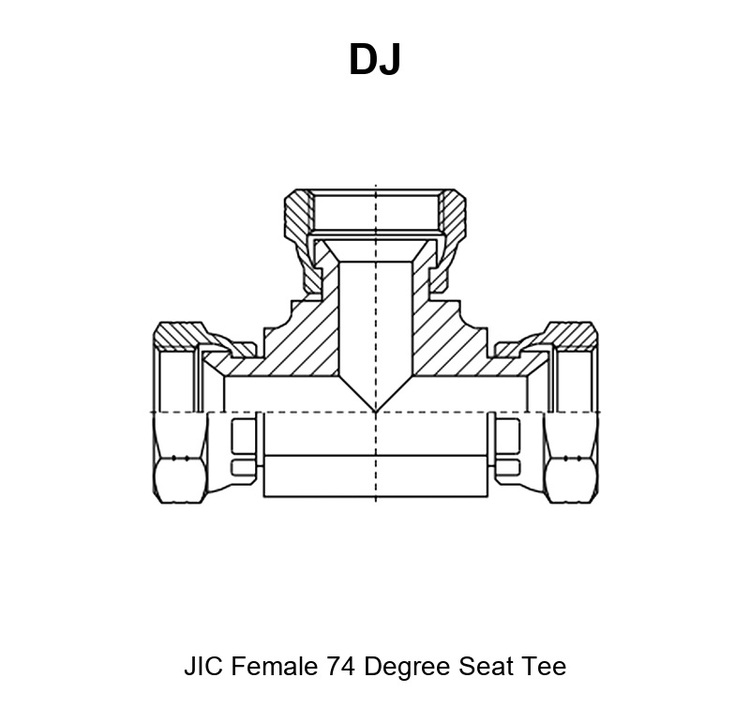
A DJ adapter is a three-port hydraulic tee with a female JIC 74 degree seat at every port, so a circuit can be split or combined at a point where all three connections are male 74 degree cone stud ends. Every row in the table is an equal tee: E, F and G carry the same thread size. The DJ adapter is a machined straight-body tee, with two ports on the run and one on the branch, and it seals metal-to-metal on the 74 degree cone seat, without an O-ring and without a thread sealant.
1. What a DJ Adapter Does
The DJ adapter joins three lines that all use the female 74 degree seat connection. It is a run tee adapter, so it does not simply pass a flow through: it divides the run or brings a branch line into it. Two of the three ports lie on a common axis and form the run, marked E and F on the drawing. The third port is the branch, marked G, and it is arranged at 90 degrees to the run so a pressure line, a gauge line, a return line or a pilot line can be taken out of the main circuit at that point.
Both connection ends of every row must match their mating stud ends exactly. Thread size and pitch, seat angle and seat condition all have to agree, because that agreement is the precondition for eliminating leakage at the conversion point. A hydraulic adapter of this type has three chances to leak instead of two, and it is also a bending load point, so the accuracy of the seat faces matters as much as the thread fit.
The sealing principle of this series is the 74 degree cone seat. This is a metal-to-metal joint: the male stud end carries a 74 degree cone, and it seats on the wide cone face machined inside each female port of the tee. The DJ adapter does not seal on a 37 degree flare, on an O-ring, on a flat face, or on tapered pipe threads, and it therefore cannot be used with a 37 degree flared hose end, an ORFS hose end, an O-ring boss stud or an NPT nipple. This is the single most important distinction to keep in mind when this tee is selected.
Core advantages of the series:
- Three female 74 degree seat ports on one machined body, forming an equal tee in every published size.
- Straight run plus a branch at 90 degrees, so one part splits a line without an extra fitting.
- Metal-to-metal 74 degree seat sealing, so no elastomer and no thread sealant are needed at the port.
- A separate hex at each port plus a body hex, so each connection can be tightened and re-checked independently.
- Sizes from 7/16″X20 through 1.5/16″X12, matching the SAE J514 74 degree seat family.
- Carbon steel with trivalent chromium zinc plating, or 304 / 316 stainless steel for corrosive service.
2. DJ Specifications
This tee adapter is described below by its two connection functions: the run, and the branch. Read the run block for the line that passes through the tee, and the branch block for the line that leaves it.
2.1 Connection 1 – Female 74 degree seat, run ports E and F
- Thread standard and family: SAE J514, SAE 74 degree seat and flareless family. The thread form is the unified fine thread used by the JIC 74 degree cone stud end of the same dash size.
- Thread sizes available at E and F: 7/16″X20, 1/2″X20, 9/16″X18, 3/4″X16, 7/8″X14, 1.1/16″X12, 1.5/16″X12.
- Gender: female adapter thread (internal) at both run ports.
- Sealing method: metal-to-metal contact on the 74 degree cone seat machined in each port, against the 74 degree cone of the mating male stud end. No O-ring, no bonded washer and no thread sealant is used at the seat.
- Mating port standard: a male 74 degree cone stud end of the same dash size and thread, as defined in the SAE J514 74 degree seat family.
- Arrangement: E and F lie on a common axis to form the run, so the flow enters one and leaves the other in a straight line.
2.2 Connection 2 – Female 74 degree seat, branch port G
- Thread standard and family: SAE J514, SAE 74 degree seat and flareless family, the same family as the run ports.
- Thread sizes available at G: the same seven steps as the run, because every row of the DJ table is an equal tee.
- Gender: female adapter thread (internal) at the branch port.
- Sealing method: metal-to-metal contact on the 74 degree cone seat of the branch port, against the 74 degree cone of the mating male stud end.
- Mating port standard: a male 74 degree cone stud end of the same dash size and thread as E and F.
- Arrangement: G is the branch port, arranged at 90 degrees to the run axis. It is the port that takes the third line out of or into the circuit.
2.3 Construction and Materials
- Body material: carbon steel, 304 stainless steel, 316 stainless steel or brass, selected per order.
- Plating: trivalent chromium zinc plating (Cr3+) or zinc-nickel plating on carbon steel bodies. Stainless steel bodies are supplied without plating.
- Seat form: each of the three ports is machined with an internal 74 degree cone seat. The seat faces are cut in the same set-up as the threads where the process allows, so the seat runs true to its thread.
- Seal material: this adapter carries no elastomeric seal, no O-ring and no bonded washer. The 74 degree seat is a metal-to-metal joint, and there is no elastomer to select and no elastomer to age.
- Machining process: the tee body is turned and milled from bar stock on CNC lathes and machining centres, the three seats and threads are cut, and the part is deburred.
- Hex features: the body carries four hex features in total. S1 is the width across flats of the first hex feature, and S2, S3 and S4 are the widths across flats of the hexes associated with the three ports. Confirm the hex-to-port assignment on the series drawing when wrench access is critical. Threads are gauged with plug gauges, and the seat faces and the common end dimension are checked against the drawing batch by batch before packing.
2.4 Pressure and Temperature
Temperature is governed by the body material, because this tee has no elastomeric seal to limit it. A carbon steel body with zinc plating suits general hydraulic service, and 304 or 316 stainless steel is selected for corrosive environments. Where a seal material question arises elsewhere in the same circuit, the published material ranges are approximately -30°C to +100°C for NBR, -20°C to +200°C for FKM and -40°C to +120°C for EPDM elastomers.
Working pressure for a given DJ size is confirmed per order by HENGHUA engineering, based on the thread size, the body wall thickness, the sealing method and the material selected. No single pressure figure is published here for a specific size, because a 7/16″X20 tee and a 1.5/16″X12 tee do not share one rating. A tee also concentrates stress where the branch meets the run, so the branch load expected on the installation is part of the selection and is reviewed with the enquiry.
2.5 Part Number and Dimension Table
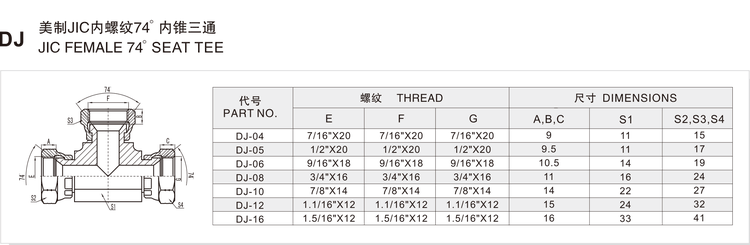
The table below is the complete published dimension table for the DJ JIC adapter series. Every row is reproduced in printed column order.
| PART NO. | E | F | G | A,B,C | S1 | S2,S3,S4 |
|---|---|---|---|---|---|---|
| DJ-04 | 7/16″X20 | 7/16″X20 | 7/16″X20 | 9 | 11 | 15 |
| DJ-05 | 1/2″X20 | 1/2″X20 | 1/2″X20 | 9.5 | 11 | 17 |
| DJ-06 | 9/16″X18 | 9/16″X18 | 9/16″X18 | 10.5 | 14 | 19 |
| DJ-08 | 3/4″X16 | 3/4″X16 | 3/4″X16 | 11 | 16 | 24 |
| DJ-10 | 7/8″X14 | 7/8″X14 | 7/8″X14 | 14 | 22 | 27 |
| DJ-12 | 1.1/16″X12 | 1.1/16″X12 | 1.1/16″X12 | 15 | 24 | 32 |
| DJ-16 | 1.5/16″X12 | 1.5/16″X12 | 1.5/16″X12 | 16 | 33 | 41 |
How to read the columns:
- PART NO. is the ordering code. Every published DJ part number is an equal tee, so one dash code describes all three ports.
- E is the thread at the first run port, written in catalogue notation. The fraction and the number after X give the thread size and the pitch in threads per inch, so 9/16″X18 is a 9/16″ unified fine thread at 18 threads per inch.
- F is the thread at the second run port. E and F are identical in every row, because the run is parallel.
- G is the thread at the branch port. It is identical to E and F in every row of this table.
- A,B,C is the end dimension of the three ports, in millimetres. The three ports share one common value in every published row, which is why the column carries three letters against a single figure.
- S1 is the width across flats of the first hex feature on the body, in millimetres.
- S2,S3,S4 are the widths across flats of the hexes associated with the three ports, in millimetres. They are wrench sizes, not thread sizes.
Thread size and dash chart:
| Dash code | Nominal size | JIC thread | Part number | S1 (mm) | S2,S3,S4 (mm) |
|---|---|---|---|---|---|
| -04 | 1/4″ | 7/16″X20 | DJ-04 | 11 | 15 |
| -05 | 5/16″ | 1/2″X20 | DJ-05 | 11 | 17 |
| -06 | 3/8″ | 9/16″X18 | DJ-06 | 14 | 19 |
| -08 | 1/2″ | 3/4″X16 | DJ-08 | 16 | 24 |
| -10 | 5/8″ | 7/8″X14 | DJ-10 | 22 | 27 |
| -12 | 3/4″ | 1.1/16″X12 | DJ-12 | 24 | 32 |
| -16 | 1″ | 1.5/16″X12 | DJ-16 | 33 | 41 |
3. How to Read a DJ Part Number
The DJ part number has two parts: the series prefix and the dash size.
- DJ is the series prefix. It identifies the JIC adapter of this page: an equal female 74 degree seat tee with three ports, as listed in this table.
- The dash number is the size code. It follows the SAE J514 dash convention, in which the number is the nominal tube outside diameter in sixteenths of an inch: 04 means 4/16″ or 1/4″, 05 means 5/16″, 06 means 3/8″, 08 means 1/2″, 10 means 5/8″, 12 means 3/4″ and 16 means 1″.
- The dash size fixes the thread, not the tube size alone. DJ-08 carries a 3/4″X16 thread at all three ports, which is the thread used by the 1/2″ dash in the 74 degree seat family.
- No suffix is applied to any row in the DJ table. Other series in the same catalogue use suffixes such as -SP, -WD or -PK to mark a variant of that series; if a suffix appears on your drawing, quote the full part number including it.
Worked example using a real row of the table. Part number DJ-08 decodes as follows:
- Series: DJ, equal female 74 degree seat tee.
- Run ports E and F: 3/4″X16 female 74 degree seat, one port at each end of the run.
- Branch port G: 3/4″X16 female 74 degree seat, at 90 degrees to the run.
- Common end dimension A, B and C: 11 mm at each of the three ports.
- Body hex S1: 16 mm. Port hexes S2, S3 and S4: 24 mm.
4. Installation and Fitment
A 74 degree seat joint is made by drawing the male cone into the female seat until the two metal faces meet. Tightening is a feel-and-angle operation rather than a flat torque figure. Bring the stud end in finger-tight, then snug it with a wrench and continue only as far as the port maker’s specification requires. The joint is metal-to-metal, so once the cone face is fully seated no further tightening improves the seal; it only loads the thread and the body.
Keep the seat faces clean and free of burrs and old sealant. A 74 degree seat seals on a machined cone face, and a single nick or a trapped chip will produce a weep that no amount of tightening will remove. Do not apply PTFE tape or liquid sealant to the cone face of the stud end; sealant belongs on tapered pipe threads, not on this joint. Where the connection runs through a swivel nut, oil the thread lightly so the nut turns freely and the cone is not dragged across the seat.
Because this is a tee, alignment is a design issue as well as an assembly issue. Support the branch line so that its weight and its vibration are not carried by the tee seat, and tighten the three connections in an order that does not pre-load the body.
Assembly steps:
- Confirm that each mating stud end is a male 74 degree cone of the same dash size and thread as E, F and G, and that it is not a 37 degree flare or an O-ring boss.
- Inspect the three seats and the mating cones for nicks, burrs, corrosion and trapped debris.
- Clean the threads and the cone faces, and remove any old sealant from the threads.
- Fit the stud ends hand-tight, then line up the branch at 90 degrees to the intended run direction.
- Snug each connection with the correct wrench on the port hex, and hold the body with S1 so the tee is not twisted as a whole.
- Leak-check the assembly at the pressure agreed for the system, then re-check the branch alignment and the wrench marks on all three connections.
Common fitment errors and their symptoms:
- Fitting a 37 degree flared hose end into a 74 degree seat port. The two cone angles differ, no full metal-to-metal contact is generated, and the joint weeps from the first pressurisation.
- Applying thread sealant to the cone face. The symptom is a joint that will not seat and a seat face contaminated with a cured film.
- Over-tightening to stop a weep. The symptom is a stretched thread or a distorted seat, because the metal faces are already in contact and further torque only deforms the joint.
- Carrying the branch load on the tee. The symptom is a weep that appears only when the branch line is pressurised or vibrating.
- Mixing dash sizes across the tee. The symptom is a thread that starts easily but reaches seat contact at a different depth than the other two ports.
5. Applications and Industries
Application tags for this hydraulic adapter: hydraulic systems, oil and gas, industrial equipment, construction machinery, agriculture, marine and material handling.
Concrete scenarios where a DJ adapter earns its place:
- Dividing a pressure line without an extra fitting. A single tee placed on a manifold run splits oil to a cylinder and to a pressure gauge line. All three outlets are female 74 degree seat, so the branch and the run use the same stud ends and the same wrench size.
- Return and pilot line take-off. The 74 degree seat family is common on mobile equipment circuits, and a tee in the return line can feed a cooler or a pilot circuit without a second adapter.
- Test and service benches. A bench working with 74 degree seat hose ends needs a way to bring in a gauge or a second circuit, and the tee does that with one part.
- OEM assembly lines. Where a machine is designed entirely in the SAE J514 74 degree seat family, the tee keeps the whole run on one thread and one seat angle, so an operator never has to identify a mixed joint at the station.
The same part suits fluid power circuits, agricultural implement hydraulics, marine deck equipment, construction machinery and material handling systems, provided every mating stud end is a male 74 degree cone of the same dash size and the fluid suits the body material chosen. For offshore and coastal service, 304 or 316 stainless steel is the usual selection.
6. Replacement and Cross-Reference Guide
Replacement selection for this hydraulic adapter is organised by thread standard and sealing method, never by brand or catalogue number. A female 74 degree seat tee adapter is identified by three measurements, and nothing else is needed to find a matching part in the DJ table.
Measure these three things:
- Measure the thread at each port: thread outside diameter and pitch in threads per inch. The dash sizes in this table run 7/16″X20 to 1.5/16″X12, and a matching part must agree on both the diameter and the pitch.
- Check the seat angle. A 74 degree seat is a wide cone seat, and it is not the same joint as a 37 degree flare. Look at the cone face of the mating stud end, or check the mating part against SAE J514, before ordering.
- Confirm the port gender and the port count. The DJ series is a female adapter at all three ports and is an equal tee, so it replaces a worn or damaged female 74 degree seat tee of the same dash size. It does not replace a male-to-male run tee, a reducing tee or a cross.
Once the three answers are known, choose the row whose E, F and G columns match the measured thread. Check S1 and S2, S3, S4 against the wrench clearance available around the branch before ordering.
Series that are commonly confused with DJ and are not interchangeable: the SAE J514 JIC 37 degree flare family, which seals on a conical flare face of a different angle; the SAE J1926-3 / ISO 11926-3 O-ring boss family, which seals with an O-ring on a straight-thread stud end and a lock nut; the SAE J1453 ORFS family, which seals on a flat face against an elastomeric O-ring; and the NPT and BSPT tapered pipe thread families, which seal on the thread flanks and need a sealant. Each of these seals by a different mechanism and must be matched to its own port standard.
7. Ordering, Packaging and Delivery
To order a JIC adapter from this series, give the series code plus the full part number, for example DJ-08, and confirm the following with the enquiry:
- Full part number, including any suffix shown on your drawing or packing list.
- Confirmation that the mating stud ends at all three ports are male 74 degree cones of the matching dash size and thread.
- Body material: carbon steel, 304 stainless steel, 316 stainless steel or brass.
- Plating for carbon steel bodies: trivalent chromium zinc plating (Cr3+) or zinc-nickel plating.
- Quantity and the required delivery date.
Packaging is arranged for both distributor shelves and direct-to-line OEM delivery: parts are packed in labelled bags or boxes carrying the full part number, with cartons marked for size and quantity. Sample orders and mixed-size trial orders are accepted for validation before a production release. Custom sizes, specials and drawing-based manufacture can be quoted for OEM programmes. Lead time is confirmed per order, because it depends on size, material, plating and quantity.
8. FAQ
What is the difference between JIC 37° flare and ORFS, and which should I use? A JIC 37° flare fitting seals metal-to-metal on a conical flare face, and it is specified by SAE J514 in the SAE 37° flared family. An ORFS fitting, specified by SAE J1453, seals on a flat face against an elastomeric O-ring held in a groove. Use the family that matches the port on your equipment. Neither one is a substitute for the DJ tee, which has 74 degree seat ports and seals on a wide cone face.
Can NPT and BSPT be interchanged? No. NPT is an American tapered pipe thread made to ANSI/ASME B1.20.1, and BSPT is a British tapered pipe thread made to ISO 7-1. They differ in thread form and pitch, so the same nominal size will often start by hand and then bind, and the joint will weep. Where a pipe thread has to meet a 74 degree seat port, use an adapter that converts between the two families instead of forcing a thread.
How do I identify the correct DJ adapter size? Measure the thread diameter and pitch of one port and match it to the E column of the table. A 3/4″X16 port calls for DJ-08, and a 9/16″X18 port calls for DJ-06. Confirm that all three ports on the equipment are the same size, because every published DJ part number is an equal tee, and check the hex sizes against the wrench clearance around the branch.
What seal material should I select for my fluid and temperature? This tee has no elastomeric seal, because the 74 degree seat is a metal-to-metal joint, so the material decision here is the body and the plating. Carbon steel with trivalent chromium zinc plating suits general hydraulic service, and 304 or 316 stainless steel is selected for corrosive environments. Where an elastomer is used elsewhere in the same circuit, the published ranges are approximately -30°C to +100°C for NBR, -20°C to +200°C for FKM and -40°C to +120°C for EPDM.
How is the working pressure of this adapter determined? Working pressure is confirmed per order by HENGHUA engineering, based on the thread size, the body wall thickness, the sealing method and the material selected. Because a 7/16″X20 tee and a 1.5/16″X12 tee do not share one rating, no single figure is published for the whole series. The branch load and the support arrangement of the branch line are also part of that review, because a tee concentrates stress where the branch meets the run.
What is the minimum order quantity and can I get samples? Sample orders and mixed-size trial orders are accepted for validation before a production release. Minimum order quantity depends on the size, the material and the plating selected, and it is confirmed with the quotation. Send the full part number and the quantity you need, and the order desk will quote the smallest practical release quantity for that configuration.
Can a 37° flared hose end be fitted into this tee? No. A 37° flare seals on a conical flare face at 37 degrees, while these ports seal on a 74 degree cone seat. The two angles do not match, so the flare cannot reach full metal-to-metal contact and the joint will weep. Use a male 74 degree cone stud end of the matching dash size, and keep 37° flared assemblies on their own ports.
Can I use the DJ adapter as a run tee with one port plugged? It is a three-port equal tee, so any of the three ports can be closed to make a two-port run only if the plugging method provides a seal at the 74 degree seat and is rated for the system pressure. The usual answer is to keep all three ports in use or to select a different part for a two-port junction. Confirm the plugging arrangement with HENGHUA engineering so the seat and the branch thread are not damaged.
Send the full DJ adapter part number, the port sizes and the quantity you need, and HENGHUA will confirm the drawing, the material and the lead time with the quotation.
Related series in the same family: the 1J adapter (straight) and the 1J4 adapter (45° elbow). Browse the full Hydraulic Adapters range for the complete SAE J514 JIC, NPT, ORFS and ISO 6162 flange families.



 English
  Spanish
  Portuguese
  French
  German
  Arabic