
Asking how to choose a garden hose? The answer is four decisions in a fixed order: bore, material, couplings and storage. Bore sets the flow you feel and the reach you get. Material decides how the hose behaves in your coldest week. Couplings decide whether it seals on your tap. Storage decides how much of the coil you will have to lift.
This guide moves from principle to numbers to verification. You will see how bore changes flow, how wall material changes stiffness and weight, and how thread standards decide whether a fitting seals. Every figure below is either a published value with its condition, arithmetic labelled as calculated, or a stated production range. A single default bore would not fit every yard, so this guide gives the arithmetic instead. By the end you can write your own specification and compare two hoses on paper before you buy.
1. How to Choose a Garden Hose: The Four Variables That Decide It
What Are the Four Variables, in Order?
Work through bore, material, couplings and storage in that order. Bore sets how much water arrives and how far you can push it. Material sets how the hose feels in cold or heat and how long it lasts. Couplings decide whether the hose connects to your tap, your nozzle and your tools. Storage decides whether you will still enjoy using the hose next spring. If two hoses differ on bore, the other three comparisons become secondary.
Why Does the Order Matter More Than Any Single Feature?
A wide bore on a stiff hose is still hard to drag around a corner. A light hose with the wrong thread still leaks at the tap. The order matters because each decision narrows the next one. Fix the bore for your flow and reach first, then choose a material that tolerates your winter, then match the thread, then size the storage to the weight you will lift. The phrase how to choose a garden hose hides four separate decisions, and each one can be checked on paper.
What Can You Measure, and What Must You Judge?
Bore, inside area, mass per metre and working pressure are measurable and often published with conditions. Feel, coil memory and behaviour below freezing are harder to put on a label. Treat measurable numbers as hard filters and the softer qualities as tie-breakers. A pressure figure becomes a comparison only when its test condition travels with it.
What Is a Decision and What Is a Preference?
A decision changes whether the hose works for your yard. A preference changes only how it feels while it works. Bore, thread standard and pressure rating are decisions, because getting them wrong stops the job. Cover colour, handle shape and coil style are preferences, because they do not change flow or fit.
Does the Hose Form Change How You Compare Two Hoses?
The four variables apply whatever form the hose takes, so compare a coiled or an expandable hose by the same five written values rather than by its shape. Ask for the bore, the working pressure and the length as stated by the seller for that form, then run the same four filters. Form stays a preference unless it changes one of those values.
2. Which Garden Hose Size Suits Your Tap and Your Reach?
How Do the Common Bores Compare?
The four common nominal bores are half an inch, five eighths of an inch, three quarters of an inch and one inch. In metric terms those are 12.7 mm, 15.9 mm, 19.1 mm and 25.4 mm. The inside cross-section grows faster than the diameter, because area rises with the square of the bore. The term garden hose size refers to this nominal bore, also called the inside diameter (ID), not to the outside diameter (OD) of the hose.
Nominal garden hose size, bore, inside area and relative flow
| Nominal size | Bore (mm) | Inside area (mm²) | Relative flow at equal velocity |
|---|---|---|---|
| 1/2 in | 12.7 | 127 | 1.00 |
| 5/8 in | 15.9 | 198 | 1.56 |
| 3/4 in | 19.1 | 285 | 2.25 |
| 1 in | 25.4 | 507 | 4.00 |
Inside areas are calculated from the exact inch bores, 15.875 mm and 19.05 mm, then rounded to whole square millimetres; recomputing from the rounded metric bores above gives 287 mm² and 199 mm² instead.
What Does the Relative Flow Column Mean in Practice?
Relative flow compares two bores at the same water velocity, so it is a like-for-like ratio rather than a promise about your tap. At equal velocity, a five-eighths bore carries about 1.56 times the flow of a half-inch bore. A three-quarter bore carries about 2.25 times, and a one-inch bore about 4.00 times. These figures are calculated from the inside areas above. Your actual flow still depends on supply pressure, hose length and fittings.
Does the Outside Diameter Matter?
The outside diameter matters for storage and for fittings, not for flow. Flow depends on the inside bore. A thick cover can make a five-eighths hose look as large as a three-quarter hose while carrying less water. When you compare two hoses, confirm the bore from the written specification rather than from the look of the coil. Bore is also the first filter when you learn how to choose a garden hose for a specific yard, and it answers what size garden hose you need before the label does.
How Does Length Change the Flow You Feel?
Friction grows with length. The Hazen-Williams relationship uses a diameter exponent of 4.87, so friction loss falls very steeply as bore rises. Doubling the bore cuts friction loss by about 29 times, a figure calculated from that exponent. That is why a long run benefits from a larger bore, and why a thin hose feels weak at the far end of a big yard. Use the same bore for the whole run, because a narrow coupling, the fitting screwed or clipped to each hose end, creates a local restriction.
How Do You Pick a Length That Reaches Without Waste?
Measure the path the hose will travel, not the straight-line distance. Add for the route around beds, trees and corners, because every bend adds effective length. A hose that is far too long is heavy, slow to drain and awkward to store. One that is too short forces you to move the tap or buy an extension. A single hose in the 50 ft to 100 ft range covers many domestic gardens. A balcony or a rented courtyard may need 25 ft rather than 100 ft, where the same bore saves weight without losing reach.
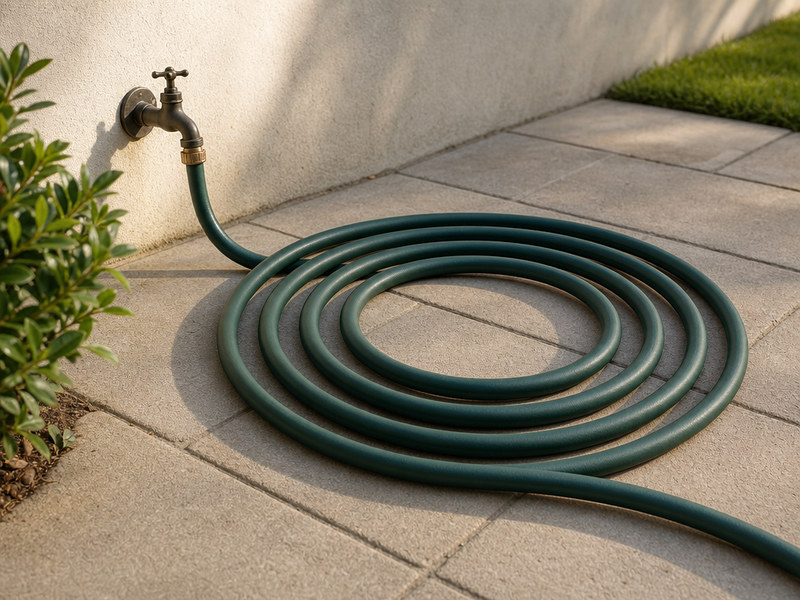
A garden hose coiled in wide loops beside a tap.
3. How Does Material Decide How the Hose Behaves?
Which Constructions Are Common, and What Does Each Do Well?
Four constructions cover most domestic garden hoses: plasticised PVC, often sold as vinyl, rubber such as EPDM, a hybrid of the two, and reinforced multi-layer hose. Each trades weight, flexibility, cold performance and price differently. None is superior at everything, and the right answer depends on your climate and how you use the hose. The table below shows a calculated mass per metre at a five-eighths bore, using the stated wall thickness and an assumed compound density of about 1.15 to 1.40 g/cm³.
Calculated mass per metre at a 5/8 in bore, by construction
| Construction | Wall (mm) | Mass per metre (g, calculated) |
|---|---|---|
| Plasticised PVC | 1.5 | about 115 |
| EPDM rubber | 2.0 | about 135 |
| Hybrid | 2.0 | about 140 |
| Reinforced multi-layer | 2.5 | about 166 |
Why Does PVC Stiffen in Cold Weather?
Plasticised PVC has a cold stiffness threshold below about 5 °C, which is 41 °F. Below that temperature the compound becomes noticeably harder to uncoil and more prone to cracking under a sharp bend. Rubber compounds keep more flexibility at low temperature, which is why cold-climate gardens often favour rubber or hybrid construction. If you garden where winters reach freezing, check the stated temperature range before you buy.
How Do Material and Climate Combine?
Choose for the worst week of your year, not the average. Hot sun attacks the plasticiser in plasticised PVC and can harden a cheap cover over a few seasons. Cold makes a stiff hose brittle at the bend. A hybrid keeps some of the light weight of plasticised PVC while borrowing the cold tolerance of rubber. For a climate-by-climate breakdown, see the PVC vs rubber garden hose comparison.
How Does Wall Thickness Change Weight?
Wall thickness sets three things at once: the mass per metre, the stiffness, and the resistance to kinking at a given bore. At a five-eighths bore the mass per metre rises from about 115 g for a plasticised PVC wall of 1.5 mm to about 166 g for a reinforced multi-layer wall of 2.5 mm. Those are calculated values, not measured product data. A 100 ft run is about 30.5 m, so 115 g per metre is roughly 3.5 kg dry and 166 g per metre is roughly 5.1 kg, both calculated. Weigh that trade-off against how far you carry the hose.
What About End of Life and Recyclability?
Material choice also affects what you do with the hose when it finally fails. Plasticised PVC is a single polymer, while some reinforced hoses combine several layers and a textile braid. Separating those layers is not always practical. Where recycling matters to you, ask the seller what the hose is made of and how it should be disposed of. Treat the answer as part of the specification, not an afterthought. A shelf label that counts plies tells you how many layers the wall has, not the bore or the working pressure, so ask for those two values as well.
4. What Makes a Kink Free Garden Hose Work in Practice?
Why Do Hoses Kink at All?
A hose kinks when the wall collapses at a tight bend and the inside passage closes. Thin walls, soft compounds and a wide bore all bend more easily. A kink does not just slow the water; it stops flow at that point and raises pressure upstream of the bend. A kink free garden hose is built so the wall resists that collapse. Reinforcement, a thicker wall or a hybrid construction each fight kinking in a different way.
Which Construction Resists Kinking Most Effectively?
Construction choices that affect kink resistance:
- A reinforced multi-layer hose uses a woven or cross-hatched layer that holds the wall round through a bend.
- A hybrid hose keeps a rubber-like outer skin that recovers its shape after being bent.
- A thicker wall raises stiffness and resists collapse, at the cost of added weight.
- A smaller bore bends to a tighter radius before the wall closes.
Does a Kink Free Claim Need a Condition?
Any hose can kink if you force it tightly enough, so read the claim with its condition. Manufacturers usually mean the hose resists kinking under normal handling, or that it recovers when the bend is released. The two practical questions are how to stop garden hose from kinking on a real route, and how to keep hose from kinking when it is put away under load. Ask whether the claim applies at the working pressure or only when the hose is empty. A hose that stays round when empty can still flatten when it is charged and hot.
How Do You Test Kink Resistance Yourself?
Fill the hose, close the far end and bend it through a tight curve while watching the flow at the nozzle. Note the point where the flow drops. Repeat the same bend after the hose has sat in the sun, because heat softens the wall. A hose that survives both tests is likely to serve you well. This simple check tells you more than any single word on a label.
Where Should You Route a Hose to Avoid Kinks?
Route the run so the hose bends in long, even curves and never doubles back on itself. Keep the curve radius generous when the hose leaves the tap and enters the nozzle, because those two points see the sharpest angles. Avoid pulling the hose around a corner against a wall, which forces a tight fold. A smooth route does as much for kink resistance as the hose construction itself, and it costs nothing.
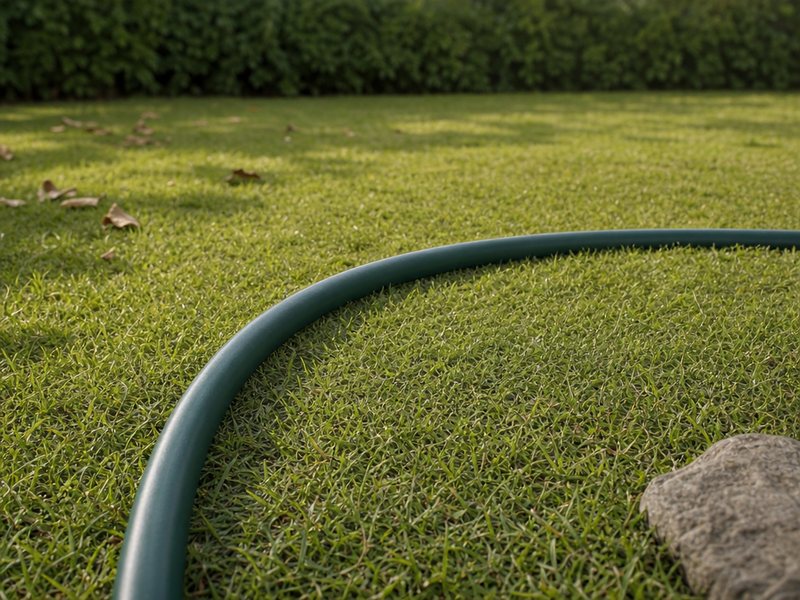
A hose bending round a wide curve instead of a sharp fold.
How Do You Recover a Hose That Has Already Kinked?
Empty the hose and lay it straight so the wall can relax, then check the collapsed point for a whitened, cracked or creased wall. Refill it and compare the flow at the far end with the flow you had before the kink. A hose that keeps folding at the same spot has taken a permanent set, so treat how to prevent hose from kinking there as a routing job rather than a material job.
5. Which Garden Hose Nozzle and Couplings Fit Your Tap?
What Thread Does a Garden Tap Use?
Most garden taps and hose ends use garden hose thread (GHT), also written NH. This is the garden hose thread size quoted on taps and fittings. It is a straight thread at three quarters of an inch nominal with 11.5 threads per inch, and it seals on a rubber washer rather than on the threads. Pipe thread, or NPT, is different: it is tapered at a ratio of 1:16 and seals on the threads themselves. Mixing the two without an adapter is a common cause of leaks.
Garden hose thread and pipe thread compared
| Standard | Form | Seals on | Typical use |
|---|---|---|---|
| GHT / NH | Straight, 3/4 in nominal, 11.5 threads per inch | Rubber washer | Garden taps and hose ends |
| NPT | Tapered 1:16 | The threads | Pipe and metal fittings |
How Do Couplings and the Garden Hose Nozzle Interact?
Every coupling and every nozzle restricts the line, and two restrictions in series cost more flow than one. If you fit a narrow nozzle to a wide hose, the nozzle sets the flow and the hose bore is wasted. If you fit a wide nozzle to a narrow hose, the hose starves the nozzle. Match the garden hose nozzle sprayer to the bore when its head has a fixed orifice, and choose an adjustable one when your jobs vary. Quick-connect garden hose fittings add a small restriction and a possible leak point, so check the thread and the washer on every garden hose sprayer connection.
Which Nozzle Type Suits Which Job?
Match the nozzle to the task:
- A spray gun gives a controlled fan for beds, cars and paths.
- An adjustable nozzle changes pattern and pressure with a twist.
- A high-pressure jet reaches a fence or a drain but uses more water.
- A fan or soaker head spreads water gently over a seed bed.
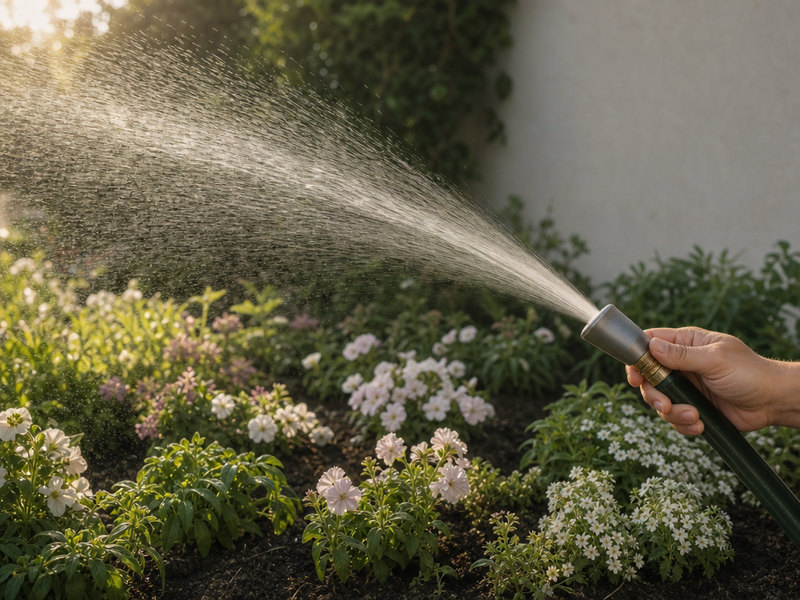
A fan spray head held over a flower bed.
Why Does a Washer Matter More Than the Thread?
A garden hose thread seals on a rubber washer, so a perished washer leaks even when the thread itself is sound. Replace the washer before you blame the fitting. Keep a few spares, because they cost little and fail with age and heat. A tapered pipe thread seals on the threads instead, so it needs sealant rather than a washer. Knowing which seal your joint uses tells you where to look first.
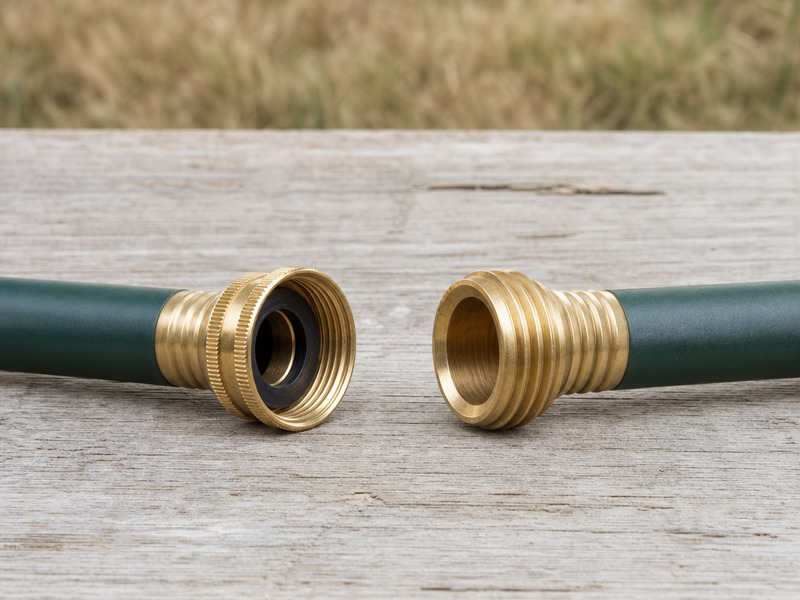
Two hose ends side by side with a rubber washer in place.
What Does the Nozzle Do to the Pressure You Feel?
A nozzle trades flow for speed. Force the same flow through a smaller opening and the water leaves faster, which is why a jet feels powerful. The pressure at the tap does not change; the nozzle simply converts pressure into velocity. A domestic supply planning range of 40–80 psi is a useful assumption, not a guarantee. Measure your own static pressure if a nozzle behaves unexpectedly.
When Should You Change the Fittings Instead of the Nozzle?
Thread standards are the step most buyers miss when they learn how to choose a garden hose. If the hose will not seal on the tap, the problem is usually the thread or the washer, not the nozzle. Replace a hardened washer first, because it costs little and fails often. If the tap uses a different standard, fit a proper adapter rather than forcing a mismatched coupling.
6. How to Choose a Garden Hose Storage Solution That Works
What Sets the Size of the Storage You Need?
Storage has to hold the hose when it is empty but still wet, so it must drain and it must be sized to the coil. A mounted reel, a cart, a wall hook and a box each suit a different yard. The key numbers are the hose length, the outside diameter of the coil and the weight when charged. Work out the weight on paper before you choose, because a full hose is far heavier than the dry coil. A cart suits a gardener who moves between beds, and a wall hook suits a renter who cannot fix a reel to a wall.
Why Does Weight Decide the Storage?
Water weighs one kilogram per litre, so one litre weighs one kilogram and one US gallon weighs about 3.79 kilograms. Combine that with the mass per metre above to estimate what you will actually lift. If the total is more than you want to carry, choose a cart or a reel with a swivel so you pull the hose instead of carrying it.
How Do You Plan Garden Hose Storage for a Small Space?
For a small yard, a wall-mounted reel keeps the coil off the ground and out of the way. A box keeps the coil tidy but needs a level spot to stand on. A hook is cheap but leaves the coil in the sun. Whatever you choose, drain the hose before you coil it, and keep it out of direct sun to slow UV damage. A garden hose storage box must both drain and shade the coil; a box that seals the hose in holds the water against it.
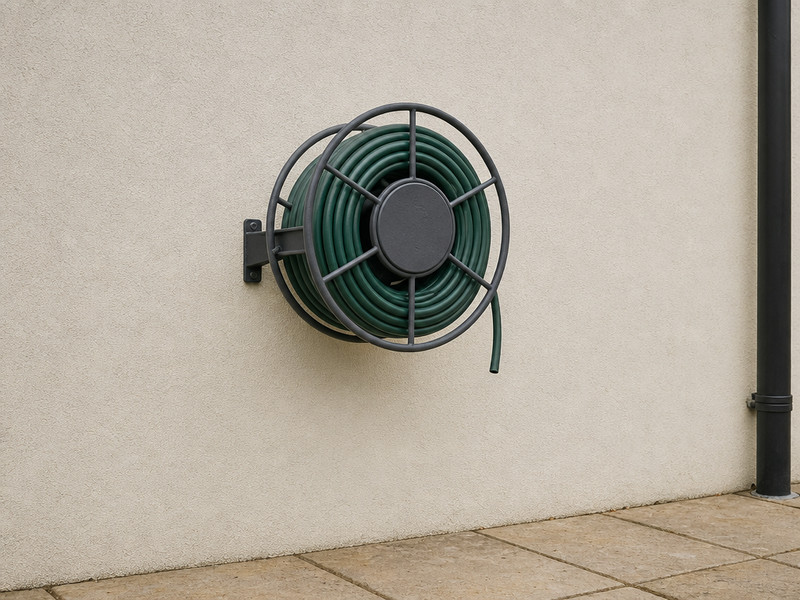
A wall-mounted reel holding a drained coil clear of the ground.
How Should You Coil a Hose So It Lasts?
Coil the hose in wide loops rather than tight turns. Wide loops avoid training a permanent bend and keep the wall round. Drain the hose first so the coil is light and does not trap water. Hang or reel the coil so air can reach it.
What Shortens Hose Life in Storage?
What shortens hose life when the hose is put away wet:
- Trapped water that freezes inside the bore and splits the wall.
- Direct sunlight that hardens the cover over several seasons.
- Tight coils that train a permanent bend into the hose.
- Kinks left under load, which fatigue the reinforcement.
7. Which Pressure Ratings and Durability Claims Should You Check?
What Do Working Pressure and Burst Pressure Mean?
A working pressure is the level a hose should see in normal service. A burst pressure is the level at which the wall fails in a test. The ratings used on this site are 150 psi working and 400–500 psi burst. Treat the two numbers as separate filters: the working rating decides whether the hose suits your supply, and the burst rating sets the margin above it. Always ask which of the two a seller is quoting.
Pressure and supply values used on this site, with metric equivalents calculated
| Item | Value used | Metric (calculated) |
|---|---|---|
| Working pressure | 150 psi | 10.3 bar |
| Burst pressure | 400–500 psi | 27.6–34.5 bar |
| Burst-to-working ratio, general service | 3:1 | same ratio |
| Burst-to-working ratio, higher consequence | 4:1 | same ratio |
| Domestic supply planning range | 40–80 psi | 2.8–5.5 bar |
What Burst-to-Working Ratio Is Reasonable?
A common rule is a burst-to-working ratio of 3:1 for general service. Where a failure could injure someone or release a large volume, a ratio of 4:1 is more appropriate. Check that the working pressure sits well below your supply. A domestic supply planning range of 40–80 psi leaves a wide margin against a 150 psi working rating, but a pressure-washer feed or a shock surge can spike higher. If your tap is a low-pressure gravity feed, run the arithmetic at that pressure rather than at the planning range.
How Does Bore Change Friction and Durability?
A narrow bore raises friction loss steeply over a run of any length, because the Hazen-Williams friction-loss diameter exponent is 4.87 and the loss grows faster than the bore shrinks. A hose that is too thin for its length runs at higher internal pressure for the same flow, which stresses every joint. Matching bore to run length is therefore a durability decision, not only a flow decision.
What Do Sunlight and Ozone Do Over Time?
Sunlight and ozone age the cover of any hose, whatever the compound. Ultraviolet light breaks down the surface, and the damage shows first as a dull, stiff or cracked skin. Keeping the hose out of direct sun when it is not in use is the simplest defence. Storage in shade does more for service life than any coating claim, and it costs nothing.
What Does a Pressure Rating Cover, and Where Does It Stop?
A pressure rating covers the wall under steady internal pressure; these four things sit outside it:
- Damage from dragging the hose over a sharp edge or a hot surface.
- Ageing of the cover under sunlight and ozone.
- Kinks that concentrate stress at a single point.
- Repeated bending at a coupling, which fatigues the joint.
How Do You Verify a Durability Claim?
Ask for the test condition behind any claim. A burst or impulse test states the pressure, the temperature and the number of cycles. Without those, the number cannot be compared with another product. For how to choose a garden hose on evidence rather than adjectives, the test method matters more than the headline figure. If a seller cannot state the condition, treat the claim as a description rather than a measurement.
8. How Do You Compare Two Hoses Before You Buy?
What Should You Write Down?
Write a specification profile for each candidate before you decide:
- Bore and length, so you can compare flow and reach on equal terms.
- Working and burst pressure, each with its stated test condition.
- Material and wall thickness, which set weight and cold behaviour.
- Thread type and end fittings, to confirm the hose fits your tap and tools.
- Stated storage and temperature range, to match your climate.
How Do You Compare Flow on Paper?
Multiply the inside area of each candidate by the same assumed velocity and compare the relative figures. The relative flow column above does this for the four common bores: 1.00, 1.56, 2.25 and 4.00. If two hoses share a bore, they deliver the same flow at the same pressure over the same length, whatever the cover looks like.
How Do You Compare Weight and Handling?
Use the calculated mass per metre to estimate the dry weight of each candidate, then add the water it holds. A stiffer hose feels heavier because it resists bending, even at the same mass. If two hoses are close on mass, pick the one with the better cold rating for your climate.
What If Two Hoses Pass Every Filter?
If two candidates pass all five written values, choose the one with the easier handling. A hose you can coil without effort gets used more often. If they are still equal, choose the one with the clearer published conditions, because a verifiable specification is worth more than a vague claim. There is no single winner across all yards; there is only the hose that fits your route and your habits. A good quality garden hose and an easy to use garden hose are simply the ones that pass these filters while the numbers stay close.
What Closes the Decision?
Decide with the four variables in order: bore, material, couplings, storage. Any hose that passes all four decision variables is a sound choice for your yard. The remaining differences are preference, not performance. For a repeatable method you can use on any yard, this page shows how to choose a garden hose by the numbers rather than by the label. For the underlying families of water hose, see the types of water hoses guide, and for bore selection in more depth, see the hose size selection guide. Our own garden hose constructions are listed on the consumer products page.
If you would rather not run the arithmetic yourself, send your route length, your tap pressure, the thread on your tap and the tools you need to feed through our contact page. We will return a specification profile for your yard.
FAQ
What Is the First Thing to Decide When Buying a Garden Hose?
Decide the bore first, because it sets flow and reach before any other feature matters. The four common bores are half an inch, five eighths, three quarters and one inch, or 12.7 mm, 15.9 mm, 19.1 mm and 25.4 mm. Then confirm the length covers your route. Material, couplings and storage follow once the bore is fixed.
How Do I Choose a Garden Hose Size for a Long Run?
Choose a larger bore for a long run, because friction loss rises as the bore falls, and it rises steeply: the friction-loss diameter exponent is 4.87, so a wider bore lowers the push the water needs. Measure the route rather than the straight line, and keep one bore for the whole run. Avoid a narrow extension at the far end.
Is a Kink Free Garden Hose Worth the Extra Cost?
It is worth it if you coil and uncoil the hose often, or if you route it around tight corners. A kink free garden hose resists the wall collapse that stops flow, so you spend less time walking back to fix a bend. If your hose stays on a flat, open run, the benefit is smaller. Check the condition behind the claim either way.
Where Should Garden Hose Storage Go in a Small Yard?
Put garden hose storage where the hose ends anyway, and keep it off the ground. A wall-mounted reel or a hook near the tap saves space and lets the hose drain. A box hides the coil but traps water and heat unless it drains. Whichever you choose, shade the coil and drain the hose before you put it away.
Which Garden Hose Nozzle Is Best for Watering Beds?
A fan or soaker head suits beds best, because it spreads water gently and avoids washing soil away. A spray gun suits paths and cars, and a jet suits cleaning rather than watering. Match the garden hose nozzle to the job and to the bore. A fixed narrow nozzle on a wide hose wastes the capacity of the hose.
Is There a Short Checklist for How to Choose a Garden Hose?
Yes. Check the bore against your flow and reach, the material against your climate, the thread against your tap, and the storage against the weight you will lift. Then compare working and burst pressure with their stated test conditions. Write the five values on one line and compare candidates side by side.
What Pressure Rating Should a Garden Hose Have?
A working rating of 150 psi paired with a burst rating of 400–500 psi is the combination this site quotes, and the pair matters more than either number alone. Check the ratio: 3:1 suits general service, and 4:1 suits a situation where failure could injure someone. Write the condition beside each figure, so that two ratings can be compared.
Do I Need a Rubber or a Vinyl Hose?
Choose rubber or a hybrid if your winters freeze or you garden in strong sun, because rubber keeps flexibility at low temperature. Choose plasticised PVC for light weight and lower cost in mild conditions, but note its cold stiffness threshold below about 5 °C, or 41 °F. Match the material to the coldest week your garden sees, not to the mildest.
How Long Should a Garden Hose Last?
Service life depends on material, sunlight and storage, so no single number applies. A hose kept out of the sun, drained and coiled loosely outlasts one left charged on a hot path. Reinforcement and a rated working pressure are signs of a longer-lived construction. Check the stated storage and temperature range on the label before you buy.
Can One Hose Carry Drinking Water and Water the Garden?
Only a hose labelled for potable water should carry drinking water. Choose a hose with an explicit drinking-water rating on the label, because some compounds can affect taste. If there is no such statement, keep the hose for the garden and use a separate rated hose for drinking water.
Are All Garden Hoses the Same Size?
No. The bore sets the flow, and two garden hose sizes that look the same on the shelf can differ inside. A hose sold as a five-eighths model usually measures 15.9 mm inside, while a nominal three-quarter hose measures 19.1 mm, so the flow difference is real. Read the bore from the published specification, or measure the inside diameter with a caliper, before you compare two hoses.
What Is a Good Garden Hose for a Small Yard?
For a small yard, a good garden hose is one you can coil and carry without effort: a five-eighths bore, a length matched to the route, and a wall stiff enough to resist kinking at the tap. Weight decides more than any label, because a hose you avoid using waters nothing. Match the length to the path, then confirm the thread and the washer fit your tap.
About HENGHUA
HENGHUA is a hose manufacturer supplying distributors, retailers and OEM or private-label programmes. Our families include GLOBHOSE for high-performance hydraulic hose and FLEXMAX for flexible industrial hose, alongside a garden hose range. We support custom branding and tailored product solutions. Our technical content team publishes guides such as this one to show how to choose a garden hose on measurable terms, and to state the limits of what a rating can tell you.
This guide treats a rating as incomplete until its test condition is known, so a buyer can compare two figures on equal terms rather than on the headline number alone.
To see the current range, visit the shop, or send an enquiry through our contact page.






 English
  Spanish
  Portuguese
  French
  German
  Arabic
  Russian
  Indonesian
  Japanese
  Korean