
Hose permeation is the movement of a chemical through the wall rather than along it. Molecules absorb into the inner surface, diffuse through the polymer and desorb from the outside, driven by a concentration gradient. The rate depends on the polymer, the temperature, the chemical and the wall thickness, which is why a bare claim that one hose “leaks less” means nothing without conditions attached.
PTFE passes least of the common linings, PP most, and the gap widens as temperature rises. This guide explains the mechanism, ranks the common linings, and sets out what a supplier should be asked to prove before a permeation limit is written into an order.

Figure 1. The raised patch sits between two binding marks, with the cover still intact over it.
What Is Hose Permeation?
The wall build sets how much polymer sits in that path, which is why hose permeation is quoted against a build rather than against a polymer name. A thin film stack puts less material between the product and the air than a thick rubber tube, and the difference is one a plant can measure on a length of hose rather than argue about.
The driving force is the difference in concentration between the inside and the outside. That is why a hose left full of solvent permeates faster than one that has been drained, and why ventilation around the hose matters as much as the liner.
Permeation through a hose wall is not a defect. Every polymer passes some chemical, and for hose permeation the question is the rate, the conditions and whether the amount matters for the duty.
Where it does matter, the consequences are odour, product loss, worker exposure and, in enclosed spaces, a flammable atmosphere. Each has a different threshold, which is why one number cannot serve all three.
Which Polymer Permits Least?
Among the linings used in composite hose, the ranking is consistent across chemical families even though absolute rates vary enormously.
| Lining | Relative permeation | Best use | Watch point |
|---|---|---|---|
| PTFE | Lowest | Solvents, aromatics, odour-sensitive duty | Cost, flexibility at small bore |
| UHMWPE | Low to moderate | Chemicals, abrasion, food | Higher than PTFE on aromatics |
| XLPE | Moderate | Water, dilute chemicals, fuel | Not for aggressive solvents |
| PP | Highest of the polyolefins | Aqueous product, food, dilute acids | Aromatics and solvents pass readily |
| Rubber families (CPE, EPDM) | Moderate to high, thickness dependent | Acids, oxidisers, slurry | Compounding affects the rate |
Table 1. Relative permeation by lining. Absolute values depend on chemical, temperature and thickness, so the table ranks rather than quantifies.
The gap between PTFE and PP is large enough to change a decision, as the PTFE comparison sets out for solvent duty. A hose that smells of solvent through a PP liner can be addressed by moving to a fluoropolymer, and no amount of extra PP thickness closes the gap completely.
Rubber-family linings sit in the middle and depend heavily on the compound. A thick CPE tube can pass less vapour than a thin PP film, which is why thickness and chemistry have to be considered together.
Why Does Temperature Change It So Much?
Diffusion is thermally activated. As a rough rule of thumb, the rate roughly doubles for every ten degrees of temperature rise, and the effect is stronger near a polymer’s softening point.
That rule explains a pattern plants notice without being able to name. A hose that is odour-free in winter becomes noticeable in summer, and a hose on a warm line smells worse than the identical hose on a cold one.
It also means a permeation figure quoted at ambient says little about a line running at 60 °C. The lining permeation rate at service temperature is the number that matters, and it is the one suppliers rarely publish.
Where a plant runs hot product through a polyolefin liner, permeation is often the limiting factor before chemical resistance is. The liner survives; the smell and the loss do not.
Does Thickness Help?
Yes, and roughly in proportion. Doubling the wall thickness halves the rate, because diffusion is a linear process through a homogeneous material.
The practical limit is that a thicker film costs flexibility and money, and composite walls have a fixed stack. Increasing the film means changing the build rather than adding a layer to an existing hose.
For a given bore, a heavier wall also reduces the bend radius and adds weight, which matters on a handled line. That trade is why thickness is rarely the first answer when permeation becomes a problem.
The first answer is usually a different polymer. The second is ventilation and detection. Thickness comes third, and mostly on rubber-family linings where the tube can be built heavier without changing the construction.
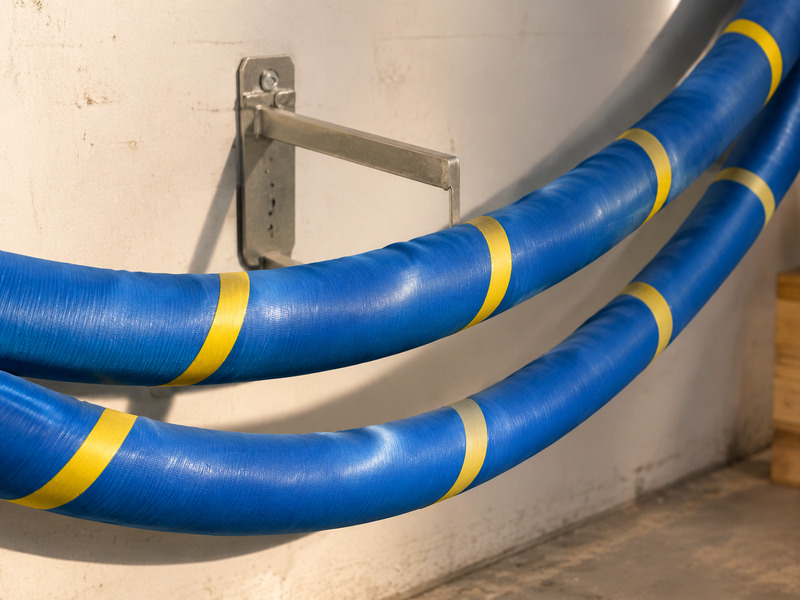
Figure 2. Side light picks out the ridges, and the dust on the rack shows the hose has hung there a while.
How Is It Measured?
Three methods appear in supplier data, and they answer different questions.
The gravimetric cup method measures weight loss from a cup sealed with a sheet of the material over time. It is the classic approach for liquids and is covered by standards for rubber and thermoplastic sheets.
Gas transmission methods measure the flow of a gas through a film under a defined pressure difference, and they suit volatile chemicals more than liquids.
Full-assembly testing measures the hose rather than a coupon, usually by detecting vapour in a chamber around a filled length. It is the most relevant and the least common, because it needs equipment and time.
When you ask for data, ask which method produced it. A coupon result on a film says nothing about the adhesive that bonds it to fabric, and the bond is a real permeation path in a composite wall.
What Does a ppm Permeation Hose Claim Mean?
Usually less than the buyer hopes. A number quoted in ppm without conditions is not a specification.
Four conditions are needed before a figure means anything: the chemical and its concentration, the temperature, the wall thickness or bore, and the area and time basis. Without them, two suppliers can quote ppm figures that differ by orders of magnitude and both be accurate.
The second problem is what the number refers to. A lining permeation rate may describe mass per area per time, a concentration in a chamber, or an odour threshold. Those are different quantities, and comparing them is a category error that survives because the units look similar.
The practical approach is to ask for the test report rather than the headline. A report shows the method, the conditions and the result, and it can be compared with another report produced the same way.
Where no report exists, a trial with a detector in the working area is a legitimate substitute, and the chemical resistance guide sets out how to read the compatibility data that goes with it. It measures the thing you actually care about, which is concentration where people work, rather than a laboratory number.
Where Does Permeation Become a Safety Issue?
In enclosed spaces, and on lines that run through buildings rather than outdoors.
A hose in a well-ventilated yard disperses vapour as fast as it is produced. The same hose in a plant room, a pit or a tunnel accumulates it, and the concentration can reach a flammable range at a rate that surprises people who have only seen the hose outdoors.
Three controls address it, and they are used together rather than as alternatives. Choose the lowest-permeation lining the duty allows, ventilate or detect in the enclosure, and inspect for the blistering that shows the wall is working harder than expected.
Electrical area classification matters here too. A hose passing vapour into a classified space is a source that the classification study should account for, and a change of product can invalidate an old study.
What Are the Mitigation Options?
| Option | Effect | Cost | When to use |
|---|---|---|---|
| Fluoropolymer liner | Large reduction | High | Solvents, aromatics, odour complaints |
| Thicker film | Proportional reduction | Moderate | Rubber-family linings |
| Shorter hose run | Less area, less total loss | Low | Layout allows it |
| Forced ventilation | Dilutes concentration | Moderate | Enclosed spaces |
| Gas detection | Warns before hazard | Moderate | Confined or classified areas |
| Drain after transfer | Removes the source | Very low | Whenever possible |
Table 2. Mitigation options in order of cost. The last row is free and is the one most often skipped.
Draining is worth its own note. A hose left full holds a reservoir of chemical against the liner, and the permeation continues overnight with nobody watching. A drained hose permeates from a film of residue rather than a column of liquid.
How Do You Specify a Permeation Limit?
Write the duty, the limit and the method.
The duty is the chemical, concentration and temperature. The limit is a maximum concentration in the working area, or a maximum mass loss over a period, whichever the plant can measure. The method is the test that produced the supplier’s figure, and it should match the one used to verify.
Then add one line for the response. If the measured concentration exceeds the limit, what happens? A hose change, a ventilation upgrade or a product change, decided in advance rather than in the moment.
That gives a supplier something to answer and an auditor something to re-check. One written as “low permeation” cannot, and it will be answered with a phrase.
Why Does Hose Permeation Matter Commercially?
Three costs, and only one of them appears on a maintenance budget.
A hose permeation problem usually arrives as a smell rather than a failure. The first cost is product loss. A line that passes vapour continuously loses material every hour it is filled, and on a high-value solvent that loss is measurable over a year.
The second is odour and complaint. A plant that smells of solvent at the boundary has a permeation problem whether or not any hose has failed, and the investigation usually starts with the cheapest component in the system.
The third is worker exposure. Occupational limits are set on concentration in air, not on mass loss, so a hose that is commercially acceptable can still be a compliance problem in a poorly ventilated area.
A permeation composite hose enquiry that names only the chemical leaves all three unanswered. The useful request names the working area, the concentration limit and the exposure time, because those decide which lining is worth the premium.
What Should You Ask Before Accepting a Number?
Ask for the report, not the figure, and check four things in it. The datasheet fields should carry the same four.
The chemical and its concentration. The temperature of the test. The thickness or the bore tested. And the quantity measured, with its units and its area or time basis.
Then check whether the test was on a coupon or on an assembly. A coupon result on a film is a material property; a permeation composite hose result on a full assembly includes the bond, the cover and the fittings, which is what the plant actually has.
Finally, check the date. Polymer formulations change, and a report from a decade ago may describe a liner that is no longer made.
Where the report is missing, a site test is a reasonable substitute: fill the hose, ventilate the area, and measure concentration where people work. That measurement is crude and it is directly relevant.
Where Do Permeation Specifications Go Wrong?
Two ways, and both are common in a permeation composite hose specification.
The first is specifying a lining permeation rate without a temperature. A rate measured at ambient, applied to a hot line, understates the problem by a factor that grows with every ten degrees.
The second is treating a ppm permeation hose claim as a guarantee. A ppm figure describes a test, not a service condition, and the service condition includes joints, fittings and the way the hose is installed.
The corrective is the same in both cases: name the condition, name the measurement, and agree what happens when the measurement is exceeded.
Frequently Asked Questions
What is hose permeation in simple terms?
It is chemical passing through the hose wall rather than through the bore. The liner absorbs it, it diffuses through, and it evaporates outside.
Which lining has the lowest permeation?
PTFE, among the linings used in composite hose. UHMWPE is next, then XLPE and PP.
Can a thicker liner stop permeation?
No, it slows it in proportion to thickness. A polymer that passes a chemical readily still passes it through a thicker wall, just more slowly.
Why does my hose smell more in summer?
Because diffusion is temperature dependent and roughly doubles for each ten degrees. The same hose permeates far more at 35 °C than at 15 °C.
What does a ppm permeation hose figure mean?
It depends entirely on the conditions and the quantity being measured. Ask for the test report, which states method, temperature, thickness and basis.
Is permeation a defect?
No. Every polymer passes some chemical. The question is the rate and whether it matters for odour, loss or safety.
Our product room is sealed and the smell reaches the office next door. Is that a hose fault?
Usually not, and the rate matters more than the smell. A hose that passes vapour at a measurable rate will load a sealed room over a shift, so the answer is ventilation or a different wall build rather than a tighter coupling. Get the rate first, then decide whether the hose is the right one for an enclosed space.
Does permeation affect burst pressure?
Not directly. A permeated hose can still hold its rated pressure, which is why a blister is a warning rather than a failure.
About HENGHUA
HENGHUA builds composite hose with PTFE, UHMWPE, XLPE and PP liners, and states which liner suits a permeation-sensitive duty rather than quoting a single figure. Where a client needs a test basis, we will say what can be provided and what cannot.
Send the chemical, temperature and the concentration limit you need to hold, and we will recommend the lining and the verification that goes with it.
Reviewed by the HENGHUA technical team. Last updated 11 November 2026.


 English
 Spanish
 Portuguese
 French
 German
 Arabic
 Russian
 Indonesian
 Japanese
 Korean