
Racores hidráulicos ORFS
ORFS Hydraulic Fittings: SAE J1453 O-Ring Face Seal Range
ORFS hydraulic fittings solve the one problem a flare connection cannot: weeping. Instead of sealing metal against metal on a 37° seat, an ORFS joint compresses an O-ring between two flat faces, so nothing has to deform to seal — and nothing wears out when the joint is serviced. Built to SAE J1453 (ISO 8434-3 internationally), the range covers dash sizes -04 through -24, with a published torque window and pressure classes that hold leak-free service in high-vibration, high-pressure mobile and industrial systems. This page gives you the full thread and torque chart, pressure classes, configurations, hose-side matching, installation rules, and ordering terms. Confirm your dash size from the tables, then request a quote in minutes.
Why Buy from Us
Five facts that separate us from a parts reseller:
| Trust Anchor | What It Means for You | |
|---|---|---|
| 1 | Factory Direct Manufacturer | We produce the fittings and ferrules, not just resell them. |
| 2 | Batch-Tested Quality | Dimension-inspected with calibrated gauges; salt-spray tested to at least 120 hours per ISO 9227. |
| 3 | ORFS in a Full Catalog | ORFS hydraulic fittings plus JIC, SAE O-ring boss, flange, BSP, NPT, and metric connections from one supplier. |
| 4 | Verified Quotes in One Business Day | Send the dash size, configuration, and hose type. You get a confirmed part number, price, and lead time in one working day. |
| 5 | Free Samples for Qualified Projects | Test the face seal and crimp quality before committing to production volume. |
Mostrando los 11 resultados
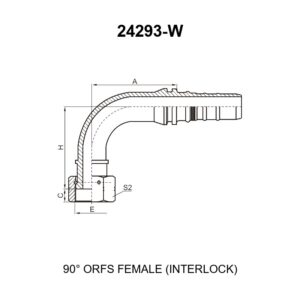
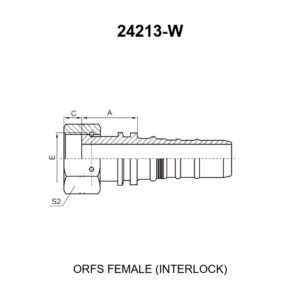
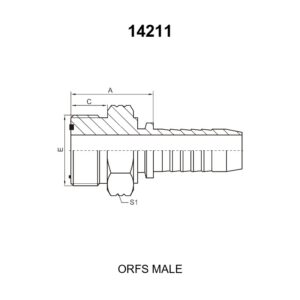
What Are ORFS Hydraulic Fittings?
ORFS stands for O-Ring Face Seal. An ORFS hydraulic fitting ends in a flat face with a machined groove that holds an O-ring; the mating half carries a flat face and a swivel nut. When you torque the nut, the two faces clamp together and the O-ring is compressed in its groove — that compressed O-ring is the entire seal. There is no metal-to-metal seat, no thread sealing, and no sealant.
This is the design’s advantage. A 37° flare depends on two metal seats deforming against each other, so a scratch, a re-torque, or a slightly misaligned tube can start a weep that gets worse with vibration. An ORFS face seal holds its sealing element inside a protected groove, which is why ORFS is specified on equipment where a film of oil on a fitting is not acceptable — and why the joint can be opened and re-torqued repeatedly without losing its seal.
| Factor | ORFS | JIC 37° Flare |
|---|---|---|
| Sealing element | O-ring compressed between flat faces | Metal-to-metal flare seat |
| Re-torque / repeated service | Forgiving — the O-ring is replaced, not the seat | Seat damage is permanent |
| Vibration behavior | High resistance; no seat fretting | Can weep under sustained vibration |
| Thread at dash -06 | 11/16-16 UN | 9/16-18 UNF |
| Sealant | Never | Never |
Core value: replace the O-ring, torque to the published value, and an ORFS joint seals leak-free for years — the face seal is the most forgiving high-pressure connection in fluid power.
Three customer paths:
- For OEM manufacturers — eliminate weeping joints and field warranty claims on high-vibration machines.
- For end users and maintenance teams — service a leak-free connection without replacing fitting bodies or seats.
- For distributors — stock dash -04 to -24 in rigid and swivel configurations with matched O-ring kits.
Key Specifications
Connection-Side: Threads and Torque (SAE J1453-1)
Every ORFS hydraulic fittings assembly starts with the thread size, and the torque window is narrow enough that feel is not an option. Values below are for dry threads at room temperature.
| Thread (UNF/UN) | Dash | Torque (Nm) | Max Remedial Torque (Nm) |
|---|---|---|---|
| 9/16-18 | -04 | 24–27 | 29 |
| 11/16-16 | -06 | 40–44 | 45 |
| 13/16-16 | -08 | 55–60 | 65 |
| 1-14 | -10 | 60–66 | 111 |
| 1-3/16-12 | -12 | 90–99 | 146 |
| 1-5/16-12 | -14 | 115–126 | 189 |
| 1-7/16-12 | -16 | 125–138 | 221 |
| 1-11/16-12 | -20 | 170–187 | 308 |
| 2-12 | -24 | 200–220 | 360 |
Note the traps. ORFS threads are straight UNF/UN, but they are not the same sizes as JIC at the same dash — a -06 ORFS is 11/16-16 while a -06 JIC is 9/16-18. And the maximum remedial torque is a ceiling for retightening a joint that has already been torqued; exceeding it stretches the nut and damages the faces.
Pressure Classes
ORFS hydraulic fittings are a high-pressure family, with capacity that declines as the size grows.
| Dash Range | Typical Working Pressure |
|---|---|
| -04 to -12 (to 1-3/16 in) | Up to about 400 bar (5,800 psi) |
| -16 (1-7/16 in) | About 315 bar (4,570 psi) |
| -20 (1-11/16 in) | About 250 bar (3,600 psi) |
| -24 (2 in) | Confirm for the exact configuration |
Assembly rating follows the lower of the hose rating and the fitting rating. On impulse or flexing service, derate further and confirm the value with our engineers before release.
Configurations
ORFS hydraulic fittings ship in the bodies below; every one shares the same face-seal principle, so the O-ring and torque window stay the same across the family.
| Configuration | Descripción | Typical Use |
|---|---|---|
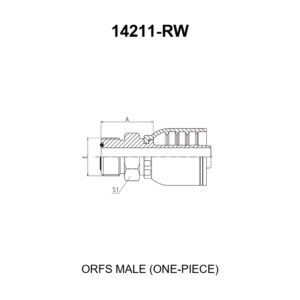
| ORFS male, rigid | Straight male face seal on a hose tail | Fixed routing into a swivel port |
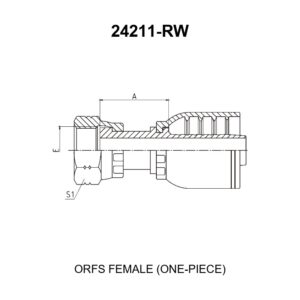
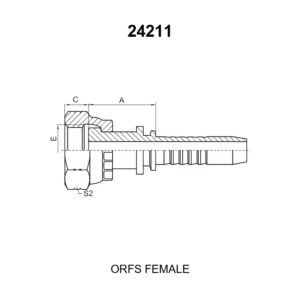
| ORFS female, swivel nut | Female with a swivel nut; the classic ORFS half | Connecting to a male ORFS port |
| ORFS male, swivel | Male end that rotates before final torque | Tight or awkward routing |
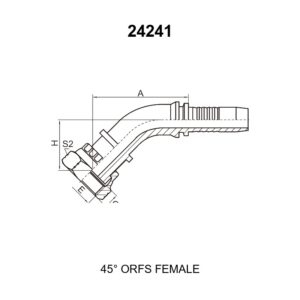
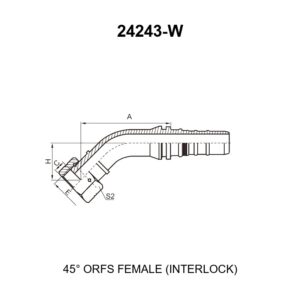
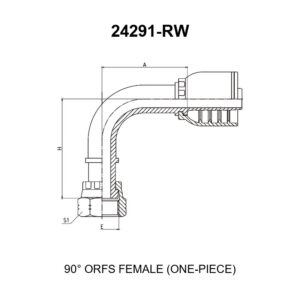
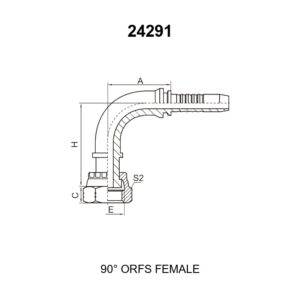
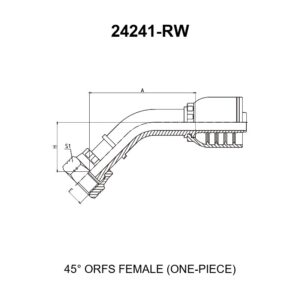
| 45° / 90° elbow | Angle bodies in either style | Routing around obstacles |
| Tee, cross, bulkhead | Multi-port and panel-mount bodies | Manifolds and bulkheads |
| Caps and plugs | Sealing faces for open ports | Test and transport protection |
| Adapters | ORFS to JIC, SAE ORB, BSPP, NPT, metric | Repair and conversion work |
Hose-Side: Matching the Crimp End
The hose end of every fitting in this range is crimped with the ferrule series matched to your hose family — 1SN and 2SN braided constructions for general and medium service, 4SP/4SH and R12 spirals for high pressure, and PTFE assemblies for corrosive media. The assembly pressure rating follows the hose family, so we confirm the hose, ferrule, and ORFS end as one matched set.
Materials and O-Ring Compounds
| Component | Standard Option | Corrosive-Service Option |
|---|---|---|
| Fitting body and nut | Carbon steel, zinc or clear trivalent chrome | Stainless steel |
| O-ring, standard | NBR (nitrile) for petroleum-based fluids | FKM for high temperature and aggressive fluids |
| O-ring, special service | EPDM for water-glycol and brake fluid service | PTFE-encapsulated for chemical resistance |
Standard NBR O-rings suit petroleum-based hydraulic oil; FKM extends the temperature range and resists aggressive fluids; EPDM suits water-glycol and automotive brake fluid. Confirm the compound against the fluid and temperature of your system — the O-ring is the only sealing element in the joint.
Key Features
- Face seal with the O-ring protected in a machined groove — no metal-to-metal seat to damage
- Zero-leak performance on high-vibration and high-pressure circuits
- Published torque window with a defined maximum remedial torque per size
- Repeat service: replace the O-ring and re-torque, rather than replacing the fitting
- Dash -04 to -24 in rigid, swivel, elbow, tee, bulkhead, and adapter configurations
Crimping and Installation
The crimp end follows the same discipline as any hydraulic assembly; the face seal end has its own rules. Work through both:
- Cut the hose square with a hose cutter or fine-tooth saw and remove all debris.
- Prepare the hose end per the hose maker’s instructions; skive where required (for example 4SH and R12).
- Insert the stem fully into the hose bore and slide the ferrule on, seated against the stem shoulder.
- Crimp with a hydraulic hose crimping machine to the target crimp diameter from the hose maker’s chart.
- Verify the crimp O.D. with a caliper and record the value.
- Lubricate the O-ring with a drop of the system fluid so it seats without rolling.
- Align both flat faces, hand-thread the nut, and confirm the faces are contacting squarely.
- Torque to the SAE J1453-1 value for your dash size with a calibrated wrench.
Rules that prevent face-seal failures:
- Never use thread sealant or PTFE tape; the O-ring seals, and tape shreds can enter the circuit.
- Inspect the O-ring and both faces whenever a joint is opened; replace a cut, flat, or swollen O-ring.
- Keep the faces clean and free of nicks — a single scratch across the groove gives fluid a path past the O-ring.
- Do not mix ORFS parts with JIC or SAE O-ring boss fittings, even when the threads appear to engage.
- Support the hose so vibration cannot work the nut loose or skew the faces.
Nomenclature: Describing an ORFS Fitting
An ORFS fitting is described by three fields. Learn them and you can read any line item:
| Campo | Meaning | Example |
|---|---|---|
| Dash size | The ORFS thread size | -08 (13/16-16) |
| Configuration | Rigid, swivel, elbow, adapter | Female swivel nut, 90° |
| Hose end | The hose size and family | -08 hose, 2SN |
A typical description reads: -08 ORFS female swivel, 90° elbow x -08 hose. We assign the exact part number, nut, and O-ring for your configuration on request — send the dash size, configuration, and hose family, and our engineers confirm the set before you order.
Matching and Identification
ORFS hydraulic fittings are often mistaken for other straight-thread connections because the threads look similar. Measure the thread and inspect the face:
| Feature | ORFS | JIC 37° Flare | SAE O-Ring Boss |
|---|---|---|---|
| Face appearance | Flat face with an O-ring groove | 37° cone seat | Flat base with an O-ring |
| Sealing element | O-ring compressed between faces | Metal flare seat | O-ring at the boss face |
| Swivel nut | Standard on the female half | Optional | Not applicable |
| Sealant | Never | Never | Never |
| Best for | Zero-leak, high vibration, high pressure | General high-pressure service | Port connections on manifolds |
The identification test that settles it: if the fitting has a flat face with a groove holding an O-ring and a swivel nut, it is ORFS. If it has a 37° cone, it is JIC. If the O-ring sits at the base of a straight thread that threads into a boss, it is SAE O-ring boss.
If you cannot identify a fitting on your machine, send photos with a ruler in the frame and we identify the style, dash size, and matching set free of charge.
Applications and Industries
ORFS hydraulic fittings are specified wherever a leaking joint is unacceptable:
- Mobile hydraulics on construction and earthmoving equipment
- Mining and drilling equipment under continuous vibration
- Agricultural machinery and implements
- Marine and offshore deck machinery
- Industrial power units, presses, and manifolds
- Machine tools and injection molding equipment
- Any circuit where oil weeping creates a safety, environmental, or warranty issue
Operating temperature follows the O-ring compound and the hose: standard NBR O-rings suit typical petroleum hydraulic service, while FKM compounds extend the upper range for high-temperature circuits. Confirm the combination against your fluid and hose data sheet.
Ordering and Packaging
- Unit of measure: sold per piece (EA); O-ring kits sold per set
- MOQ: one box per size; mixed-size sample kits available
- Supplied as complete sets: fitting, nut, and matched O-ring
- Customization: configuration, angle, material, O-ring compound, private labeling
- Export packing: corrugated cartons with moisture barrier for sea freight
ORFS Hydraulic Fittings FAQ
What does ORFS mean and how does it seal? ORFS stands for O-Ring Face Seal. The fitting ends in a flat face with a groove holding an O-ring; the mating half has a flat face and a swivel nut. Torquing the nut compresses the O-ring between the faces, and that compressed O-ring is the seal.
Can ORFS fittings replace JIC fittings? No. Both use straight threads, but the thread sizes differ at the same dash number and the sealing method is completely different — a 37° flare seat versus a flat face with an O-ring. The two systems must not be mixed.
Why is ORFS preferred for zero-leak systems? Because the sealing element is protected inside a groove rather than formed by deforming two metal seats. There is no seat to scratch or fret, so the joint resists vibration, tolerates repeated service, and does not develop the slow weep that flare connections can show over time.
Do ORFS fittings need sealant or PTFE tape? Never. The O-ring does the sealing. Sealant or tape contaminates the faces, and PTFE shreds can block downstream passages in valves and pumps.
What torque should I use? Use the SAE J1453-1 value for your dash size — for example 40–44 Nm for -06, 55–60 Nm for -08, and 90–99 Nm for -12, with a defined maximum remedial torque for retightening. Always use a calibrated torque wrench, and confirm the value for your specific configuration.
What is the difference between ORFS and SAE O-ring boss? Both use an O-ring, but they seal in different places. ORFS seals between two flat faces and the O-ring sits in a groove in the fitting face; SAE O-ring boss has a straight thread that goes into a port, with the O-ring sealing at the base against the boss face. They are not interchangeable.
Can I reuse an O-ring when I open a joint? Inspect it every time: a cut, flattened, or swollen O-ring will not seal again. In practice, keeping matched O-ring kits on the shelf and fitting a new one at every service is the cheapest insurance in a face-seal system.
- Manguera hidráulica2727 productos
- Manguera hidráulica en espiral con alambre de acero66 productos
- Manguera hidráulica trenzada con alambre de acero1010 productos
- Manguera hidráulica reforzada con tejido33 productos
- Manguera hidráulica termoplástica33 productos
- Manguera industrial5959 productos
- Manguera de aire99 productos
- Manguera de agua1111 productos
- Manguera de aceite1616 productos
- Manguera para productos químicos66 productos
- Manguera de vapor33 productos
- Manguera multiusos22 productos
- Mangueras para alimentos y bebidas44 productos
- Manguera para hormigón44 productos
- Manguera para cemento22 productos
- Manguera para la manipulación de materiales1111 productos
- Manguera para dragado44 productos
- Accesorios hidráulicos162162 productos
- Accesorios reutilizables para mangueras66 productos
- Racores para mangueras sin casquillo88 productos
- Accesorios hidráulicos JIC1515 productos
- Racores hidráulicos métricos3838 productos
- Racores hidráulicos NPT66 productos
- Racores hidráulicos BSP2626 productos
- Racores hidráulicos SAE3030 productos
- Banjo Hydraulic Fittings44 productos
- Racores hidráulicos ORFS1111 productos
- Virola1111 productos
- Accesorios con brida2626 productos
- Accesorios de una sola pieza2323 productos
- Hydraulic Adapters9494 productos
Send a Mail
henghua@hhgpipe.com
Make a Call
+15822925523
86-22-83859963
Mon - Sun: 09:00 am - 22:00 pm
Main Office
Tianjin, China
Hezhong Building, Youyi North Road
 English
  Spanish
  Portuguese
  French
  German