
Accesorios reutilizables para mangueras
Reusable Hose Fittings: Two-Piece and Push-On Field Attachable Range
Reusable hose fittings let you build or repair a hydraulic line in the field with hand tools — no crimping machine, no waiting for a shop. A two-piece design, the insert sits inside the hose bore while the socket threads over the cover, mechanically gripping and sealing the hose as you tighten. This page is the complete guide to our reusable hose fittings range: how they work, which hoses they fit, pressure and temperature limits, step-by-step assembly, reuse rules, and ordering terms. Confirm your hose type and end thread from the tables, then request a quote in minutes.
Why Buy from Us
Five facts that separate us from a parts reseller:
| Trust Anchor | What It Means for You | |
|---|---|---|
| 1 | Factory Direct Manufacturer | We produce the fittings and ferrules, not just resell them. |
| 2 | Batch-Tested Quality | Dimension-inspected with calibrated gauges; salt-spray tested to at least 120 hours per ISO 9227. |
| 3 | Full Connection Coverage | Reusable ends in JIC, ORFS, ORB, BSPP, and NPT — plus crimp fittings for high-pressure work. |
| 4 | Verified Quotes in One Business Day | Send the hose type, dash, and end thread. You get a confirmed part number, price, and lead time in one working day. |
| 5 | Free Samples for Qualified Projects | Test the fit, grip, and torque before committing to production volume. |
Mostrando los 6 resultados
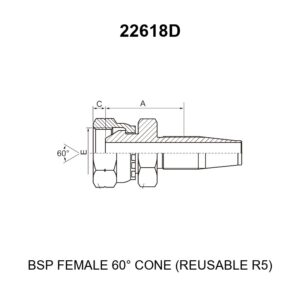

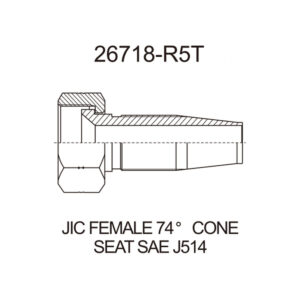
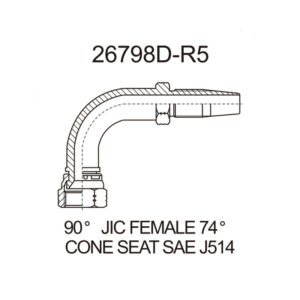
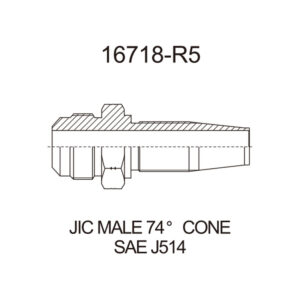
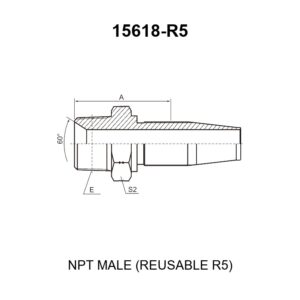
What Are Reusable Hose Fittings?
Reusable hose fittings — also called field attachable fittings — are hose-end connectors that assemble in the field without a crimping machine. Instead of a permanent crimped ferrule, a two-piece reusable fitting grips the hose mechanically: an insert goes inside the bore, an outer socket threads onto the hose cover, and tightening compresses the hose between them for a combined mechanical grip and seal. The fitting can later be removed from a worn hose and installed on a new one.
They are a maintenance tool, not a universal replacement for crimped assemblies. Where the line is safety-critical, runs above about 210 bar, or sees pressure spikes, a crimped assembly remains the safer choice.
| Factor | Reusable Fittings | Crimped Fittings |
|---|---|---|
| Typical pressure | Up to about 210 bar (3,000 psi) on R5 | 350–700 bar on matched hose |
| Assembly | Field or shop, hand tools only | Crimping machine and dies |
| Tooling cost | Low — wrenches | High — machine and die inventory |
| Best for | Emergency repair, fleet maintenance, low-pressure returns | OEM assembly, high-pressure, safety-critical |
Core value: match the reusable fitting to the hose construction, apply the published torque, and a field-built assembly holds — mix the wrong hose or skip the torque, and it will pull off.
Three customer paths:
- For OEM manufacturers — prototype hydraulic systems that still change weekly, then transition to crimped production parts.
- For end users and maintenance teams — repair a line on-site with wrenches instead of towing the machine.
- For distributors — stock one reusable family that fits R5 and selected braided hoses, with sample kits and private labeling.
Key Specifications
Connection-Side: End Thread Options
Reusable hose fittings use the same threaded ends as crimped fittings, so they connect to the standards already on your machine:
| End Type | Estándar | Sealing Method |
|---|---|---|
| JIC 37° flare | SAE J514 / ISO 8434-2 | Metal-to-metal flare seat |
| ORFS | SAE J1453 | O-ring face seal |
| SAE O-ring boss | SAE J1926 / ISO 11926 | O-ring at the port face |
| BSPP / G | ISO 228-1 | Arandela adherida o junta tórica |
| NPT / NPTF | ASME B1.20.1 / B1.20.3 | Thread interference; NPTF seals dry |
| Hose barb | — | Clamp or ferrule band |
Parallel-thread ends (JIC, ORFS, ORB, BSPP) seal at the seat, never with thread sealant. Tapered ends (NPT, BSPT) require approved thread sealant.
Hose-Side: Compatibility Matrix
This is the decision that matters most. Reusable fittings grip the hose cover mechanically, so they only work where the cover and reinforcement allow it.
| Tipo de manguera | Reusable Compatible? | Notas |
|---|---|---|
| SAE 100R5 | Yes | Designed for reusable ends; textile cover grips well |
| SAE 100R1AT / 1SN | Sometimes | Only with manufacturer-approved reusable ends |
| SAE 100R2AT / 2SN | Limited | Lower-pressure sizes only; not for high-pressure circuits |
| SAE 100R6 / textile braid | Push-on only | Low pressure; barb or push-on fittings |
| SAE 100R12 / R13 / R15 spiral | No | Multi-spiral hose must be crimped |
| PTFE / stainless braid | No | Requires specialized crimped ends |
| Thermoplastic (R7/R8) | Sometimes | Generally crimped; check approval |
If the hose maker does not list a reusable fitting as approved for that hose, do not use one: the wrong combination can strip the cover, cut the reinforcement, or blow off under pressure. For spiral and PTFE hoses, use our crimped ferrule series instead — see the crimp-side range on our hydraulic hose ferrule pages.
Pressure and Temperature Limits
| Tipo de montaje | Typical Pressure | Notas |
|---|---|---|
| Two-piece reusable on R5 | Up to about 210 bar (3,000 psi) | Smaller sizes; derate as size and temperature increase |
| One-piece push-on | Up to about 20 bar (300 psi) | Return, suction, and pneumatic lines |
| Standard NBR seals | -40 °C to +100 °C | Viton or PTFE seals extend the range |
For dynamic service — impulse, vibration, or flexing — reduce the rated pressure by 25 to 50 percent. We confirm the rating for your exact hose-and-fitting combination with every quote.
Materials and Finish
| Component | Opción estándar | Corrosive-Service Option |
|---|---|---|
| Insert and socket | AISI/SAE 12L14 carbon steel, machined | Stainless steel |
| Plating | Zinc; clear trivalent chrome | Stainless (no plating) |
| Seals | NBR O-rings | Viton and other compounds on request |
Key Features
- No crimping machine required — assemble with open-end and socket wrenches
- Two-piece insert-and-socket design, removable and reusable on a new hose
- Left-hand socket thread grips the hose cover without cutting the reinforcement
- Thread ends interchangeable with JIC, ORFS, ORB, BSPP, and NPT systems
- One-piece push-on ends for return, suction, and pneumatic lines
Crimping and Installation
A reusable hose fittings assembly is only as good as the installation. Follow this sequence every time:
- Select the correct fitting for the hose: match dash size, reinforcement type, and end thread.
- Cut the hose square with a hose cutter — not an abrasive wheel, which leaves dust and heat-damaged rubber.
- Inspect the hose end and remove loose rubber, frayed braid, or cover fragments.
- Lubricate the insert, the socket threads, and the hose bore with clean hydraulic fluid.
- Screw the hose into the socket (left-hand thread) until the hose bottoms, then back out one quarter turn.
- Place the insert on the mandrel and screw the insert into the socket until it seats.
- For swivel ends, leave about 1/32 in (0.8 mm) clearance between the swivel nut and the socket.
- Tighten to the published torque with calibrated wrenches — never an impact gun.
- Inspect for uniform compression, no cover bulging beyond the socket, and no exposed reinforcement.
- Pressure test the assembly gradually before returning the machine to service.
Safety checklist before sign-off:
- The fitting is approved by the maker for this exact hose type and dash size.
- The assembly rating meets system working pressure, including spikes.
- The hose is cut square and free of debris.
- Insert and socket are the same design family; never mix brands.
- Torque was applied with calibrated wrenches to the published value.
- A pressure test passed before the assembly entered service.
Reuse Rules and Maintenance
Reusable hose fittings can move to a new hose, but they are not immortal. Retire a fitting after more than three remove-and-reinstall cycles, or after any leak, cover damage, or thread distress.
- Inspect the insert and socket for thread damage, cracks, corrosion, or deformation before every reuse.
- Replace O-rings and seals every time — elastomers take a set after compression.
- Cut the old hose away rather than unwinding the socket from a loaded hose.
- Clean with lint-free cloth and solvent, then store dry in a sealed container.
- Mark each assembly with the install date and pressure test result.
Nomenclature: Describing a Reusable Fitting
A reusable fitting is described by three fields. Learn them and you can read any line item:
| Campo | Meaning | Example |
|---|---|---|
| Hose dash | Nominal hose size in 1/16 in steps | Dash -08 (1/2 in) |
| End thread | The connection standard | JIC 37° male |
| Design | Two-piece reusable or one-piece push-on | Two-piece |
A typical description reads: -08 two-piece reusable fitting, JIC 37° male x 1/2 in R5 hose. We assign the exact part number, socket, and insert for your configuration on request — send the hose type, dash, and end thread, and our engineers confirm the code before you order.
Matching and Identification
Field attachable and crimped fittings can look identical at the thread end, so identify the hose side before ordering:
| Feature | Two-Piece Reusable | Crimped Assembly |
|---|---|---|
| Hose end | Socket threads over the cover | Ferrule is swaged on and permanent |
| Reutilización | Removable, reusable | Single-use |
| Visible joint | Threaded socket line | Smooth, uniform crimp |
| Tooling | Wrenches | Máquina de engaste |
If you cannot identify the fittings on your machine, send photos with a ruler in the frame and we identify the design, dash size, and end thread free of charge.
Applications and Industries
Reusable hose fittings are standard where downtime is expensive and a crimper is far away:
- Agricultural equipment and sprayers
- Truck, bus, and heavy-duty transport fleets
- Construction and earthmoving machines
- Mining and drilling support equipment
- Industrial maintenance and prototyping shops
- Marine and remote-site service fleets
Operating temperature follows the hose and seal: standard nitrile assemblies typically run from -40 °C to +100 °C; Viton or PTFE seals extend the range where the hose tube allows.
Ordering and Packaging
- Unit of measure: sold per set (insert + socket), packed in boxes per size
- MOQ: one box per size; mixed-size sample kits available
- Supplied with new O-rings; spare seal kits available
- Customization: end thread standard, carbon steel or stainless, plating, private labeling
- Export packing: corrugated cartons with moisture barrier for sea freight
Reusable Hose Fittings FAQ
Are reusable hydraulic fittings as strong as crimped fittings? No. A crimped ferrule interlocks mechanically with the reinforcement and is rated higher. Reusable fittings are limited to about 210 bar (3,000 psi) on R5 hose in smaller sizes, and should be derated 25 to 50 percent in dynamic service.
What pressure can reusable hose fittings handle? Two-piece reusable assemblies on SAE 100R5 typically handle up to about 210 bar (3,000 psi) in smaller sizes; one-piece push-on ends are limited to roughly 20 bar (300 psi). Always confirm the rating for your exact hose and fitting combination.
Can I use reusable fittings on any hydraulic hose? No. They suit SAE 100R5 and, with manufacturer approval, selected R1AT and R2AT sizes. Spiral hoses (R12, R13, R15) and PTFE hoses must be crimped — a reusable socket cannot grip multi-spiral or stainless-braid reinforcement safely.
How many times can a reusable fitting be reused? There is no universal number. Retire the fitting after more than three remove-and-reinstall cycles, or immediately after any leak, cover damage, or thread distress. Replace the O-rings every time, regardless of appearance.
Do reusable fittings need thread sealant? Parallel-thread ends (JIC, ORFS, ORB, BSPP) seal at the seat and need no sealant. Tapered ends (NPT, BSPT) require approved thread sealant, exactly as on a crimped fitting.
Why is the socket thread left-handed? The socket cuts into the hose cover with a left-hand thread while the insert makes up with a right-hand thread, so final tightening pulls the socket tighter onto the hose instead of unwinding it.
Can a reusable fitting be switched to a different hose size? No. The socket is matched to the hose dash size and cover construction, and the insert to the bore. Changing size requires a different insert-and-socket set.
- Manguera hidráulica2727 productos
- Manguera hidráulica en espiral con alambre de acero66 productos
- Manguera hidráulica trenzada con alambre de acero1010 productos
- Manguera hidráulica reforzada con tejido33 productos
- Manguera hidráulica termoplástica33 productos
- Manguera industrial5959 productos
- Manguera de aire99 productos
- Manguera de agua1111 productos
- Manguera de aceite1616 productos
- Manguera para productos químicos66 productos
- Manguera de vapor33 productos
- Manguera multiusos22 productos
- Mangueras para alimentos y bebidas44 productos
- Manguera para hormigón44 productos
- Manguera para cemento22 productos
- Manguera para la manipulación de materiales1111 productos
- Manguera para dragado44 productos
- Accesorios hidráulicos162162 productos
- Accesorios reutilizables para mangueras66 productos
- Racores para mangueras sin casquillo88 productos
- Accesorios hidráulicos JIC1515 productos
- Racores hidráulicos métricos3838 productos
- Racores hidráulicos NPT66 productos
- Racores hidráulicos BSP2626 productos
- Racores hidráulicos SAE3030 productos
- Racores hidráulicos tipo banjo44 productos
- Racores hidráulicos ORFS1111 productos
- Virola1111 productos
- Accesorios con brida2626 productos
- Accesorios de una sola pieza2323 productos
- Adaptadores hidráulicos9494 productos
Send a Mail
henghua@hhgpipe.com
Make a Call
+15822925523
86-22-83859963
Mon - Sun: 09:00 am - 22:00 pm
Main Office
Tianjin, China
Hezhong Building, Youyi North Road
 English
  Spanish
  Portuguese
  French
  German
  Arabic