
Racores para mangueras sin casquillo
Socketless Hose Fittings: Push-On and Barbed Range Guide
Socketless hose fittings are the fastest connection in fluid power: a one-piece barbed stem that the hose pushes straight onto — no socket, no ferrule, no crimping machine, and in most cases no tool at all. They pair exclusively with socketless (push-on) hose for low-pressure transfer of hydraulic fluid, fuel, air, oil, and water, up to about 24 bar (350 psi). This page is the complete guide to our socketless hose fittings range: how the grip works, which hoses are compatible, pressure limits, step-by-step assembly, material selection, and ordering terms. Confirm your hose type and end thread from the tables, then request a quote in minutes.
Why Buy from Us
Five facts that separate us from a parts reseller:
| Trust Anchor | What It Means for You | |
|---|---|---|
| 1 | Factory Direct Manufacturer | We produce the fittings and ferrules, not just resell them. |
| 2 | Batch-Tested Quality | Dimension-inspected with calibrated gauges; salt-spray tested to at least 120 hours per ISO 9227. |
| 3 | One-Piece Barbed Program | Socketless ends in JIC, SAE, BSPP, BSPT, NPT, and metric threads, plus double-barb connectors. |
| 4 | Verified Quotes in One Business Day | Send the hose type, dash, and end thread. You get a confirmed part number, price, and lead time in one working day. |
| 5 | Free Samples for Qualified Projects | Test the grip and seating before committing to production volume. |
Mostrando los 8 resultados
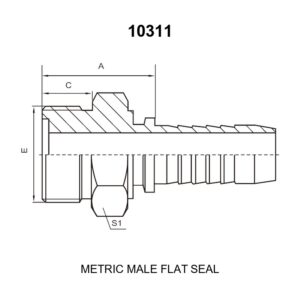
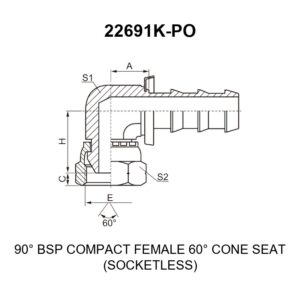
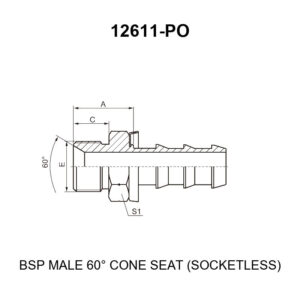
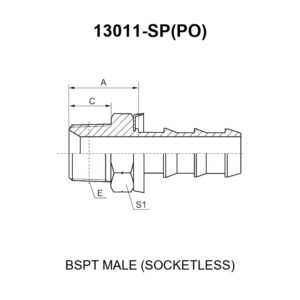

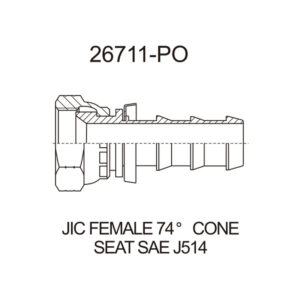


What Are Socketless Hose Fittings?
Socketless hose fittings — also called push-on, push-lock, or hose barb fittings — are hose-end connectors with no socket and no ferrule. The fitting is a single machined or brazed piece: a threaded end on one side and a multi-barbed stem on the other. The hose pushes directly onto the barbs, and the hose’s own elasticity grips the stem to hold the joint and seal it. Because there is no separate socket, there is nothing to crimp, nothing to thread on, and no tooling to buy.
They work only as a matched system. Socketless fittings must be used with socketless (push-on) hose — the hose whose tube and cover are designed for barb-only retention. Pushing them into braided or spiral hose does not create a safe joint.
| Factor | Socketless Fittings | Crimped Fittings |
|---|---|---|
| Typical pressure | Up to about 24 bar (350 psi) | 350–700 bar on matched hose |
| Assembly | Push on by hand; often no tool | Crimping machine and dies |
| Parts per joint | One | Two (fitting + ferrule) |
| Best for | Fuel, air, oil, water, low-pressure returns | High-pressure, safety-critical circuits |
Core value: socketless fittings cut assembly time to seconds and remove a leak path — but only when the fitting, the hose, and the pressure limit match.
Three customer paths:
- For OEM manufacturers — cut assembly time and tooling cost on low-pressure lines built in volume.
- For end users and maintenance teams — replace a fuel, air, or return line on the spot, with no crimper on site.
- For distributors — stock one barbed program across six thread standards, with sample kits and private labeling.
Key Specifications
Connection-Side: End Thread Options
Socketless fittings carry a standard threaded end on one side and a barbed stem on the other, so they adapt directly to the ports and components already on your machine:
| End Type | Estándar | Sealing Method |
|---|---|---|
| JIC 37° flare | SAE J514 / ISO 8434-2 | Metal-to-metal flare seat |
| SAE O-ring boss | SAE J1926 / ISO 11926 | O-ring at the port face |
| BSPP / G | ISO 228-1 | Arandela adherida o junta tórica |
| BSPT / R | ISO 7-1 | Thread interference; sealant required |
| NPT / NPTF | ASME B1.20.1 / B1.20.3 | Thread interference; NPTF seals dry |
| Metric | ISO 6149 and 24° cone families | O-ring or cone seat |
| Hose barb | — | Push-on; double-barb connectors for hose-to-hose |
Common sizes run from 1/4 in to 1 in. Parallel-thread ends seal at the seat and need no thread sealant; tapered ends (NPT, BSPT) require approved sealant.
Hose-Side: Compatibility
Socketless hose fittings grip by friction and hose elasticity, so hose construction decides whether the joint is safe.
| Tipo de manguera | Socketless Compatible? | Notas |
|---|---|---|
| Socketless / push-on hose (textile braid, push-lock) | Yes | Designed for barb-only retention |
| SAE 100R6 | Yes | Low-pressure return and general service |
| SAE 100R3 / textile braid | Yes | Low pressure, non-conductive options |
| SAE 100R1AT / R2AT (wire braid) | No | Reinforced braid requires a ferrule or socket |
| SAE 100R12 / R13 / R15 spiral | No | Must be crimped |
| PTFE / stainless braid | No | Requires specialized crimped ends |
For wire-braid or spiral hose, use our crimped ferrule series; for field repairs at higher pressure on R5 hose, see our two-piece reusable fittings page.
Pressure and Temperature Limits
| Tipo de montaje | Typical Pressure | Notas |
|---|---|---|
| Socketless on matched push-on hose | Up to about 24 bar (350 psi) | Confirm the rating for your hose and size |
| Clamp-free pneumatic push-lock | Up to about 24 bar (350 psi) | Where the manufacturer approves clamp-free use |
| Standard rubber tube | -40 °C to +100 °C | Check the hose data sheet for the exact range |
Never exceed the lower of the hose rating and the fitting rating. On impulse, vibration, or flexing service, derate further and confirm the assembly with our engineers.
Materials and Finish
| Component | Standard Option | Corrosive-Service Option |
|---|---|---|
| Fitting body | Carbon steel, one-piece machined or brazed | Stainless steel |
| Low-pressure and fuel service | Brass | Stainless steel |
| Plating | Zinc; clear trivalent chrome | Stainless (no plating) |
Key Features
- One-piece design: no socket, no ferrule, no separate parts to lose
- Push-on assembly in seconds; frequently no tool required
- Fewer joints than a crimped assembly — fewer potential leak paths
- Smooth internal bore and full-flow barb geometry for improved flow
- Six thread standards plus double-barb hose connectors, 1/4 in to 1 in
Crimping and Installation
Socketless hose fittings assemble by hand — correctly, every time, if you follow the sequence:
- Cut the hose square with a fine-tooth saw or hose cutter; avoid abrasive wheels that leave dust.
- Remove all debris, loose braid, and cover fragments from the hose end.
- Hold the fitting in soft jaws or a protected vice so the threads and barbs are not marked.
- Soften the hose end in hot water just below boiling for a few minutes, immersing 50–70 mm.
- Push the hot hose onto the barbed stem with a twisting action until it bottoms against the collar.
- Do not use lubricant — residue can reduce the grip and affect the security of the joint.
- Confirm the hose is fully seated against the collar, with no cover damage or exposed reinforcement.
- Fit the specified band clamp where the manufacturer requires one for the service.
- Pressure test gradually before returning the machine to service.
Assembly rules that prevent failures:
- Use socketless fittings only with hose approved for barb retention.
- Never shorten the barbed stem or cut barbs to ease assembly.
- Do not reuse a socketless fitting after it has leaked, pulled off, or been removed with damage.
- Replace the hose, not just the fitting, when the cover is cut or the tube is scored.
Nomenclature: Describing a Socketless Fitting
A socketless fitting is described by three fields. Learn them and you can read any line item:
| Campo | Meaning | Example |
|---|---|---|
| Hose size | Nominal hose size, imperial or metric | 3/8 in (dash -06) |
| End thread | The connection standard | JIC 37° male |
| Stem style | Single barb, multi-barb, or double barb | Multi-barb |
A typical description reads: 3/8 in socketless fitting, JIC 37° male x 3/8 in push-on hose. We assign the exact part number for your configuration on request — send the hose type, size, and end thread, and our engineers confirm the code before you order.
Matching and Identification
Three assembly styles look similar from the thread end. Identify the hose side before ordering:
| Feature | Socketless | Two-Piece Reusable | Crimped |
|---|---|---|---|
| Hose end | Exposed barbed stem | Threaded socket | Smooth ferrule |
| Parts | One | Two (insert + socket) | Two (fitting + ferrule) |
| Tooling | Usually none | Wrenches | Máquina de engaste |
| Typical pressure | Up to 24 bar | Up to 210 bar on R5 | 350–700 bar |
If you cannot identify the fittings on your machine, send photos with a ruler in the frame and we identify the style, size, and end thread free of charge.
Applications and Industries
Socketless hose fittings suit low-pressure transfer wherever speed of assembly matters:
- Fuel, gasoline, and diesel lines
- Air and shop-service lines, including clamp-free pneumatic systems
- Low-pressure lube and oil lines
- Coolant and water lines
- Hydraulic return lines with petroleum or water-based fluids
- Machine tools, automotive, and motorsport plumbing
- Agricultural and utility equipment service
Operating temperature follows the hose tube: standard rubber constructions typically run from -40 °C to +100 °C. Confirm the media compatibility of the tube, cover, and any seals with your hose data sheet.
Ordering and Packaging
- Unit of measure: sold per piece (EA), packed in boxes per size
- MOQ: one box per size; mixed-size sample kits available
- Supplied as single fittings or as hose-and-fitting kits on request
- Customization: end thread standard, brass or stainless, plating, private labeling
- Export packing: corrugated cartons with moisture barrier for sea freight
Socketless Hose Fittings FAQ
What pressure can socketless hose fittings handle? Matched socketless assemblies are typically rated up to about 24 bar (350 psi). The limit is the lower of the hose rating and the fitting rating, so confirm the value for your hose type and size before ordering.
Which hoses fit socketless hose fittings? Only hose approved for barb retention: socketless or push-on hose, SAE 100R6, and textile-braid constructions. Wire-braid, spiral, and PTFE hoses require a ferrule or socket and must be crimped.
Do socketless fittings need a clamp? It depends on the fitting and the service. Many push-lock systems are clamp-free; others specify a band clamp for vibration or higher-pressure duty. Follow the manufacturer’s instruction for your exact combination.
Can I use lubricant to slide the hose on? No. Lubricant leaves residue that can reduce the grip. Soften the hose end in hot water just below boiling instead, then push it on with a twisting motion until it bottoms against the collar.
Brass, carbon steel, or stainless steel — which should I choose? Brass suits low-pressure fuel, air, and water lines and resists corrosion well. Zinc-plated carbon steel suits general hydraulic and pneumatic service. Stainless steel handles corrosive media, marine, and hygienic environments.
Can socketless fittings be reused? Yes, while the fitting is undamaged and the barbs are intact — the fitting can move to a new piece of the same hose type and size. Discard any fitting that has leaked, pulled off, or been removed with barb or thread damage.
How do I know the hose is seated correctly? The hose end must bottom against the collar with no gap, no cover bulging behind the barb, and no exposed reinforcement. If a gap remains, cut the hose back, soften it again, and refit — never force it with a mallet.
- Manguera hidráulica2727 productos
- Manguera hidráulica en espiral con alambre de acero66 productos
- Manguera hidráulica trenzada con alambre de acero1010 productos
- Manguera hidráulica reforzada con tejido33 productos
- Manguera hidráulica termoplástica33 productos
- Manguera industrial5959 productos
- Manguera de aire99 productos
- Manguera de agua1111 productos
- Manguera de aceite1616 productos
- Manguera para productos químicos66 productos
- Manguera de vapor33 productos
- Manguera multiusos22 productos
- Mangueras para alimentos y bebidas44 productos
- Manguera para hormigón44 productos
- Manguera para cemento22 productos
- Manguera para la manipulación de materiales1111 productos
- Manguera para dragado44 productos
- Accesorios hidráulicos162162 productos
- Accesorios reutilizables para mangueras66 productos
- Racores para mangueras sin casquillo88 productos
- Accesorios hidráulicos JIC1515 productos
- Racores hidráulicos métricos3838 productos
- Racores hidráulicos NPT66 productos
- Racores hidráulicos BSP2626 productos
- Racores hidráulicos SAE3030 productos
- Banjo Hydraulic Fittings44 productos
- Racores hidráulicos ORFS1111 productos
- Virola1111 productos
- Accesorios con brida2626 productos
- Accesorios de una sola pieza2323 productos
- Hydraulic Adapters9494 productos
Send a Mail
henghua@hhgpipe.com
Make a Call
+15822925523
86-22-83859963
Mon - Sun: 09:00 am - 22:00 pm
Main Office
Tianjin, China
Hezhong Building, Youyi North Road
 English
  Spanish
  Portuguese
  French
  German