
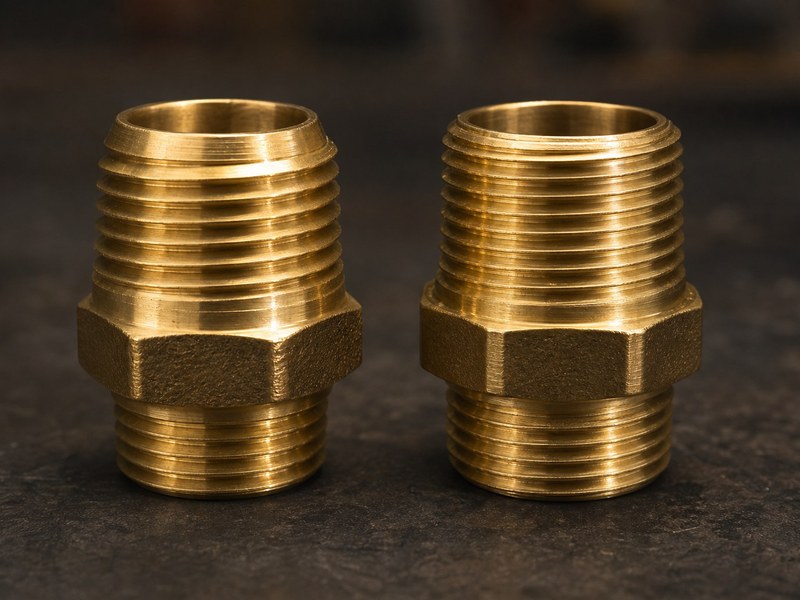
NPT and BSP are not interchangeable. NPT (National Pipe Taper, ANSI/ASME B1.20.1) is a 60-degree US taper thread with flat crests; BSP (British Standard Pipe, ISO 228-1 for parallel BSPP, ISO 7-1 for tapered BSPT) is a 55-degree British thread with rounded crests. Their pitches match only at 1/2 inch and 3/4 inch (14 TPI), and even there the angle mismatch prevents a reliable seal. If you are mixing US and European air equipment, the fix is an NPT to BSP adapter at the boundary — never force the threads together. Below: the NPT vs BSP thread size chart, a two-minute identification method, and the thread air fittings use by region.
Quick answer: NPT (60°, US) and BSP (55°, UK) are not interchangeable — the pitch coincides only at 1/2″ and 3/4″ (14 TPI), and angle and form never match. Measure with a 55°/60° pitch gauge, then convert with an adapter at the boundary.
What Is an NPT Thread?
NPT stands for National Pipe Taper, the US standard pipe thread defined in ANSI/ASME B1.20.1. The thread form is a 60-degree V with truncated (flat) crests and roots.
That taper is the sealing mechanism: NPT is cut on a 1:16 taper, so the diameter changes by 0.75 inch per foot of thread length. As the male thread is torqued into the female port, the flanks wedge together until the metal deforms and locks.
A correctly assembled NPT joint normally needs thread sealant — PTFE tape or pipe dope — to fill the tiny spiral path left between the flanks. In our fitting shop, NPT is what we machine most often for customers in the United States. It dominates plumbing, compressed air lines, hydraulic piping, and general industrial service across North America.
On air equipment you will find NPT on air compressor tank ports, regulators, gauges, and the male ends of most quick couplers sold in the US market. There is also NPTF (National Pipe Taper Fuel, ANSI/ASME B1.20.3), a dryseal variant designed to seal without sealant; it appears where fuel or high-integrity joints demand it.
What Is a BSP Thread?
BSP stands for British Standard Pipe, and it comes in two forms: BSPP (parallel, ISO 228-1) and BSPT (tapered, ISO 7-1). Both use a 55-degree thread angle with rounded crests and roots — the Whitworth form — the quickest visual clue that a fitting is BSP, not NPT.
BSPP, often marked simply “G” (as in G1/4), is a straight thread. It cannot seal on the threads, so the joint relies on a washer, bonded seal, or O-ring under the hex, or on PTFE tape at low pressure. BSPT, marked “R” or “Rc”, is tapered at the same 1:16 rate as NPT and seals the same way — flank interference plus sealant.
The BSPP vs BSPT distinction is where most confusion starts: a parallel G thread will not seal against a tapered R thread no matter how much tape you apply, and the reverse is equally true. The two belong to the same family but behave like different standards.
BSP is the default thread for most of the world outside North America. European pneumatic brands, FRL units, solenoid valves, and most push-to-connect fittings are threaded in G1/8, G1/4, or G3/8. Chinese and Taiwanese pneumatic component makers follow the same convention, so nearly all “standard” pneumatic fittings exported from Asia are BSP unless the order specifies NPT.
BSPP vs BSPT: What’s the Difference?
Because BSP arrives in two forms, the BSPP vs BSPT question deserves a table of its own:
| Feature | BSPP (G) | BSPT (R / Rc) |
|---|---|---|
| Thread form | Parallel, straight | Tapered, 1:16 |
| Governing standard | ISO 228-1 | ISO 7-1 |
| Marking on the hex | “G” (for example G1/4) | “R” (male) or “Rc” (female) |
| Sealing method | Washer, O-ring, or bonded seal (PTFE tape only at low pressure) | Flank interference plus thread sealant |
| Seals against the other form? | No | No |
Ordering tip: when you specify a BSP part, always state the form — G (parallel) or R/Rc (tapered) — because the two never seal against each other.
NPT vs BSP: The Key Differences at a Glance
If you only remember one block from this article, remember the table below. Whether you search NPT vs BSP or BSP vs NPT, the answer is the same: different angle, different form, different pitch — and only a coincidental match on paper.
| Difference | NPT | BSP |
|---|---|---|
| Thread angle | 60 degrees | 55 degrees |
| Thread form | Truncated (flat) crests and roots | Rounded crests and roots (Whitworth) |
| Taper | Tapered, 1:16 | BSPP parallel; BSPT tapered 1:16 |
| Sealing method | Thread flank interference + sealant | BSPP: washer, O-ring, or bonded seal; BSPT: interference + sealant |
| Governing standard | ANSI/ASME B1.20.1 (North America) | ISO 228-1 (BSPP) and ISO 7-1 (BSPT) |
| Regional use | USA, Canada, Mexico | Europe, Asia, Oceania, South America |
The one-sentence rule: NPT seals on its taper; BSP seals on a washer (parallel) or on its taper (tapered) — and neither standard accepts the other’s threads. Every leak we troubleshoot involving a “thread that almost fit” traces back to this rule being ignored.
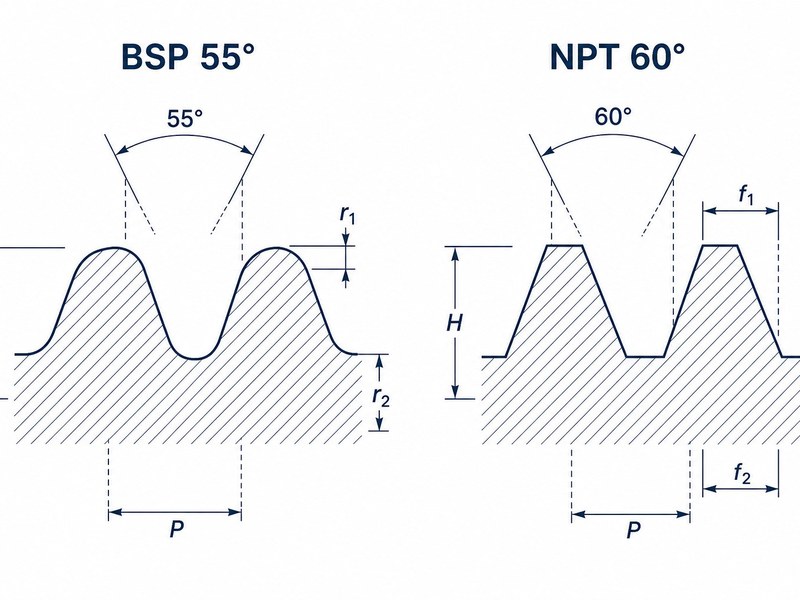
Figure 1. The 55° vs 60° flank angle and the crest shape are the two details that separate BSP from NPT.
Are NPT and BSP Threads Interchangeable?
No — not in any size and not in any combination. NPT and BSP threads are not compatible because they differ in thread angle (60° vs 55°) and thread form (flat vs rounded), and their pitches coincide at only two sizes: 1/2 inch and 3/4 inch, both at 14 TPI.
In practice, “are NPT and BSP threads compatible” is one of the most common questions we receive by email, usually with a photo attached. The answer never changes: if the two parts are not both NPT or both BSP, they must meet through an adapter. The same rule holds for BSPP vs BSPT inside the BSP family: a parallel G fitting and a tapered R fitting are both BSP but will not seal against each other.
Can an NPT fitting thread into a BSP port?
At 1/2 inch and 3/4 inch a male NPT will start into a female BSPT port: both are tapered and the pitch matches at 14 TPI. The problem is the flanks. The 55-degree BSP flanks and the 60-degree NPT flanks do not coincide, so only the crests and roots touch instead of full flank faces. The joint binds partway, galling starts, and the connection weeps at working pressure. Stop at the first sign of binding. Tightening past the binding point cracks aluminum and cast-iron ports — use the correct adapter instead.
BSPT and NPT are not interchangeable: in the BSPT vs NPT pairing, a BSPT male will not seal in an NPT female port, and the reverse is equally true. The combination table below covers every pairing.
| Combination | Threads engage? | Reliable seal? | Verdict |
|---|---|---|---|
| Male NPT → Female BSPT | Only at 1/2″ and 3/4″, partially | No | Avoid; galling and leaks |
| Male BSPT → Female NPT | Only at 1/2″ and 3/4″, partially | No | Avoid; port damage risk |
| Male NPT → Female BSPP (G) | No — angle and pitch mismatch | No | Never force |
| Male BSPP (G) → Female NPT | No — angle and pitch mismatch | No | Never force |
| NPT × BSP adapter (correct size) | Yes | Yes | Correct way to convert |
NPT vs BSP Thread Size & Compatibility Chart
Nominal pipe size refers to the nominal bore of the pipe, not the thread diameter, and it does not mean the two standards share dimensions. NPT and BSP diameters differ slightly at every size, and the pitches differ at every size except 1/2 inch and 3/4 inch.
| Nominal Size | NPT TPI | BSP TPI | NPT Major OD (inch) | NPT Major OD (mm) | BSP Major OD (inch) | BSP Major OD (mm) |
|---|---|---|---|---|---|---|
| 1/8 | 27 | 28 | 0.405 | 10.29 | 0.383 | 9.73 |
| 1/4 | 18 | 19 | 0.540 | 13.72 | 0.518 | 13.16 |
| 3/8 | 18 | 19 | 0.675 | 17.15 | 0.656 | 16.66 |
| 1/2 | 14 | 14 | 0.840 | 21.34 | 0.825 | 20.96 |
| 3/4 | 14 | 14 | 1.050 | 26.67 | 1.041 | 26.44 |
| 1 | 11.5 | 11 | 1.315 | 33.40 | 1.309 | 33.25 |
| 1-1/4 | 11.5 | 11 | 1.660 | 42.16 | 1.650 | 41.91 |
| 1-1/2 | 11.5 | 11 | 1.900 | 48.26 | 1.882 | 47.80 |
| 2 | 11.5 | 11 | 2.375 | 60.33 | 2.347 | 59.61 |
Three notes from our inspection bench. An NPT thread runs 18 TPI at 1/4 inch and 3/8 inch while BSP runs 19 — a pitch gauge reads the difference instantly. At 1 inch and above, NPT runs 11.5 TPI against BSP’s 11, again a mismatch. And even at 1/2 inch and 3/4 inch, where both standards use 14 TPI, the angle mismatch and a major-diameter difference of 0.015 inch at 1/2 inch (0.840 vs 0.825) and 0.009 inch at 3/4 inch (1.050 vs 1.041) prevent a proper joint.
How to Identify an NPT or BSP Thread
Identification takes about two minutes with a thread pitch gauge and a caliper. We use this five-step sequence in our workshop whenever a customer sends in an unmarked fitting or a photo of a pump port.
- Check the thread angle first. A 55-degree pitch gauge fits BSP threads; a 60-degree gauge fits an NPT thread. If the 55-degree gauge seats snugly and the 60-degree gauge rocks, you are holding BSP — the angle test is definitive, and it also settles the BSPT vs NPT question when the taper alone is ambiguous.
- Look at the crests. Rounded, softly curved crests mean BSP (Whitworth form). Flat, truncated crests mean NPT.
- Count the threads per inch. Match the reading to the chart: 27, 18, 14, or 11.5 TPI is NPT; 28, 19, 14, or 11 TPI is BSP.
- Check the taper. Measure the outside diameter at the first full thread, then one inch back. A 1:16 taper reads roughly 0.0625 inch smaller at the second point. Both NPT and BSPT taper; BSPP is perfectly parallel.
- Read the markings and the mating part. “G 1/4” or “R 1/4” stamped on the hex means BSP. An unmarked fitting in North America is usually NPT. The mating equipment is the final authority — if the machine came from Europe, expect BSP.
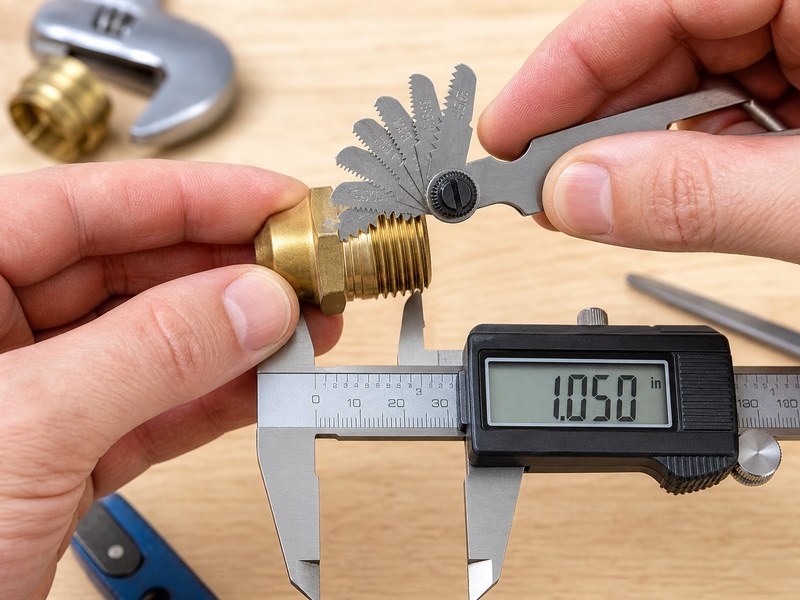
Figure 2. The 55° vs 60° pitch gauge test separates BSP from NPT faster than any other check.
| Check point | NPT indicates | BSP indicates |
|---|---|---|
| Thread angle gauge | 60-degree gauge fits | 55-degree gauge fits |
| Crest shape | Flat, truncated | Rounded (Whitworth) |
| TPI at 1/4″ and 3/8″ | 18 TPI | 19 TPI |
| Taper | 1:16 on male threads | BSPP parallel; BSPT 1:16 |
| Typical marking | Often none (US assumption) | “G” (parallel) or “R”/”Rc” (tapered) |
| Equipment origin | North America | Europe, Asia, Oceania |
Where the BSP vs NPT question remains open, treat the part as NPT only if the equipment is North American, and verify with the mating part before ordering. A wrong guess costs more than a careful measurement.
Download the printable one-page NPT vs BSP thread identification card (PDF) — the five checks and the TPI chart condensed onto a single sheet for the workshop bench. It fits in a toolbox lid and settles a thread question in the field without internet access.
NPT to BSP Adapter: When and How to Convert
Scope of use: use an NPT to BSP adapter for compressed air and water service within the adapter’s rated pressure — confirm the rating on the datasheet; typical shop air runs 90 to 150 psi. For hydraulic pressure above the adapter’s rating, or fuel and corrosive media, select a steel or stainless adapter rated for that service, or use the appropriate hydraulic fitting standard.
An adapter is the correct answer whenever a US-market compressor or air system must connect to European or Asian pneumatic components — or the reverse. We recommend an adapter in three situations:
- The port is threaded G1/4 or G1/8 (BSPP) and you must connect an NPT hose, coupler, or tool.
- The equipment is NPT and you are installing a European-made FRL unit, solenoid valve, or gauge.
- You are unsure of the thread standard and do not want to risk a marginal direct connection.
| Adapter style | Typical use | Sealing detail |
|---|---|---|
| Hex nipple NPT × BSPT | Male-to-male conversion between a port and a line | NPT side seals on its taper; BSPT side seals on its taper with sealant |
| Male NPT × Female BSPP (G) | Connecting NPT hose ends to European G-thread ports | BSPP side needs the washer, O-ring, or bonded seal that belongs to the port |
| Male BSPP (G) × Female NPT | Connecting European components into US piping | BSPP side seals at its seat; NPT side on the taper |
| Reducing adapter | Size conversion (for example 1/4″ NPT × G1/8) | Verify both sizes and both thread standards before ordering |
Common conversions include NPT to BSPT and NPT to BSPP (G) adapters — the NPT vs BSPP case is the most common one in air systems; specify which BSP form your port uses when ordering.
Not sure which adapter you need?
Send a photo of the port and the mating end to the HENGHUA engineering team. We identify NPT, BSPP, and BSPT threads, confirm compatibility, and recommend the correct adapter or hose assembly — usually within one business day.
Get a quotation with free thread identification
Three things to verify before ordering any adapter: the exact nominal size and TPI on both ends; the working pressure rating, which should match or exceed the hose and system rating — confirm the rated pressure on the adapter’s datasheet before assembly; and the material for the media — brass for air and water, steel or stainless for high pressure and corrosive service. On the BSPP side, use the washer, O-ring, or bonded seal that the port was designed for; PTFE tape is an optional helper, not the seal.
| Media / pressure | Recommended material | Note |
|---|---|---|
| Compressed air, 90–150 psi | Brass | Standard choice for workshop air systems |
| Water (non-corrosive) | Brass | Check local potable-water codes |
| High-pressure hydraulic (above 3,000 psi) | Carbon steel / stainless steel | Pipe threads are not the first choice; prefer SAE/JIC hydraulic fittings |
| Fuel / corrosive media | Stainless steel | Select by media compatibility; NPTF dryseal or dedicated fittings |
An adapter is inexpensive compared with the alternative: a cracked port, a contaminated system, or a production line stopped by a weeping joint. When in doubt, convert properly.
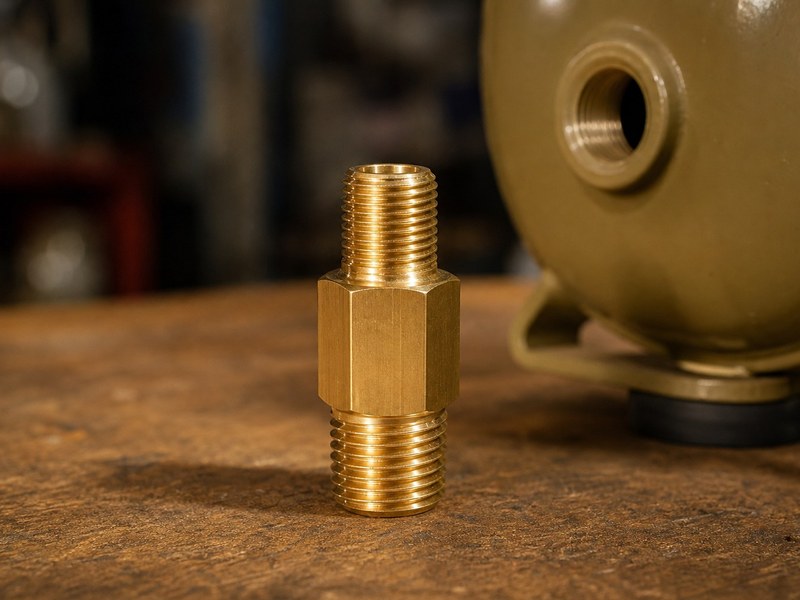
Figure 3. A purpose-made adapter converts standards correctly; direct threading does not.
Which Thread Do Air Fittings Use: NPT or BSP?
Air fittings use NPT in North America and BSP in Europe and Asia — check the equipment’s country of origin, not the fitting’s appearance. The NPT vs BSP question usually surfaces when a system mixes equipment from both regions — for example, a US air compressor feeding European tools, or an Asian pneumatic valve installed into US piping.
| Air equipment | North America | Europe / Asia |
|---|---|---|
| Compressor tank ports | 1/4″ NPT (larger units: 3/8″, 1/2″ NPT) | G1/4 (BSPP) on many compact units; 1/4″ BSPT on others |
| Quick couplers and plugs | 1/4″ NPT male on industrial-interchange bodies | 1/4″ BSP male on ISO 6150 and European-style bodies |
| Regulators and FRL units | 1/4″ or 3/8″ NPT | G1/4, G3/8 (BSPP) |
| Pressure gauges | 1/4″ NPT | G1/4 (BSPP) |
| Push-to-connect fittings | 1/4″ NPT (North American lines) | G1/8, G1/4, G3/8 |
| Air tool inlet threads | 1/4″ NPT (US-spec tools) | 1/4″ BSP (many EU and Asian tools) |
The working rule we give every customer: match the thread to the equipment’s home market, and place one adapter at the boundary where the two standards meet. Do not try to make the threads themselves meet. The most common air fitting size on both sides of the Atlantic is 1/4-inch nominal — the difference is whether that 1/4 inch is NPT or BSP, and only a gauge tells you which.
Not sure where you fall in the NPT vs BSP decision? Match your situation:
| Your situation | Thread you need | One-line answer |
|---|---|---|
| US factory, all equipment bought locally | NPT | Use NPT fittings and hose directly; no adapter needed |
| US compressor + European tools or valves | Mixed standards | Fit one adapter at the boundary where the standards meet |
| First purchase, equipment imported from Europe | Determined by equipment origin | Send a photo of the port to HENGHUA for free identification (one business day) |
| Maintenance technician replacing a leaking fitting | Match the original part | Measure with a 55°/60° pitch gauge and the TPI chart; don’t guess by appearance |
| OEM exporting to Europe, product needs G threads | BSPP or BSPT | Specify the target-market standard; OEM/ODM private label supported |
| Distributor stocking for two markets | Both standards | Stock NPT and BSP versions of the same nominal size |
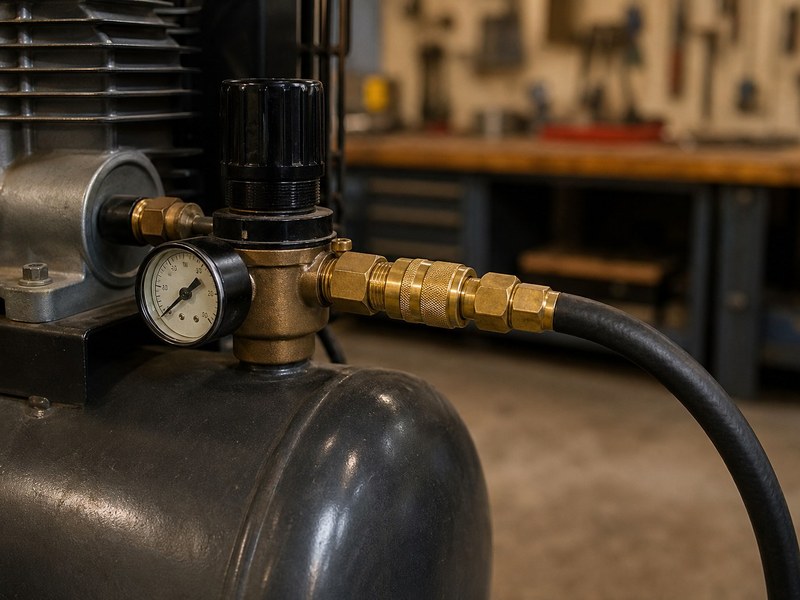
Figure 4. Air systems mix standards when equipment crosses borders; one adapter at the boundary solves it.
Common NPT and BSP Mistakes That Cause Air Leaks
Almost every air leak we troubleshoot involving mixed fittings traces back to one of these five errors. The table doubles as a pre-installation checklist.
| Mistake | Resultado | Correct approach |
|---|---|---|
| Forcing an NPT male into a G port | Partial engagement, leak, cracked aluminum port | Use a proper conversion adapter |
| Applying PTFE tape to a BSPP (G) thread | Leak that no amount of tape fixes | Fit the washer, O-ring, or bonded seal the port was designed for |
| Using a 60-degree gauge on BSP (or miscounting TPI) | Wrong part ordered | Use the 55-degree gauge and the TPI chart |
| Assuming 1/2″ NPT equals 1/2″ BSP | Leak at the joint; galling | Measure major diameter and pitch, never trust the name |
| Reusing a fitting with damaged threads | Weeping at working pressure | Inspect threads under good light; replace the fitting |
Sealant placement matters too. On a tapered thread (NPT or BSPT), thread sealant goes on the male threads and the first thread is left clean so no material enters the line. On a parallel BSPP thread, treat the washer or O-ring as the seal and tape as a helper at most. Check the port for the sealing seat before assembly: a BSPP joint without a seat needs a new port or an adapter, not more tape.
How many turns? Hand-tighten the fitting, then add wrench turns until resistance climbs sharply: about 2–3 turns for 1/8-inch to 1/2-inch NPT and 1.5–2 turns for 3/4 inch and larger. A BSPP (G) joint seals by washer or O-ring compression, not by thread wedging — stop about 1/4 to 1 turn after the washer contacts the face; overtightening damages the seal. These are workshop guidance values; follow the fitting manufacturer’s installation specification where one is provided.
NPT vs BSP FAQs
Quick answers to the questions we hear most often from air system users and buyers.
Are NPT and BSP threads the same?
No. NPT is a 60-degree American taper thread with flat crests; BSP is a 55-degree British thread with rounded crests, made in both parallel (BSPP) and tapered (BSPT) forms. They look similar at arm’s length and are not interchangeable.
Are NPT and BSP threads interchangeable?
No. The thread angles differ (60° vs 55°), the forms differ, and the pitches match at only 1/2 inch and 3/4 inch. Even where the pitch matches, the flank mismatch prevents a reliable seal. Convert with an adapter instead.
What is the difference between NPT and BSPT?
In the NPT vs BSPT comparison, both threads taper at 1:16 and look nearly identical, but NPT (ANSI/ASME B1.20.1) uses a 60-degree angle with flat crests while BSPT (ISO 7-1) uses 55 degrees with rounded Whitworth crests. They are not interchangeable; a pitch gauge tells them apart.
Which is better, NPT or BSP?
Neither is better. North American equipment uses NPT; European, Asian, and Oceanian equipment uses BSP (BSPP or BSPT). Choose by equipment origin and use an adapter at the boundary when a system mixes both.
Is BSPT the same as NPT?
No — BSPT vs NPT is a comparison of two tapered threads with the same 1:16 rate but different angles: BSPT is 55 degrees, NPT is 60 degrees. The identical taper is exactly why the two are so often mistaken for each other, but a BSPT male will not seal in an NPT female port, and the reverse is equally true.
Can I use an NPT fitting on a BSP port?
Only through a correct adapter. A male NPT may start into a female BSPT port at 1/2 inch or 3/4 inch, but the 55-degree flanks cannot engage properly, the joint leaks, and overtightening risks cracking the port.
What is the difference between BSPP and BSPT?
BSPP (G, ISO 228-1) is a parallel thread that seals with a washer, O-ring, or bonded seal under the hex — not on the threads themselves; PTFE tape works only at low pressure. BSPT (R/Rc, ISO 7-1) is tapered at 1:16 and seals by flank interference plus thread sealant. A parallel G thread and a tapered R thread will not seal against each other. Full comparison: see the BSPP vs BSPT table in the BSP section above.
Is NPT the same as JIC?
No. JIC (Joint Industry Council, SAE J514) is a 37-degree flare fitting that seals on a cone-and-seat interface in hydraulic lines. It is not a pipe thread and does not mate with NPT or BSP threads.
What thread do air compressor fittings use?
In North America, compressor tank ports, regulators, gauges, and couplers are almost always NPT, typically 1/4 inch. In Europe and Asia, the same components are typically G1/4 or G1/8 (BSPP), or 1/4 inch BSPT. Check the equipment origin before ordering.
How do I tell NPT from BSP?
Use a thread pitch gauge: the 55-degree gauge fits BSP, the 60-degree gauge fits NPT. Then check the crest shape (rounded = BSP, flat = NPT) and count the TPI against the size chart. Markings like “G 1/4” or “R 1/4” confirm BSP.
Do I need an NPT to BSP adapter?
Yes, whenever a US-standard NPT connection must meet a European or Asian BSP connection. A purpose-made adapter converts both the thread and the sealing method correctly; direct threading is not a recognized connection.
Is a G thread the same as BSP?
Yes. “G” is the standard marking for BSPP, the parallel form of British Standard Pipe defined in ISO 228-1. G1/4 means a 1/4-inch parallel BSP fitting that seals with a washer, O-ring, or bonded seal — not with tape alone.
For the straight, non-pressure variant of NPT pipe thread, see our NPSM vs NPT thread guide.
Conclusion: Match the Thread, Not the Name
The NPT vs BSP decision comes down to one rule: measure the actual thread — angle, crest form, TPI, and taper — before ordering. If the equipment is North American, expect NPT; if it came from Europe, Asia, or Oceania, expect BSP — and where the two must meet, use a proper NPT to BSP adapter rated for your working pressure. Do that, and your air system will hold pressure, survive vibration, and come apart again when you need it to.
If you are sourcing air hose assemblies, fittings, or adapters and are not certain which thread your equipment uses, send a photo of the port and the mating end to the HENGHUA engineering team — we identify NPT and BSP threads and confirm compatibility before you spend money on the wrong part.
About HENGHUA: One Factory, Both Thread Standards
HENGHUA is a rubber hose manufacturer producing reinforced rubber air hose assemblies and threaded fittings for pneumatic and industrial fluid transfer. Every connection described in this guide is part of our standard production: hose ends, couplers, and adapters in NPT and BSP (both BSPP and BSPT), machined in brass, steel, and stainless steel.
Thread accuracy is the difference between a joint that seals and one that weeps, so we gauge every batch to the ANSI/ASME B1.20.1 and ISO 228-1 / ISO 7-1 dimensions in the charts above — checking angle, pitch, taper, and major diameter before assembly. Our test bench pressure-cycles NPT and BSP assemblies against exactly the failure modes listed in this article’s troubleshooting table.
- Factory-direct supply — consistent pricing and lead times for distributors, OEMs, and brands.
- Dual-standard coverage — NPT and BSP fittings, hose ends, and adapters across 1/8-inch to 2-inch sizes, so one supplier covers both markets.
- Material options — brass, carbon steel, and stainless steel matched to your pressure rating and media.
- OEM / ODM service — custom hose lengths, end configurations, and private-label packaging for your brand.
- Engineering support — thread identification from photos, compatibility confirmation, and sample testing before bulk orders.
Not sure whether your port is NPT or BSP? Send a photo of the port and the mating end to our engineering team, and we will identify the thread and recommend the correct fitting or adapter — usually within one business day.
Contact the HENGHUA engineering team for a quotation or request free samples to verify thread fit on your own equipment.


 English
  Spanish
  Portuguese
  French
  German