
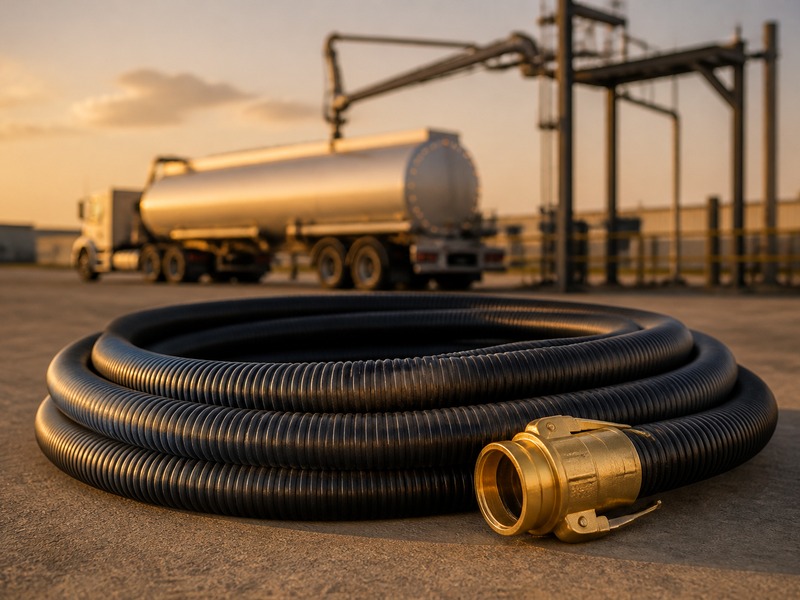
A petroleum transfer hose is the flexible connection that moves gasoline, diesel, fuel oil, and other refined products between storage, loading racks, tank trucks, railcars, and ships — and choosing the right one comes down to five decisions: hose type (bulk transfer or drop hose), bore size, working pressure, end fittings, and the standards the hose is built to. This guide explains each of those decisions in order, compares bulk transfer hose with drop hose, covers top loading and bottom loading layouts, and ends with a specification checklist plus honest buying guidance for fleets, depots, and distributors.
What Is a Petroleum Transfer Hose?
A petroleum transfer hose is a flexible rubber hose engineered to handle refined petroleum products in bulk loading and discharge service. It is a low-pressure product by design: the typical tank truck and loading rack hose is rated around 150 PSI (10 bar) working pressure, a fraction of what a hydraulic hose carries. Its job is to move large volumes of fuel quickly and safely while staying flexible enough to connect a fixed pipe to a moving truck, railcar, or vessel.
Every hose in this family shares the same four-layer anatomy, though materials vary by duty:
- Tube: a smooth oil-resistant inner layer, almost always nitrile (NBR), made conductive so static charge cannot build up on the fluid path.
- Refuerzo: textile plies carry the pressure; a steel helix wire or rigid helix is added where the hose must keep its round shape under flexing or vacuum.
- Portada: an abrasion-, oil-, ozone-, and weather-resistant rubber outer layer; drop hoses often use a corrugated cover for extra flexibility and kink resistance.
- Static control: a copper continuity wire bonded between end fittings, plus a conductive tube, drains charge to the grounding point.
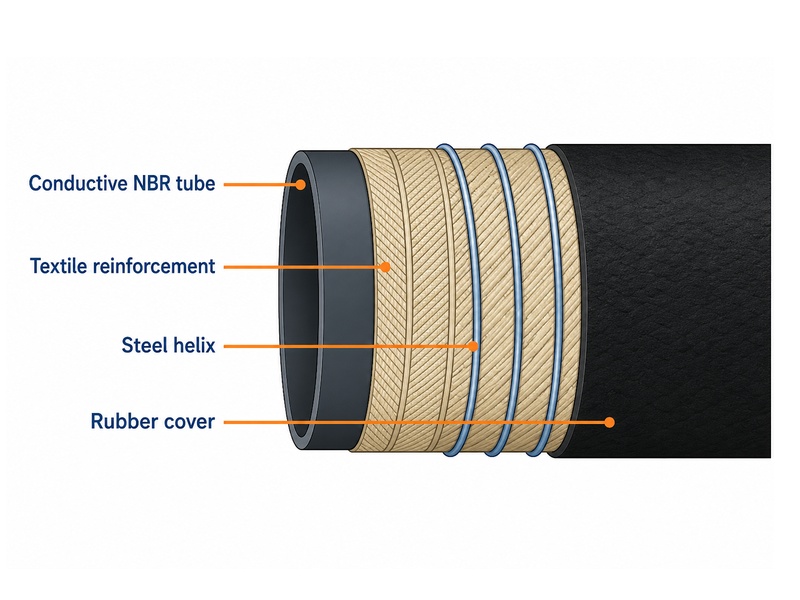
Figure 1. The four layers of a transfer hose: tube, reinforcement, cover, and static continuity wire.
Transfer hose construction, layer by layer
| Layer | Typical material | Job in the hose |
|---|---|---|
| Tube | Conductive nitrile (NBR) | Resists fuel swelling; drains static charge |
| Refuerzo | Synthetic textile plies (+ steel helix for flexing or vacuum duty) | Carries working pressure; resists collapse and kinking |
| Cover | Oil- and weather-resistant rubber, smooth or corrugated | Protects the carcass from abrasion, oil splash, and sunlight |
| Static wire | Copper continuity wire | Bonds the end fittings for grounding during transfer |
Two families dominate this category, and the first buying decision is simply telling them apart: the bulk transfer hose that runs from the pump or rack piping, and the short drop hose that makes the final connection into the tank.
Bulk Transfer Hose vs Drop Hose: What Is the Difference?
The category splits into two different jobs: “bulk transfer hose” and “drop hose”. Buyers who confuse them end up with a hose that is either too stiff for the last few feet or too light for the main line.
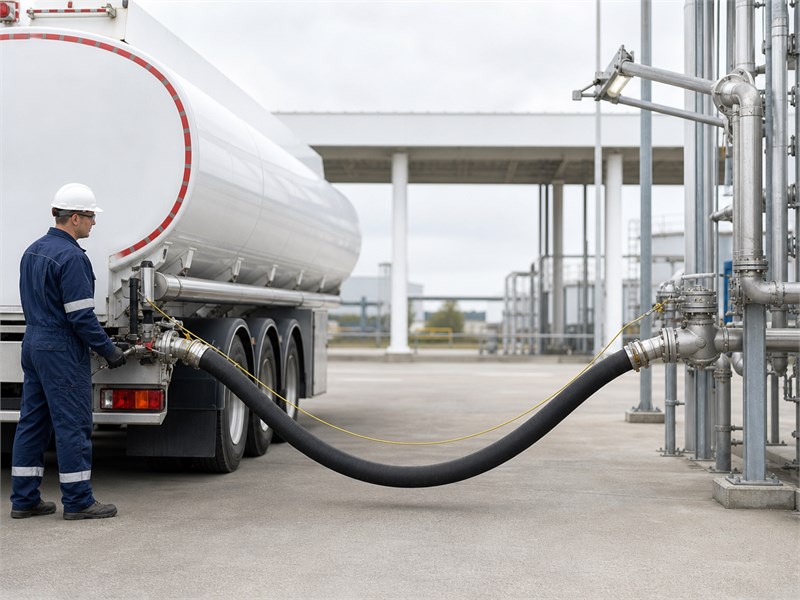
A bulk transfer hose (also called a loading hose or tank truck hose) is the long run that carries product from storage, a pump, or a loading arm. It can be 20 to 100 feet long, is rated for pump discharge pressure, and is built to be dragged, coiled, and coupled repeatedly.
A drop hose is a short, highly flexible section — typically 4 to 10 feet — used at a loading rack to make the final connection from the loading arm or rack piping down into the tank hatch of a truck or railcar. It gets its name from the fact that product literally drops through it by gravity or low pump pressure during top loading. Because it hangs vertically and is flexed at every connection, a drop hose needs a tighter bend radius and lighter handling weight than a main-line hose.
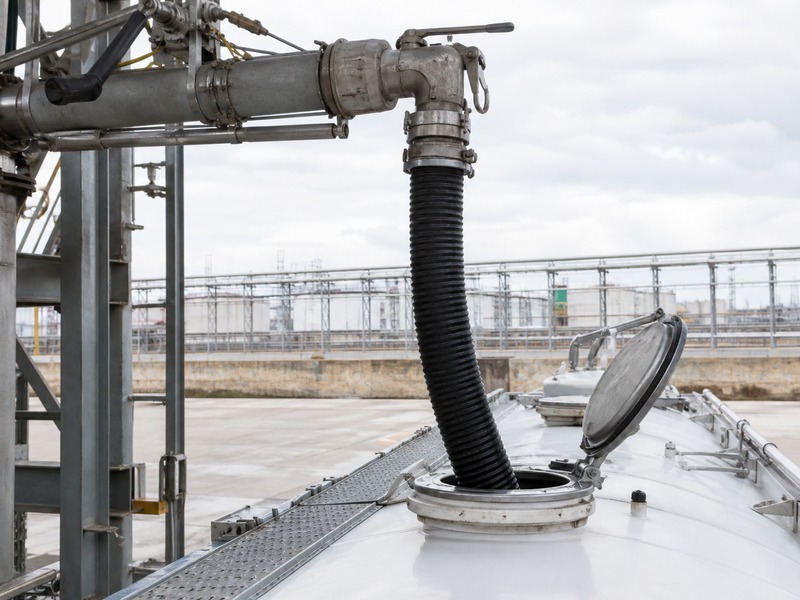
Figure 2. A fuel drop hose makes the final short connection between the loading arm and the tank hatch.
Bulk transfer hose vs drop hose at a glance
| Feature | Bulk transfer hose | Drop hose |
|---|---|---|
| Typical length | 20-100 ft | 4-10 ft |
| Typical bore | 2-4 in (up to 6 in marine) | 2-4 in |
| Typical working pressure | 150 PSI (10 bar), higher for large loading systems | 150 PSI (10 bar) rated; often runs at low pressure or gravity |
| Key requirement | Pressure rating, abrasion resistance, long service life | Flexibility, low weight, kink resistance, tight bend radius |
| Main job | Main run from pump or rack to the vehicle area | Final connection into the tank hatch (top loading) |
Both are rated for the same fuels, but they are optimized differently. If you are outfitting a loading rack, you will usually buy the two together: a heavier bulk line plus replaceable drop hoses, which take the most abuse and are designed to be swapped out quickly.
Where Is a Petroleum Transfer Hose Used?
The same hose family serves every point where refined product changes containers. Understanding the duty at each location matters, because pressure, flow, and inspection rules differ:
- Loading racks and tank truck terminals: the largest volume use — product moves from storage tanks into road tankers at 300-600 US gpm or more through 3-in and 4-in lines.
- Railcar loading facilities: similar flows to truck racks, often with longer hose runs and stricter grounding rules.
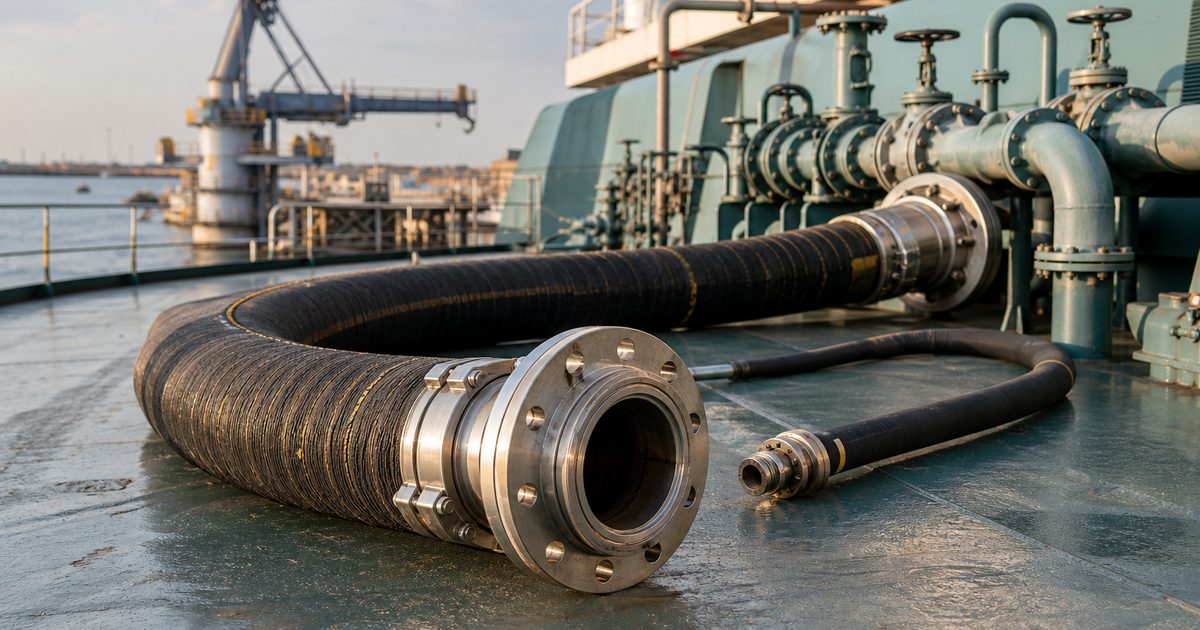
- Marine terminals and bunkering: marine loading hose moves product between docks, barges, and ships, and is specified to stricter marine standards and safety factors.
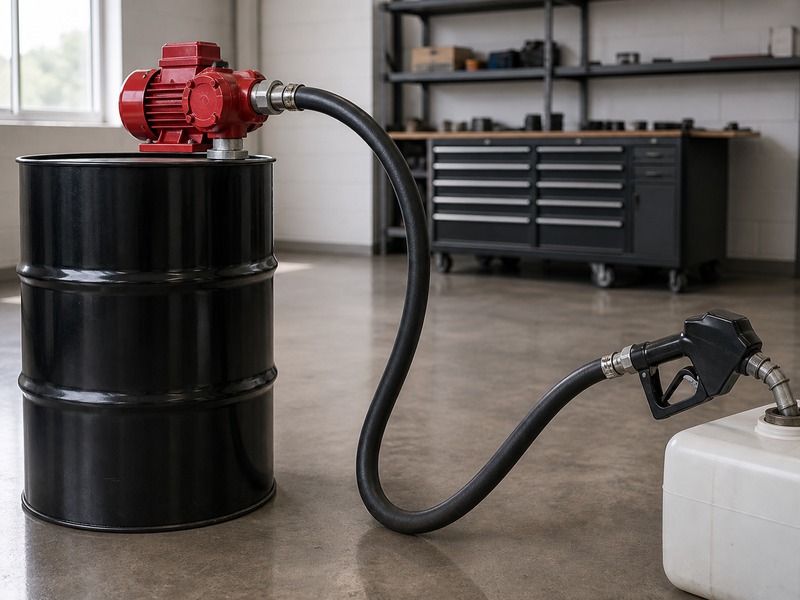
- In-plant and depot transfer: short runs between bulk tanks, day tanks, process equipment, and waste oil collection points.
- Aviation and specialty fuel points: dedicated constructions for jet fuel and similar products, usually marked for that specific fuel.
In every one of these locations, the layout question that decides which hose you need is the same: are you loading from the top or from the bottom?
Top Loading vs Bottom Loading: Which Hose Goes Where?
Top loading drops product into the tank through an open or sealed hatch. Bottom loading pumps product in through a coupler below the liquid level while the displaced vapor is returned to the storage tank. The two layouts use different hardware, and the hose choice follows the layout.
Top loading is where the drop hose lives. The loading arm or flexible hose is positioned over the hatch, and the fuel drop hose makes the connection down into the tank. Product falls through the hose by gravity or low pump pressure, which is why drop hoses are rated for flow, not for high pressure. Top loading is common for railcars and smaller truck racks, and it is splash loading unless a downspout or bottom fill is used — so static control and grounding rules are strict.
Bottom loading connects to a loading adapter at the base of the tank, so no hose enters the hatch. The main hose or loading arm handles the liquid, and a separate vapor recovery hose carries the displaced vapor back to the storage tank so nothing is vented to atmosphere. Bottom loading dominates modern truck racks because it is faster, safer, and required by vapor recovery regulations in many regions.
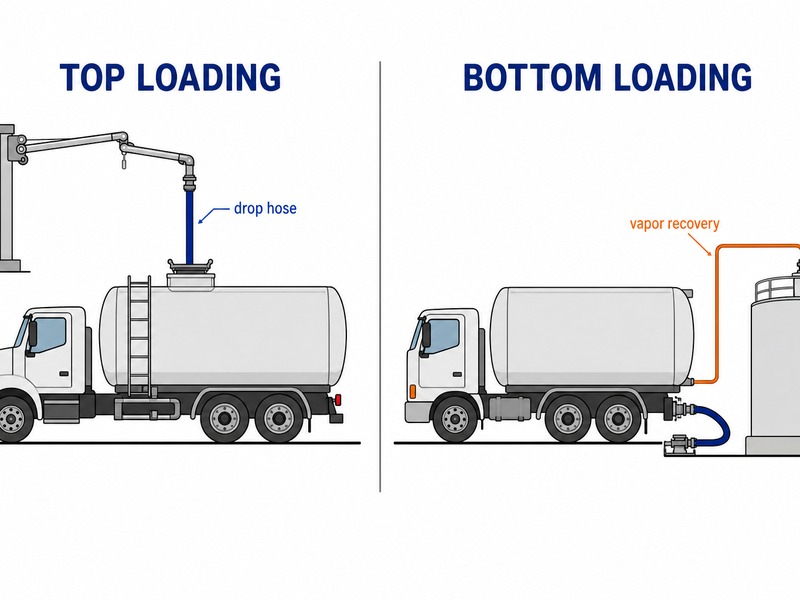
Figure 3. Top loading uses a drop hose into the hatch; bottom loading uses a base coupler plus a vapor-recovery connection.
Top loading vs bottom loading: hose requirements
| Factor | Top loading | Bottom loading |
|---|---|---|
| Product connection | Drop hose into the hatch | Loading arm or hose to a base coupler |
| Vapor handling | Often none (splash risk higher) | Separate vapor recovery hose returns vapor |
| Typical flow | 300-600 US gpm | Up to 600-1,000 US gpm on large racks |
| Static risk | Higher with splash filling | Lower, but bonding still required |
| Hose focus | Flexible fuel drop hose | Rated bulk hose plus a vapor-recovery line |
If your rack is converting to bottom loading, the vapor-recovery hose is not optional: vapor-balance regulations and safe practice require the displaced vapors to be returned, not released. Specify the vapor hose for the same fuel, temperature, and static continuity as the liquid line.
Step 1: Size the Petroleum Transfer Hose by Flow, Not by the Port
Size the bore from the flow rate you need to move, never from the port size already on the truck or pump. An undersized hose raises fluid velocity, which increases pressure drop, heats the product, and accelerates wear; an oversized hose costs more, weighs more, and is harder to handle at the rack.
A practical planning rule is to keep velocity between 10 and 15 ft/s on discharge lines, and lower — around 5 ft/s — on any suction line. For volatile products such as gasoline, also respect the loading-velocity guidance in API RP 2003 and NFPA 77, which limit splash-filling speeds regardless of hose rating. The flow capacities below are planning values calculated at 10-15 ft/s for typical refined fuels; confirm final sizing against the manufacturer’s flow table and your pump curve.
Transfer hose size chart: typical flow capacity by inner diameter (planning values)
| Inner diameter | Typical flow at 10-15 ft/s (US gpm) | Common loading duty |
|---|---|---|
| 1 in (25 mm) | 25-35 | Small pumps, drum and day-tank transfer |
| 1-1/2 in (38 mm) | 55-85 | Delivery trucks, small loading points |
| 2 in (51 mm) | 100-150 | Standard drop hose and smaller rack lines |
| 3 in (76 mm) | 220-330 | Main tank truck loading lines |
| 4 in (102 mm) | 390-590 | High-rate racks, railcar and terminal loading |
| 6 in (152 mm) | 880-1,320 | Marine terminal and large bulk transfer |
On a typical truck rack loading at 400-600 gpm, a 4-in main line with a 3-in or 4-in drop hose is the common combination. If you are unsure whether your pump can fill the hose fast enough, ask the supplier to confirm velocity and pressure drop for your exact flow before you buy.
Step 2: Match Working Pressure to the Loading System
A transfer hose for road tanker and loading rack service is normally rated 150 PSI (10 bar) working pressure, which matches the EN 1761 fuel truck delivery standard and the majority of rack pumps. Marine loading hose and large terminal hose are rated higher, and the burst rating is typically at least four times the working pressure.
Three pressure points deserve attention before purchase:
- Pump discharge pressure: size the hose rating above the maximum the pump can deliver at a closed or blocked outlet, not the normal running pressure.
- Pressure surges: quick-closing valves at loading racks can double the pressure in a line for an instant. A hose working at its rated maximum continuously has no margin for this; 150 PSI-rated hose on a 100 PSI system is the usual safety buffer.
- Vacuum: standard bulk transfer and drop hose is not rated for suction. If any part of the line pulls product from a tank below the pump, you need a suction-rated construction such as an oil suction and discharge hose, which adds helix reinforcement for full-vacuum service.
Never substitute a drop hose or a plain bulk hose on a suction leg, and never use a low-pressure petroleum hose on a hydraulic circuit — the two product families are rated for completely different worlds. When in doubt, request the manufacturer’s pressure and burst test certificate for the exact hose and size you intend to install.
Step 3: Check the Tube, Cover, and Static Control
The specification sheet lists materials for a reason: tube and cover compounds decide fuel compatibility and service life, and the static path decides whether the hose is safe on a loading rack.
Tube compound. Conductive nitrile (NBR) is the standard tube for gasoline, diesel, kerosene, fuel oil, and mineral oils. Confirm the hose is marked for the aromatic content of your fuel — EN 1761-type hoses are commonly rated for fuels with up to 50% aromatics, and specialty constructions cover higher contents. If you move chemicals, used oil with unknown contaminants, or fuels outside the marked range, ask for a compatibility check before purchase; tube swelling and liner collapse are the usual failure modes when the wrong tube meets the wrong fuel.
Cover construction. Smooth covers are easier to clean and drag well on the ground; corrugated covers flex more easily and resist kinking, which is why corrugation is common on fuel drop hose and tank truck hose that is coiled and uncoiled daily. Either way, the cover must resist oil splash, abrasion, ozone, and weather — a cover that cracks lets water and grit into the carcass and ends the hose early.
Static control. Refined fuels flowing through rubber generate static charge. The hose answers with a conductive tube and a copper continuity wire bonded to both end fittings, and the loading system answers with bonding and grounding — chassis to rack earth — before product flows. NFPA 77 and API RP 2003 describe the grounding practice for tank truck and tank car loading. In our factory testing we check continuity wire resistance on every assembled hose; if you measure open continuity between fittings on a used hose, take it out of service immediately, because a broken static path cannot be repaired in the field.
Step 4: Choose End Connections and Fittings
The fitting determines how fast the hose connects, how well it seals, and how easily it can be swapped when a drop hose wears out. Five connection types cover nearly all petroleum loading work:
End fittings for petroleum transfer and drop hose
| Tipo de acoplamiento | Typical use | Notas |
|---|---|---|
| Camlock (cam and groove) | Drop hose and rack connections changed every shift | Fast, tool-free coupling; standard on 2-4 in loading hose |
| Flange (ANSI) | Permanent rack piping, marine and terminal lines | Bolt-on security; standard for larger and marine hoses |
| Threaded (BSP, NPT) | Smaller lines, pumps, and adapters | Thread family must match; see our NPT vs BSP thread guide |
| Dry disconnect | Bottom loading couplers, high-value or hazardous product | Minimizes spillage when uncoupling under pressure |
| Stainless or aluminum ends | Corrosive or high-purity service, frequent coupling | Specified with the hose assembly, not added later |
Fittings should be factory-fitted and pressure-tested with the hose, not clamped on at the site by guesswork. A crimped or swaged assembly keeps the static wire bonded through the fitting; a field repair that breaks that bond compromises the whole static control system. For drop hose that is swapped frequently, standardize on one coupling type across the rack so every spare hose fits every arm, and keep a small stock of pre-made assemblies rather than repairing worn ends in the field.
Petroleum Hose vs Fuel Transfer Hose vs Oil Suction and Discharge Hose
The naming across the petroleum hose family confuses even experienced buyers, because the products overlap. Three distinctions clear it up:
- Petroleum hose (this guide’s scope) — bulk loading and discharge of refined products: tank truck hose, loading rack hose, and drop hose. Discharge duty, 150 PSI class, EN 1761-type.
- Fuel transfer hose — the lighter, hand-held hose for dispensers, pumps, and small transfer jobs, usually 3/4 to 1 in bore, often with a nozzle or swivel. Fine for small volumes; not the tool for a 500 gpm rack.
- Oil suction and discharge (OS&D) hose — the helix-reinforced heavy-duty hose rated for full vacuum, used where a line must both suck from a below-grade tank and push product onward.
If your application pulls product from a tank lower than the pump, or combines suction and discharge in one line, an OS&D hose is the correct choice — see our oil suction and discharge hose guide for the full selection procedure. If the job is pure pressure loading from a rack, stay with a bulk transfer hose or the appropriate drop hose, and you will pay for exactly the construction the duty needs.
Step 5: Verify Standards, Markings, and Test Records
Standards are the shorthand that tells you a hose was built and tested for a defined duty. For petroleum bulk loading, three references cover most of the world’s fleets and racks:
- EN 1761 — rubber hoses for fuel truck delivery: loading and discharge of liquid hydrocarbon fuels at up to 10 bar working pressure. The reference for tank truck hose in Europe and most export markets.
- EN 1765 / marine practice — oil suction and discharge hoses for ship-to-shore and barge work, usually specified by the terminal operator or OCIMF-style guidelines with higher safety factors than truck hose. Marine loading hose is a specialist purchase: confirm the required working pressure, end flanges, and inspection interval with the terminal before ordering.
- API RP 1007 and NFPA 77 — not hose standards but the loading-practice references that govern bottom loading, vapor recovery, and static grounding on racks. A hose that meets EN 1761 still depends on the rack following these practices.
Every compliant hose carries a printed marking line on the cover with the manufacturer, standard, size, working pressure, and a date code. Read it before every purchase and before every annual inspection: the date code tells you the hose’s age, and most operators retire petroleum hose after 6-10 years in fuel service even if the cover looks sound, because rubber ages from the inside out. Ask the supplier for the batch test certificate (pressure test, continuity test, and date of manufacture) so your records match the hose.
How Much Does a Petroleum Transfer Hose Cost?
Price scales with bore size, length, fittings, and standard. As a planning range for factory-new hose in 2026, expect roughly \$4-\$9 per foot for 2-in, \$7-\$14 per foot for 3-in, and \$10-\$20 per foot for 4-in bulk transfer hose, with factory-fitted camlock or flange ends adding a set price per assembly. Drop hose is usually priced per assembly rather than per foot, because the fittings and the short, corrugated construction dominate the cost.
Three buying rules keep the total cost honest:
- Compare rated hose, not lowest price. Two 3-in hoses at very different prices usually differ in tube compound, helix quality, and test coverage. Ask what standard each is built to and request the test certificate.
- Add the lifetime cost. A cheap hose that fails at the rack costs more in downtime, spill cleanup, and safety exposure than the price difference on the invoice. Fleet buyers we work with replace drop hose on condition, not on calendar alone.
- Include spare drop hoses in the order. Because drop hose takes the most abuse, stocking one spare per active loading position is standard practice; ask about MOQ, lead time, and warranty terms before committing to a bulk order.
HENGHUA supplies factory-direct, which typically undercuts distributor pricing for equivalent EN 1761-type construction — but verify by asking for a quote against your specification, and confirm lead time and warranty in writing before ordering.
How to Inspect and Maintain a Loading Hose
A loading hose is a safety component, and inspection is a habit, not an event. We recommend a quick visual check before every shift and a documented inspection at least every 12 months:
- Check the cover for cuts, cracks, blisters, soft spots, and abrasion down to the reinforcement.
- Look for kinks, crushing, or flat spots, especially near the end fittings and on the drop hose.
- Confirm the fittings are tight, undamaged, and free of corrosion at the crimp or swage.
- Measure electrical continuity between the two end fittings; open continuity means the static path is broken.
- Read the date code and retire the hose at the manufacturer’s stated maximum service life.
- Keep records of every inspection, pressure test, and the product each hose has carried.
The most common premature failures we see in loading service are all preventable: dragging a heavy 4-in line by the hose body instead of the fittings, coiling tighter than the minimum bend radius, leaving hose in direct sun for years, and using a discharge-only hose on a suction leg. Train operators on the bend radius and the grounding sequence, and a quality hose will deliver its full rated service life.
Preguntas frecuentes
What is a petroleum transfer hose used for?
It moves gasoline, diesel, kerosene, fuel oil, and similar refined products between storage tanks, loading racks, tank trucks, railcars, and ships during bulk loading and discharge. It replaces rigid pipe wherever the connection has to flex — for example, between a fixed loading arm and a truck that moves as it fills.
What is the difference between a bulk loading hose and a drop hose?
A bulk loading hose is the long main line that carries product from the pump or storage to the loading area, rated for full pump pressure and repeated dragging. A drop hose is a short, extra-flexible section, usually 4 to 10 feet, that connects the loading arm to the tank hatch during top loading. They are complementary: racks typically use a bulk line plus replaceable drop hoses.
Can a drop hose be used for suction service?
No. Drop hose and standard bulk transfer hose are built for discharge duty, where the pump pushes product through the hose. Suction service requires a helix-reinforced hose rated for vacuum, such as an oil suction and discharge hose; using a discharge-only hose on a suction leg makes it collapse and can damage the pump.
What working pressure do tank truck hoses need?
Tank truck hose for fuel delivery is normally rated 150 PSI (10 bar) working pressure, matching the EN 1761 standard, with a burst rating at least four times higher. Size the rating above the maximum pump discharge pressure including surge, and confirm the burst and test certificate with the supplier.
Do I need a vapor recovery hose for bottom loading?
Yes, when the rack is set up for bottom loading. Bottom loading displaces vapor from the tank as it fills, and a vapor recovery hose returns that vapor to the storage tank instead of venting it. Vapor recovery is both a regulatory requirement in most regions and standard safe practice, and the vapor hose needs the same fuel compatibility and static continuity as the liquid line.
How long does a petroleum transfer hose last?
With correct use and regular inspection, a quality transfer hose in this class typically serves 6-10 years in fuel loading duty. Service life depends on the fuel, sunlight exposure, handling, and how often it is flexed and dragged. Follow the date code, inspect before every shift, and retire the hose at the manufacturer’s stated maximum service life even if the cover looks acceptable.
Final Verdict
Bulk loading and drop hose service is not a place for guesswork: match the hose family to the layout (bulk transfer line plus drop hose for top loading, vapor recovery for bottom loading), size the bore from flow, verify the 150 PSI-class rating against your pump and surge conditions, and buy only hose with a clear standard, date code, and test certificate. Done that way, the hose is a dependable, low-cost component of a safe rack — and the inspection habit you keep is what actually protects the operation.
If you are specifying hose for a fleet, a terminal, or an OEM program, send HENGHUA your flow rate, layout, and fitting preference. Our engineers will confirm the correct size and construction, provide the test certificate, and quote factory-direct pricing with lead time and warranty terms — so you can order the right petroleum transfer hose with confidence. Contact HENGHUA for a quote and free samples.


 English
  Spanish
  Portuguese
  French
  German