
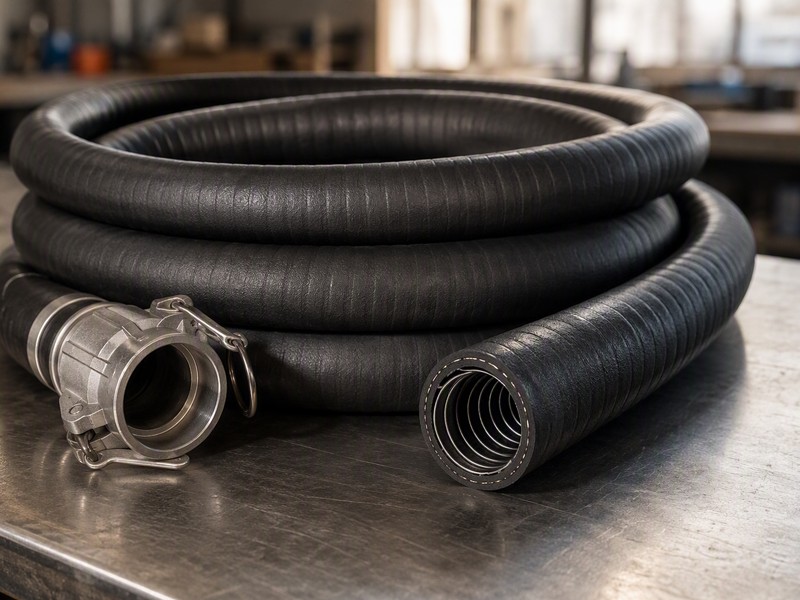
An oil suction and discharge hose is a flexible rubber hose engineered to move petroleum products such as diesel, fuel oil, lubricating oil, and mineral oil under both suction (vacuum) and discharge (pressure) conditions, commonly built to EN 1765 or DIN 20023 in 10 bar and 20 bar working pressure classes, with sizes from 3/4 to 6 inch inside diameter. In short: choose 10 bar for most transfer, depot and tanker duty, step up to 20 bar when pump pressure or surge demands it, and confirm full vacuum plus an oil-resistant NBR tube. This guide covers the full size range with a DN conversion chart and flow table, explains pressure, vacuum and temperature ratings, and maps the hose to its main applications.
You will also learn how the hose is built, why the spiral steel wire helix matters for suction service, and how to tell a suction hose from a discharge hose before you buy. We finish with a selection checklist, installation steps, failure modes, and the questions our customers ask most — HS code, price, reel lengths, and 10 vs 20 bar.
What Is an Oil Suction and Discharge Hose?
An oil suction and discharge hose earns its name — one hose for both sides of the pump. It sits between a lightweight oil transfer hose, which cannot hold vacuum, and a hydraulic hose built for thousands of PSI.
The construction explains the behaviour. The inner tube is an oil-resistant nitrile (NBR) rubber compound that resists swelling in diesel, fuel oil, or lubricating oil. Around it, high-tensile textile cord carries the pressure and a spiral steel wire helix stops the hose collapsing under vacuum. The cover is oil-, weather-, and abrasion-resistant rubber; for low-resistance products, a conductive or antistatic version drains static build-up, as EN 1765 requires.
In short, this is the hose family also sold as petroleum suction hose, oil suction and delivery hose, or fuel oil transfer hose — the naming varies by region, but construction and ratings follow the same standards.
How Is It Different from a Hydraulic Hose?
A suction and discharge hose and a hydraulic hose differ in pressure rating and construction: this family works at 10 or 20 bar (145 or 290 PSI) with textile reinforcement plus a wire helix, while a hydraulic hose carries oil at 1,000 to 6,000 PSI with steel wire reinforcement. Choosing the wrong family — a suction hose on a high-pressure outlet — is a fast way to burst a line, as our oil hose working pressure vs burst pressure guide explains. For a 1,000+ PSI outlet, use a hydraulic hose.
Oil Suction and Discharge Hose Sizes: How to Read Them
Hose sizes are stated by inside diameter (ID) — inches for the imperial market, millimetres or DN for the metric market. DN is the metric equivalent: DN 25 equals a 1-inch bore, DN 50 equals 2 inches. Size follows from flow rate and velocity, not outside diameter.
Common Oil Suction Hose Sizes and Flow Capacity
The most common sizes in service are 1, 1-1/2, 2, 3, and 4 inches, with 6-inch hoses for high-flow tanker and terminal duty.
In our factory the same range is produced in both 10 bar and 20 bar classes. The wall thickness is the main difference: a 20 bar hose carries more textile layers and a larger outside diameter for the same bore.
Common hose sizes with metric equivalents.
| Size (inch ID) | DN (mm) | Inside diameter (mm) | 10 bar class | 20 bar class |
|---|---|---|---|---|
| 3/4 | DN 19 | 19 | Yes | Yes |
| 1 | DN 25 | 25 | Yes | Yes |
| 1-1/4 | DN 32 | 32 | Yes | Yes |
| 1-1/2 | DN 38 | 38 | Yes | Yes |
| 2 | DN 50 | 50 | Yes | Yes |
| 2-1/2 | DN 63 | 63 | Yes | Yes |
| 3 | DN 75 | 75 | Yes | Yes |
| 4 | DN 100 | 100 | Yes | Yes |
| 5 | DN 125 | 125 | Yes | On request |
| 6 | DN 150 | 150 | Yes | On request |
Flow capacity follows bore area and velocity: Q = A × v. At the recommended 3 m/s, a 2-inch (DN 50) bore moves about 21 m³/h and a 4-inch (DN 100) bore about 85 m³/h. Keep velocity between 1.5 and 4 m/s for oil service — below 1.5 m/s sediment settles, above 4 m/s you waste pump energy and wear the tube. Pump spec in litres per minute? Convert to m³/h and pick your row.
Flow capacity (m³/h) by bore and velocity (Q = A × v, nominal inside diameter).
| Size (inch ID) | DN | Flow at 1.5 m/s | Flow at 2 m/s | Flow at 3 m/s | Flow at 4 m/s |
|---|---|---|---|---|---|
| 1 | 25 | 2.7 | 3.5 | 5.3 | 7.1 |
| 1-1/2 | 38 | 6.1 | 8.2 | 12.2 | 16.3 |
| 2 | 50 | 10.6 | 14.1 | 21.2 | 28.3 |
| 3 | 75 | 23.9 | 31.8 | 47.7 | 63.6 |
| 4 | 100 | 42.4 | 56.5 | 84.8 | 113.1 |
| 6 | 150 | 95.4 | 127.2 | 190.9 | 254.5 |
Worked example: a 30 m³/h diesel pump needs about a 3-inch bore at 2 m/s — see the 2 m/s column above (31.8 m³/h). Values use nominal inside diameter; verify against the factory data sheet.
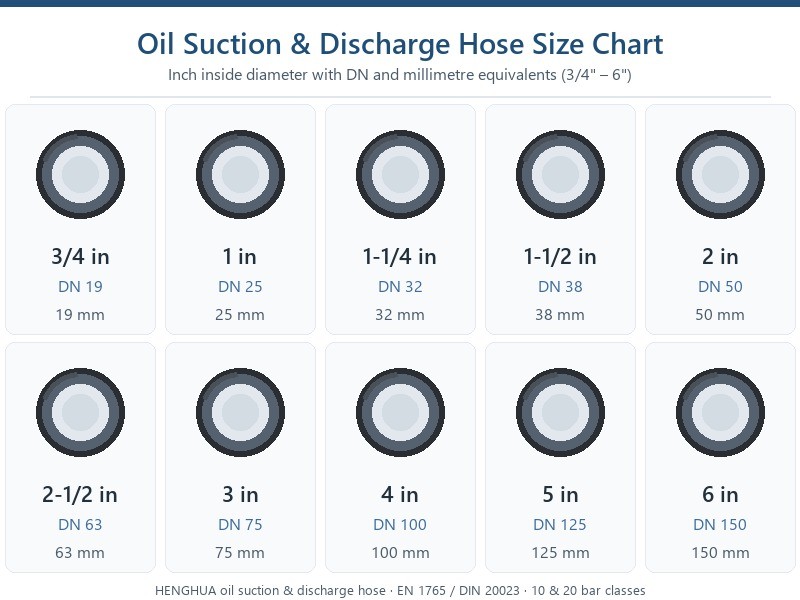
Figure 2. Inch, DN, and millimetre size equivalents for this hose family.
What Lengths Are Available (Reels vs Cut to Length)?
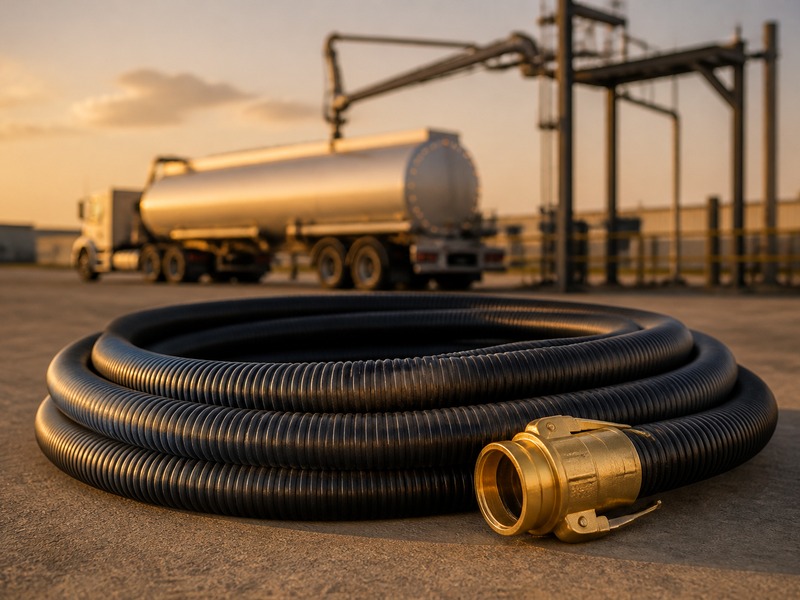
This hose family is supplied in continuous lengths — commonly 20, 30, and 60 metres on a reel — or cut to length with factory-fitted end connections. Rolls suit fabricators assembling their own lines; cut-and-fitted lengths arrive ready to bolt in. Buying cut lengths with the correct end fittings eliminates the most common field failure: a coupling that pulls out under pressure.
Working Pressure and Vacuum Ratings Explained
Ratings are printed on the cover of every compliant hose. Working pressure is the maximum continuous internal pressure at the rated temperature; burst pressure is the destructive-test pressure — four times working pressure for this family, per EN 1765 and DIN 20023. A 10 bar oil suction and discharge hose therefore bursts at not less than 40 bar, a 20 bar hose at not less than 80 bar — see the test-data section below for the program.
Vacuum rating is the second number that matters. A hose marked for full vacuum operates at 0.9 bar negative pressure without collapsing, because the wire helix resists the inward force. Use a helix-equipped suction hose on any line that pulls vacuum; a discharge-only hose belongs on pressure-only lines.
Temperature rating defines the safe fluid range. Both classes share the same -30 to +80 °C continuous range, with short peaks up to +100 °C for the duration stated on the data sheet; at the cold end the hose stays flexible to about -30 °C, important for outdoor tanker work in winter.
Rating summary for the 10 bar and 20 bar classes.
| Rating | 10 bar class | 20 bar class |
|---|---|---|
| Presión de trabajo | 10 bar (145 PSI) | 20 bar (290 PSI) |
| Minimum burst pressure | 40 bar (580 PSI) | 80 bar (1,160 PSI) |
| Vacuum rating | Full vacuum (0.9 bar) | Full vacuum (0.9 bar) |
| Temperature range | -30 to +80 °C | -30 to +80 °C |
| Safety factor (burst / working) | 4:1 | 4:1 |
| Typical standard | EN 1765 | DIN 20023 |
Can a Suction and Discharge Hose Handle Full Vacuum?
A suction and discharge hose handles full vacuum only when built with a wire helix and marked for full vacuum service. Hoses without that marking — even in the 10 bar class — collapse under suction. If your pump draws a hard vacuum, specify full vacuum and confirm it on the data sheet. In our tests, a 3-inch hose without the helix collapses at roughly 0.3 bar of vacuum — far below what a suction pump generates; test conditions are in the factory type-test report.
What Is the 4:1 Safety Factor?
The 4:1 safety factor means the minimum burst pressure is four times the working pressure. It absorbs surges, aging, and abrasion damage so a hose in service stays well away from its failure point. The same ratio is used for hydraulic hoses in SAE J517 and EN 853, and it is built into the EN 1765 and DIN 20023 classes. Burst pressure is a destruction-test value, not an operating limit: run a 10 bar hose at 10 bar or less, never “up to 40 bar”.
Suction Hose vs Discharge Hose: What Is the Difference?
The terms “suction hose” and “discharge hose” describe two constructions in this product family. A suction hose has the spiral steel wire helix and is rated for full vacuum plus low pressure, so it can pull fluid and push it. A discharge hose (sometimes called a delivery hose) has textile reinforcement without the helix; it pushes fluid but collapses if the pump pulls vacuum. The common phrase covers the combined-duty product: the helix-equipped hose that does both jobs.
Suction vs discharge vs combined-duty construction.
| Property | Suction hose | Discharge hose | Suction and discharge hose |
|---|---|---|---|
| Spiral wire helix | Yes | No | Yes |
| Vacuum rating | Full vacuum | None or partial | Full vacuum |
| Presión de trabajo | 10 bar typical | 10 or 20 bar | 10 or 20 bar |
| Best for | Pump inlet, tank emptying | Pump outlet, gravity feed | Loading arms, tanker duty |
For tanker and terminal work, the combined-duty hose is the standard choice because one hose handles both pump-out and pump-in. For fixed installations where the pump always pushes, a discharge hose is lighter, cheaper, and easier to handle. In many regions this product is simply called a petroleum suction hose. The suction-rated construction costs more than discharge-only for the same bore; the premium is small next to the cost of a collapsed line — confirm it in your quotation.
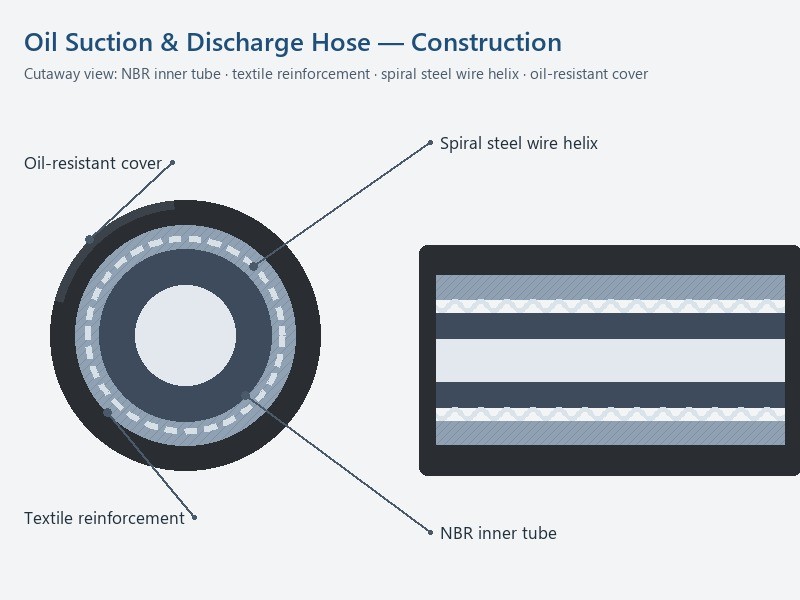
Figure 3. The four layers: inner tube, textile reinforcement, wire helix, and cover.
Oil Suction and Discharge Hose Applications
This hose family is a workhorse of petroleum handling — one product covers most low-pressure oil duties. The table below maps applications to the sizes and ratings we see most often in the field.
Typical applications with common sizes and ratings.
| Solicitud | Typical size | Typical rating |
|---|---|---|
| Tanker truck loading and unloading | 3 to 4 inch | 10 bar, full vacuum |
| Fuel oil and diesel transfer at depots | 2 to 4 inch | 10 or 20 bar |
| Oil terminal and loading-arm service | 4 to 6 inch | 10 bar, full vacuum |
| Hydraulic oil return lines and hydraulic suction hose duty | 1 to 2 inch | 10 or 20 bar |
| Lubrication oil circulation systems | 3/4 to 1-1/2 inch | 10 bar |
| Transformer oil filling and draining | 1 to 2 inch | 10 bar |
| Waste oil collection and recycling | 2 to 3 inch | 10 bar, full vacuum |
| Vacuum truck / tank cleaning duty | 4 inch | 10 bar, full vacuum |
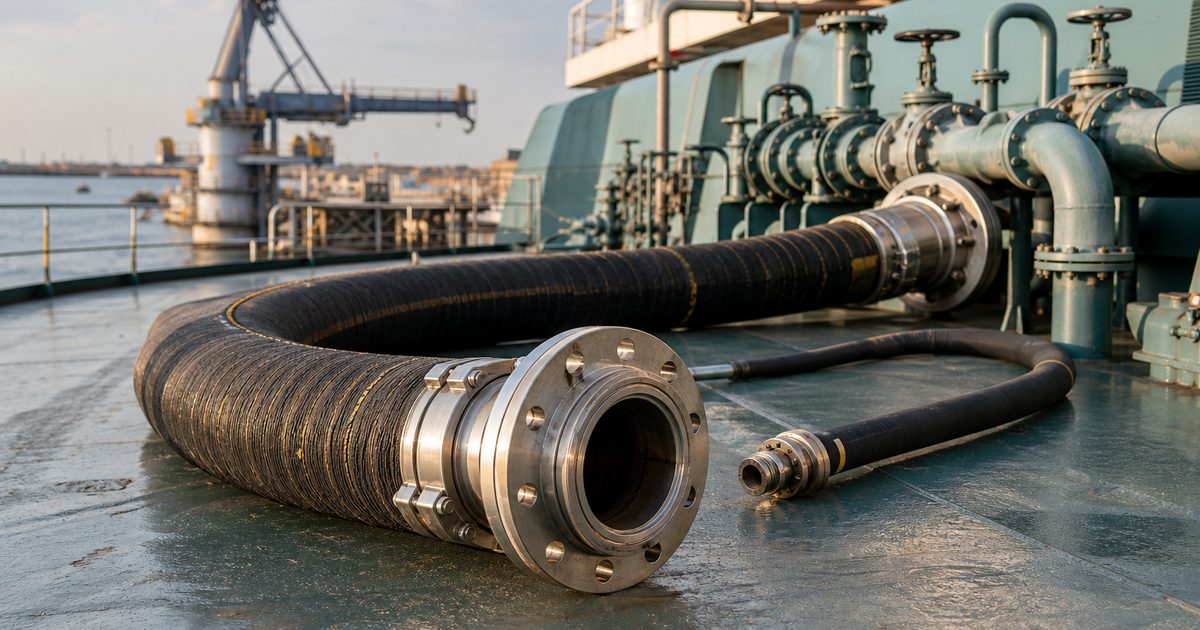
| Marine bunkering and harbour transfer | 3 to 6 inch | 10 bar |
Sourcing for tanker fleets, depots or OEM programs? Send your sizes and pressure class — our engineering team confirms the right construction and quotes the same day. contact our team
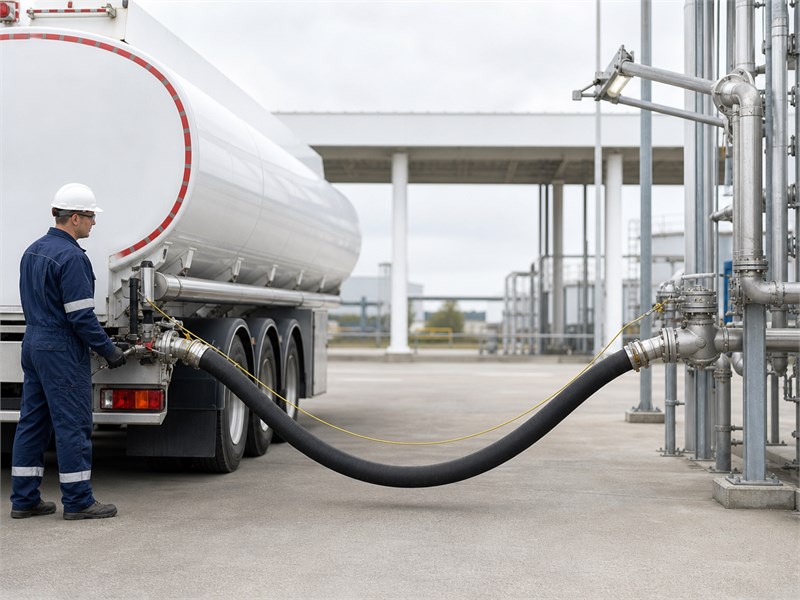
Tanker truck duty exercises every rating at once: the pump pulls vacuum to empty the compartment, pushes product through the loading arm, and the hose is dragged, driven over, and stored outdoors. That is why the oil transfer hose on a road tanker is typically the 4-inch, 10 bar, full-vacuum construction with an abrasion-resistant cover and a conductive tube for static safety. In industrial plants, the same hose serves as a hydraulic oil return line on presses and machine tools.

Figure 4. Tanker loading: the hose handles vacuum on suction, pressure on discharge, and outdoor abuse in between.
How to Choose the Right Oil Suction Hose
Match five parameters to the duty, then check the standard and the fittings:
- Fluid compatibility. Confirm the tube is rated for the specific product; aromatic fuels and hot oils may need a special compound.
- Size and flow. Calculate the bore from flow rate and velocity (1.5 to 4 m/s for oil). Undersizing raises velocity, pressure drop, and wear.
- Pressure and vacuum. Select 10 or 20 bar from the maximum pump outlet pressure; confirm full vacuum if the inlet runs below atmospheric. Choose by working pressure and vacuum — not burst pressure.
- Temperature. Match the compound to the fluid range; continuous service above +80 °C needs a heat-rated construction.
- Fittings and length. Choose camlock, flange, or threaded ends (BSP or NPT). Our hydraulic fittings types guide and NPT vs BSP thread guide explain the options.
Browse our oil hose range for current sizes and ratings, then check three things on the data sheet: the cover-marked working pressure and vacuum rating, the standard reference (EN 1765 or DIN 20023), and whether the supplier proof-tests every reel. At HENGHUA, every oil suction and discharge hose is proof-tested at 1.5 times working pressure before shipping, and batch samples are burst-tested to confirm the 4:1 factor has not drifted.
Which Fluids Are Compatible with the NBR Tube?
Diesel, fuel oil, kerosene, lubricating oil and mineral oil are the core service fluids for the standard NBR tube. Compatibility falls as aromatic content rises; the matrix below is a working guide at 20 °C — confirm the specific product against the factory data sheet.
NBR tube compatibility with common petroleum products.
| Fluid | Compatibility with NBR tube | Note |
|---|---|---|
| Diesel fuel | Bien | Core service fluid |
| Fuel oil (light and heavy) | Bien | Core service fluid |
| Kerosene / jet fuel | Bien | Confirm temperature limits |
| Lubricating oil | Bien | Core service fluid |
| Mineral oil | Bien | Core service fluid |
| Crude oil | Limited | Depends on aromatic content — confirm with data sheet |
| Aromatic fuels and solvents | Poor | Use a special compound |
Compatibility is a tube-level property: cover and fittings must be checked separately, and temperature changes the picture.
EN 1765 vs DIN 20023: Which Standard Should I Specify?
Both standards govern the same product family in Europe. EN 1765 is the European standard, widely referenced in tanker, depot and terminal specifications; DIN 20023 is the German national standard, common in Central European and OEM specs. Both cover the 10 and 20 bar classes, the 4:1 safety factor, and cover marking. State the standard on your order so the hose is tested and marked accordingly.
EN 1765 and DIN 20023 at a glance.
| Artículo | EN 1765 | DIN 20023 |
|---|---|---|
| Scope | Hose assemblies for suction and discharge service | Hose assemblies for suction and discharge service |
| Status | European standard | German national standard |
| Working pressure classes | 10 / 20 bar | 10 / 20 bar |
| Safety factor | 4:1 | 4:1 |
| Constructions | Suction and discharge | Suction and discharge |
| Cover marking | Required, incl. standard number | Required, incl. standard number |
Factory Test Data: What We Measure on Every Batch
Every HENGHUA reel ships with a factory test record, and the cover marking matches those records. The program below is the standard test set for a 4-inch, 10 bar, full-vacuum class hose.
Factory type-test program for the 4-inch, 10 bar, full-vacuum class. 0.9 bar applies to helix-equipped hoses; 0.3 bar is the no-helix collapse threshold.
| Test | Requirement |
|---|---|
| Hydrostatic proof test | 1.5 x working pressure, 5 min, no leak |
| Burst test (n=3) | 40 bar minimum |
| Vacuum collapse test | 0.9 bar, 30 min |
| Conductivity (antistatic class) | Per EN 1765 antistatic requirements |
Test sheets accompany every reel shipped, and factory type-test reports are available on request. The requirements above are the pass criteria — every reel must meet them before it ships.
How Should I Install and Ground This Hose?
Installation mistakes show up as leaks, collapsed lines and static hazards. Replacing a suction line on a fuel pump? Follow the five steps, then re-check the cover marking.
- Check the marking. Confirm bore, pressure, vacuum rating and temperature range on the cover match the duty.
- Fit the ends. Camlock — align, seat, close both arms until they lock; flanged ends (PN16 flange rating) — follow the torque sequence. Factory-fitted ends remove most of this variability.
- Bond the ends. On conductive or antistatic hose, connect bonding wires at both ends and ground the system; antistatic classes are marked for this per EN 1765.
- Route with respect. Keep above the minimum bend radius, avoid sharp edges, and use a protective sleeve in high-traffic areas. Weight per metre and minimum bend radius vary by size and class — exact values are in the factory data sheet.
- Test before use. Run a leak test at working pressure and confirm the hose holds vacuum.
Common Mistakes and Failure Modes
Most failures in this product family are predictable and avoidable — drawn from field returns and our own test records.
- Using a discharge-only hose on a suction line. The hose collapses, starves the pump, and fails early. Always confirm the vacuum rating.
- Exceeding working pressure. Spikes from a closed valve or worn pump can double the pressure; the 4:1 factor absorbs a few, but continuous overpressure shortens life.
- Dragging the cover over sharp edges. Abrasion exposes the textile reinforcement, which wicks oil and blisters. Use an abrasion-resistant cover or a sleeve.
- Storing outdoors unprotected. UV cracks cheap covers within a season; a good NBR cover with carbon black resists far longer.
- Wrong end fitting or bad crimp. A camlock that does not seat, a mismatched flange pattern, or a wrong-spec crimp all leak or pull out. Factory-fitted ends remove this variable.
- Ignoring static. Moving petroleum generates static charge; on tanker and terminal duty, use a conductive or antistatic tube and bond the ends.
- Running past service life. UV cracks the cover and repeated flexing work-hardens the helix. Inspect annually; replace when the cover blisters, reinforcement shows, or a proof test fails.
Oil Hose FAQ
What is this hose made of?
The inner tube is an oil-resistant nitrile (NBR) rubber compound; the reinforcement is high-tensile textile cord with an embedded spiral steel wire helix for vacuum resistance; the cover is oil-, weather-, and abrasion-resistant rubber. Conductive versions add a carbon-loaded layer for static dissipation.
What working pressure rating does an oil hose have?
The standard classes are 10 bar (145 PSI) and 20 bar (290 PSI), with minimum burst pressures of 40 bar and 80 bar at a 4:1 safety factor. Both classes are rated for full vacuum (0.9 bar) when built with the wire helix.
Can these hoses carry diesel and fuel oil?
Yes — diesel, fuel oil, lubricating oil, and mineral oil are the core service fluids for the petroleum suction hose family, and the NBR tube resists swelling in them. For aromatic or solvent-heavy products, confirm the compound rating before ordering.
What oil suction hose sizes are available?
Standard sizes run from 3/4 inch (DN 19) to 6 inch (DN 150) inside diameter; 1, 1-1/2, 2, 3, and 4 inches are the most common. Size refers to inside diameter; a 10 bar and a 20 bar hose of the same bore differ in wall thickness and OD.
What is the difference between a suction hose and a hydraulic hose?
This hose works at 10 or 20 bar with full vacuum, textile reinforcement plus a wire helix for high flow at low pressure. A hydraulic hose carries hydraulic oil at 1,000 to 6,000 PSI with steel wire reinforcement. They are not interchangeable, and the selection guidance in our how to select hydraulic oil hose guide explains the boundary.
Which end fittings work with oil hoses?
Camlock (cam and groove) couplings are the most common for tanker and transfer work because they connect in seconds; flanged ends (PN16 flange rating) suit terminals and loading arms; threaded BSP or NPT ends suit plant and machine connections. All can be factory-fitted, crimped or clamped to spec.
What is the HS code for oil suction and discharge hose?
Rubber hose with fittings generally falls under HS 4009 (textile- or metal-reinforced rubber hose). The exact 8- or 10-digit code depends on the reinforcement and fittings and differs between markets — for example, US HTS versus EU CN code. Confirm the precise code with your customs broker; we can advise based on the exact construction you order. For your exact size and quantity, request a quotation — same-day reply.
How much does an oil suction and discharge hose cost?
Price is driven by bore size, pressure class, wall thickness, fittings, length and volume: a 2-inch 10 bar hose sits at the low end of the range, a 4-inch or 20 bar construction is substantially more, and volume orders cut the per-metre price. For your exact size and quantity, request a quotation — same-day reply.
What lengths come on a reel?
Standard supply is 20, 30 and 60 metres on a reel, or cut to length with factory-fitted couplings. Buying cut-and-fitted lengths removes the most common field failure: a coupling fitted on site that pulls out under pressure. For cut-and-fitted lengths, request a quotation — same-day reply.
Do I need a 10 bar or a 20 bar oil hose?
Use the 10 bar class for most transfer, depot and tanker duties; step up to 20 bar when pump outlet pressure or surge exceeds 10 bar. Select by working pressure and vacuum rating — not by burst pressure. Send your pump spec — contact our team.
I’m a first-time buyer replacing a failed suction hose on a fuel pump — how do I identify the size and rating I need?
Read the old hose’s cover marking for bore, working pressure and vacuum rating; if the marking is worn, measure the inside diameter and confirm the pump’s maximum pressure and flow. Then match: size from flow and velocity (1.5-4 m/s), pressure from the pump outlet, full vacuum if the inlet runs below atmospheric. If the old hose collapsed, check for a wire helix — that tells you if the failure was a construction mismatch rather than age. Not sure? Send a photo of the old hose’s cover marking — we confirm the replacement. contact our team
I manage a fleet of tankers and want to standardize on one hose — what should I specify?
For mixed tanker duty, specify 4-inch, 10 bar, full-vacuum, conductive tube, abrasion-resistant cover per EN 1765 — one construction covers pump-out, pump-in and outdoor abuse. One spec simplifies spares, training and inspection. For fleet specs and volume pricing, contact our team
How long does an oil suction hose last and when should I replace it?
In normal transfer duty with proper storage, a well-built hose serves for years; the practical lifetime depends on duty, temperature and handling. Replace it when the cover cracks or blisters, the helix or textile shows through, the couplings pull or leak, or a proof test fails. An annual inspection of cover, couplings and marking catches problems early.
Final Verdict
An oil suction and discharge hose is the right product whenever you move petroleum products at 10 or 20 bar, need full vacuum on the suction side, and want one hose for both duties. Order by inside diameter in inches or DN, confirm the pressure and vacuum rating on the cover, match the fittings to the installation, and buy from a supplier who proof-tests every reel and can show the data.
If you are sourcing oil suction and discharge hoses for tanker fleets, depots, hydraulic oil return lines, or OEM programs, contact our team with your sizes and pressure class. We supply the full range from 3/4 to 6 inch in both 10 bar and 20 bar classes, arrange samples and lead times for bulk orders, and support custom lengths, conductive covers, private labeling, and OEM/ODM programs — all backed by a clear warranty.

 English
  Spanish
  Portuguese
  French
  German