
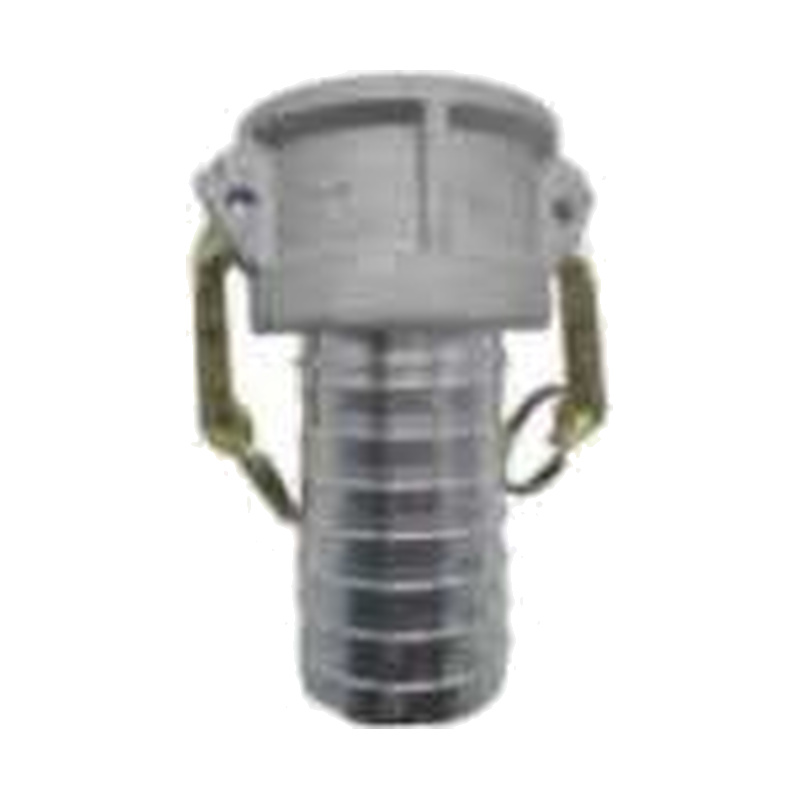
Serrated hose tails are male-thread adapters with a barbed shank that pushes into the hose bore and is held by a clamp. The barbs bite the inner tube, which resists pull-out under pressure and vibration. They are supplied in brass, steel and stainless, threaded BSP or NPT, and sized by hose bore with the shank diameter matched to the tube rather than the cover.
Serrated tails against smooth tails
| Tail | Grip | Hose | Failure it prevents |
|---|---|---|---|
| Serrated | Barbs bite the inner tube | Braided, textile-reinforced, pressure hose | Pull-out under pressure or vibration |
| Smooth | Friction and clamp load only | Soft wall, thin cover, food and suction hose | Cut inner tube from a barb |
The serration is not decoration: each ring is a small barb that resists the hose sliding off the shank. On a braided hose the barbs sit between the reinforcement and the tube, which is why a serrated tail holds where a smooth one pulls out. On a soft, thin-wall hose the same barbs can cut the tube, and there the smooth tail is the correct part.
Serrated hose tails: Two variants, listed separately
The Type C serrated tail is listed in two variants at each nominal size, and the part numbers differ only in where the M sits: C075M-AL has the M in the size position, C075-AL-M has it at the end. The numbers do not state what the M stands for, so it is read as a variant code rather than as an abbreviation.
| Part number | Body diameter A | Bore B | Inserted length L1 |
|---|---|---|---|
| C075M-AL | 32.1 mm | 21.2 mm | 28.2 mm |
| C075-AL-M | 41 mm | 32.5 mm | 84 mm |
At the same nominal size the second variant has a larger body and an inserted length nearly three times as long, so the two are not interchangeable in an assembly: one is a short tail and the other reaches further into a thick wall. Confirm which variant the assembly needs rather than ordering by size alone.
The tails run in aluminium, brass and SS316, and the three are listed on separate tables with their own lengths; a length taken from the aluminium column does not transfer to brass. The 8 in variant is quoted on request.
Matching the tail to the hose
A serrated tail is sized by the shank diameter, which has to match the hose inside diameter, not the bore printed on the hose. Measure the tube: a hose marked 1 in may run 25 mm or 25.4 mm, and a shank that is 1 mm too large will split the tube on assembly while one that is 1 mm too small will pull out.
The clamp sits behind the last barb, on the shank barrel. A clamp placed over the barbs cannot compress the tube into the grooves and the joint will weep; a clamp placed too far back leaves the hose free to creep forward.
Materials and threads
Brass is the general choice for water, air and oil, and it machines to a clean barb without burrs. Steel is used where the tail is welded or where cost matters, and stainless where the medium or the washdown would attack brass. Threads are BSP or NPT, and the two do not seal against each other: a BSP tail will start in an NPT port and leak.
No pressure rating on the tail
The tail is not the pressure-limiting part of the assembly and no rating is published for it. The joint is limited by the hose, the clamp and the medium; a 1 in brass tail on a 10 bar braided hose and the same tail on a soft suction hose are the same part with very different working limits.
Assembly practice
Warm the hose end and use a lubricant that suits the medium: a soap solution for water, and nothing oil-based on a hose that will carry oxygen or a solvent. Push the tail fully home so the last barb is inside the tube, then fit the clamp behind it.
Serrated hose tails are also made in a long-shank version for thick-wall hose, where the standard shank would sit entirely inside the cover without reaching the tube.
Serrated hose tails pull out when the clamp sits too far back, and they split the tube when the shank is a size too large. Both failures happen on the bench rather than in service, which is why the bore is measured rather than read off the hose print.
Ordering information
- Shank diameter, matched to the hose inside diameter
- Thread size and standard: BSP or NPT
- Material: brass, steel or stainless
- Tail length, if a long shank is needed
- Clamp, if the assembly is supplied complete
- Quantity per size
Frequently asked questions
Serrated hose tails or smooth tails?
Serrated for braided or pressure hose where pull-out is the risk; smooth for soft or thin-wall hose where a barb would cut the tube.
How do I choose the shank size?
Measure the hose inside diameter. The shank has to match the tube, not the nominal bore on the hose print.
Where does the clamp go?
Behind the last barb on the plain barrel, not over the barbs.
What pressure do they hold?
No figure is published for the tail; the hose, the clamp and the medium set the limit.
What is the minimum order, and can I get samples?
MOQ, samples and lead time are confirmed per line with the price, because each size is a separate run.
Related reading
- Ferrules and hose tails
- Crimp ferrules
- LNC couplings
- Industrial hose couplings
Serrated hose tails are quoted by shank diameter, thread and material, with the clamp on the same order.
Send the six fields and we come back with the price.


 English
 Spanish
 Portuguese
 French
 German
 Arabic
 Russian
 Indonesian
 Japanese
 Korean