
Air hose flow rate is set by the inside diameter of the hose, not by the number shown on the compressor gauge. A wider bore gives airflow through the hose more room to travel, so velocity falls, friction drops, and more usable air reaches the tool. Pressure alone cannot force a large volume of air through a narrow passage. This guide explains how diameter, length, and fittings cost you air, compares 1/4, 3/8, and 1/2 inch hose in a flow chart, and shows how to check the airflow in your own workshop.
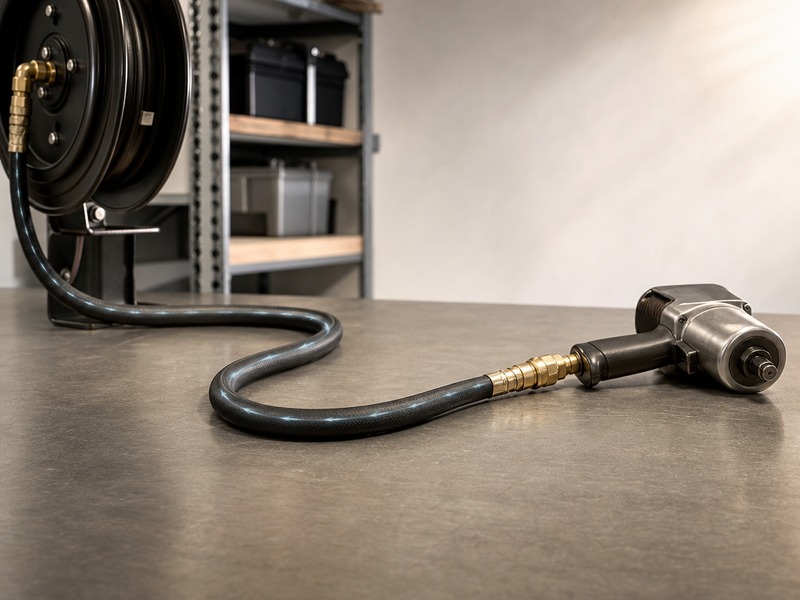
Figure 1. A 3/8 inch hose delivering compressed air to a pneumatic tool at 90 PSI.
Short Answer: Yes — and Diameter Does More Than Pressure Alone
When a pneumatic tool feels weak, most people reach for the regulator on the air compressor. That helps only until the gauge hits its limit. In most workshops the real limit is the hose feeding the air tool, not the pump.
The tank can hold 90 PSI all day, yet the air still has to travel through the hose, and every foot costs pressure. Inside diameter decides how large that cost is. Two hoses rated to the same working pressure can deliver very different volumes of air. On this page, “hose size” means the inside diameter, or bore, in quarter-inch steps.
A 3/8 inch hose carries roughly twice the flow of a 1/4 inch hose at the same pressure. That is why an undersized hose can make a capable compressor behave like a small one. If you are still choosing a hose, our guide to choosing an air hose covers material, length, and fittings.
How Air Actually Moves Through a Hose
Compressed air flow is the volume of air that passes a point in the hose each minute, usually written in SCFM. Velocity is how fast that air moves. Both are tied to the size of the passage. At a fixed flow, a smaller bore forces the same volume through a tighter space, so velocity rises, and velocity drives friction.
Higher velocity is not free. As air rushes along the wall of the hose, it rubs against the rubber, PVC, or polyurethane, turning useful pressure into heat and noise. Engineers call this friction loss. In the turbulent flow found in most workshop hoses, friction loss grows with the square of the flow. Double the flow and the loss roughly quadruples.
Every hose therefore has a working pressure limit and a practical flow limit. The rating tells you how much pressure the hose can safely hold. Flow capacity tells you how much air it can move before friction eats the pressure that the compressor produced.
A useful mental model is a busy doorway. The same number of people can pass whether the door is wide or narrow, but through a narrow door they must run to do it. Compressed airflow behaves the same way. Squeeze the same volume through a smaller opening and it moves faster, rubs harder against the wall, and loses more pressure along the route.
Flow, Velocity, and Friction in Plain Numbers
Flow is proportional to cross-sectional area, and area is proportional to the square of diameter. That relationship explains most of what follows. Going from a 1/4 inch bore to 3/8 inch raises the available area by more than twice. Going from 3/8 inch to 1/2 inch raises it again by roughly 78 percent.
Friction loss falls with roughly the fifth power of diameter, so the gain in usable pressure is even larger than the gain in area. In practice, that is why one size up often cures a weak-tool complaint. It is also why air hose diameter deserves more attention than the pressure setting on the regulator.
Why Diameter Has an Outsized Effect on Air Hose Flow Rate
The physics reduces to two rules. First, flow is proportional to cross-sectional area, and area is proportional to the square of the inside diameter. Second, in turbulent flow the friction loss rises with the square of the flow and falls with roughly the fifth power of the diameter.
Written together, those rules show why small changes in air hose diameter create large changes in air hose flow rate. A modest step up in bore removes a surprisingly large share of the resistance.
The fifth-power relationship sounds dramatic, but it matches everyday experience. Moving from 1/4 inch to 3/8 inch nearly triples the cross-sectional area, and the friction the air meets drops by an even larger factor. At the same inlet pressure, a 3/8 inch hose delivers about twice the flow of a 1/4 inch hose.
Air hose length works in the opposite direction. Loss accumulates along the run, so a 50 foot hose loses more than a 25 foot hose of the same bore. A 3/8 inch hose loses about 2 to 5 PSI for every 25 feet. A 1/4 inch hose running 50 feet at a modest flow of 8 cubic feet per minute loses about 6 PSI.
Compressed air flow therefore depends on three things at once: how wide the passage is, how long it is, and how much air you ask it to carry. Change any one of them and the pressure at the far end moves. That is why a tool can run well on a short whip hose and struggle on the same hose stretched across a bay.
Air Hose Flow Rate Chart: 1/4 vs 3/8 vs 1/2 Inch
Table 1 lists typical air hose sizes at 90 PSI, the run each supports, and the planning loss per bore. Treat the figures as planning ranges rather than guarantees, and always defer to the printed label on the hose.
| Inside diameter | Typical flow at 90 PSI (SCFM) | Recommended maximum length | Typical tasks | Pressure drop per 25 ft (PSI) |
|---|---|---|---|---|
| 1/4 inch | 5–10 | 25 ft | blow guns, small nailers, short whip hoses | about 3 (note: 6 PSI at 50 ft and 8 SCFM) |
| 3/8 inch | 10–20 | 50 ft | impact wrenches, spray guns, ratchets | 2–5 |
| 1/2 inch | 20–35 | 100 ft | heavy impact wrenches, sanders, die grinders | 1–2 |
Planning basis: a 90–100 PSI inlet, a straight hose, a light 8–20 flow, no fittings counted.
The pattern is easy to read. Each step up in bore roughly doubles the hose airflow and doubles the length you can run before pressure drop becomes a problem. If a tool stalls under load, check the air hose diameter and air hose sizes before you blame the compressor. Our air hose size chart gives the same information in a printable format.
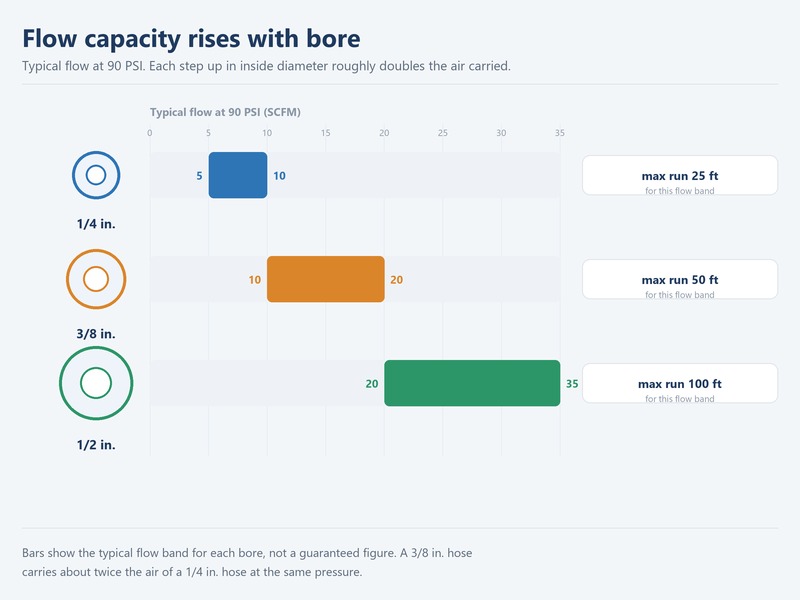
Figure 2. Flow capacity rises with bore: a 3/8 inch hose carries about twice the air of a 1/4 inch hose at the same pressure.
Where the Airflow Goes: A Pressure Drop Breakdown
Where Each Pound of Pressure Goes
Pressure does not vanish in one place. It leaks away along the whole path from the tank to the air tool. Six elements each add their own tax: hose length, bore, quick connect couplers, fittings and elbows, kinks, and leaks. Table 2 breaks down where air hose flow rate and pressure are lost.
| Source of loss | Typical effect | Why it happens |
|---|---|---|
| Hose length | steady loss along the run | air rubs against the hose wall |
| Undersized bore | largest single loss | velocity and friction rise sharply in a narrow passage |
| Quick connect coupler | small but repeated loss | an internal restriction and a change of section |
| Fittings and elbows | localised loss at each joint | turns and adapters disturb the flow |
| Kink or tight coil | sudden large loss | the passage is squeezed almost shut |
| Leaking joint | continuous loss | air escapes before it reaches the tool |
A 3/8 inch hose costs about 2 to 5 PSI per 25 feet. A 1/4 inch hose at 50 feet costs about 6 PSI at a modest flow. Add a quick connect coupler pair, a filter, and a few elbows, and the total climbs quickly. If the air compressor holds 120 PSI and the tool needs 90 PSI, you have roughly 30 PSI of budget. Spend it on the hose length you actually need, not on restrictions you can remove.
For a deeper look at the numbers, see our companion article on compressed air friction loss in hoses. It explains how to estimate loss from length, flow, diameter, and fittings.
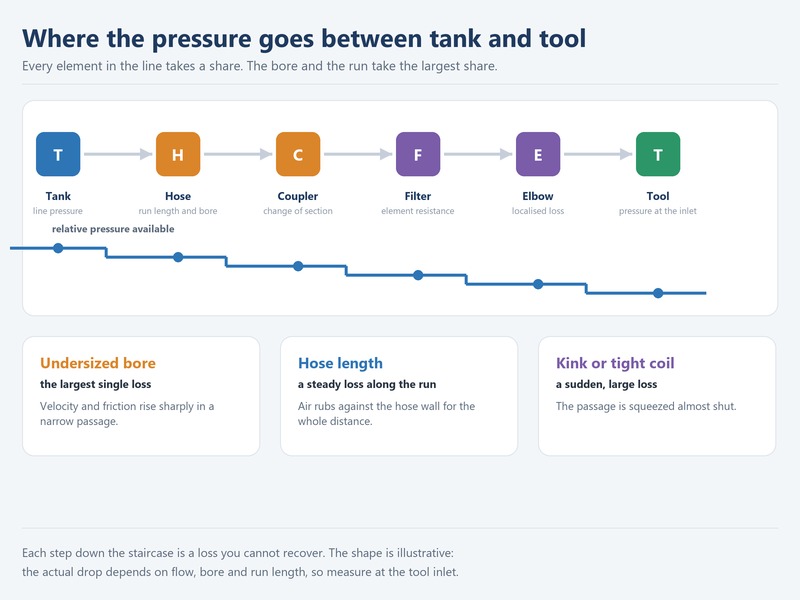
Figure 3. Pressure falls step by step from the tank to the tool as air passes the hose, couplers, and fittings.
Does a Bigger Hose Always Mean More Air at the Tool?
No. A bigger bore never creates air; it can only stop wasting the air your air compressor already makes. If the pump delivers 10 SCFM, a 1/2 inch hose cannot turn that into 25. It simply removes a restriction that was holding the system back.
There are practical limits too. Large-bore hose is heavier, stiffer, and more expensive per foot, and it takes more room on a reel. It also stores more compressed air, which matters for handling and for energy safety. For a short whip hose at the tool, a 1/4 inch bore is often perfectly adequate.
The right question is not how big the hose can be, but how much air the job needs. Add up the air demand of the tools you run at the same time, note the pressure they require, then choose the smallest air hose sizes that keep the loss inside your budget. Our air hose sizing guide walks through that calculation tool by tool.
One more caution: a very large hose on a low-flow job can also slow the response of the regulator, because more air is stored in the line. The hose then acts like a small receiver, and the pressure at the tool takes longer to settle. Correct sizing of air hose diameter and length avoids that effect as well.
How to Measure Airflow in Your Own Setup
Before you buy a different hose, measure. A low-cost pressure gauge fitted at the air tool inlet tells you more than any label, and it takes only a few minutes.
The Gauge-at-the-Tool Method
- Set the regulator so the tool runs at its rated pressure with the trigger held.
- Fit a gauge at the tool inlet, as close to the tool as the fittings allow.
- Run the tool under load and read the gauge.
- Compare that reading with the gauge on the tank.
- Note the gap between the two readings.
- Repeat the test with a shorter hose or a larger bore to confirm the cause.
A drop of more than about 10 PSI (about 10% at a 100 PSI inlet) between tank and air tool is a strong hint that the hose is undersized, too long, or restricted by fittings. If the air hose length or the bore is the cause, the gauge will show it.
Repeating the test with the tool switched off separates a flow problem from a simple leak. If the pressure recovers, the hose is the restriction. If it does not, look for a leak, and use our air hose leak repair guide to trace it. To confirm the bore, measure instead of guessing with the air hose measuring guide.
A quick worked example. A 1/2 inch impact wrench pulling 8 cubic feet per minute on a run whose hose and fittings total 100 ft of equivalent length shows 92 PSI at the tank. At the planning figure of 3 PSI per 25 ft for 1/4 inch hose, the run costs about 12 PSI, so the tool sees roughly 80 PSI. Fitting 3/8 inch hose on the same run, at 2 PSI per 25 ft, lifts the reading to about 84 PSI.
Kinks, Couplers, and Other Flow Killers
A hose can be the right diameter and still underperform. Small restrictions add up, and several of them are easy to overlook.
- Kinks — a bent hose can pinch the passage almost shut, and even a partial kink raises velocity and loss.
- A worn quick connect coupler — a tired coupler adds a restriction every time air passes through it.
- Fittings and adapters — each extra adapter adds a direction change and a fresh leak path.
- Long thin pigtails — a 1/4 inch whip hose is fine at the tool, but a long 1/4 inch run is not.
- Leaks — a small leak at a joint wastes air around the clock and quietly lowers pressure at the tool.
Small restrictions matter because compressed air flow is unforgiving: every narrow point casts a long shadow downstream. Kinks and worn couplers are easy to miss because the hose still looks fine from the outside.
Squeeze the hose along its length while the system is pressurized and watch the gauge at the tool. If the reading jumps, you have found the restriction. Keep a spare quick connect coupler and a spare whip hose on the shelf, so a failure never stops the job.
When to Replace Instead of Repair
Replace the hose, rather than repairing it, when you find a crack, a blister, a section kinked flat, or a leak at the crimp. Fit a new hose rated to the working pressure of your system, keep the assembly inside the temperature range printed on the label, and inspect the coupling at every service. A hose that has been patched with tape or a clamp can fail under pressure, and compressed air injuries happen quickly. Regular inspection is cheaper than a failure on the workshop floor.
Compressor Airflow FAQs
Does hose diameter really change airflow more than pressure does?
Diameter matters more than most people expect. At a fixed inlet pressure, going from 1/4 inch to 3/8 inch roughly doubles the flow the hose can carry, because area rises with the square of diameter and friction falls even faster. Raising pressure helps only until the compressor or the tool reaches its limit. If the tank gauge is already high and the tool is still weak, the hose is the bottleneck.
How much pressure drop is normal on a workshop hose?
A 3/8 inch hose typically loses about 2 to 5 PSI per 25 feet. A 1/4 inch hose running 50 feet at a low flow loses around 6 PSI. Total loss often reaches 5 to 15 percent of the inlet pressure once couplers, filters, and elbows are included. Anything far above that usually points to an undersized or restricted hose rather than normal friction.
Will a longer hose lower my air hose flow rate?
Yes. Loss builds along the run, so doubling the length roughly doubles the pressure lost to friction. That is why the recommended maximum lengths stay modest: about 25 feet for 1/4 inch, 50 feet for 3/8 inch, and 100 feet for 1/2 inch. If you need a longer run, step up one bore size instead of adding pressure.
Do quick connect couplers reduce airflow?
They can. Every coupler adds a small restriction and a change of section, and a worn or low-flow design adds more than a new one. A pair of couplers may cost only a few PSI on a healthy system, but on a long, narrow run those losses stack up. Choose a full-flow coupler and replace any that leak or feel loose.
Is a 1/2 inch hose always better than 3/8 inch?
No. A larger bore only helps if the compressor can supply the extra volume. On a short run with a small tool, a 1/2 inch hose adds weight, cost, and stiffness for no gain. Match the bore to the flow the tool needs and to the length of the run. One size up from a starved setup is usually enough.
How do I know whether the hose or the compressor is the problem?
Measure pressure at both ends. Read the tank gauge and a second gauge fitted at the tool while the tool runs under load. A wide gap means the hose and fittings are costing you air. If both gauges read about the same and the tool still stalls, the air compressor is not keeping up with demand.
What else can steal air before it reaches the tool?
Leaks, a clogged filter, a partly closed valve, a kinked hose, and an undersized manifold all cost pressure. Together they can consume a large share of your system pressure, and the tool slows down without any obvious fault. Check the simple items first, then review air hose length and diameter, because those two are the usual suspects.
Match the Hose to the Airflow You Need
Getting air hose flow rate right is a specification problem, not a guess. HENGHUA manufactures reinforced air hoses and complete hose assemblies for workshops, distributors, and OEM brands. Every air hose we build uses a high-tensile textile reinforcement layer with an abrasion- and oil-resistant cover, is rated 200–500 PSI, and leaves the factory with crimped brass fittings and a pressure test on every batch.
We supply 1/4, 3/8, and 1/2 inch bore in rubber, PVC, polyurethane, and hybrid constructions, with custom lengths, fittings, colours, reels, and OEM/ODM branding. Because we control compounding, extrusion, braiding, and crimping in one plant, lead times stay short for bulk orders and the specification on the label is the specification you get. If you are sourcing air hoses for retail, distribution, or industrial use, send us your specification and we will quote against it. Get a quote and free samples
Final Verdict: Size the Hose for Air Hose Flow Rate, Not Just Pressure
Air hose flow rate is a plumbing problem, not a pressure problem. The compressor sets the pressure, but the hose and the fittings decide how much of that pressure survives the trip to the tool.
Start with the tool: find its rated air demand and its required working pressure. Then choose the smallest air hose sizes that keep the loss inside your budget, keep the run as short as the job allows, and verify the result with a gauge at the tool. If you want a hose that holds its rating in service, explore our air hose range and we will quote the bore, length, and fittings you need.
Written by the HENGHUA engineering team, with input from workshop and maintenance teams across North America and Europe. HENGHUA manufactures reinforced air hoses and hose assemblies in rubber, PVC, polyurethane, and hybrid constructions, from 1/4 inch to 1/2 inch, rated 200–500 PSI, with custom lengths, fittings, colours, and OEM branding. .






 English
  Spanish
  Portuguese
  French
  German
  Arabic
  Russian
  Indonesian
  Japanese
  Korean