
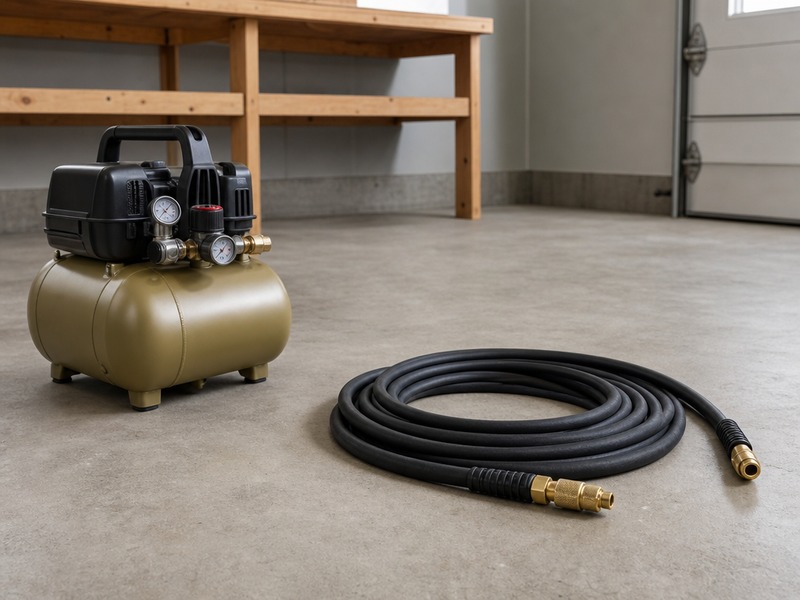
The best air compressor hose is the one that delivers your tool’s rated inlet pressure at the tool rather than at the tank. That holds whether you run a home garage compressor, a framing crew, or an auto shop bay. For most setups, that means a 3/8 inch bore, 50 feet or less, rated comfortably above your compressor’s output. Four decisions get you there: inside diameter against tool airflow, material against temperature and abrasion, pressure rating against the line you run, and fittings against what your tools already use.
What Makes the Best Air Compressor Hose?
The best air compressor hose keeps the tool’s rated inlet pressure at the tool, not at the tank. For most setups that means 3/8 in. bore, 50 ft or less, rated above your compressor output, with the material matched to temperature and abrasion. Four decisions get you there: inside diameter, material, pressure rating, and fittings. If you prefer to start from pressure and material specifications alone, the companion page on compressor hose pressure ratings covers that angle in more depth.
The Four Decisions Behind the Best Air Compressor Hose
The best air compressor hose is rarely the cheapest hose on the shelf. It is the hose that keeps air moving at the tool’s rated pressure without adding friction, leaks, or an unnecessary failure mode.
Inside Diameter Matched to Airflow
Inside diameter sets how much air the hose can move. A 1/4 inch bore that looks adequate while the compressor idles will starve a high-consumption tool the moment you pull the trigger. Size the bore to the tool’s airflow requirement first, then check the total run length, because length adds loss on top of diameter.
Working Pressure Rating With Margin
Your compressor may deliver 90 to 150 PSI, yet the hose is chosen on its working pressure rating, not on the tank gauge alone. Consumer-grade hose typically carries a 200 to 300 PSI rating, while industrial rubber hose runs 300 to 500 PSI. Burst pressure is normally three to four times the rating, so pick a hose that leaves clear headroom above the highest pressure you will run.
Material Matched to Temperature and Abrasion
Rubber hose built to ISO 2398:2024 covers −40 °C to +70 °C and resists abrasion and oil. Thermoplastic hose built to ISO 5774:2023 covers −10 °C to +60 °C and weighs far less. A rubber air hose tolerates a cold concrete floor and being dragged across it, while PVC stiffens below roughly 0 °C and can crack if it is forced.
Fittings and Couplers That Already Match
A hose is only as useful as its ends. Coupler styles are not interchangeable, so check the quick connect coupler style before you order. Industrial (Milton) plugs will not seal in Automotive (Tru-Flate) couplers, and forcing them damages both parts. If your tools already wear one style, buy a hose and compressor hose fittings that match that style rather than replacing every plug.
A Length That Keeps Pressure Drop Small
Every foot of hose costs a little pressure drop. For 3/8 inch hose, the typical loss is 2 to 5 PSI per 25 feet. Buy the shortest hose that comfortably reaches the work, and move the compressor closer rather than adding another 50 feet.
A short checklist before you order:
- Inside diameter matched to the tool’s airflow, not to the coupler size
- Rated pressure at least double your maximum line pressure
- Material rated for the coldest and hottest conditions you work in
- Coupler style identical to the plugs already on your tools
- Length no longer than the job actually needs
Best Air Compressor Hose by Setup: Home Garage, Framing Crew, Auto Shop, Industrial Bay
The best air compressor hose for one job is frequently the wrong hose for the next. The table maps four common setups to the hose that keeps each one productive.
Table 1. Hose choice by setup, at 90 PSI, typical values.
| Setup | Recommended hose | Working pressure target | Material | Typical tools |
|---|---|---|---|---|
| Home garage | 3/8 in. × 50 ft | 300 PSI | Rubber or hybrid | Impact wrench, inflator, blow gun |
| Framing crew | 3/8 in. × 50 ft | 300 PSI | Rubber | Framing nailer, stapler |
| Auto shop | 3/8 in. × 50 ft, 1/2 in. beyond that | 300–500 PSI | Rubber | Impact wrench, air ratchet, blow gun |
| Industrial bay | 1/2 in. up to 100 ft | 300–500 PSI | Rubber | Grinder, sander, production tools |
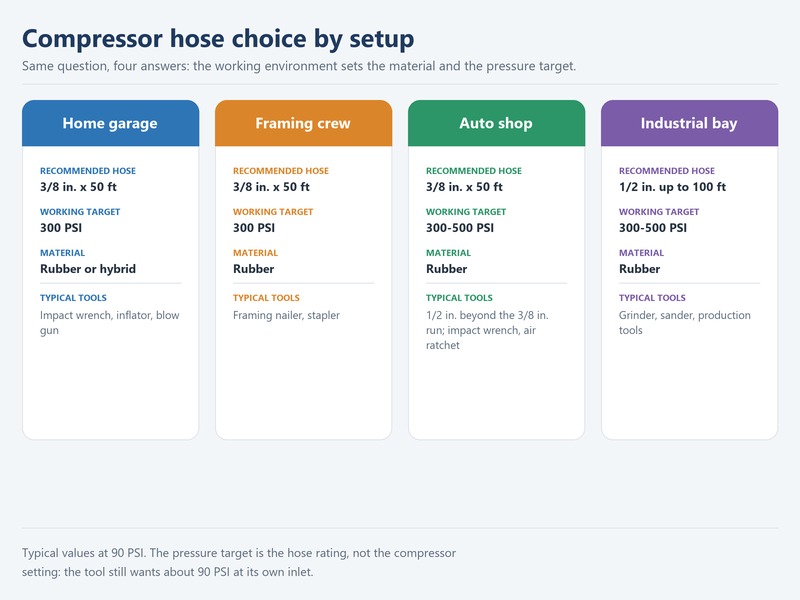
Figure 2. Compressor hose choice by setup and working environment.
The home garage row is the one most buyers need. A 3/8 inch hose at 50 feet covers the majority of home compressors, from a 20-gallon vertical unit to a 30-gallon portable, and still drives a nail gun without strain.
A framing crew lives with the same 3/8 inch hose, but the priorities shift. The hose is dragged over lumber, gravel, and concrete all day, so abrasion resistance matters more than weight. A rubber air hose survives that treatment, and its wider temperature window keeps it usable from a cold morning start to a hot afternoon roof. Confirm the compressor hose fittings match every tool before the crew leaves the yard. The air hose fittings guide explains every coupler and thread style.
Impact wrenches are rated near 90 PSI at the tool, so a 3/8 inch hose at 50 feet is the practical ceiling before the loss begins to cost torque. Beyond 50 feet, step up to 1/2 inch rather than accepting a weaker tool.
An industrial bay usually runs 1/2 inch hose up to 100 feet because grinders and sanders consume more air than hand tools. In that setting a fixed or retractable air compressor hose reel keeps the working length short and the loss predictable.
How Do Compressor Output and Hose Size Set the Airflow You Get?
Compressors are sold on tank pressure, but hoses are chosen on flow. A unit that reaches 90 to 150 PSI at the tank can still leave a tool sluggish if the hose is too narrow or too long to carry the volume the tool needs. The tool itself is rated for an inlet pressure that is usually 90 PSI, and that is the number the hose has to protect. A starter air compressor hose kit often bundles one length with two fittings, but that length still has to match the tool you own.
Table 2. Hose size, flow, maximum run, and reference pressure drop, at 90 PSI, typical values.
| Inside diameter | Flow at 90 PSI | Maximum recommended length | Reference pressure drop | Typical tools |
|---|---|---|---|---|
| 1/4 in. | 5–10 SCFM | 25 ft | 50 ft at 8 SCFM ≈ 6 PSI | Inflators, small nailers, blow guns |
| 3/8 in. | 10–20 SCFM | 50 ft | 2–5 PSI per 25 ft | Impact wrenches, nail guns, spray guns |
| 1/2 in. | 20–35 SCFM | 100 ft | Lowest per foot of the three | Grinders, sanders, high-demand tools |
A 1/4 inch hose reaches its limit at the tool, not at the tank. On a 50 foot run at 8 SCFM the drop rises to roughly 6 PSI. A nail gun or a blow gun on a short lead is the only place it belongs; anything that pulls more air should move up a size.
The 3/8 inch hose is the working default because it is the smallest bore that keeps a 50 foot run inside the site’s 2 to 5 PSI per 25 feet planning band. It still feeds an impact wrench or a spray gun, and that is why it is the best air compressor hose for most workshops.
The 1/2 inch hose is the answer for continuous demand, not for distance. It carries 20 to 35 SCFM, so grinders, sanders, and production tools that never stop are the real reason to step up; a workshop that only needs extra reach should add a larger bore, not a longer hose.
When you are unsure, work backward from the tool. If the numbers are close, size up rather than down, because a slightly larger hose rarely hurts while a smaller one pushes the working pressure at the tool under spec. For a tool-first walkthrough of the same logic, see what size air hose do I need, and on a bulk order confirm the lead time.
Compressor Hose vs Standard Air Hose: What Actually Differs?
A reinforced hose is built for compressed air service. It has a reinforcement layer, a published working pressure, and a cover that resists oil and abrasion.
Three differences matter in practice. First, reinforcement: the hose carries a textile braid or spiral that stops the tube expanding under pressure, while an unreinforced tube balloons and fails earlier. Second, temperature range: rubber and thermoplastic compressor hoses publish standardized windows, while generic tube often does not. Third, fittings: the hose is normally supplied with ends in one of the common coupler styles. Industrial (Milton) and Automotive (Tru-Flate) couplers look similar and are not interchangeable, and every quick connect coupler seals on a spring-loaded collar rather than on threads.
If you are still choosing between a compressor-specific hose and a general air hose for light duty work, read the broader overview in how to choose an air hose. It sets out where the cheaper option is acceptable and where it is not.
Which Hose Material Fits Your Job? Rubber, Hybrid, PVC, Polyurethane
Material decides temperature range, weight, abrasion resistance, and price.
Table 3. Hose materials by temperature range, rated pressure, and typical retail range, at 90 PSI, typical values.
| Material | Standard | Temperature range | Pressure rating | Handling | Typical retail range |
|---|---|---|---|---|---|
| Rubber | ISO 2398:2024 | −40 °C to +70 °C (−40 °F to +158 °F) | 300–500 PSI industrial | Heavy, stays flexible in cold | $0.60–0.80 per ft |
| Hybrid | ISO 5774:2023 | −10 °C to +60 °C (14 °F to 140 °F) | 200–300 PSI | Light, good cold flexibility | $0.50–0.70 per ft |
| PVC | ISO 5774:2023 | −10 °C to +60 °C (14 °F to 140 °F) | 200–300 PSI | Light, stiff below 0 °C (32 °F) | $0.40–0.60 per ft |
| Polyurethane | ISO 5774:2023 | −10 °C to +60 °C; some makers to −20 °C | 200–300 PSI | Light, kink-resistant | $0.50–0.70 per ft |
Rubber remains the reference point for compressor work, and the table shows why: a rubber air hose is the only row that keeps its flexibility below freezing while still resisting oil and abrasion. ISO 2398:2024 sets that framework, with a standard internal rated cap of 25 bar, roughly 360 PSI. It is the best air compressor hose for work that is dragged over concrete or left in a cold shop overnight.
A hybrid air hose blends a rubber cover with a lighter thermoplastic core, which is the balance it sells: most of the cold flexibility of rubber at less weight. For a home garage that sees occasional winter use, a hybrid air hose is the practical compromise, because it will not pay the full rubber price for the days the hose actually matters.
PVC is the budget option and the one to treat with care. Its rating is honest, but its flexibility floor is the number to watch: below roughly 0 °C it stiffens rather than flexes, so it is the wrong pick for a cold shop or a high-output line.
Polyurethane sits between PVC and rubber, and its advantage is handling rather than temperature. It is the lightest of the four and resists kinks better than PVC, which suits a hose that is coiled and carried. If you are weighing the two most common options directly, rubber vs PVC air hose breaks the trade-offs down further.
How to Connect, Leak-Test, and Store a New Hose
A new hose is not ready until it is connected, leak-tested, and stored without tension on an air compressor hose reel.
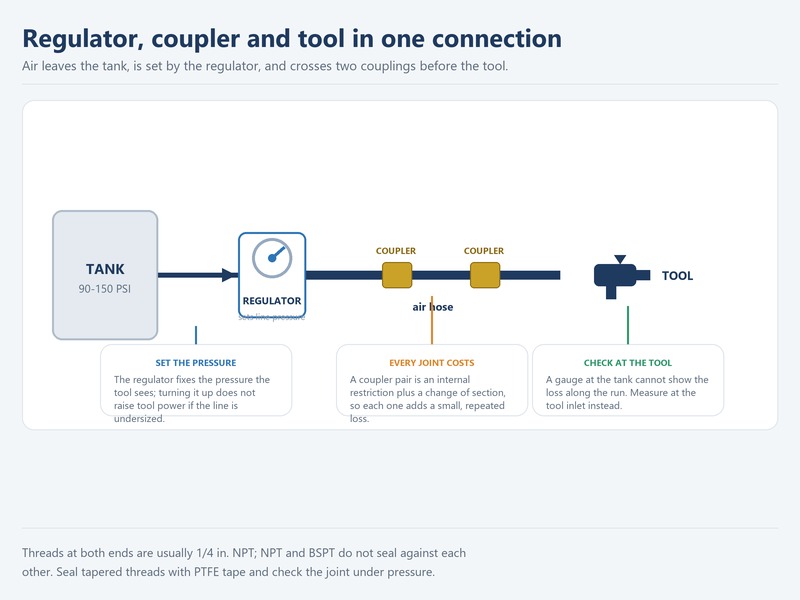
Figure 3. Regulator, coupler, and tool in a compressor hose connection.
Connect the Hose Without Damaging the Threads
- Confirm the thread — most compressor ports and fittings use 1/4 inch NPT, and NPT is not interchangeable with BSPT.
- Wrap the thread — apply PTFE tape in the direction of the thread, two or three turns, leaving the first thread bare.
- Match the coupler — line up the quick connect coupler on the hose with the compressor hose fittings already on your tools.
- Tighten by hand, then a quarter turn — over-tightening splits fittings and creates the leak you were trying to avoid.
A quick connect coupler seals on a spring-loaded collar, so it should click and hold without tools.
Leak-Test Before You Trust It
Pressurize the line and test three ways. Brush soapy water on every joint and watch for bubbles. Listen along the hose for a steady hiss, especially near the crimps. Then watch the pressure gauge, because a system that loses pressure with the tool closed is leaking somewhere. If the hose itself is damaged rather than a fitting, follow the air hose leak repair guide instead of taping over the damage.
Store It So It Lasts
Coil the hose loosely and hang it rather than leaving it in a tangle on the floor. If the hose lives on a wall-mounted reel, release the tension before storage so the spring is not held under load.
When Is a Compressor Hose the Wrong Fix — and When Must It Be Replaced?
If the tool is weak, check the compressor first. A compressor that cannot keep up with the tool’s airflow will not be fixed by a larger hose. If the compressor reaches its rated pressure and the tool still lacks power, measure the pressure at the tool with a gauge.
Replace the hose as a unit when it shows any of these: a cut cover, exposed reinforcement, a bulge, a stiff and cracked section, or a fitting pulled loose. Tag the assembly, take it out of service, and replace it with a new factory-tested one. A field repair — tape, a clamp, or a shortened crimped end — cannot restore the batch pressure rating, and every crimped assembly is tested as a unit before it ships.
Two regulatory anchors are worth knowing. Where a hose exceeds 1/2 inch inside diameter, OSHA 29 CFR 1926.302(b)(7) asks for a safety device at the source of supply or branch line to reduce pressure in case of failure. OSHA 29 CFR 1926.302(b)(5) then requires that pneumatic power tools are not operated above the manufacturer’s safe operating pressure for the hose, fittings, and tool. Both rules point the same way: the label is the limit, and margin is not optional.
Compressor Hose FAQs
The questions below cover what buyers ask most often when they search for the right hose.
What is the best air compressor hose for a home garage?
A 3/8 inch hose of 50 feet or less, rated 300 PSI, is the hose we recommend for most home garages. That size covers impact wrenches, inflators, and light pneumatic work without the weight of a 1/2 inch line. Choose rubber if the garage is unheated, or a hybrid if you want something lighter to coil.
Can I use a PVC hose with an air compressor?
Yes, within limits. PVC carries a 200 to 300 PSI rating and a standard range of −10 °C to +60 °C, but its practical flexibility floor is about 0 °C. It suits warm, light duty work. For a cold garage, or for heavy daily use, a rubber or a hybrid air hose holds up far better.
My impact wrench feels weak at the end of a 100 ft hose on a job site: is the hose or the compressor the problem?
Pressure drop is the usual cause, and it is a hose problem more often than a compressor problem. On a 50 ft run of 3/8 in. hose at 15 SCFM, the tool end sees roughly 4 to 10 PSI less than the tank. That band comes from the site’s 2 to 5 PSI per 25 feet planning figure, and it is pressure the tool never recovers. A 1/4 inch hose at 50 feet and 8 SCFM loses about 6 PSI. Shorten the run or increase the bore, and check the compressor only if the tank gauge itself is falling.
Are Industrial and Automotive couplers interchangeable?
No. Industrial (Milton) and Automotive (Tru-Flate) couplers look similar but will not seal correctly across styles, and forcing them damages both parts. Match the compressor hose fittings to the plugs already on your tools, or standardize every tool on one style instead.
How do I find a leak in a compressor hose?
Pressurize the system, then brush soapy water on each joint and watch for bubbles. Listen along the hose for a steady hiss near the crimps. Finally, watch the pressure gauge with the tool closed, because a slow fall means a leak. Repair fittings, and replace any hose with a damaged tube or cover.
What does an air compressor hose kit usually include?
A typical air compressor hose kit pairs a length of hose with two fittings and a coupler, and sometimes adds a blow gun, a tire inflator, or a coiled section. Check the coupler style and the rating first, because a kit is only useful if its fittings match your tools and its rating exceeds your line pressure.
How long should a compressor hose last in daily use?
Service life depends on material, abrasion, and how the hose is stored. A rubber hose dragged daily over concrete will wear faster than a hybrid kept on a reel. Inspect the cover and the crimps monthly, retire any hose showing cracks or exposed reinforcement, and expect several years from a hose that is coiled and stored properly.
I have a 60 gal compressor in a home garage and need a compressor hose for a 50 ft run to a framing nail gun — what should I order?
A 3/8 inch by 50 foot hose rated 300 PSI covers that job, and rubber is the safer choice if the garage is unheated. A framing nailer draws air in bursts, so a 3/8 in. bore on a 50 ft run keeps the tool inside its working range without dropping to a 1/4 in. line. Order the coupler style your nailer already uses, because a mismatched plug leaks from the first shift.
Source the Right Compressor Hose
Whether your answer is rubber air hose or a hybrid air hose, and whether you need a single length or an air compressor hose kit, the specification you order should be the specification you receive. The same holds whether the hose will sit in a toolbox or live on an air compressor hose reel. Ask any supplier for the rated pressure, the temperature range, the standard the hose is built to, and the delivery schedule for a repeat order. Treat lead time as part of the specification.
To get a usable quote on the first pass, send five things: bore, material, pressure rating, length, and the fitting or coupler style your tools use.
HENGHUA manufactures reinforced air hoses and complete hose assemblies for workshops, distributors, and OEM brands. Every air hose we build uses a high-tensile textile reinforcement layer with an abrasion- and oil-resistant cover, is rated 200–500 PSI, and leaves the factory with crimped brass fittings and a pressure test on every batch. We supply 1/4, 3/8, and 1/2 inch bore in rubber, PVC, polyurethane, and hybrid constructions, with custom lengths, fittings, colours, reels, and OEM/ODM branding.
Because we control compounding, extrusion, braiding, and crimping in one plant, lead times stay short for bulk orders and the specification on the label is the specification you get. If you are sourcing air hoses for retail, distribution, or industrial use, send us your specification and we will quote against it. Get a quote and free samples
Final Verdict: Start With the Tool, Finish With the Label
Choosing the best air compressor hose is a short exercise once the decisions are in the right order. Start with the tool and its airflow, size the bore and length from there, choose the material that survives your temperature and abrasion, and confirm the rating and fittings before you pay. Then read the label, because the printed pressure, temperature range, and standard are the numbers that keep the hose safe and the tool productive. For bulk orders, add lead time and batch testing to the same list.
If you are buying one hose, a 3/8 inch by 50 foot rubber or hybrid hose rated 300 PSI covers most home and shop work. Tell us the bore, material, pressure, fittings, and length you need, and we will quote against it.
Written by the HENGHUA engineering team, with input from workshop and maintenance teams across North America and Europe. HENGHUA manufactures reinforced air hoses and hose assemblies in rubber, PVC, polyurethane, and hybrid constructions, from 1/4 inch to 1/2 inch, rated 200–500 PSI, with custom lengths, fittings, colours, and OEM branding.






 English
  Spanish
  Portuguese
  French
  German
  Arabic
  Russian
  Indonesian
  Japanese
  Korean