
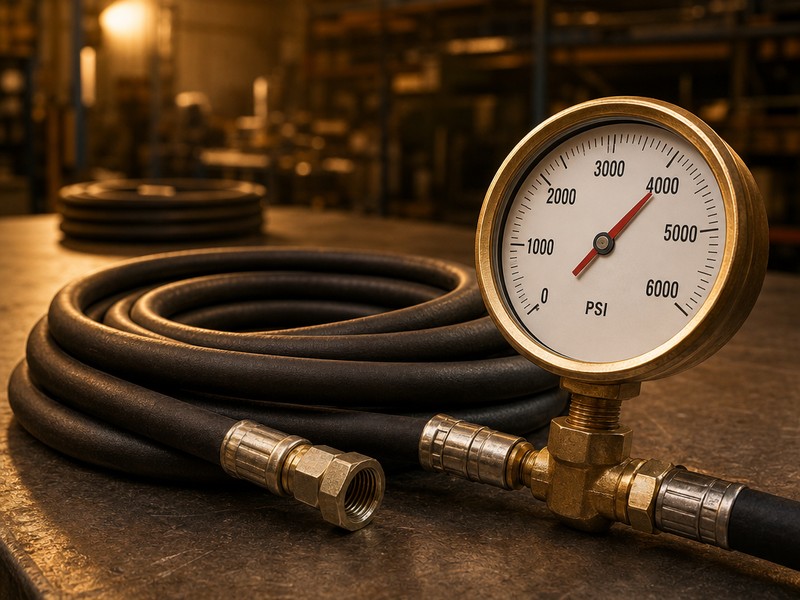
Oil hose working pressure is the maximum internal pressure an oil hose can carry continuously and safely at its rated temperature, while burst pressure is the destructive-test pressure at which the hose ruptures — and for most oil hoses the two are separated by a 4:1 safety factor, meaning the minimum burst pressure is four times the working pressure rating. This guide explains what each rating means, how they are tested, why the 4:1 ratio exists, and how to choose the right working pressure for hydraulic, transfer, and suction duty.
Beyond the oil hose working pressure basics, you will learn how proof pressure fits between the two ratings, how temperature and surges change real-world safety, and how to read the marking on the cover. We answer the questions buyers ask most — what working pressure a 10 bar oil suction hose has, what burst pressure a 4,000 PSI hydraulic hose has, and whether an oil hose can fail below its rating. The guidance draws on our factory test records and the requirements in SAE J517 (the U.S. standard for hydraulic hose and hose assemblies), EN 853 (hydraulic hose with wire braid reinforcement), EN 1765 (oil suction and discharge hose), and DIN 20023 (oil and fuel hose). Whatever your role — technician, distributor, or OEM buyer — the working pressure is the number you spec against.
What Is Oil Hose Working Pressure?
Oil hose working pressure — also called operating or rated pressure — is the maximum internal pressure a hose is designed to carry continuously, at a stated reference temperature, for its expected service life. Think of it as the pressure the hose is built to live at, not the pressure it can survive once.
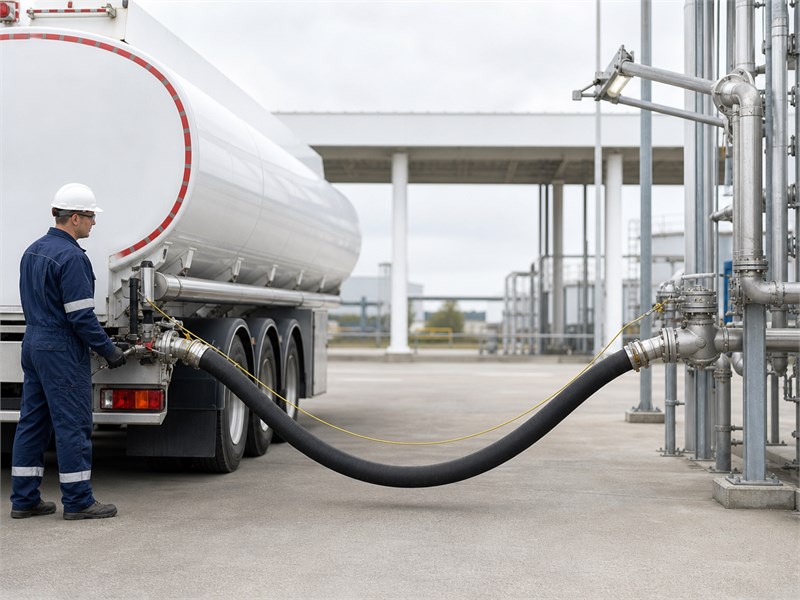
An oil hose is any hose built to carry oil or petroleum products, and the family spans two very different pressure levels. Hydraulic hoses carry hydraulic oil at high pressure — a 3/8-inch SAE 100R2 hose is rated 4,000 PSI (275 bar). Oil suction and discharge hoses move petroleum products at low pressure — 10 bar (145 PSI) is standard for tanker and plant duty, with 20 bar (290 PSI) versions.
The working pressure rating of an oil hose is set by destructive and fatigue testing during development and verified by routine production tests. In our factory, every production reel is proof-tested before it is cut and crimped; the working pressure printed on the cover is the value the hose proved it could sustain, divided by the required safety factor.
What Is Oil Hose Burst Pressure?
Oil hose burst pressure is the internal pressure at which the hose physically ruptures during a destructive test. It is measured once, in a laboratory: a sample is pressurized with water or oil until it fails and is destroyed, so the value is always a test result, never an operating limit. A hydrostatic burst test rig raises pressure from zero to failure in 30 to 60 seconds and records the rupture pressure, following ISO 1402.
For a 10 bar oil suction hose, the minimum burst pressure is 40 bar (580 PSI) at a 4:1 safety factor. A hydraulic hose working pressure of 4,000 PSI corresponds to a burst pressure of 16,000 PSI.
Across the [sample size to be filled] burst tests HENGHUA ran on production batches, [percentage of ruptures at fittings to be filled, based on actual factory records before publication]% of ruptures occurred at the end fitting or where the reinforcement was disturbed during assembly — which is why we burst-test samples from every batch. End fittings deserve the same attention as the cover, as our hydraulic fittings types guide explains.

Figure 1. Burst testing is a destructive laboratory test: the hose is pressurized until it ruptures and the failure pressure is recorded.
Never operate an oil hose at or near its burst pressure. The burst rating is the failure point the design must keep far away from your system pressure. A hydraulic hose rupturing at 16,000 PSI releases an oil jet that can penetrate skin — the injection injury hazard. Instead, select a hose whose working pressure exceeds the system maximum; inspect the cover and fittings before each use; and stop and investigate whenever the gauge approaches the working pressure.
Oil Hose Safety Factor: The 4:1 Rule Explained
Once the working pressure vs burst pressure relationship is clear, the safety factor is simply the ratio between them: safety factor = minimum burst pressure ÷ working pressure. A 10 bar hose bursting at 40 bar and a 4,000 PSI hydraulic hose bursting at 16,000 PSI both carry a 4:1 factor. The Rubber Manufacturers Association (RMA) has long recommended 4:1, and SAE J517, EN 853, EN 1765, and DIN 20023 all build to it.
Why 4:1 and not 2:1? The rating assumes a new, undamaged hose at a reference temperature; real service is harder. Pressure spikes can momentarily double the internal pressure, elastomers age, and covers get dragged and cut. The 4:1 ratio absorbs these unknowns so that even a worn hose stays well away from failure.
Typical safety factors by oil hose application.
| Application | Typical safety factor | Reason |
|---|---|---|
| Hydraulic hoses (SAE J517, EN 853) | 4:1 | Industry standard for high-pressure oil service |
| Oil suction and discharge hoses (EN 1765, DIN 20023) | 4:1 | Minimum burst of 4× working pressure required by the standards |
| Oil transfer and fuel hoses | 3:1 or 4:1 | Depends on construction and the standard referenced |
| Aerospace and safety-critical systems | 5:1 or higher | Extreme consequences of failure |
Does Every Oil Hose Use a 4:1 Safety Factor?
No — check rather than assume. Most hydraulic hoses built to SAE J517 and EN 853 carry 4:1, and oil suction hoses built to EN 1765 and DIN 20023 use 4:1 as a minimum; some thermoplastic and fuel hoses are designed to 3:1. Our advice: look for a hose that prints both ratings, such as “SAE 100R2AT 3/8-inch, 4,000 PSI W.P., 16,000 PSI burst” — that is where the oil hose pressure rating question stops being academic.
Why Is the Safety Factor Not 1.5:1?
A 1.5:1 factor would mean a 10 bar oil hose bursts at 15 bar — it would fail under a mild surge and age out of spec within a season. The 4:1 oil hose safety factor is the margin that keeps a hose safe on the day it is finally replaced, not just the day it was new.
What Is Proof Pressure and Why Does It Matter?
Between working pressure and burst pressure sits proof pressure — the pressure at which a hose is tested for leaks and swelling without permanent deformation. It is typically 1.5 times the working pressure, applied to every production reel to catch weak samples before shipment. Unlike a burst test, it is non-destructive: the hose is pressurized, held, inspected, and released. EN 1765 requires a proof test on every oil suction hose, and SAE J517 specifies proof pressure levels for hydraulic hoses.
Every HENGHUA oil hose is proof-tested at 1.5 times its working pressure before shipment, and samples from every batch are burst-tested to confirm the safety factor has not drifted. When comparing supplier quotes, asking “do you proof-test every reel?” separates manufacturers who measure from those who assume.
Oil Hose Working Pressure vs Burst Pressure vs Proof Pressure: Key Differences at a Glance
The table below condenses the working pressure comparison into the five facts that matter for selection, operation, and inspection.
Working pressure vs burst pressure vs proof pressure for oil hoses.
| Property | Working pressure | Proof pressure | Burst pressure |
|---|---|---|---|
| Definition | Max pressure for continuous, safe operation | Test pressure applied without permanent deformation | Pressure at which the hose ruptures |
| Test type | Design rating from fatigue and development testing | Non-destructive production test | Destructive laboratory test |
| Typical value relative to working pressure | 1× | 1.5× | 4× (3× for some fuel hoses) |
| What happens if exceeded | Accelerated fatigue, swelling, eventual failure | None, by design | Catastrophic rupture; hydraulic oil injection hazard |
| Typical values for oil hoses | 10 bar (145 PSI) – 4,000 PSI (275 bar) | 15 bar (218 PSI) – 6,000 PSI (414 bar) | 40 bar (580 PSI) – 16,000 PSI (1,103 bar) |
Read the table as a safety ladder: working pressure is where the hose lives, proof pressure is where the factory verifies it, and burst pressure is the failure point the first two numbers keep you away from. If a datasheet gives only one number, ask for the other two — an oil hose burst pressure rating is only meaningful against the working pressure behind it.
What Oil Hose Working Pressure Does Each Hose Type Carry? (Reference Table)
High-pressure oil hose (hydraulic, up to 5,000 PSI) and low-pressure oil hose (transfer and suction, 10–20 bar) are different products with different test regimes. Hydraulic hose working pressure runs from about 1,000 PSI for a 1-inch 1-wire hose to 5,000 PSI for a 1/4-inch 2-wire hose, while transfer hoses start at 10 bar (145 PSI).
Typical working pressure and burst pressure by oil hose type.
| Hose type | Standard | Typical sizes | Working pressure | Burst pressure (4:1) | Temperature range |
|---|---|---|---|---|---|
| Hydraulic, 1-wire braid | SAE 100R1AT / EN 853 1SN | 1/4″ – 1″ | 1,000–3,000 PSI (69–207 bar) | 4,000–12,000 PSI | -40 to +100°C |
| Hydraulic, 2-wire braid | SAE 100R2AT / EN 853 2SN | 1/4″ – 1″ | 2,000–5,000 PSI (138–345 bar) | 8,000–20,000 PSI | -40 to +100°C (125°C peak) |
| Hydraulic, spiral reinforcement | EN 856 4SP / 4SH | 3/8″ – 2″ | 350–420 bar (5,000–6,000 PSI) in 3/8″–1/2″; lower in larger bores (per datasheet) | 4× working pressure | -40 to +100°C (125°C peak) |
| Oil suction and discharge | EN 1765 / DIN 20023 | 1″ – 6″ (DN 25–150) | 10 bar (145 PSI) | 40 bar (580 PSI) | -30 to +80°C |
| Oil suction and discharge, heavy duty | DIN 20023 | 1″ – 6″ | 20 bar (290 PSI) | 80 bar (1,160 PSI) | -30 to +80°C |
| Oil transfer / petroleum delivery | EN 1765 / BS 5842 | 1″ – 4″ | 10 bar (145 PSI) | 40 bar (580 PSI) | -30 to +80°C |
| Fuel and oil-resistant hose | SAE J30 / ISO 7840 | various | 3–10 bar typical (44–145 PSI) | 4× working pressure | -30 to +100°C |
Two details deserve emphasis: for suction service, the vacuum rating matters as much as the pressure rating — EN 1765 hoses are rated for full vacuum — and the values above are typical per-standard figures, while the exact oil hose pressure rating of a given size is defined in the datasheet. Treat this table as your quick-reference hydraulic hose working pressure chart for comparing sizes before you open a datasheet.
Unsure which oil hose working pressure your system needs? Send us your pump relief setting, hose size, and fluid — our engineers will confirm the right rating and reply with the datasheet the same business day. Samples with test data available on request. Get a free hose selection check
What Oil Hose Working Pressure Do You Actually Need?
The golden rule: the hose’s working pressure must exceed the maximum pressure the system can produce — not the normal operating pressure. For hydraulic circuits, that means the pump relief valve setting or the highest spike the system can generate; for transfer lines, the pump dead-head pressure. One failed regulator sends full system pressure straight into the hose, so match the rating to the worst case.
For a hydraulic system with a 3,000 PSI relief setting, a 3/8-inch SAE 100R2 hose rated 4,000 PSI gives a clean margin — the common practice is to select the next standard hydraulic hose working pressure above the system relief. For oil suction and discharge lines, choose the 10 bar class for standard duty and the 20 bar class where pumps generate more pressure; rate the hose for full vacuum if it serves the suction side.
Temperature changes the real working pressure. Ratings are stated at a reference temperature of about 70°F (20°C). Most rubber oil hoses need no derating while the fluid temperature stays at or below 100°C (212°F); above 100°C, apply the manufacturer’s derating curve — SAE 100R2 class hoses, for example, may be used at a 125°C peak, with the allowable pressure at that temperature defined in the hose datasheet.
Pressure rating is only half of the selection puzzle. Inner diameter controls how much oil actually flows: a 1-inch oil suction hose carries roughly four times the flow of a 1/2-inch hose at the same velocity, so long runs need bigger diameters rather than higher ratings. Our hydraulic hose selection guidance covers the diameter math, and our hydraulic hose vs air hose guide explains why one service must never be substituted for the other.
If you are a maintenance technician replacing a hose on an existing machine, match the printed rating and date code of the old hose exactly. If you are a distributor or procurement buyer sourcing for a fleet, ask for the batch test certificate with every shipment.
What Happens When Pressure Exceeds the Working Pressure Rating?
Exceeding the working pressure rating does not cause one predictable failure — it causes several, depending on how the overpressure happens. Understanding oil hose working pressure and its burst rating explains why: the entire safety reserve sits in the margin between the two ratings.
- Pressure surges are the most dangerous. When a valve closes quickly, a pressure wave — what pipe engineers call water hammer — can briefly push the internal pressure far above the working rating. A surge lasting milliseconds can push a hose toward its burst pressure even though the gauge reads normal. In our test records, a rapid-closure test on a 10 bar suction hose produced a transient peak of [actual peak value to be filled, with percentage of 40 bar burst rating, based on factory test records before publication].
- Sustained overpressure accelerates fatigue. Every pressure cycle causes microscopic strain in the reinforcement and elastomer; operating above the working pressure multiplies the strain per cycle, so damage accumulates faster — visible first as swelling, then as cover cracking near the fittings, and eventually as failure at a fraction of the original burst pressure. Hydraulic hoses are additionally verified by impulse testing to SAE J343 or ISO 6803 — hundreds of thousands of pulses at up to 133% of the working pressure while heated.
Can an Oil Hose Burst Below Its Working Pressure Rating?
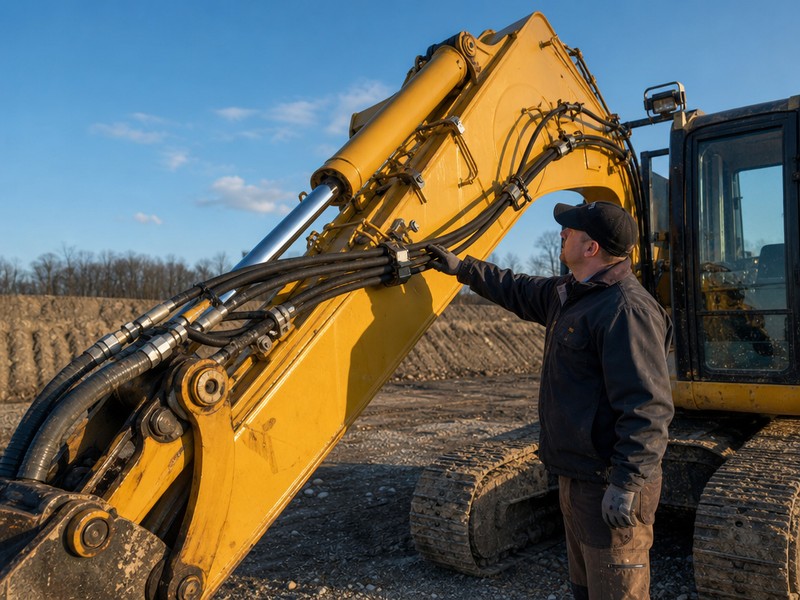
Yes, and this surprises most users. The working pressure rating assumes a healthy hose; a damaged one can fail at a fraction of its rated pressure — the most common causes we see in returned products are crushed or kinked sections, cut covers, UV-cracked covers, over-tightened fittings, and the wrong fluid. A hydraulic hose that has been crushed, kinked hard, or stored in the sun for years has no reliable oil hose pressure rating left — replace it, because the burst number printed on the cover describes the hose it was, not the hose it has become.
Case Example: When a Hose Fails Below Its Rating
Case example (anonymized): In [year and region of the de-identified case to be filled], a distributor returned [quantity in reels to be filled] reels of 10 bar suction hose that burst at [actual burst pressure to be filled, must be <40 bar and self-consistent with the 4:1 narrative] bar during commissioning. Burst tests on the returned reels traced the failure to [root cause to be filled, e.g., fluid incompatibility or storage conditions]. The hose had fallen below its 4:1 factor: fluid attack cut the burst margin from the rated 40 bar to [same numerical value as the actual burst pressure above, must be <40 bar and self-consistent with the 4:1 narrative] bar — the printed rating always assumes the rated fluid.
How to Read an Oil Hose Pressure Marking
Every reputable oil hose carries its ratings printed on the cover, usually repeated along the full length. Knowing what to look for turns a 30-second glance into a complete safety check:
- Working pressure — the number you plan around, printed in PSI, bar, or both.
- Burst pressure — the destructive-test value; verify it is 3–4× the working pressure.
- Standard reference — SAE J517, EN 853, EN 1765, or DIN 20023 — a recognized test framework.
- Size and construction — inner diameter (3/8″, 1/2″, 1″, or dash size like -6), and construction type (1-wire, 2-wire, spiral, textile).
- Temperature range and date code — most oil hoses span about -30 to +80°C or -40 to +100°C, and the date code gives batch traceability.

Figure 2. A complete oil hose cover marking: working pressure, burst pressure, standard reference, and temperature range.
A cover that prints “working pressure 4,000 PSI” and nothing else — no burst value, no standard, no temperature range — leaves its safety factor unverified. Compare that with “SAE 100R2AT 3/8″, 4,000 PSI W.P., 16,000 PSI burst”: the second gives you everything needed without trusting a marketing claim.
Common Myths About Oil Hose Pressure Ratings
Several persistent myths cause real purchasing mistakes.
Myth 1: A higher burst pressure means a better hose. A higher burst pressure means a higher safety factor, which is good — but also a heavier, stiffer hose that handles worse and costs more. A 4,000 PSI hydraulic hose is the wrong tool for a fuel transfer line.
Myth 2: Staying below the working pressure is always safe. It is safe for a healthy hose. A damaged cover, a kinked section, a surge, or high temperature can each push a hose toward failure well below its rated pressure — which is exactly what the oil hose safety factor is designed to absorb.
Myth 3: All 10 bar oil hoses are the same. Two hoses can both say 10 bar and have different burst pressure ratings, vacuum ratings, reinforcement, and test regimes behind them.
Myth 4: You should buy the highest pressure hose you can find. Overspecifying buys weight, stiffness, and cost without any safety benefit once the working pressure comfortably exceeds the system maximum.

Oil Hose Pressure FAQs
What is the difference between oil hose working pressure vs burst pressure?
Working pressure is the maximum pressure the hose can carry continuously and safely; burst pressure is the destructive-test pressure at which it ruptures. The ratio between them is the safety factor, normally 4:1, so a 10 bar hose typically has a minimum burst pressure of 40 bar.
What is the burst pressure of a 4,000 PSI hydraulic hose?
At the standard 4:1 safety factor, 16,000 PSI — confirm the value on the datasheet, because some specifications use 3:1, putting burst at about 12,000 PSI.
What is the working pressure of a 10 bar oil suction hose?
10 bar (145 PSI) continuous, with a minimum burst pressure of 40 bar (580 PSI) and full vacuum rating for suction service.
What is the difference between a 10 bar and a 20 bar oil suction hose?
Choose the 10 bar class for standard tanker and plant duty; choose the 20 bar DIN 20023 class — 290 PSI working pressure, 80 bar burst — where pumps generate more pressure or the line feeds a long vertical lift.
Why is the safety factor 4:1 on oil hoses?
Because real service is harder than the rating assumes: pressure surges, temperature, aging, and physical damage all reduce the strength of a hose over time. The 4:1 oil hose safety factor keeps even a worn or abused hose well away from failure in normal operation.
Can an oil hose burst below its working pressure?
Yes, if the hose is damaged — crushed, kinked, cut, UV-cracked, chemically attacked, or aged near the fittings. The working pressure rating applies to a healthy hose; inspect before every use and replace any hose with visible damage.
Why do hydraulic hoses burst?
Hydraulic hoses burst when internal pressure reaches the burst rating (typically 4× the oil hose working pressure), or earlier if the hose is damaged, kinked, surged, or run above its temperature limit. In most assemblies the end fitting is the first point of failure — fitting quality, crimp depth, and torque matter as much as the hose rating.
What working pressure do I need for a 3,000 PSI hydraulic system?
Choose the next standard hydraulic hose working pressure above the system relief setting — typically a 3/8-inch SAE 100R2 hose rated 4,000 PSI. The working pressure must always exceed the maximum pressure the system can produce.
Still choosing between ratings? Send us your system pressure, hose size, and fluid — get a datasheet-backed recommendation by the next business day.
Final Verdict: Choose the Right Oil Hose Working Pressure
For most buyers, the oil hose working pressure question reduces to one number: the maximum pressure your system can produce, plus a comfortable margin. Match a hose whose working pressure exceeds that number, verify the printed oil hose burst pressure is at least 3–4 times the working pressure, check temperature and fluid compatibility, confirm the vacuum rating for suction service, and inspect the hose before each use. That combination — correct rating, verified safety factor, honest inspection — is the entire safety story at any price point. When sourcing, ask for the datasheet before the price: a supplier who can show all three ratings plus the standard has actually tested the safety factor. Request a quote and samples — our engineering team will match the right rating and size to your system, with a reply within one business day.
About HENGHUA
HENGHUA is a professional manufacturer of rubber hoses for hydraulic oil, oil suction and discharge, oil transfer, fuel, and air service, supplying distributors, workshops, and OEM brands worldwide. Every HENGHUA oil hose is built with a defined 4:1 safety factor, proof-tested at 1.5 times working pressure before shipment, and burst-tested per production batch — the working pressure and burst pressure printed on every cover are measured values, not marketing numbers. We manufacture hydraulic hoses across the SAE 100R1, 100R2, and EN 856 spiral range, and oil suction and discharge hoses to EN 1765 and DIN 20023 in the 10 and 20 bar classes, with custom lengths, fittings, colors, and OEM/ODM branding. Browse the full HENGHUA oil hose range for documented working and burst pressures.
Because we control everything from compound mixing to final pressure testing, we deliver documented quality at factory-direct pricing, with short lead times for bulk orders and a clear warranty on every reel. If you are sourcing oil hoses, contact our team for a quote and samples — we will send the test data with the sample.

 English
  Spanish
  Portuguese
  French
  German