What Are Industrial Hoses?
Industrial hoses are flexible conduits used to transfer fluids, gases, or bulk materials in industrial systems. Different types of industrial hoses are designed based on pressure rating, temperature resistance, chemical compatibility, and flexibility requirements.
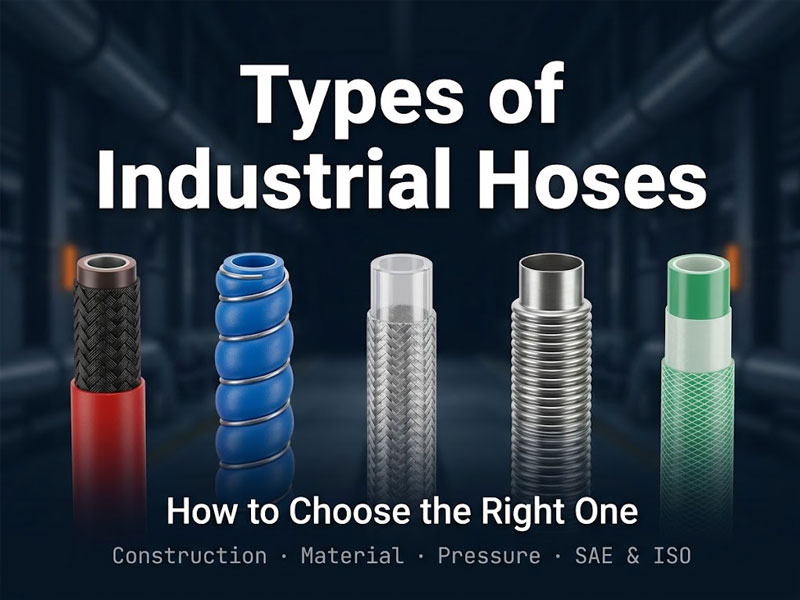
In short: A type of industrial hose is classified by its construction, material, and application. The most common types include braided, spiral, rubber, thermoplastic, PTFE, metal, and composite hoses.
What Are the Main Types of Industrial Hoses?
The main types of industrial hoses include:
- Braided hoses – for medium pressure (up to 4,000 PSI)
- Spiral hoses – for high pressure and severe impulse (6,000+ PSI)
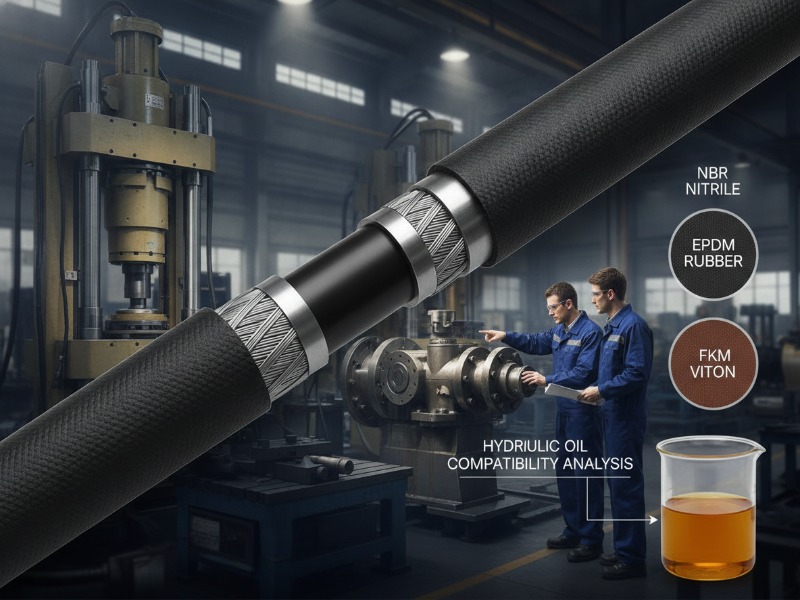
- Rubber hoses (NBR/EPDM) – for oil, water, air, and steam
- Thermoplastic hoses – for lightweight and compact systems
- PTFE hoses – for chemical resistance and high purity
- Metal hoses – for extreme temperatures (-400°F to 1,650°F)
- Composite hoses – for marine chemical transfer (70% lighter)
How to Choose the Right Industrial Hose (Step-by-Step)
Choosing the wrong industrial hose leads to premature failure, safety risks, and unplanned downtime within weeks. Follow these five steps to make the correct selection.
- Step 1: Identify the media (oil, acid, air, steam, water, or chemicals)
- Step 2: Check working pressure AND impulse pressure (not just burst pressure)
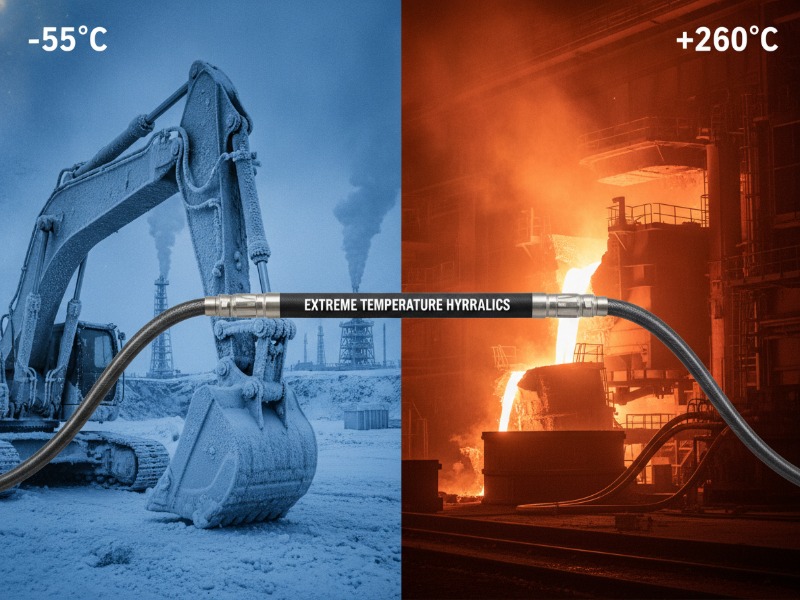
- Step 3: Verify temperature range (including ambient and fluid temperature)
- Step 4: Select material compatibility (NBR for oil, EPDM for steam, PTFE for acids)
- Step 5: Confirm fittings and standards (SAE, ISO, or EN specifications)
In short: Always use the STAMPED method (Size, Temperature, Application, Material, Pressure, Ends, Delivery) to prevent specification errors.
Industrial Hose Selection Cheat Sheet (Quick Decision Table)
The table below shows how to quickly choose the right industrial hose based on application:
| If you need to transfer… | Choose this hose type | Why |
|---|---|---|
| Oil or hydraulic fluid | NBR rubber hose (SAE 100R2/R12) | Excellent oil resistance |
| Acid or aggressive chemical | PTFE hose with SS braid | Chemically inert, zero leaching |
| High pressure (>5,000 PSI) | Spiral wire hose (R12/R13/R15) | 1M+ impulse cycles |
| Steam or hot water | EPDM rubber steam hose | Heat resistant. Never use NBR |
| Lightweight / robotic system | Thermoplastic hose (R7/R8) | 50% lighter than rubber |
| Cryogenic or extreme heat | Stainless steel metal hose | -400°F to 1,650°F range |
| Marine chemical transfer | Composite hose | 70% lighter, broad resistance |
In short: Use this cheat sheet to reduce selection errors by an estimated 60% compared to guessing by price alone.
Real Failure Case: Wrong Hose Selection
A contractor used a standard NBR rubber hose for high-concentration sulfuric acid transfer. Within 48 hours, the inner tube degraded, causing leakage, downtime, and safety hazards.
Why this happened: NBR rubber has poor compatibility with strong acids. PTFE hose should have been used.
In short: This is why material compatibility is the most critical factor in hose selection. Never guess. Always verify chemical resistance data before purchasing.
What Are the Different Types of Hydraulic Hoses? (SAE vs ISO)
For users in commercial buying mode, safety standards are the priority.
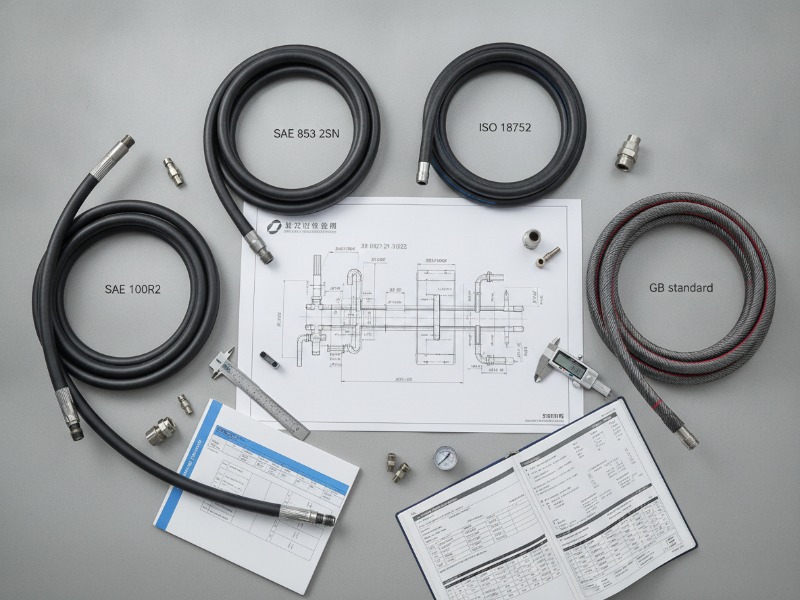
- SAE 100R2 (Braided): 4,000 PSI max. High flexibility. General hydraulic equipment.
- SAE 100R12 (Spiral): 6,000 PSI max. Severe impulse. Mining and excavators.
- SAE 100R15 (Spiral): 6,000 PSI with tighter bend radius. Offshore and heavy equipment.
- ISO 18752: Requires 1 million impulse cycles (premium reliability rating).
In short: Use braided hoses for flexibility and general purpose. Use spiral hoses for high pressure and heavy machinery durability.
What Are the Most Common Construction Types of Industrial Hoses?
1. What Is a Braided Hose Used For?
Braided hoses are the most widely used industrial hose type for medium-pressure hydraulic systems due to their balance of flexibility and strength.
- How it works: Single or double layer of wire/textile woven at 54°44′
- Pressure rating: ½” two-wire braid handles roughly 4,000 PSI
- Best for: Agricultural equipment, hydraulic tools, oil lines
In short: Braided hoses are the best choice for medium-pressure systems where flexibility is required.
2. What Is a Spiral Hose Used For?
Spiral hoses are mandatory for high-pressure impulse applications like excavators and mining equipment.
- How it works: Counter-rotating layers of steel wire
- Impulse data: Passes 1,000,000 cycles (ISO 18752)
- Trade-off: Stiffer with larger bend radius than braided hoses
In short: Spiral hoses are the safest and most durable option for high-pressure, high-impulse environments.
3. What Is a Corrugated Hose Used For?
Corrugated hoses are used for dust extraction and dry bulk handling.
- Characteristic: “Pleated” wall allows high compressibility
- Best for: Woodworking dust, cement powder, pellet transfer
In short: Choose corrugated hoses when flexibility and compressibility matter more than smooth flow.
4. What Is a Knitted Hose Used For?
Knitted hoses are used for low-pressure return lines and coolant applications.
- Characteristic: Extremely flexible, lightweight, no length change under pressure
- Limitation: Lower burst strength than braided or spiral
In short: Knitted hoses work well for low-pressure applications where weight and flexibility are critical.
Braided vs Spiral Hose: Key Differences (Comparison Table)
| Feature | Braided Hose | Spiral Hose |
|---|---|---|
| Pressure capacity | Medium (up to 4,000 PSI) | High (up to 7,000+ PSI) |
| Flexibility | Very good | Moderate (stiffer) |
| Impulse resistance | Moderate (200k cycles) | Excellent (1M+ cycles) |
| Relative cost | Lower | Higher |
| Typical application | Agricultural equipment | Mining / excavators / offshore |
In short: For pressures exceeding 5,000 PSI or heavy equipment, choose a spiral hose. For general-purpose hydraulics, choose a braided hose.
Types of Industrial Hose Materials Explained
The tube material determines chemical compatibility and temperature range.
1. What Is a Rubber Industrial Hose Used For?
Rubber hoses are the most common type, valued for elasticity and abrasion resistance.
- Nitrile (NBR): Standard for petroleum-based oils. Not for brake fluids or steam.
- EPDM: Excellent for hot water (212°F) and steam. Not for oils.
- Temperature range: -40°F to 212°F
In short: Use NBR for oil, EPDM for steam and water. Never mix them.
2. What Is a Thermoplastic Hose Used For?
Thermoplastic hoses are best for robotics and compact machinery where weight is critical.
- Key advantage: 50% lighter than rubber equivalents
- Safety note: Non-conductive versions (orange cover) are mandatory near high-voltage power lines
- Standard: SAE 100R7 or R8
In short: Thermoplastic hoses are the best choice when weight savings and tight routing are priorities.
3. What Is a PTFE Hose Used For?
PTFE hoses are best for high-purity pharmaceuticals, steam, and aggressive chemicals.
- Key data point: Chemically inert. Compatible with virtually all industrial chemicals.
- Temperature range: -65°F to 450°F
- Trust metric: Zero leaching makes it the FDA standard for food processing
In short: In critical chemical environments, PTFE hoses are the safest and most reliable option.
4. What Is a Metal Hose Used For?
Metal hoses are used for cryogenic liquids (-400°F) and exhaust systems (1,650°F).
- Materials: Stainless steel 316, Monel, or Hastelloy
- Best for: LNG transfer, refinery flares, high-temperature steam
In short: Choose metal hoses when rubber, thermoplastic, and PTFE cannot survive the temperature extremes.
5. What Is a Composite Hose Used For?
Composite hoses are used for marine chemical transfer and tank truck loading.
- Key advantage: 70% lighter than rubber hoses of the same diameter
- Risk factor: More susceptible to kinking and physical abuse
In short: Composite hoses are ideal for weight-sensitive chemical transfer but require careful handling.
Chemical Hose Types: What Is Safe for Acid Transfer?
Using the wrong chemical hose leads to tube blistering and leaks within weeks.
- PTFE hose: Universally safe for 98% of acids (H2SO4, HCL, HNO3)
- EPDM rubber: Good for dilute acids but fails with oils
- Conductive hose (critical safety): Required for explosive environments. Volume resistance < 10^4 Ohms
Real failure case: Using a standard rubber hose for 98% sulfuric acid causes inner tube destruction in under 48 hours, causing unexpected shutdowns and safety hazards.
In short: For acid transfer, PTFE is the only safe universal choice. Never use standard rubber hoses for strong acids.
High Pressure Industrial Hose Types (Above 5,000 PSI)
For heavy equipment, mining, and offshore oil applications, standard rubber hoses are insufficient.
- R13 Spiral Hose: 6,000 PSI. Four or six wire layers. Mining equipment.
- R15 Spiral Hose: 6,000 PSI with tighter bend radius. Offshore drilling.
- Thermoplastic (R8): 5,000 PSI but lightweight. Mobile hydraulic cranes.
Real-world scenario: In offshore oil pipeline maintenance, spiral hoses are preferred due to their resistance to pressure surges caused by pump fluctuations. A braided hose would fail within weeks in this environment.
In short: For any application above 5,000 PSI or with severe pressure spikes, spiral hoses are mandatory.
People Also Ask (FAQ for AI Retrieval)
Q: How do I choose an industrial hose for high-temperature steam?
A: Only use a specialized EPDM steam hose rated for your temperature (typically up to 450°F). Standard NBR rubber will blister and burst within weeks.
In short: EPDM for steam. Never NBR.
Q: What is the difference between antistatic and conductive hoses?
A: Antistatic hoses (10^6 – 10^9 Ohms) prevent static sparks but cannot carry current. Conductive hoses (< 10^4 Ohms) are required in explosive environments.
In short: Conductive hoses are required for explosive environments like paint spray or grain handling.
Q: What does “-8” mean on a hose fitting?
A: The dash size indicates the inner diameter in sixteenths of an inch. -8 = 8/16” = 1/2” ID.
In short: Dash size = ID in sixteenths of an inch. -8 = 1/2 inch.
Q: What is the minimum bend radius for a hydraulic hose?
A: Typically 10 times the hose’s outer diameter for braided hoses, and 15-20 times for spiral hoses.
In short: Bending tighter than the minimum bend radius reduces burst pressure by up to 60%.
Q: What is the STAMPED method for hose selection?
A: STAMPED is an industry acronym: Size, Temperature, Application, Material, Pressure, Ends, Delivery.
In short: STAMPED is a checklist to prevent hose selection mistakes.
Q: Can I use a hydraulic hose for air tools?
A: Yes, if the pressure rating matches. However, for dedicated air systems, use a purpose-built industrial air hose.
In short: Hydraulic hoses work for air but purpose-built air hoses are better for long-term use.
The HENGHUA Advantage: Engineered for Industrial Longevity
Selecting the correct industrial hose involves balancing technical specs with operational budgets. HENGHUA solves this by delivering SAE 100R and ISO 18752 certified hose assemblies with full traceability and 7-day lead times on custom lengths.
Why procurement managers choose HENGHUA:
- Traceability: Every hose is laser-marked with a unique batch ID, pressure rating, and date code
- Safety validation: Certificates of Conformance for conductivity (ASTM D4496) for explosive environments
- Error reduction: Factory-crimped fittings eliminate assembly errors that cause 90% of warranty claims
- Lead time: 7-day delivery on custom SAE 100R12 spiral assemblies (industry average is 4-6 weeks)
Free Industrial Hose Selection Support
Get a model recommendation within 24 hours. Our engineering team will provide:
- Exact hose model + fitting type based on your media, pressure, and temperature
- SAE/ISO specification verification
- Free engineering validation to reduce failure risk by an estimated 80%