

Both materials can carry steam, so which one handles a given steam line better is a fair question, and the honest answer is an applicability boundary rather than a contest. A PTFE steam hose fits high-purity, chemically aggressive or very hot lines, while a rubber hose fits general saturated steam service where flexibility and budget matter most.
This guide compares temperature limits, pressure and mechanical strength, permeation and cleanliness, flexibility, and service life. It closes with a condition-to-choice table so a buyer can match the hose to the line instead of to a slogan. Every pressure and temperature pair below comes from published saturated steam data and published hose standards.
About a 13-minute read at 250 words per minute; a boundary-based steam hose comparison of PTFE and rubber for plant buyers and maintenance engineers.
What Counts as a PTFE Steam Hose in a Steam Line?
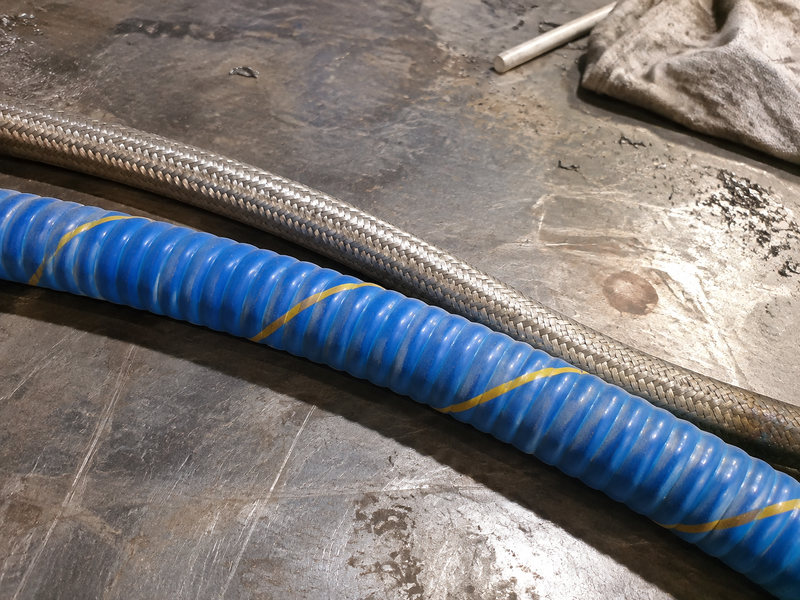
A PTFE steam hose uses a smooth polytetrafluoroethylene tube as its wetted surface. That tube is usually reinforced with stainless steel wire braid, and it may carry a protective braid or wrap on the outside. The decisive layer is the material that touches the steam, not the appearance of the outer cover.
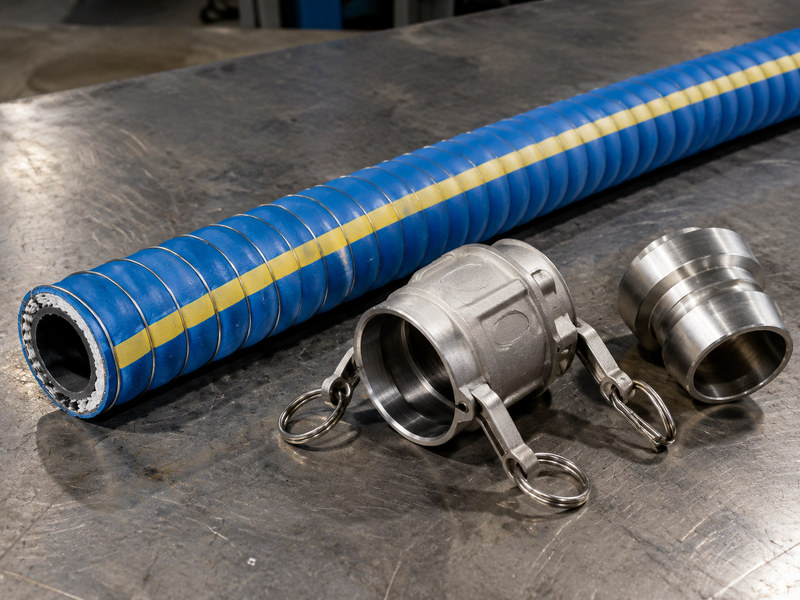
A rubber steam hose is built from an EPDM tube, a textile or steel wire reinforcement layer, and a perforated cover. The perforations allow steam that has seeped into the wall to escape instead of blistering the cover. The hub guide to EPDM steam hose for saturated steam explains why that polymer copes with steam service.
Table 1. Construction layers and the pressure-carrying element in each hose type.
| Element | PTFE hose | Rubber hose |
|---|---|---|
| Wetted tube | Smooth PTFE | EPDM |
| Reinforcement | Stainless steel wire braid | Textile for low pressure or steel wire for high pressure |
| Outer cover | Protective braid or wrap | Perforated EPDM |
| Pressure carried by | Braid layer | Reinforcement layer |
| Steam hose standard | Outside the scope of ISO 6134 | ISO 6134 Type 1 and Type 2 |

Figure 1. Layer order in a PTFE steam hose and in a rubber hose, read from the wetted tube outward to the outer cover.
Saturated steam keeps pressure and temperature locked together, so a PTFE hose is specified with the same reading method as a rubber one. You read the line pressure, look up the saturation temperature, then compare that temperature with the limit held by the tube and the finished assembly.
Temperature Limits: Where a High Temperature Hose Stops and PTFE Begins
ISO 6134:2024 sets the working envelope for rubber hose construction in two types. Type 1 carries a maximum working pressure of 0.6 MPa, written as 6 bar, and its saturation temperature is 164 °C. Type 2 carries a maximum working pressure of 1.8 MPa, written as 18 bar, at 210 °C.
The reinforcement follows the type. Type 1 uses a textile reinforcement, while Type 2 uses steel wire. Burst and verification testing runs to ISO 1402. Related test and vocabulary standards include ISO 4023, ISO 7326, ISO 8031, ISO 8033, ISO 8330 and ISO 10619-1, which name the checks rather than change the limits.
Where a line runs hotter than the EPDM envelope allows, PTFE becomes the applicable material rather than a superior one. That is the whole boundary: a high temperature hose is chosen by the temperature the line actually reaches, and by the steam conditions that fix it.
Table 2. Saturated steam pressure and temperature pairs used to read steam service conditions.
| Pressure (bar g) | Absolute pressure (bar a) | Saturation temperature (°C) | Saturation temperature (°F) |
|---|---|---|---|
| 6 | 7.01 | 165.0 | 329.0 |
| 10 | 11.01 | 184.1 | 363.4 |
| 14 | 15.01 | 198.3 | 389.0 |
| 18 | 19.01 | 209.8 | 409.7 |
| 20 | 21.01 | 214.9 | 418.8 |
| 25 | 26.01 | 226.1 | 438.9 |

Figure 2. Applicability ranges of PTFE and rubber constructions shown against the saturated steam line.
Two anchor points keep this table honest. ISO 6134 Type 1 writes 164 °C at 6 bar, and the published steam data put 6 bar g at 165.0 °C. Type 2 writes 210 °C at 18 bar, and the data put 18 bar g at 209.8 °C. The small gaps come from rounding at the standard boundary.
Table 2 shows the middle of the EPDM envelope. Published data put 10 bar g at 184.1 °C and 14 bar g at 198.3 °C, so both stay inside Type 2 and keep the rubber hose as the direct fit. Above that envelope, 20 bar g at 214.9 °C and 25 bar g at 226.1 °C sit past the ISO 6134 ceiling, where a wider temperature envelope takes over.
Superheated steam is a separate case, and it is worth naming here. In a superheated line the temperature is pushed above the saturation value for the same pressure, so the two numbers come apart and must be read separately. That is why a superheated duty leaves the EPDM envelope defined by the standard and moves the choice toward a construction with a wider temperature envelope.
PTFE Steam Hose vs Rubber in Pressure and Mechanical Strength
The pressure a steam hose carries is held by its reinforcement, not by its tube. In a PTFE steam hose the soft liner is thin and the stainless steel braid does the load-carrying work. In a rubber construction the EPDM tube and the textile or steel reinforcement share the duty, which is why the standard splits its two types by reinforcement.
Mechanical strength also covers crush, kink and pull resistance. A PTFE construction depends on the braid and on correct end fittings, because the liner itself offers little structure. A rubber construction carries a molded wall that resists abrasion and external damage more readily at the tube level.
Neither statement is a ranking. It is a fit question: a line that runs at high pressure and constant flexing asks for a construction whose reinforcement and tube are matched to that duty. The finished assembly rating is a separate matter, and it is easy to read past the correct number.
A catalog working pressure describes the hose body at a reference temperature. The end fitting and the way it is attached can limit the finished assembly further, so a steam hose order should state the assembly rating rather than only the body rating. Steam duty calls for a dedicated steam fitting secured with a bolted safety clamp.
Permeation and Cleanliness in Steam Service
Steam is a demanding medium for cleanliness because it carries heat, water droplets and traces of boiler chemistry. A PTFE tube is chemically inert and does not readily absorb the fluid, so it suits lines where the steam touches food, pharmaceutical or fine chemical product. Its smooth wall also flushes clean with less hold-up.
An EPDM tube meets the same saturated steam conditions and is the standard choice for general plant steam. Where the fluid is aggressive, or where a residue left in the tube is unacceptable, the material choice tips toward PTFE. The chemical hose pages cover PTFE and FEP specifications and applications in that context.
The broader family view, including rubber, PTFE and UHMWPE hose, is a useful companion when the fluid is not clean steam alone. Permeation, chemical attack and product purity all pull the decision in the same direction: match the wetted material to the fluid, not to the pressure number.

Figure 3. Permeation and cleanliness scenarios for a PTFE tube and a rubber tube in steam service, shown as a material boundary rather than a ranking.
Cleanliness has a second edge in steam service, because condensate carries whatever the boiler treatment leaves behind. A tube that holds a film of that residue can release it into the next product batch, and a tube with a rough wall holds more of it. Material selection therefore follows the purity target of the line, and it is settled before the pressure rating is even considered.
Flexibility, Bend Radius and Installation Differences
A PTFE steam hose is stiffer than a rubber one, so it asks for a wider bend and better support along the run. A rubber steam hose bends more easily, which helps in tight skids and at moving equipment. Flexible does not mean stronger, and stiff does not mean unreliable, because each belongs to a different layout.
Installation practice follows the same boundary. A steam line needs a drain point and a way to purge condensate, and a hose should not carry its own weight across a long span. For the bend geometry itself, follow the maker’s published minimum bend radius for the chosen size and construction.
Support and routing decide whether a good hose stays good. Runs that hang free, rub across structural steel or flex at a fixed coupling fail early, whatever the tube material is. Use a support that spreads the load, and keep the hose clear of hot surfaces and sharp edges along the whole run.
Steam Hose Comparison: Condition to Choice
This is where the steam hose comparison earns its keep. Table 3 states the boundary between the two materials in plain terms, and Table 4 turns a plant condition into a first choice. Read the condition in the left column, then follow the row to the material that belongs on that duty.
Table 3. Applicability boundary between PTFE and rubber hose by property.
| Property | PTFE hose | Rubber hose |
|---|---|---|
| Temperature band | Upper band, above the EPDM envelope | General saturated steam band |
| Pressure carried by | Stainless steel braid | Textile or steel wire reinforcement |
| Chemical and permeation | Inert, low absorption | Suited to steam, limited with aggressive fluids |
| Flexibility | Stiffer, wider bend radius | More flexible, tighter routing |
| Purity | Preferred for product contact | Preferred for utility steam |
| Standard coverage | Outside ISO 6134 scope | ISO 6134 Type 1 and Type 2 |
Table 4. Condition to choice for steam service.
| Condition on the line | First choice |
|---|---|
| Saturated steam inside the ISO 6134 Type 1 band | Rubber, textile reinforced |
| Saturated steam inside the ISO 6134 Type 2 band | Rubber, steel wire reinforced |
| Steam above the EPDM envelope | PTFE |
| Product contact or high purity steam | PTFE |
| Aggressive or solvent-bearing condensate | PTFE |
| Tight routing and frequent handling | Rubber |
Two rules keep the table usable. First, a condition inside the EPDM envelope usually stays with rubber, because the standard already covers it. Second, a condition that leaves the EPDM envelope moves to PTFE, and that move is about applicability rather than quality. Where two rows apply, the temperature band decides first.
Also note the boundary against a neighboring comparison. This page stops at PTFE versus rubber. The metal braided option is a different question, handled in the companion rubber hose vs stainless steel braided article. The EPDM boundary itself is covered by the companion is EPDM good for steam guide.
Cost and Service Life Across a Steam Cycle
Cost and life in steam service track the duty, not the material label. A line that cycles from cold to hot many times a day works the tube and the reinforcement harder than a line that runs steady. Condensate left in the bore after shutdown adds water hammer and internal attack on the next start.
Service life also depends on how the hose is stored and supported. Hanging a stiff PTFE assembly from its couplings, or dragging a rubber hose over sharp edges, shortens life whatever the tube is made of. Commercial terms are normally quoted as a planning figure rather than a fixed number, so ask for a factory-direct price against a defined duty.
One derating note belongs here. For saturated steam the temperature and the pressure are not free variables, so the reading method is the saturation curve itself. Above the EPDM envelope, a high temperature hose moves to PTFE construction. A true temperature coefficient only enters when the medium is superheated steam or hot water, never for saturated steam.
Inspection ties the two halves of this question together. A steam hose should be checked for cover blisters, cracked tube ends, loose couplings and kinks before each campaign. Where a cover shows a soft bulge, the reinforcement under it has usually taken the damage first, and that hose leaves service before the next start.
How to Specify a PTFE Steam Hose Order
A complete steam hose order names the medium, the pressure at the inlet, and the temperature that pressure produces. It names the bore and length, the end connections, and whether the item ships as a factory assembly. It also states the working pressure and the temperature bound together, never one without the other.
The end fitting belongs in the same list. Order the fitting type beside the hose part number, so the clamp arrives as part of one steam-rated assembly rather than as a separate item. Note whether the rating you were quoted is the hose body or the finished assembly, because the assembly value governs the installed line.
Table 5. Data to confirm before a PTFE or rubber hose order is quoted.
| Item | What to state |
|---|---|
| Medium | Saturated steam, superheated steam or hot water |
| Pressure | Working pressure at the inlet |
| Temperature | Saturation temperature for that pressure |
| Size | Bore and length |
| End connections | Fitting type and connection method |
| Rating basis | Hose body or finished assembly |
| Construction | Tube material and reinforcement |
Documentation belongs in the order too. Ask for the working pressure, the temperature it pairs with, the construction and the assembly rating on the delivery paperwork, so the installation team can match the hose to the line it was bought for. A hose that ships with clear data is easier to inspect and easier to replace.
For a full view of what is available across the range, see the PTFE hoses and fittings overview. HENGHUA builds steam hose on EPDM tubes with textile or steel wire reinforcement and a perforated cover, and can supply factory assemblies, custom lengths, jacket printing and private label work.
PTFE Steam Hose and Rubber Steam Hose FAQs
Can a PTFE steam hose replace a rubber hose on every line?
No. A PTFE steam hose fits the duty that leaves the EPDM envelope, or where the steam touches product. On ordinary saturated steam inside the ISO 6134 bands, a rubber hose is already covered by the standard and is the direct fit. Replacement is a boundary decision, so compare the actual pressure and its saturation temperature before switching a line.
Why does ISO 6134 cover rubber hose but not PTFE?
ISO 6134:2024 is titled for rubber hoses and hose assemblies for saturated steam, so its scope is rubber construction. It defines Type 1 at 6 bar and 164 °C with textile reinforcement, and Type 2 at 18 bar and 210 °C with steel wire reinforcement. A PTFE hose is engineered to its maker’s data, not to that standard.
Does a higher steam pressure always mean a higher temperature?
For saturated steam, yes. Pressure and temperature move together along the saturation curve, so a higher pressure always produces a higher saturation temperature. Published data puts 6 bar g at 165.0 °C and 18 bar g at 209.8 °C. Superheated steam breaks the link, because its temperature is set above the saturation value for the same pressure.
At what pressure does saturated steam reach 210 °C?
Published saturated steam data put 210 °C at about 18 bar g. That matches the ISO 6134 Type 2 boundary, which allows a maximum working pressure of 18 bar at 210 °C with steel wire reinforcement. The reference table used here lists 18 bar g as 209.8 °C, so the standard rounds the same point to 210 °C.
Which material handles permeation better in steam service?
A PTFE tube resists permeation because the polymer is inert and does not readily absorb the fluid. An EPDM tube serves saturated steam well and is the common utility choice, yet it is not the right material for aggressive condensate or product-contact steam. The boundary is drawn by the fluid and the purity target, not by pressure alone.
Do I still need a temperature derating factor for saturated steam?
Not in the usual sense. For saturated steam the temperature and the pressure are locked by the saturation curve, so you read the pressure, look up the temperature, and compare it with the hose limit. A true temperature coefficient applies to superheated steam and hot water, where the two values can move independently.
Is a PTFE hose harder to install than a rubber one?
A PTFE hose resists bending at the liner, so the installation brings the support closer to any change in direction instead of letting the hose absorb the turn. A rubber hose takes a longer unsupported run and field handling more readily. Neither installation is harder in absolute terms; the work sits in the support and the routing.
What decides the working pressure of a finished steam hose assembly?
The assembly rating is decided by its weakest part, which is often the end connection rather than the hose body. When a fitting is attached, the combination sets the installed limit, so a steam order should state whether the quoted figure is the body or the finished assembly.
Can one comparison table settle every line in a plant?
A steam hose comparison table settles the first choice, not every detail. It shows which material fits a condition, and it separates utility steam from product-contact duty. You still confirm the pressure, the saturation temperature and the assembly rating for each line. Treat the table as a starting point, then verify the values that matter on that specific run.
What data should I have ready before requesting a quote?
Have the medium, the inlet pressure and the saturation temperature ready, then add the bore and length, the end connections, and whether you need a factory assembly. State the construction you expect, and say whether the rating you want is for the hose body or the finished assembly. Those details remove guesswork from the quote.
Deciding Between PTFE and Rubber for Steam Service
Start from the line, not from the material. If the steam sits inside the ISO 6134 bands of 6 bar at 164 °C or 18 bar at 210 °C, a rubber hose with the matching reinforcement is the direct fit. If the duty leaves that envelope, or the steam touches product, the applicable choice becomes a PTFE steam hose with a stainless steel braid.
The deciding evidence is a pressure reading and the saturation temperature it produces, compared with the limit of the tube and the finished assembly. Hold those three values together, pick the material that stays inside its envelope, and the decision needs no ranking.
Ready to specify a line? Get a quote and free samples.
About HENGHUA
HENGHUA is a professional hose and fitting manufacturer supplying global distributors, retailers and OEM brands. The steam hose line centers on an EPDM tube with textile or steel wire reinforcement and a pin-pricked cover. On-site steam products include EPDM steam hose at 170 °C and EPDM high temperature steam hose at 230 °C. End connections are available as clamp-type safety couplings, flanges and threads to suit the condition. The factory also offers assemblies, custom lengths, jacket printing and private label or OEM/ODM work, with factory-direct pricing, short batch lead times and a warranty.
 English
 Spanish
 Portuguese
 French
 German
 Arabic
 Russian
 Indonesian
 Japanese
 Korean