
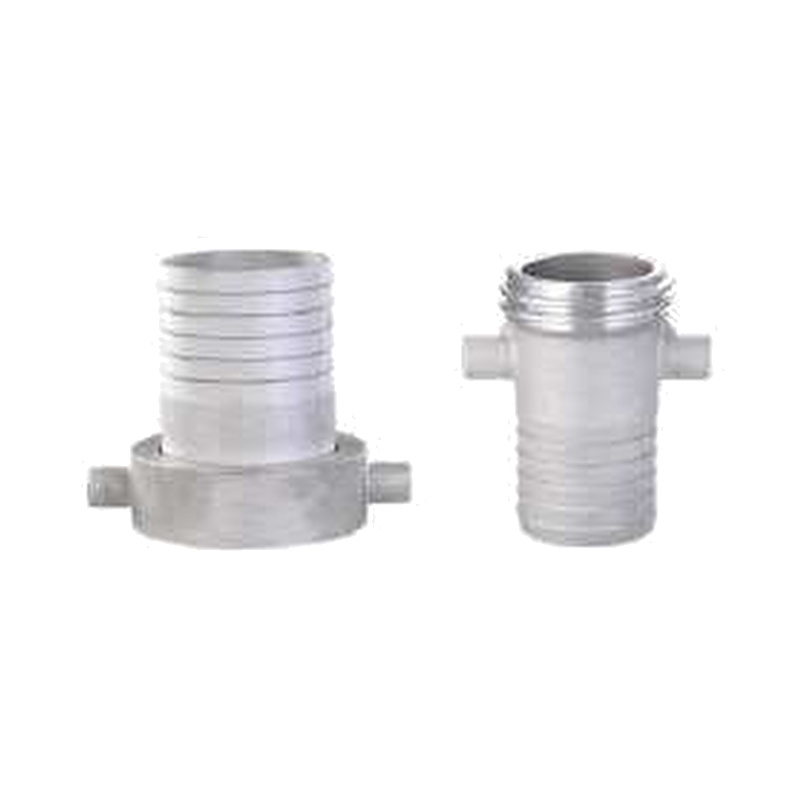


Pin lug couplings are aluminium hose ends with a lug cast on each side of the body, so the fitting can be held by hand, by a hook spanner or by a pin while the joint is turned. This range is the three pin lug families in aluminium: the pin lug with a brass nut from 1-1/2 in to 6 in, the aluminium pin lug, and the pin lug cap that closes an end. All three are made to be made up and released by hand, which is what separates them from a crimped or clamped end.
|
|
|
|
|
Pin lug couplings: the three families and what each one is
- Pin lug with brass nut – PLS. A hose shank carrying a brass nut, with the lug on the nut. The nut is the part that turns, and brass against an aluminium body is the pairing that keeps a joint from seizing after it has been left made up.
- Aluminium pin lug – SHC. The lug is on the body itself rather than on a separate nut, so the fitting is one aluminium piece and the lug turns with the hose.
- Pin lug cap – PLC. A cap that closes a pin lug end, with a lug on each side and a raised boss in the middle. The lugs are the handle: a cap that has been sitting on a wet line comes off far more easily with a shoulder to pull than with a smooth rim.
Pin lug couplings: sizes and part numbers
| Size | Part number |
|---|---|
| 1-1/2 in | PLS-150 |
| 2 in | PLS-200 |
| 2-1/2 in | PLS-250 |
| 3 in | PLS-300 |
| 4 in | PLS-400 |
| 6 in | PLS-600 |
| Size | Part number |
|---|---|
| 1-1/2 in | PLC150-AL |
| 2 in | PLC200-AL |
| 2-1/2 in | PLC250-AL |
| 3 in | PLC300-AL |
| 4 in | PLC400-AL |
The aluminium pin lug is printed differently, and it is worth being exact about it because it decides whether an order ships right. The part list shows four sizes against five part numbers: 1-1/2 in, 2 in, 3 in and 4 in, with SHC150-AL, SHC200-AL, SHC250-AL, SHC300-AL and SHC400-AL. The two columns do not run one to one. Send the size you need and the number is confirmed against the body before the order is made, rather than guessed from the sequence.
Why the lug is on the body and not on a spanner flat
A round aluminium body with a wet hose on it cannot be gripped: a strap wrench slips and a pipe wrench marks it. The lug gives a shoulder that a hand, a hook spanner or a pin can hold.
It also keeps the end serviceable in the field: a joint made up by hand can be released by hand, without a press.
What is not published, and why that matters
These two part lists carry size and part number only. They print no pressure rating, no alloy grade and no thread standard for the pin lug ends. That is not an omission on this page: it is what the source gives, and inventing a number would be worse than leaving it out.
In practice, a rating has to be confirmed per order if the line is rated, because the finished assembly is set by the hose and the attachment, not by the fitting alone. The thread, where the end is threaded, has to be quoted rather than assumed.
Where pin lug ends are used
They belong to the part of a hose system that is made up and released repeatedly rather than permanently: fire main outlets and attack lines on services using a lugged end, suction inlets at a pump, and tanker hose that is coupled per load.
What to check before ordering
- The size on this page is the nominal size of the end, printed against the part number. Quote it together with the hose bore and with the outside diameter of the cover at the point the shank sits.
- The family. PLS and SHC are not interchangeable parts of the same joint; they are two different ways of ending a hose. Say which one the equipment already has.
- The thread, where the end is threaded. The thread standard is not named in the list, so it is quoted on the order.
- The cap or plug, if the line is blanked between loads. Order the cap with the same size as the end it closes.
Ordering information
- Part number, or family plus size: PLS, SHC or PLC
- Hose bore and cover outside diameter
- Thread, if the end is threaded
- Quantity per size
Frequently asked questions
What are pin lug couplings used for?
They end a hose that is made up and released by hand: fire main and suction lines, and tanker or bulk hose that is coupled per load. The lug gives the grip that a round aluminium body does not have.
Do pin lug couplings have a pressure rating?
The part list gives size and part number only, with no pressure figure. If the line is rated, the rating is confirmed per order against the hose and the assembly rather than taken from this page.
What is the brass nut on the PLS for?
It is the part that turns. Brass on an aluminium body does not seize the way aluminium on aluminium does, so a joint that has been left made up still comes apart with a pin through the lug.
Is the number after SHC the size?
Not reliably. The part list shows four sizes against five pin lug numbers, so the columns do not pair one to one. Quote the size and the number is confirmed against the body.
What is the minimum order, and can I get samples?
MOQ, samples and lead time are confirmed per line with the price, because each size is a separate run.
Related reading
- Fire hose couplings
- Aluminium lugged adapters and nipples
- Fire hydrant adapters
- Tank, bulk and specialty fittings
- Industrial hose couplings
Pin lug couplings are quoted by family, size and thread, and the family is the field that most often settles a wrong order.
Send the family, the size and the thread, and we come back with the price.


 English
 Spanish
 Portuguese
 French
 German
 Arabic
 Russian
 Indonesian
 Japanese
 Korean