
Why This Metric Male O-Ring to Metric Male S-Series Adapter 1EH Passes the Compliance Gate
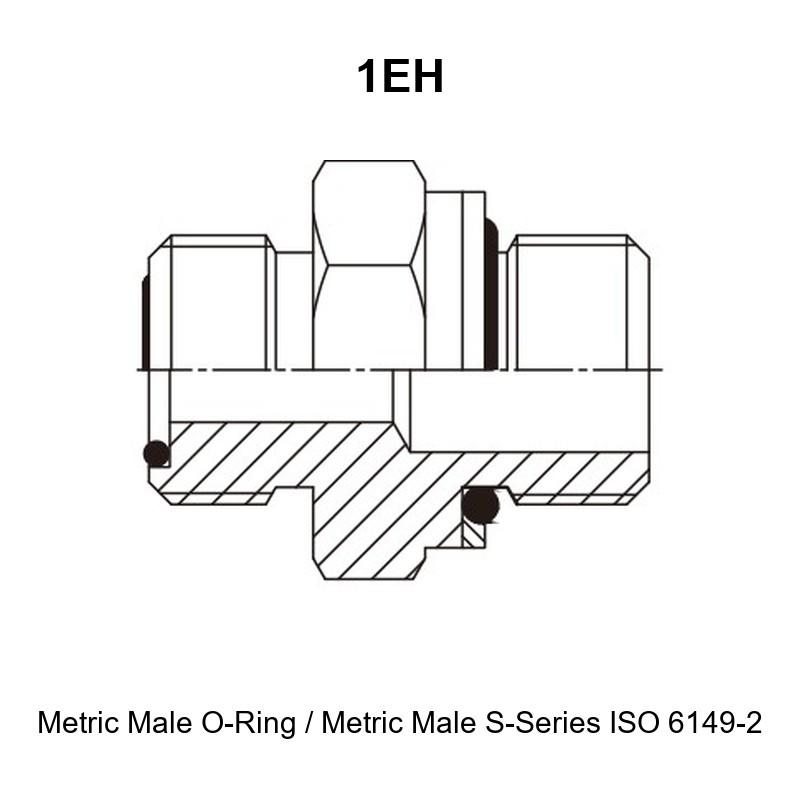
The metric male O-ring to metric male S-series adapter 1EH is a straight asymmetric adapter that joins a metric male O-ring stud end to a metric male S-series (heavy series) stud end built to ISO 6149-2. Both ends seal with an O-ring at the shoulder, so no thread sealant is used, but the two ends differ in thread size, in stud length and in O-ring size, which makes this part the stepping link between two metric port families rather than a same-size extension.
The most common use is a machine that pairs a light-series metric port with a heavy-series metric port, or a repair in which the spare port available is one size down from the manifold connection. Every size code in the matrix pairs a larger E end with a smaller F end, and each code is supplied with two different O-rings.
Core Advantages
- Two different metric port families in one body – on this metric male O-ring to metric male S-series adapter 1EH the E end is a metric male O-ring stud end and the F end is a metric male S-series stud end per ISO 6149-2.
- Twelve size pairings – the E end range is M12X1.25 through M52X2 and the matching F end range is M10X1 through M48X2.
- O-ring sealing at both shoulders – the joint stays independent of thread engagement depth on both ends, which matters when the two ports are in different materials.
- Carbon steel with plated finish – bodies are machined from carbon steel and supplied with a protective plated finish as standard practice.
- Traceable and documented – heat number on the batch label, material test report on request, and free cross-reference from a worn sample.
Technical Specifications
What Is a Metric Male O-Ring to Metric Male S-Series Adapter?
A metric male O-ring to metric male S-series adapter is a straight stud adapter whose first end seals with an O-ring against a metric port face and whose second end is a heavy-series metric stud end built to ISO 6149-2. It is not a reducer in the usual sense, because both ends are male stud ends rather than female ports, and it is not interchangeable with a 60 degree cone seat adapter even where the thread sizes happen to match.
The 1EH series exists because metric hydraulic equipment in the field is not standardised on a single port family: light-series and heavy-series ports appear on the same machine, and a stepping stud adapter is often the cleanest way to join them without adding a hose assembly. ISO 6149-2 defines the heavy-duty stud end, ISO 6149-3 defines the light-duty stud end, and ISO 6149-1 defines the mating ports.
Connection 1 – Port Side E: Metric Male O-Ring Stud End
| Item | Detail |
|---|---|
| Interface type | Metric male stud end, O-ring face seal |
| Sealing method | Elastomer O-ring in a shoulder groove, compressed against the port face |
| Thread form | Metric fine pitch, size-specific (for example M12X1.25, M22X1.5, M52X2) |
| Reference standard | Metric O-ring stud end, ISO 6149 series |
| Size range | M12X1.25 to M52X2 |
| O-ring sizes | 8X1.9 up to 40X3.1, see the dimension matrix below |
Connection 2 – Port Side F: Metric Male S-Series Stud End
| Item | Detail |
|---|---|
| Interface type | Metric male heavy-series (S-series) stud end, O-ring face seal |
| Sealing method | Elastomer O-ring in a shoulder groove, compressed against the port face |
| Thread form | Metric heavy-series pitch, size-specific (for example M10X1, M27X2, M48X2) |
| Reference standard | ISO 6149-2 stud end |
| Size range | M10X1 to M48X2 |
| O-ring sizes | 8.1X1.6 up to 44.5X3.0, always a different size from the E end |
Because the two ends differ, this adapter is not reversible and cannot be installed the wrong way round without a visible mismatch at the smaller port. The pairing rule in the matrix is simple: for every size code the F end is one size below the E end.
Dimensional Data
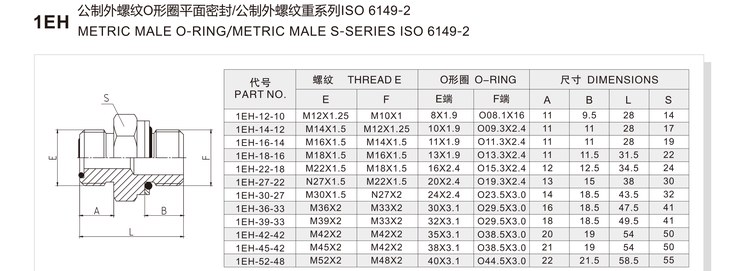
| Symbol | Meaning | Unit |
|---|---|---|
| PART NO. | Catalogue order code in the form 1EH-E-F | – |
| THREAD E | Metric male thread at the E end | mm pitch notation |
| THREAD F | Metric male thread at the F end | mm pitch notation |
| O-RING E end | O-ring designation used at the E end | mm (ID x cross-section) |
| O-RING F end | O-ring designation used at the F end | mm (ID x cross-section) |
| A | Stud end length at the E end, measured from the shoulder to the thread end | mm |
| B | Stud end length at the F end, measured from the shoulder to the thread end | mm |
| L | Overall length of the adapter across both stud ends | mm |
| S | Hex across flats of the body, the wrench size | mm |
Full Dimension Table (Part Number Matrix)
| PART NO. | THREAD E | THREAD F | O-RING E end | O-RING F end | A (mm) | B (mm) | L (mm) | S (mm) |
|---|---|---|---|---|---|---|---|---|
| 1EH-12-10 | M12X1.25 | M10X1 | 8X1.9 | 8.1X1.6 | 11 | 9.5 | 28 | 14 |
| 1EH-14-12 | M14X1.5 | M12X1.25 | 10X1.9 | 9.3X2.4 | 11 | 11 | 28 | 17 |
| 1EH-16-14 | M16X1.5 | M14X1.5 | 11X1.9 | 11X2.4 | 11 | 11 | 28 | 19 |
| 1EH-18-16 | M18X1.5 | M16X1.5 | 13X1.9 | 13.3X2.4 | 11 | 11.5 | 31.5 | 22 |
| 1EH-22-18 | M22X1.5 | M18X1.5 | 16X2.4 | 15.3X2.4 | 12 | 12.5 | 34.5 | 24 |
| 1EH-27-22 | M27X1.5 | M22X1.5 | 20X2.4 | 19.3X2.4 | 13 | 15 | 38 | 30 |
| 1EH-30-27 | M30X1.5 | M27X2 | 24X2.4 | 23.5X3.0 | 14 | 18.5 | 43.5 | 32 |
| 1EH-36-33 | M36X2 | M33X2 | 30X3.1 | 29.5X3.0 | 16 | 18.5 | 47.5 | 41 |
| 1EH-39-33 | M39X2 | M33X2 | 32X3.1 | 29.5X3.0 | 18 | 18.5 | 49.5 | 41 |
| 1EH-42-42 | M42X2 | M42X2 | 35X3.1 | 38.5X3.0 | 20 | 19 | 54 | 50 |
| 1EH-45-42 | M45X2 | M42X2 | 38X3.1 | 38.5X3.0 | 21 | 19 | 54 | 50 |
| 1EH-52-48 | M52X2 | M48X2 | 40X3.1 | 44.5X3.0 | 22 | 21.5 | 58.5 | 55 |
All dimensions are in millimetres and are transcribed from the published spec sheet for this series. The source drawing uses a comma as the decimal separator in some cells; those values are shown above with a decimal point so that the table reads consistently. The letter X in a thread callout is the pitch separator, so M10X1 means a 10 mm nominal metric thread with a 1 mm pitch, and the two O-ring numbers are the inside diameter and the cross-section in millimetres.
Two entries need attention when ordering. In 1EH-42-42 both ends carry the same thread size M42X2, but the O-rings still differ, so do not assume a symmetric part. Sizes at the top of the matrix should also be confirmed against the actual port drawing, because not every thread listed appears in the published ISO 6149 size lists.
Thread Size and Dash Chart
| Size code | THREAD E | THREAD F | O-ring E end | O-ring F end | Hex S (mm) |
|---|---|---|---|---|---|
| 1EH-12-10 | M12X1.25 | M10X1 | 8X1.9 | 8.1X1.6 | 14 |
| 1EH-14-12 | M14X1.5 | M12X1.25 | 10X1.9 | 9.3X2.4 | 17 |
| 1EH-16-14 | M16X1.5 | M14X1.5 | 11X1.9 | 11X2.4 | 19 |
| 1EH-18-16 | M18X1.5 | M16X1.5 | 13X1.9 | 13.3X2.4 | 22 |
| 1EH-22-18 | M22X1.5 | M18X1.5 | 16X2.4 | 15.3X2.4 | 24 |
| 1EH-27-22 | M27X1.5 | M22X1.5 | 20X2.4 | 19.3X2.4 | 30 |
| 1EH-30-27 | M30X1.5 | M27X2 | 24X2.4 | 23.5X3.0 | 32 |
| 1EH-36-33 | M36X2 | M33X2 | 30X3.1 | 29.5X3.0 | 41 |
| 1EH-39-33 | M39X2 | M33X2 | 32X3.1 | 29.5X3.0 | 41 |
| 1EH-42-42 | M42X2 | M42X2 | 35X3.1 | 38.5X3.0 | 50 |
| 1EH-45-42 | M45X2 | M42X2 | 38X3.1 | 38.5X3.0 | 50 |
| 1EH-52-48 | M52X2 | M48X2 | 40X3.1 | 44.5X3.0 | 55 |
Material and Heat Treatment
| Item | Typical supply | Note |
|---|---|---|
| Body material | Carbon steel, machined from bar or forged blank | Stainless steel 304 / 316L on request |
| Heat treatment | Applied where the size and duty require it | Typical practice, confirmed on the drawing |
| Surface finish | Zinc plating, trivalent passivation | Zinc-nickel or other systems on request |
| O-ring material | NBR as standard practice on both ends | FKM and other elastomers on request |
| Inspection | Dimensional check and visual thread inspection | Certified report on request |
| Documentation | Batch label with heat number; material test report on request | Third-party inspection such as BV or SGS can be arranged |
These values describe standard practice for this series rather than a customer-specific qualification. If your project carries its own material, plating or heat-treatment requirement, send it and the part will be quoted against it.
Working Pressure and Operating Envelope
This series is supplied without a single published pressure rating, because the working pressure is governed by the port standard together with the hose or fitting grade selected, and the finished assembly is only as strong as its weakest member. On a stepping adapter the weaker of the two port standards is the practical limit, so the smaller end usually decides.
Pressure data for the metric male O-ring to metric male S-series adapter 1EH can be issued against ISO or SAE requirements on request. State the intended working pressure and the applicable standard when ordering so that the correct grade is confirmed.
Temperature Range
Continuous service temperature is typically -40 °C to +120 °C for nitrile O-rings in a steel body, and it is set by the sealing elements and by the hose or tube in the circuit. Higher temperature service calls for a fluorocarbon elastomer, available on request.
How to Read the Part Number Matrix
The order code has three blocks: the series prefix, the E end size, and the F end size.
The prefix 1EH means that the first end is a metric male O-ring stud end and the second end is a metric male S-series stud end per ISO 6149-2. Read the two size blocks in the order in which they appear, because this adapter is not reversible.
| Order code | Prefix meaning | Size blocks | Full interface |
|---|---|---|---|
| 1EH-12-10 | 1EH: metric male O-ring end to metric male S-series end | E = 12 (M12X1.25), F = 10 (M10X1) | M12X1.25 O-ring end to M10X1 S-series end |
| 1EH-22-18 | 1EH: metric male O-ring end to metric male S-series end | E = 22 (M22X1.5), F = 18 (M18X1.5) | M22X1.5 O-ring end to M18X1.5 S-series end |
| 1EH-52-48 | 1EH: metric male O-ring end to metric male S-series end | E = 52 (M52X2), F = 48 (M48X2) | M52X2 O-ring end to M48X2 S-series end |
Two warnings are worth repeating. Reversing the two size blocks gives a different part, and the two ends need two different O-rings, so quote both sizes when you order spare seals. A metric thread size can also exist in the 60 degree cone system, so the size code alone is never enough to order safely.
Selection and Ordering
Selection Checklist / Decision Table
| Question | What to check | Example |
|---|---|---|
| What is on the E end port? | Port preparation, thread and pitch | Metric O-ring port, M22X1.5 |
| What is on the F end port? | Heavy-series port per ISO 6149-2, thread and pitch | S-series port, M18X1.5 |
| Which end is larger? | The E end size block is the larger thread | 1EH-22-18: E larger, F smaller |
| Is either port a cone seat? | A cone seat means a different family | If yes, do not use this part |
| Is there room for the hex? | Compare S against the manifold | S = 24 mm for 1EH-22-18 |
| Which O-rings are needed? | One size per end, they are not the same | 16X2.4 and 15.3X2.4 |
Cross Reference Service
Send a photograph of the worn fitting, a rubbing of both threads, or the old order code from your own system, and the pairing will be converted free of charge. Because this adapter has two different ends, quote both thread sizes and both O-ring sizes for this metric male O-ring to metric male S-series adapter 1EH where they are known. We quote and supply under the HENGHUA and Globhose brands only; we do not copy or re-brand another manufacturer’s product, and we do not print another company’s part number on any component.
Packaging and Logistics
| Item | Standard practice |
|---|---|
| Unit protection | Thread protectors and anti-corrosion film on machined surfaces |
| Carton | Inner bag plus export carton, size-coded labels |
| Batch label | Series, size code, quantity, heat number, production date |
| Mixed loads | Different sizes can be combined in one consignment to reach a full container |
| Urgent orders | Air freight for samples and breakdown spares |
| Standard lead time | Batch delivery of standard sizes in around seven days, subject to confirmation |
Installation and Fitment Guide
Step-by-Step Assembly
- Identify the two ends before assembly and confirm which port takes the larger thread.
- Check both port preparations and confirm that no cone seat and no tapered thread is present.
- Fit two new O-rings of the correct size, one per end, and keep them free of swarf.
- Clean both threads and both port faces, and check the shoulders for scores.
- Engage by hand until the shoulders contact, then tighten to the standard torque using the wrench flat S.
- Run a short low-pressure check before the machine returns to full duty.
Torque and Sealing Notes
Tightening torque is taken from the applicable standard data table for each thread size, not from a rule of thumb. Because the two ends differ, the correct torque for the large end and for the small end will not be the same value.
The O-rings do the sealing. Thread sealant, tape and liquid pipe dope are unnecessary on an O-ring face seal stud end and can introduce contamination into the circuit. On the larger sizes, support the manifold so that the tightening load does not go into the casting.
Installation Warnings
- Confirm which end is larger before assembly; this adapter is not reversible.
- Use two new O-rings, each of the correct size for its own end.
- Check that the heavy-series end matches an ISO 6149-2 style port.
- Keep both sealing shoulders and both port faces free of paint, burrs and dirt.
- Use the correct wrench size S and avoid gripping the threads.
- Never fit either end into a 60 degree or 74 degree cone seat port.
- Never mix up the two O-rings; they are different sizes and will not seal if swapped.
- Never use thread tape or liquid sealant to stop a leak at a shoulder.
- Never assume that identical thread sizes at both ends mean identical seals, as 1EH-42-42 shows.
Applications and Industries
Bridging light-series and heavy-series ports. When a machine mixes two metric port families, this adapter joins them in one joint instead of a hose assembly.
One-size-down adaptation. The F end is always one size below the E end, which suits ports where a manifold outlet has to feed a smaller valve port.
Repair and replacement. Field repairs often find a manifold port one size larger than the spare fitting available, and this stepping adapter closes the gap.
Hydraulic test benches. O-ring face seal joints tolerate repeated assembly well, which suits rigs that are opened and closed frequently.
Oil and gas, and industrial plant. Metric O-ring and heavy-series ports appear on valve packages, hydraulic power units, machine tools and presses, and the plated steel body suits normal industrial environments.
Industry tags: hydraulic adapter, metric O-ring fitting, S-series stud end, ISO 6149-2, stepping adapter, manifold fitting, mobile hydraulics, oil and gas, industrial machinery, repair and maintenance.
OEM Customization and Quality Traceability
Private-label marking, laser marking of your own part number, non-standard plating, stainless bodies, special O-ring compounds and made-to-drawing geometries are available on this series. Send a drawing or a sample and a quotation with lead time is returned within 24 hours.
Traceability is handled at batch level: heat number on the label, material test report on request, and third-party inspection such as BV or SGS can be arranged. Hydraulic assemblies are pressure tested as part of the normal flow, and the adapter is one link in a chain that also includes the hose, the tube and the port.
FAQ
Q: What does the 1EH prefix tell me that the 1E prefix does not? A: The 1E prefix means both ends are metric male O-ring stud ends. The 1EH prefix means the first end is a metric male O-ring stud end and the second end is a metric male S-series stud end per ISO 6149-2, so the two ends are different.
Q: Is this adapter reversible? A: No. The metric male O-ring to metric male S-series adapter 1EH has a larger E end and a smaller F end, and the two O-rings differ, so the orientation is fixed by the port sizes.
Q: What working pressure can this adapter carry? A: No single figure applies. Working pressure is governed by the port standard together with the hose or fitting grade selected, and the finished assembly is only as strong as its weakest member. On a stepping adapter the smaller port usually decides the limit.
Q: Why are two different O-rings needed? A: Each end seals against a different port geometry. The E end uses the O-ring for its metric O-ring stud end and the F end uses the O-ring for its heavy-series stud end, and the matrix lists both.
Q: Are the two ends ever the same size? A: One code in the matrix, 1EH-42-42, has the same thread size M42X2 at both ends, but the O-rings are still different, so it is not a symmetric part.
Q: Which material and finish are supplied as standard? A: Carbon steel bodies with a plated finish and nitrile O-rings are standard practice. Stainless steel, zinc-nickel plating and high-temperature elastomers are available on request.
Q: How tight should each end be, and how fast can the part ship? A: Use the torque value for each specific thread size from the applicable standard data table, applied with a wrench on the hex flat S. Standard sizes generally ship in batches in around seven days.
Request a Quote
To quote this metric male O-ring to metric male S-series adapter 1EH accurately, send five items: the thread and pitch required at the E end, the thread and pitch required at the F end, the working pressure and the fluid, the material and finish required, and the quantity with the required delivery date. Where the original part is unknown, send a photograph or a sample and both ends will be identified for you.
Quotations are returned within 24 hours, including lead time and packaging details for your destination. Bulk quantities, mixed size containers and private-label marking are all supported.
Browse the full Hydraulic Adapters range for the complete family, or contact us to request a quote, mill test reports, and samples.


 English
  Spanish
  Portuguese
  French
  German
  Arabic