


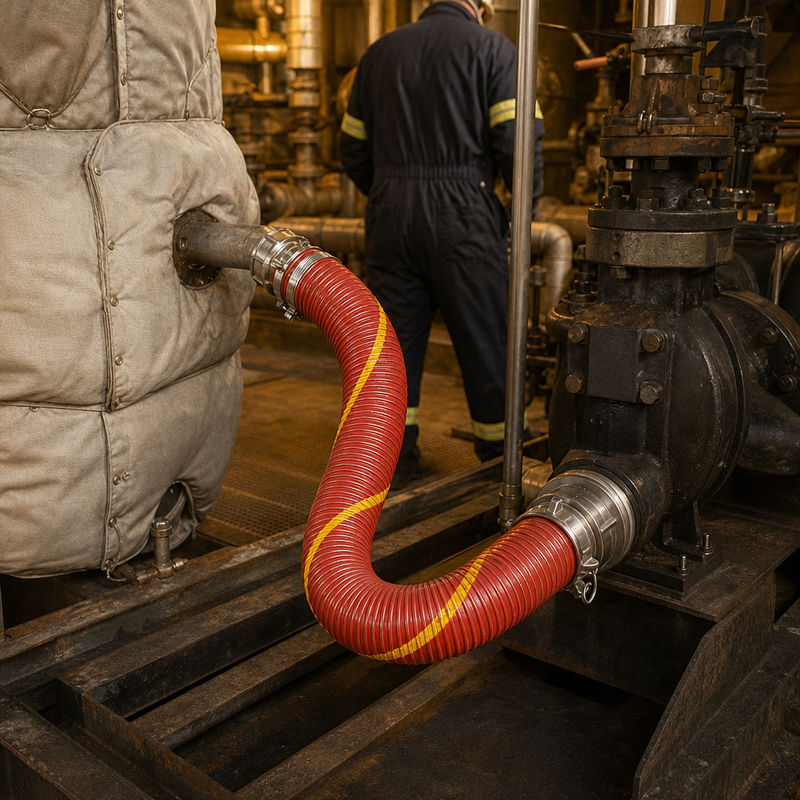
A high temperature composite hose from HENGHUA carries hot process chemicals, hot oil and heat transfer fluid at 14 bar (203 psi), in bores from 25 mm to 250 mm (1 in to 10 in). The rated window is -30°C to +177°C, which covers hot solvent, bitumen and dock duties that would soften a polypropylene-lined hose within weeks. The build is a non-vulcanised, multi-layer thermoplastic hose: PTFE over a polypropylene liner, polyamide fabric carcass, double-layer PVC coated cover, and helices that hold the bore under vacuum.
Product Overview
A high temperature composite hose sits inside the non-vulcanised, multi-layer thermoplastic family defined by EN 13765:2018, which separates vapor from liquid service and sets a 4:1 burst margin. This build is for heavy liquid duty: more plies, a helix against vacuum collapse, and a liner that holds strength at 150°C.
Four elements do the work. An SS304, SS316 or galvanised inner helix carries the bore, a PTFE over polypropylene liner holds the medium, polyamide plies take the axial load, and a double-layer PVC cover wraps an outer helix in the same steels.
Three numbers frame every enquiry: 14 bar in all eight sizes, bore from 25 mm to 250 mm, and a -30°C to +177°C window. The upper figure is why buyers specify this build.
Four properties separate it from a standard composite hose. The PTFE face handles aromatics and oxidising acids, the polyamide carcass keeps its strength when hot, 0.9 bar vacuum lets one hose suction and discharge, and stainless helices give a chloride-free wetted path.
Typical installations are hot reactor discharge, heat transfer loops, bitumen loading arms, hot oil tanker unloading and dock transfer above 100°C, using loading arms, gear pumps and manifold skids.
The problem it solves is thermal failure at the fitting. A hose soft at 20°C can creep at 160°C, and it fails at the crimp first. The polyamide carcass and PTFE liner hold their dimensions.
Every assembly is proof tested at 1.5 times working pressure. Digital crimping records tie each batch to its material lot, and we can reproduce the pressure curve for any serial number. The plant holds ISO 9001, ISO 18752, MSHA, CE, CCS, ABS and DNV.
Product Advantages of the High Temperature Composite Hose
- 177°C continuous rating. Liner and carcass hold strength where standard PP softens.
- PTFE face for aggressive media. Aromatics, chlorinated compounds and oxidising acids.
- Full vacuum at every size. The inner helix holds 0.9 bar without a separate suction hose.
- Stable crimp at temperature. Low elongation keeps the ferrule sealed through thermal cycling.
- Conductive build as standard. Continuity measured below 1 ohm/m under 100 mm bore.
- Eight sizes from one line. 25 mm to 250 mm, with flanges, camlocks or tank couplings fitted in house.
Applicable users: chemical plant maintenance teams, bitumen terminals, tanker operators, ship chandlers and EPC contractors specifying hot transfer lines.
Detailed Technical Specifications
| Hose code | ID (mm) | ID (in) | OD (mm) | Bend radius (mm) | Working pressure (bar) | Working pressure (psi) | Weight (kg/m) | Length (m) |
|---|---|---|---|---|---|---|---|---|
| HTCH-01 | 25 | 1 | 38 | 100 | 14 | 203 | 0.80 | 15 |
| HTCH-02 | 38 | 1.5 | 50 | 150 | 14 | 203 | 1.60 | 15 |
| HTCH-03 | 50 | 2 | 68 | 180 | 14 | 203 | 2.80 | 15 |
| HTCH-04 | 75 | 3 | 98 | 240 | 14 | 203 | 4.90 | 15 |
| HTCH-05 | 100 | 4 | 120 | 450 | 14 | 203 | 7.80 | 15 |
| HTCH-06 | 150 | 6 | 175 | 570 | 14 | 203 | 11.70 | 15 |
| HTCH-07 | 200 | 8 | 240 | 790 | 14 | 203 | 17.00 | 15 |
| HTCH-08 | 250 | 10 | 290 | 990 | 14 | 203 | 22.00 | 15 |
- Temperature. -30°C to +177°C published. The PTFE face touches the medium, but the polypropylene plies behind it sit a film thickness away on the same heat path, so the ceiling is the whole wall’s limit.
- Proof pressure. 1.5 times working pressure on every assembly, which is 21 bar for a 14 bar hose.
- Burst margin. 5:1 at or below 100 mm bore (70 bar), 4:1 above 100 mm (56 bar).
- Vacuum. 0.9 bar, full vacuum, in all eight sizes.
- Movement limits. Elongation 6 percent below 100 mm, 10 percent above; twist 10 degrees per metre.
- Electrical resistance. 1 ohm/m or less below 100 mm, 2 ohm/m or less above, with the helix bonded to both fittings.
- Length. 15 m standard; other lengths confirmed on the drawing.
Structure and Materials
- Inner helix. SS304, SS316 or galvanised mild steel, wound to hold the bore against vacuum and stop flattening at a tight bend.
- Liner. PTFE film over polypropylene film in multiple plies. The PTFE face carries chemical duty, the polypropylene gives body.
- Carcass. Polyamide fabric and film plies, layered dry and compressed. These take axial load, so the hose does not stretch under pull.
- Cover. Polyamide fabric and film with two layers of abrasion resistant PVC. The polyamide keeps strength when warm; the PVC takes the scuffing.
- Outer helix. SS304, SS316 or galvanised mild steel, spiralled over the cover to carry hoop load and protect the carcass when dragged.
- End fittings. Crimped ferrules with NPT male, BSP male, cam and groove, fixed or floating flange, reducing flange, tank coupling or 37 degree flare adapters.
Why the composite build holds up
Each layer answers one load. The inner helix is a spring pushing outward, so when the pump stops and the line drains the bore stays round. That is why the hose holds 0.9 bar of vacuum without a support cage, and why a wire braided rubber hose of the same bore needs a separate suction grade. Here the cage is the helix itself, built into the bore where it can act on the wall directly.
The fabric plies take axial load. A filled 15 m length of 200 mm hose wants to push its fittings apart, and the polyamide plies resist that pull without adding stiffness. They also set the elongation limit, which is why the published figure is 6 percent on small bore and 10 percent from 100 mm up.
The liner is a composite in its own right. PTFE film has near universal chemical resistance but little mechanical strength. Polypropylene film has strength but is attacked by aromatics above 100°C. Layered together, each covers the weakness of the other, and the medium only touches PTFE.
The cover is the wear part. A hot hose gets dragged across a deck, and abrasion removes cover before anything structural. Two PVC layers on a polyamide base absorb that wear and keep the carcass dry.
Safety factor, proof pressure and burst margin
This hose is published with a 5:1 burst margin up to and including 100 mm bore, and 4:1 above. On a 14 bar rating that is 70 bar minimum burst on small sizes and 56 bar from 150 mm up. The step down at 100 mm is normal for large bore composite construction: wall thickness does not scale with diameter, so the bigger sizes trade margin for flexibility.
The proof test at 1.5 times working pressure, 21 bar, is not a burst test. It proves the assembly and crimp hold at a defined pressure for a defined time, and catches a bad ferrule before the jetty. Ask what the design factor is and where it changes, whether every assembly is proof tested, and whether the burst figure is a batch minimum or a calculation, because a calculation can be right and still irrelevant to your duty.
Chemical Compatibility and Media Guide
Ratings assume the PTFE face contacts the medium and the assembly runs inside the window. Heat and concentration move a rating one step.
| Medium | Rating | Note |
|---|---|---|
| Mineral hydraulic oil | Excellent | Hot oil duty, no swelling |
| Diesel | Excellent | Tanker transfer |
| Gasoline | Good | Aromatics lower the rating near 177°C |
| Kerosene | Excellent | Low permeation |
| Crude oil | Good | Review water cut and H2S |
| Lubricating oil | Excellent | Hot drain and fill |
| Vegetable oil | Good | Fatty acids attack PP |
| Biodiesel B100 | Good | Confirm grade and water content |
| Ethanol E100 | Good | Dry ethanol preferred |
| Methanol | Good | Low permeation through PTFE |
| Toluene | Good | PTFE face required |
| Xylene | Good | Same as toluene |
| MEK | Good | Ketones pass PP, PTFE holds |
| Acetone | Good | Fast transfer, low residue |
| Ethyl acetate | Good | Esters need the PTFE face |
| Dichloromethane | Excellent | PTFE is unaffected |
| Trichloroethylene | Excellent | Confirm contact time |
| Sulphuric acid 30% | Excellent | Dilute acid is the easy case |
| Sulphuric acid 98% | Good | Hot acid needs confirmation |
| Hydrochloric acid 35% | Good | Keep the cut end dry |
| Sodium hydroxide 50% | Good | Confirm concentration at temperature |
| Ammonia 10% | Good | Aqueous, vented handling |
| Sodium hypochlorite 12% | Limited | Oxidiser; confirm |
| Hydrogen peroxide 30% | Limited | Vent decomposition gas |
| Phosphoric acid 85% | Good | Fertilizer and food plants |
| Nitric acid 65% | Good | Oxidising acid, PTFE face required |
| Acetic acid 99% | Good | Confirm temperature |
| Ethylene glycol | Excellent | Chiller and heat transfer |
| Propylene glycol | Excellent | Food grade available |
| Water | Excellent | Washdown and cooling |
| Sea water | Good | Stainless helix for wetted |
| Steam condensate | Good | Condensate only, not a steam hose |
Three rules for reading the chart. Derate for heat: a rating shown at 20°C can drop a step at 150°C. Watch concentration: 30 percent and 98 percent sulphuric acid behave like two media. Respect contact time.
Send the concentration and temperature of any medium missing from this chart and we confirm in writing before the order is released, with the full chart as a PDF.
Applications and Industries
Six applications show where the rating matters most.
Hot chemical reactor discharge. Reactor jackets and distillation bottoms to holding tanks at 140°C to 170°C.
Heat transfer fluid loops. Thermal oil heaters, expansion tanks and user equipment, where rubber hardens within a season.
Bitumen and asphalt loading. Mixing plants and roofing terminals, held above 150°C between loads.
Hot oil tanker unloading. Railcar and road tanker connections for heavy fuel oil and cutter stock.
Dock and ship-to-shore transfer. Exposed jetty lines on hot petroleum streams, where the cover takes salt.
Maintenance bypass. Temporary lines during shutdown, one flexible length replacing a fixed spool.
Selection Guide for High Temperature Composite Hose
Size, flow and pressure drop
Size on velocity, not on the pump flange. For liquid transfer keep velocity between 1 m/s and 3 m/s. A 50 mm bore passing 20 m3/h runs at about 2.8 m/s, a sensible point for a 14 bar high temperature composite hose.
Pressure drop scales roughly with the fifth power of diameter, so 75 mm cuts friction loss about five times against 50 mm at the same flow. Length adds weight too: a 250 mm hose weighs 22 kg/m, so 15 m is 330 kg empty and needs lifting gear.
End fittings and hose assembly
Fittings are crimped, not clamped. A swaged ferrule compresses carcass and liner onto a serrated insert, and the digital crimper records die size and compression for every assembly.
Common choices are NPT and BSP male, cam and groove for rack work, fixed and floating flanges for loading arms, reducing flanges, tank couplings and 37 degree flare adapters. A hose 200 mm too long bends tighter than its radius at the fitting, and that is where fatigue starts.
How it compares
| Type | Temperature | Working pressure | Vacuum | Best duty |
|---|---|---|---|---|
| This high temperature composite hose | -30°C to +177°C | 14 bar | 0.9 bar | Hot chemicals, hot oil, bitumen |
| Standard chemical composite hose | -30°C to +100°C | 10 bar | 0.9 bar | Ambient acids, alkalis, alcohols |
| PTFE composite hose | -30°C to +120°C | 20 bar to 76 mm, 15 bar from 102 mm | Confirm per size | Aggressive chemicals, moderate heat |
| Marine composite hose | -40°C to +180°C as published | 14 bar | Full vacuum | Ship-to-shore petroleum |
| Rubber suction and discharge hose | Grade dependent | Grade dependent | Needs a suction grade | General dock work |
What drives the price
PTFE film is the largest material cost and scales with surface area, so a 250 mm hose costs far more per metre than four 100 mm ones. The stainless helix is second: SS316 adds about a third over galvanised steel, and pays where the wetted path must be chloride free.
Labour and testing come next, and none of it scales down for a short length. A wholesale order of one size and one fitting combination cuts film and fabric on a single setup, which shows in the bulk price.
Common selection mistakes
- Buying temperature margin with the wrong liner. A PP liner rated to 100°C does not become a 177°C hose because the cover is thicker.
- Ignoring the bend at the fitting. The 25 mm size bent tighter than 100 mm at the ferrule fails at the crimp first.
- Using a standard grade for hot aromatics. Toluene at 140°C needs the PTFE face, not a thicker wall.
- Ordering 15 m because it is standard. A 9 m run needs 9 m, not surplus hose dragged on the ground.
Installation, Operation and Maintenance
Installation
- Support horizontal runs every 1.5 m on a saddle wide enough for the OD.
- Respect the published bend radius: 100 mm on 25 mm bore, 450 mm on 100 mm, 990 mm on 250 mm, measured to the inside of the bend.
- Keep one hose diameter of straight length at each fitting, and do not twist to align a flange; 10 degrees per metre is the limit.
- Leave a slack loop on hot lines so thermal contraction at shutdown does not pull the crimp.
- Lift 200 mm and 250 mm hose with a sling, never by the fitting.
Inspection and retirement
- Proof test at 1.5 times working pressure before first use and record the result.
- Inspect before each transfer for blisters, exposed helix, soft spots and ferrule deformation.
- Check continuity where the hose works in a flammable atmosphere: 1 ohm/m below 100 mm, 2 ohm/m at 100 mm and above.
- Retire when the cover is worn to the helix, the bend radius has visibly grown, or a proof test shows movement at the fitting.
- Review every hose at six years, replacing early on hot or aggressive duty.
Cleaning, storage and service life
Flush with a compatible solvent or water, drain, and dry with air. Do not steam clean the inside: the liner is not a steam hose and condensate sits against the film. Store coiled at or above the bend radius, out of sunlight.
Life depends on bend tightness at the fitting, dragging, temperature and chemistry. A hose at 120°C with a generous bend outlasts one at 175°C on a tight radius.
Quality Assurance and Test Data
Incoming film, fabric and wire are checked against the material certificate. Film is slit to the ply schedule, helices formed to pitch, and the carcass built on the inner helix with plies laid dry. The assembly is compressed without vulcanisation, then proof tested and marked.
| Test | Standard | What it proves |
|---|---|---|
| Hydrostatic proof | EN ISO 1402 | Assembly and crimp hold at 1.5 times working pressure |
| Burst | EN ISO 1402 | Minimum burst reaches 5:1 or 4:1 depending on bore |
| Electrical resistance | EN ISO 8031 | Continuity inside 1 or 2 ohm/m |
| Bend | EN ISO 1746 | Published bend radius without kinking |
| Dimensions | EN ISO 1307 | Bore, OD and tolerances match the sheet |
| Impulse | EN ISO 6803 | Pressure cycling does not open the crimp |
Give us the serial number and we pull the crimping record, proof curve and material certificates for that assembly. Packaging is film wrap with a plywood case for LCL.
Standards and Certifications
| Standard | What it covers | What it means for the buyer |
|---|---|---|
| EN 13765:2018 | Multi-layer non-vulcanised thermoplastic hose; 4:1 factor, 1.5x proof | Framework this hose is built against |
| EN ISO 1402 | Hydrostatic pressure testing | Defined proof and burst method |
| EN ISO 8031 | Electrical resistance and continuity | Conductive build is verifiable |
| EN ISO 1746 | Bend test | Published bend radius is a tested value |
| EN ISO 1307 | Dimensions and tolerances | Bore and OD sit inside a stated band |
| EN ISO 6803 | Impulse testing | Cycling data compares suppliers |
| IMO IBC Code | Chemical tanker cargo handling | Reference for ship-to-shore chemical transfer |
Company certifications: ISO 9001, ISO 18752, MSHA, CE, CCS, ABS, DNV, California Proposition 65, RoHS, API, GOST-R and MA metrology accreditation. Documents ship with the quotation.
Frequently Asked Questions
What is the hose made of?
An SS304, SS316 or galvanised inner helix, a PTFE over polypropylene liner, polyamide plies, a polyamide cover with two PVC layers, and an outer helix in the same steels. Nothing in the wall is vulcanised.
What does a 14 bar rating actually mean?
It is the maximum continuous working pressure at rated temperature, proof tested at 21 bar. Minimum burst is 70 bar to 100 mm and 56 bar above.
Can this hose handle vacuum?
Yes, 0.9 bar in all eight sizes. The inner helix holds the bore open, so one hose suctions and discharges.
What is the real temperature limit?
-30°C to +177°C as published. The PTFE film faces the medium and the polyamide carcass keeps its strength at the top. Confirm medium and temperature in writing.
How do I check chemical compatibility?
Use the table above, then send medium, concentration and temperature for written confirmation. Aromatics and oxidisers are where liner build matters most.
How is it different from a rubber hose?
Rubber is vulcanised, heavier, and needs a separate suction construction. This laminate with two helices is lighter, holds full vacuum and handles more heat.
How is it different from the PTFE composite hose?
The PTFE composite hose reaches 20 bar to 76 mm and +120°C. This one trades pressure for temperature, reaching +177°C at 14 bar for hot oil and bitumen.
What is the smallest trial order?
We quote from one assembly for a trial and price bulk separately. Sampling takes 48 hours and standard specifications ship in about 7 days; mixed sizes add scheduling time.
How do I get a quote or a PDF datasheet?
Send medium, concentration, temperature, pressure, bore, length, end connection, quantity and destination port through the contact form. We reply with price, datasheet PDF, compatibility chart and, where useful, a sample.
Why Source Composite Hose from HENGHUA
We are a Chinese composite hose manufacturer with our own production base, not a trading desk. The facility covers 18,000 m2 in Hebei, runs 8 high-speed lines and produces 25 million metres a year, with a Tianjin office for export paperwork. Most customers in 70+ countries began with one trial high temperature composite hose.
The certification list is the practical part of the offer. ISO 9001 covers the quality system, ISO 18752 the construction range, and MSHA, CE, CCS, ABS and DNV cover markets where a document is needed at the port. We also hold California Proposition 65, RoHS, API, GOST-R and MA metrology accreditation.
Assembly capability is in house. We crimp our own ferrules, keep digital records of every crimp, and fit NPT, BSP, camlock, flange, tank coupling and flare ends on the same line that makes the hose. A 9.4 m assembly with a floating flange one end and a camlock the other ships as a tested unit.
OEM and ODM work covers private labelling, cover colours, marking, packaging and customer ply schedules quoted from a drawing. Sampling takes 48 hours and a standard bulk run about 7 days, which lets a distributor hold stock without holding a container.
Technical support is what buyers use most after the first order. Send a medium and we say whether the PTFE face is needed, whether the temperature sits inside the window, and which fitting suits the connection.
After-sales runs on the batch record, so a claim is settled with data: material certificate, crimping record and proof test curve for that serial number.
Request a Quote
Send your medium, concentration, temperature, pressure, bore, length, end connection, quantity and destination port. Tell us whether the line is suction or discharge, because that decides if the vacuum rating is limiting, and the bend at the fitting, because that decides the cut length.
We can supply the datasheet PDF, the compatibility chart, a sample and a quotation for wholesale quantities. If your medium is not on our chart, we will say so and propose the liner that fits.
A high temperature hose is only as good as the duty data behind it, so put the medium and temperature in writing. Start from the composite hose range or request a quote.
 English
 Spanish
 Portuguese
 French
 German
 Arabic
 Russian
 Indonesian
 Japanese
 Korean