

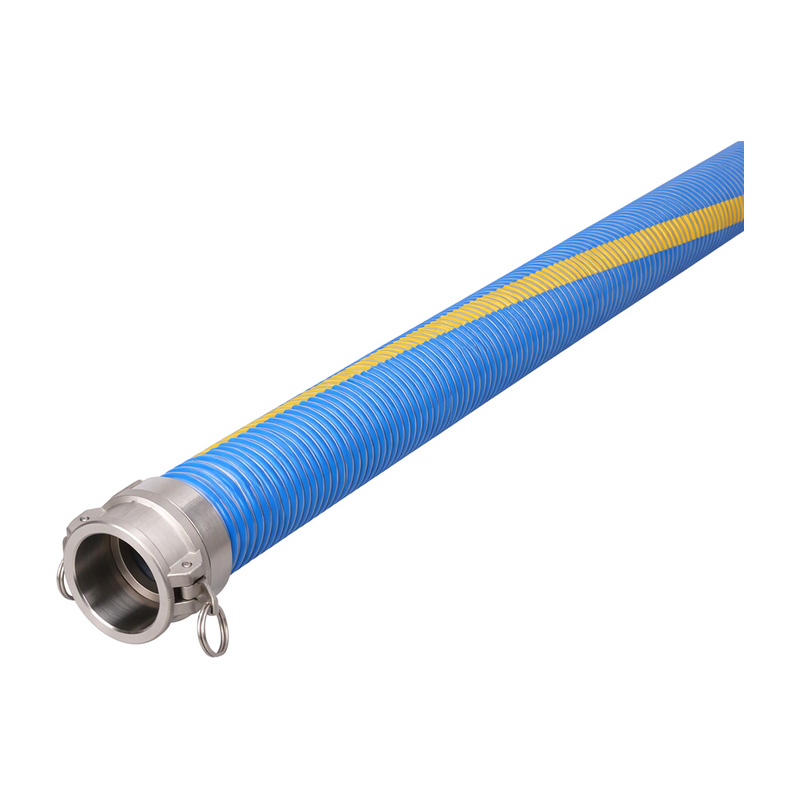

A chemical marine composite hose has to survive salt water outside and aggressive cargo inside, often on the same working day. This build covers bore 50 mm to 250 mm (2 in to 10 in), working pressure 14 bar (200 psi), service temperature -30°C to +100°C, and a standard 15 m length. The liner is multiple plies of PTFE film, so aromatics, chlorinated compounds and most oxidising acids are inside its scope. Both helices are available in stainless steel for deck exposure. Send the cargo list and the ambient conditions before you order.
Product Overview
This is a large bore composite hose for dockside and ship to shore transfer of bulk chemicals, and in the EN 13765:2018 family it sits in the heavy duty and marine classes. The design factor is 4:1 on burst. It is built for suction as well as discharge, which is what separates a dock hose from a pressure-only transfer line.
In one sentence, the chemical marine composite hose is a stainless inner helix, a PTFE film liner, a fabric carcass, a coated fabric cover and an SS316 or hot-dip galvanised outer helix, compressed into one wall without vulcanisation.
Three numbers frame it: 14 bar working pressure, 250 mm maximum bore, and a 15 m standard length that matches most loading arm geometry. Minimum bend radius runs from 180 mm at 50 mm bore to 990 mm at 250 mm.
The advantages are mostly about the environment rather than the cargo. Stainless helices do not rust on a wet deck, so the hose keeps its shape and its continuity. A PTFE liner covers a wider cargo list than a polypropylene build, which matters when one hose handles several parcels. The bore stays smooth, so discharge rates hold on high flow arms, and 2.80 kg/m at 50 mm keeps the smaller sizes manhandled by two operators.
Users are chemical tanker operators, port terminals, barge operators and tank cleaning stations. Equipment includes loading arms, manifold connections, reducers, vapor return lines and dockside pump sets.
The problem it solves is the mismatch between a plant hose and a jetty hose. Plant hoses rarely see salt spray, UV, wind load or ship motion. A marine hose is specified for all four, and for the surge that follows a valve closed against a moving column of cargo.
Quality is controlled from the wire inward. We proof test every assembly at 1.5 times working pressure, crimp with digital records, and trace each assembly to its material batch. Type approval documents from the classification societies come with the shipment when a terminal or a vessel surveyor needs them.
Product Advantages of the Chemical Marine Composite Hose
- Stainless helices both ends. SS316L inner and SS316 outer resist salt water without losing shape.
- PTFE liner for a wide cargo list. Aromatics, chlorinated compounds and oxidising acids are covered.
- Large bore to 250 mm. High discharge rates suit terminal arms and ship manifolds.
- Suction and discharge duty. The inner helix holds the bore open under vacuum.
- Full length continuity. Helices bond to the fittings so static drains end to end.
- Crimped ends with batch records. Every assembly is swaged in house and documented.
Applicable users: chemical tanker operators, port and terminal engineering teams, barge and bunker operators, tank cleaning stations, and marine hose distributors who supply type approved assemblies.
Detailed Technical Specifications
| Nominal bore | ID | OD | Min bend radius | Working pressure | Weight | Standard length |
|---|---|---|---|---|---|---|
| 50 mm (2 in) | 50 mm | 68 mm | 180 mm | 14 bar (200 psi) | 2.80 kg/m | 15 m |
| 75 mm (3 in) | 75 mm | 98 mm | 240 mm | 14 bar (200 psi) | 4.90 kg/m | 15 m |
| 100 mm (4 in) | 100 mm | 120 mm | 450 mm | 14 bar (200 psi) | 7.80 kg/m | 15 m |
| 150 mm (6 in) | 150 mm | 175 mm | 570 mm | 14 bar (200 psi) | 11.70 kg/m | 15 m |
| 200 mm (8 in) | 200 mm | 240 mm | 790 mm | 14 bar (200 psi) | 17.00 kg/m | 15 m |
| 250 mm (10 in) | 250 mm | 290 mm | 990 mm | 14 bar (200 psi) | 22.00 kg/m | 15 m |
- Temperature: -30°C to +100°C continuous. Cargoes handled near the upper limit need written confirmation.
- Safety factor: EN 13765 requires a 4:1 burst margin and a proof test at 1.5 times working pressure, which is 21 bar for this rating.
- Vacuum: the twin helix supports suction duty. State the vacuum level and we confirm the rating for the bore in writing.
- Tolerances: dimensions to EN ISO 1307. Length tolerance is stated on the quotation.
- Testing: hydrostatic proof to EN ISO 1402, impulse to EN ISO 6803, continuity to EN ISO 8031.
- Custom lengths: 15 m is standard. Shorter deck lengths and long single runs are made to order.
Structure and Materials
The chemical marine composite hose is a five layer wall built around a stainless bore.
- Inner helix: stainless steel spiral, formed in house. It resists vacuum collapse and keeps the bore round under suction.
- Liner: multiple plies of PTFE film, the only layer in contact with the cargo.
- Carcass: fabric plies that carry axial load and a diffusion path that limits permeation.
- Cover: coated fabric, abrasion resistant and tolerant of salt water and sunlight.
- Outer helix: SS316 or hot-dip galvanised mild steel, carrying hoop load and taking the abrasion of a wet deck.
Why the composite build holds up
A chemical marine hose is loaded in three directions at once: internal pressure from the cargo, vacuum from the pump, and bending from the ship’s movement against the arm. The two helices split that duty. The inner stainless helix resists collapse, so the bore does not flatten when a pump pulls a vacuum during discharge. The outer helix carries hoop load and takes the abrasion from concrete, steel decking and the hose’s own weight.
The fabric plies between them are laid at an angle, so pressure turns into tension in the fabric rather than strain in the liner. PTFE is the reason the cargo list is long: it is chemically inert to aromatics, chlorinated solvents and oxidising acids that would attack a polypropylene liner within weeks. It is also the reason the liner needs support, since PTFE is soft and creeps under load, and the compressed carcass provides that support.
Because the layers are compressed rather than bonded, the wall stays flexible at 250 mm bore. A rubber hose of the same bore and pressure class needs a thicker wall and a much larger bend radius, which is why large bore rubber suction hose travels on cradles rather than by hand.
Safety factor, proof pressure and burst margin
The 14 bar figure is a working pressure, and the 4:1 design factor puts the expected burst near 56 bar. Every assembly is proof tested at 21 bar before it is marked and packed. That test is what catches a bad crimp, and a bad crimp on a 250 mm marine hose is not a small event.
For terminal acceptance, ask for four documents: the burst ratio with the temperature at which it applies, the proof record for your serial numbers, the continuity reading end to end, and material certificates for liner and helices. Classification surveyors usually ask for the same four, so we supply them as one package.
Chemical Compatibility and Media Guide
Ratings assume a PTFE liner at ambient to moderate temperature. They guide selection and do not replace a written confirmation for your cargo.
| Medium | Rating | Note |
|---|---|---|
| Mineral hydraulic oil | Good | Check additive package and temperature. |
| Diesel | Excellent | Standard bunker and terminal duty. |
| Gasoline | Excellent | Vapor control required on deck. |
| Kerosene | Excellent | Common parcel size. |
| Crude oil | Good | State water cut and H2S. |
| Lubricating oil | Good | Viscosity raises pressure drop. |
| Vegetable oil | Excellent | Food grade parcels are routine. |
| Biodiesel B100 | Good | Confirm blend and temperature. |
| Ethanol E100 | Excellent | Common chemical parcel. |
| Methanol | Excellent | Toxic; closed transfer required. |
| Toluene | Excellent | Aromatic duty is a core application. |
| Xylene | Excellent | Same class as toluene. |
| MEK | Excellent | PTFE is unaffected by ketones; confirm temperature. |
| Acetone | Good | Short contact at ambient is routine. |
| Ethyl acetate | Excellent | Ester parcels are handled well. |
| Dichloromethane | Excellent | Chlorinated solvent; confirm gasket material. |
| Trichloroethylene | Excellent | Confirm temperature and contact time. |
| 30% sulphuric acid | Excellent | Standard acid parcel. |
| 98% sulphuric acid | Excellent | Hot acid still needs a temperature review. |
| 35% hydrochloric acid | Excellent | Common tank cleaning and cargo duty. |
| 50% sodium hydroxide | Excellent | Caustic parcels and cleaning. |
| 10% ammonia | Excellent | Aqueous ammonia is compatible. |
| Sodium hypochlorite 12% | Good | Oxidiser; confirm concentration and temperature. |
| Hydrogen peroxide 30% | Good | Confirm stabiliser package. |
| Phosphoric acid 85% | Excellent | Fertilizer parcels. |
| Nitric acid 65% | Excellent | Oxidising acid; confirm temperature. |
| Acetic acid 99% | Excellent | Glacial acid is within scope. |
| Ethylene glycol | Excellent | Coolant and antifreeze parcels. |
| Propylene glycol | Excellent | Food grade and HVAC duty. |
| Water | Excellent | Tank cleaning and ballast. |
| Sea water | Excellent | Deck wash and fire main use. |
| Steam condensate | Good | Below 100°C; this is not a steam hose. |
Three rules for reading the chart. Temperature comes first, because a PTFE liner rated Excellent at 20°C may drop a class at 95°C. Concentration and stabiliser package matter, since inhibited and uninhibited grades of one acid behave differently. Contact time matters too, because a two hour discharge and a week long heel in the line are different duties. Send the cargo list with concentrations for a written answer and the full compatibility chart as a PDF.
Applications and Industries
- Chemical tanker discharge: manifold connections and reducer spools feeding ship to shore lines at 14 bar.
- Dockside loading arms: the flexible element between the arm and the ship flange, where ship motion must be absorbed.
- Barge and coastal transfer: short runs between barge manifold and terminal line, including suction lift.
- Tank cleaning stations: caustic and acid wash lines where the same hose sees several chemicals in a shift.
- Terminal pump sets: temporary and emergency transfer lines that must be stored coiled and deployed fast.
- Marine hose distributors: type approved assemblies supplied with documentation packs for vessel acceptance.
Selection Guide for Chemical Marine Composite Hose
Size, flow and pressure drop
Bore follows the arm and the parcel size, not preference. A 150 mm line keeps velocity near 2 m/s at about 130 m3/h and a 250 mm line near 350 m3/h, so the pump curve and the ship’s line size set the choice. Long deck runs and multiple bends cost head, so check pressure drop across the whole assembly before accepting a smaller bore.
End fittings and hose assembly
Every assembly is crimped in house, with digital records against the serial number. The usual marine ends are fixed and floating flanges to the terminal bolt pattern, plus camlock, tank coupling and reducing flange where space is tight. Specify flange standard, pressure class, gasket face and bolt material together. A floating flange takes misalignment at the ship to shore composite hose manifold; a fixed flange is stiffer but needs a better aligned ship connection.
How it compares
| Build | Working pressure | Temperature | Best for | Trade-off |
|---|---|---|---|---|
| This marine build, stainless helices | 14 bar | -30°C to +100°C | Bulk chemical parcel transfer on deck | Heavier than a plant hose at large bore |
| PP chemical composite hose | 10 bar | -30°C to +100°C | Plant acid and caustic lines | Aromatics and chlorinated solvents are out |
| Heavy duty ECTFE build | 20 bar | -30°C to +80°C | High pressure oil transfer, ship to ship | Lower temperature ceiling |
| Rubber suction and discharge hose | Varies by grade | Varies by compound | Simple fuel transfer | Heavier, larger bend radius, shorter chemical list |
What drives the price
Bore dominates, because helix mass and fabric volume scale with diameter. Helix material is next: an SS316 outer helix costs more than hot-dip galvanised, and on a 250 mm hose the difference is significant. Fitting type matters as well, with flanges costing more than camlocks. Length is the last lever, since a 15 m assembly carries the same crimping and testing labour as a 6 m one.
Common selection mistakes
- Ignoring the deck environment. A plant hose with a coated carbon steel outer helix rusts at the crimp within a season.
- Sizing on the hose, not the arm. The arm, the manifold and the pump must agree before the bore is fixed.
- Skipping continuity testing. Static build up on a large bore chemical line is a real hazard, so ask for the end to end reading.
- Storing large bore hose coiled tight. A 250 mm hose stored below its 990 mm radius takes a permanent set.
Installation, Operation and Maintenance
Installation
- Keep the assembly above its minimum bend radius, 180 mm at 50 mm bore rising to 990 mm at 250 mm.
- Support the hose along its length with saddles, and never let the fittings carry the weight of a filled line.
- Allow one bore diameter of straight length at each end so the crimp sees no bending load.
- Use a floating flange or swivel at the ship end to absorb movement without twisting the hose.
- Fit protective sleeves where the cover crosses a coaming, a bollard or a steel edge.
Inspection and retirement
Inspect before every transfer: cover cuts, helix exposure, soft spots, and any gap between ferrule and cover. A hose that has been run over, or one with a kinked helix, is retired regardless of age. Check continuity at each inspection interval and record the reading so a trend is visible. As a rule, review any hose in marine chemical service at six years, and retire earlier after heavy drag loading.
Cleaning, storage and service life
Drain and flush after each cargo, then hang to dry with both ends open. Store indoors or under cover, coiled at or above the minimum bend radius, away from sunlight and ozone sources. Keep the hose off concrete for long periods, since grit works into the cover. A simple log of cargo, date and hours makes retirement a decision rather than a guess.
Quality Assurance and Test Data
Production runs in a fixed order. Incoming wire, PTFE film, fabric and coating are inspected against certificates. The inner helix is formed, the liner and carcass are laid up, and the wall is compressed without cure. Fittings are crimped on a digital press that logs pressure, stroke and die set against the serial number. Each assembly is proof tested, continuity tested where specified, marked with batch, bore, working pressure and test date, then packed.
Tests are hydrostatic proof to EN ISO 1402, impulse to EN ISO 6803 on samples, resistance to EN ISO 8031, bend to EN ISO 1746 and dimensions to EN ISO 1307. Batch records link the finished hose to wire and film lots. Export packing is film wrap plus a plywood case for LCL, and a reel with bubble wrap for FCL, which suits long marine assemblies.
Standards and Certifications
| Standard | What it covers | What it means for the buyer |
|---|---|---|
| EN 13765:2018 | Scope: multi-layer non-vulcanised thermoplastic hose for hydrocarbons, solvents and chemicals | Sets the heavy duty and marine classes, the 4:1 burst factor and the 1.5x proof test |
| EN ISO 1402 | Hydrostatic pressure testing | Method behind the 21 bar proof test on each assembly |
| EN ISO 6803 | Impulse testing | Documents pressure cycling on samples |
| EN ISO 8031 | Electrical resistance and continuity | Basis for the end to end continuity reading |
| EN ISO 1746 | Bend testing | Supports the published bend radius at each bore |
| EN ISO 1307 | Dimensions and tolerances | Reference for bore, OD and length checks |
Company certifications: ISO 9001 and ISO 18752, with CE, CCS, ABS, DNV, API, GOST-R, MSHA, RoHS, California Proposition 65 and MA held at group level. Classification society documents are issued per product and per project, so ask for the set that matches your terminal requirement.
Reference documents for terminal work, quoted as market requirements rather than as our certificates: the IMO IBC Code for cargo handling, OCIMF guidance for ship to shore connections, and USCG 33 CFR 154.810 for US facilities.
Frequently Asked Questions
What is the hose made of?
A stainless inner helix, multiple plies of PTFE film, a fabric carcass, a coated fabric cover, and an SS316 or hot-dip galvanised outer helix. The cargo only touches the PTFE liner.
What does the 14 bar rating mean?
It is the working pressure for continuous transfer, with a 4:1 design factor on burst and a 21 bar proof test on every assembly. It is not a surge rating.
Can it be used for suction?
Yes. The twin helix design supports suction duty. Tell us the vacuum level you need and we confirm the rating for that bore in writing.
What is the temperature limit?
-30°C to +100°C. Cargoes handled near the top of that range need written confirmation, since the liner margin narrows.
Which chemicals does it suit?
Aromatics, chlorinated solvents, esters, most oxidising acids and caustic solutions. Ketones are the weakest group, so confirm MEK and acetone before ordering.
How is it different from a rubber hose?
A rubber hose is vulcanised with bonded layers and a reinforcement built for pressure. This hose is compressed, so it stays flexible at 250 mm bore and holds vacuum without a separate suction grade.
When should I choose the heavy duty build instead?
When the duty is 20 bar, or when the transfer is ship to ship oil service in exposed conditions. This marine build covers the wider chemical list at 14 bar, and the heavy duty chemical composite hose covers the higher rating with a narrower cargo list.
How small can the first order be?
Sampling for a new build is quoted at 48 hours, and repeat bulk runs take about 7 days. The smallest economic order depends on bore mix and fittings, so we quote it per enquiry.
How do I get a quote or a PDF datasheet?
Send the cargo list, temperature, pressure, bore, length, flange standard and destination port through the site contact form. We return a quotation, the datasheet PDF and the compatibility chart.
Why Source Composite Hose from HENGHUA
HENGHUA produces composite hose at an 18,000 m2 facility in the Hengshui area of Hebei, with a Tianjin office for export documentation. Eight high-speed lines deliver 25 million metres a year to customers in 70+ countries. For large bore work that scale matters, because helix forming and crimping at 250 mm are the two operations that decide whether a dock hose survives a season.
Certification covers ISO 9001 and ISO 18752, plus CE, CCS, ABS, DNV, API, GOST-R, RoHS, California Proposition 65 and MA where the product and the market require them. For the chemical marine composite hose the working documents are the EN 13765:2018 test report, the proof and continuity readings for your serial numbers, and material certificates for the PTFE film and stainless helices.
Assembly is in house. We crimp flanges and camlocks on a digital press, keep records per serial number, and supply a complete assembly with a documentation pack rather than a length of hose and a box of ends. OEM and ODM work covers labelling, packaging and fitting schedules for distributors who resell under their own brand.
Sampling takes 48 hours on custom builds, and standard specifications ship on a 7 day bulk turnaround with order tracking. Technical support comes from sales engineers who work through cargo lists line by line, and after-sales starts from the batch record. As a manufacturer and exporter rather than a trading house, we can also advise which certificate your terminal or surveyor will ask to see.
Request a Quote
Send the cargo list with concentrations, the transfer temperature, the working pressure, the bore, the length, the flange standard and gasket face, the quantity and the destination port. With that we select liner, helix material and ends, then price the chemical marine composite hose against the actual duty. You will receive a quotation, the datasheet PDF, a compatibility answer for each cargo, a sample proof record and, where the project needs it, type approval documents for your surveyor. Start from the composite hose range or the site contact form.


 English
 Spanish
 Portuguese
 French
 German
 Arabic
 Russian
 Indonesian
 Japanese
 Korean