
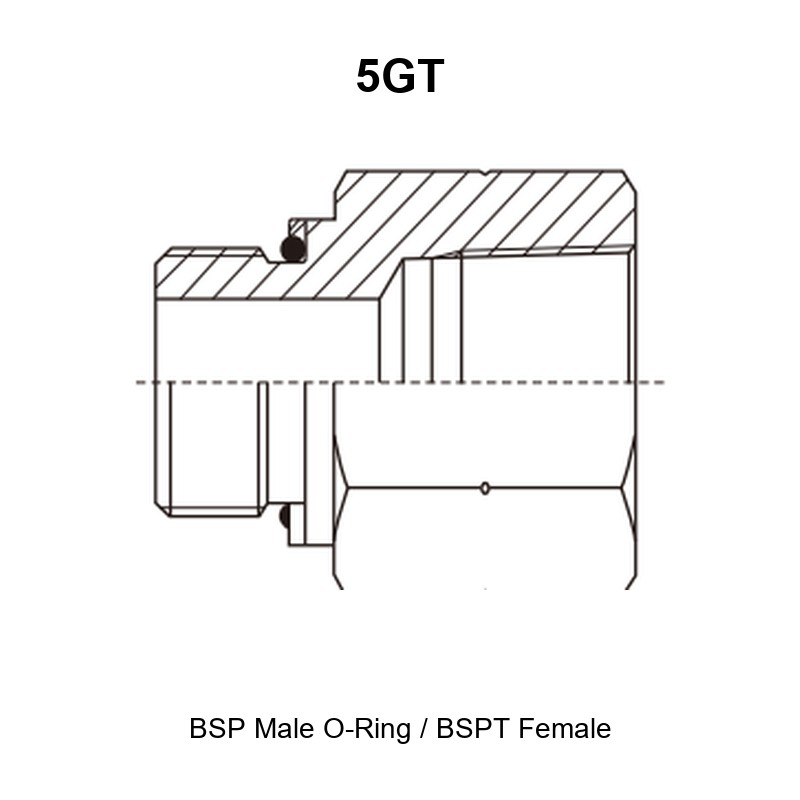
The 5GT adapter is a transition fitting with a BSP male O-ring stud end on one side and a BSPT female taper port on the other. It lets a parallel-thread port that is sealed by an O-ring be joined to a line that is sealed by a taper thread, without using an adapter stack. One end of the 5GT adapter therefore needs no sealant at all, while the other end always does, and mixing those two habits up is the most common cause of a leak on this type of fitting.
Because the two ends seal in different ways, the 5GT adapter is often selected to solve a specific assembly problem: a port with a flat face and an O-ring groove on one side, a taper-threaded hose or pipe end on the other. This page explains both sealing principles, the complete dimension table, the O-ring question, installation practice and the questions buyers ask most often.
1. What the 5GT Adapter Does
This fitting belongs to the group of adapters that change the sealing method as well as the thread. The male end carries a plain shoulder, an O-ring and a parallel BSP thread. When the adapter is screwed into its port, the O-ring is compressed against a flat face in the port and provides the seal; the thread itself does not seal and is not tapered. The female end is a taper port, so the mating male taper thread wedges into it and seals along the thread flanks, with the help of a thread sealant.
That difference has practical consequences. The O-ring end can be assembled, removed and re-used many times, because the elastomer is the only element that is deformed and it recovers when the joint is opened. The taper end cannot be re-used indefinitely, because each tightening wedges the threads a little further and a taper joint is normally re-made with fresh sealant. When a line has to be broken for service, the O-ring end is the one to open first.
The adapter is also a useful problem solver where a machine mixes thread systems. Older equipment, imported components and site-made pipework frequently bring parallel and taper connections into the same circuit, and a single transition fitting is a better answer than a chain of adapters, each of which adds a joint and consumes space.
2. 5GT Adapter Specifications
2.1 Product Scope and Configuration
The range covers straight transition fittings from R1/8 to R1, each with a male O-ring stud end and a female taper port of the same nominal size. The 5GT-08W variant carries the same thread and O-ring combination as the 5GT-08 but a longer overall body, which is used where more clearance is needed behind the port.
2.2 Materials and Surface Treatment
Standard supply is carbon steel with zinc plating for general hydraulic service. For corrosive fluids or aggressive atmospheres, 304 stainless steel or 316 stainless steel is available, and brass is offered for lower-pressure industrial and instrument lines. Plating options include trivalent chromium zinc (Cr3+) and zinc-nickel for a higher corrosion demand. No salt-spray hours and no plating thickness figures are published on this page; request the current test report from the supplier before a specification is frozen.
2.3 Threads, Standards and Sealing Principle
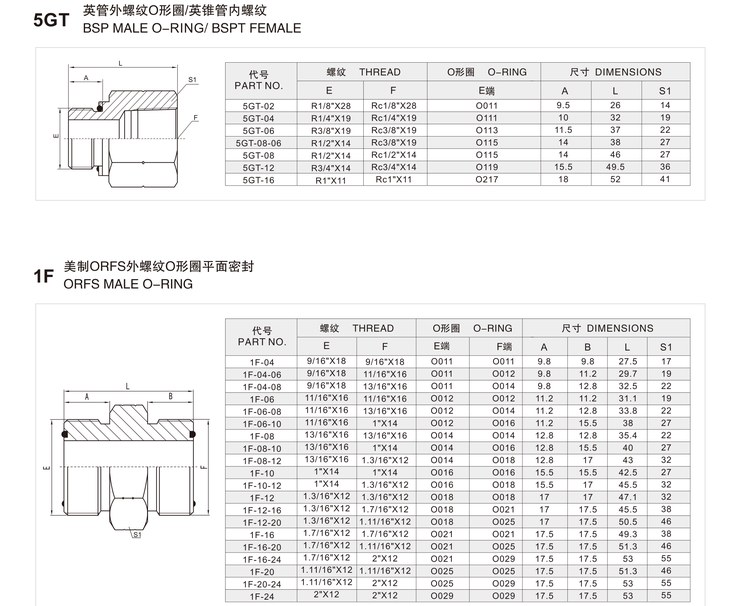
The table has two thread columns. E is the male stud end with the O-ring, intended for a port with a flat face; ISO 1179-2 describes stud ends with an O-ring, and the seal is made by the elastomer against the face rather than by the thread. F is the female taper port to ISO 7-1, commonly written Rc, which seals on the thread flanks and needs a sealant on the mating male thread. The O-ring column identifies the ring fitted to the E end. Because the two ends seal differently, confirm the exact thread form of the E port and the O-ring code against the drawing before ordering. [VERIFY WITH SUPPLIER]
2.4 Dimensions and Part Numbers
All dimensions are in millimetres. A is the length of the stud end, L is the overall length of the fitting, and S1 is the across-flats size.
| PART NO. | E THREAD | F THREAD | O-RING | A | L | S1 |
|---|---|---|---|---|---|---|
| 5GT-02 | R1/8″X28 | Rc1/8″X28 | O11 | 9.5 | 26 | 14 |
| 5GT-04 | R1/4″X19 | Rc1/4″X19 | O11 | 10 | 32 | 19 |
| 5GT-06 | R3/8″X19 | Rc3/8″X19 | O113 | 11.5 | 37 | 22 |
| 5GT-08 | R1/2″X14 | Rc1/2″X14 | O115 | 14 | 38 | 27 |
| 5GT-08W | R1/2″X14 | Rc1/2″X14 | O115 | 14 | 46 | 27 |
| 5GT-12 | R3/4″X14 | Rc3/4″X14 | O115 | 15.5 | 49.5 | 36 |
| 5GT-16 | R1″X11 | Rc1″X11 | O217 | 18 | 52 | 41 |
2.5 Working Conditions and Limits
The usable working pressure of a transition fitting depends on the thread size, the body material, the port it is screwed into and the elastomer used for the seal, so no single figure covers the whole range. The O-ring material must also be matched to the fluid: nitrile rubber is the general choice for mineral oil and covers roughly -30 degC to +100 degC, fluoroelastomer covers roughly -20 degC to +200 degC for higher temperatures, and EPDM covers roughly -40 degC to +120 degC but is not suitable for mineral oil. For a specific project, state the fluid, the working pressure, the peak pressure and the temperature range, and the supplier will confirm the material, plating, O-ring compound and assembly torque.
3. Part Number Decoding
The part number is built from the port sizes, written in the same order as the thread columns E and F.
- 5GT-02: male O-ring stud end R1/8″X28, female taper port Rc1/8″X28.
- 5GT-08: male O-ring stud end R1/2″X14, female taper port Rc1/2″X14.
- 5GT-08W: the same threads as the 5GT-08 with a longer body.
- 5GT-16: male O-ring stud end R1″X11, female taper port Rc1″X11.
The W suffix marks the long-body variant. Both ends are normally the same nominal size; where a different combination is required, the drawing number replaces the standard code and both port sizes are listed separately on the order.
4. Installation and Fitment
The two ends of this fitting are assembled in two different ways, and the sequence below keeps the difference clear.
- Check the E port. It must have a flat face and enough depth for the O-ring to compress. A taper port cannot accept the O-ring end.
- Check the O-ring for cuts, hardness and swelling before assembly, and fit a new ring if there is any doubt.
- Lubricate the O-ring lightly with the system fluid so it slides instead of rolling during tightening.
- Screw the E end in by hand and tighten it until the shoulder contacts the face. Do not use sealant on this end.
- Apply sealant to the male taper thread of the F end only, then tighten it in the same way as any taper joint.
- Re-check the taper joint after the first heat cycle. The O-ring end normally needs no re-tightening.
5. Applications and Industries
Typical applications include:
- Converting a parallel O-ring port to a taper-threaded hose or pipe end.
- Industrial power units where imported components and site pipework use different thread systems.
- Service and repair work on equipment that mixes BSP parallel and BSPT taper connections.
- Test benches where the test port is an O-ring face port and the gauge line is taper-threaded.
- Mobile hydraulics where a compact transition is needed in a confined space.
- Marine and offshore equipment: stainless steel versions for continuous salt exposure.
- Agricultural machinery: field-repairable transitions using simple tools.
6. Replacement and Cross-Reference
When replacing an existing transition fitting, work from measurements rather than from a colour code or an old marking. Record both thread designations, the O-ring code, the across-flats size S1, the stud length A and the overall length L. A replacement is equivalent only when the thread family, the sealing method of each end and the overall envelope all match. If the original part carries an unfamiliar number, measure both threads with a pitch gauge, note whether the male end has a flat face shoulder or a cone, and send the values with a photograph so the equivalent can be identified.
Never replace a transition fitting with a plain adapter of the same thread size. A plain parallel adapter would remove the O-ring seal from the parallel port and leave the joint with nothing to seal against.
7. Ordering, Packaging and Delivery
To place an order, provide:
- the part number, for example 5GT-08 or 5GT-08W;
- confirmation of both thread designations and of the O-ring code;
- the O-ring compound required for the fluid;
- the material and the plating option;
- the quantity and the required delivery date.
Parts are supplied individually protected and packed in bulk cartons or in kit bags, with the part number marked on the bag or the label. Minimum order quantities, carton quantities, marking and traceability requirements, and lead times are confirmed at the quotation stage, and special packing or kitting can be arranged for OEM programmes.
8. Frequently Asked Questions
Q1. What makes the 5GT adapter different from a plain adapter? The 5GT adapter changes the sealing method as well as the thread. Its male end seals with an O-ring against a flat face, while its female end seals on a taper thread, so it joins two different port systems in one fitting.
Q2. Do I need sealant on both ends? No. Sealant is used only on the taper-threaded end. The O-ring end must be assembled clean and dry, because a sealant there can prevent the shoulder from seating and damage the ring.
Q3. Can I re-use the O-ring? Only if it is undamaged and has not swollen or hardened. O-rings are inexpensive compared with a leak, and a new ring should be fitted whenever the joint is opened for a critical application.
Q4. Can the male end be fitted into a taper port? No. The male end needs a flat face for the O-ring to seat against, and a taper port does not provide one.
Q5. Which O-ring material should I choose? Nitrile rubber is the general choice for mineral oil, fluoroelastomer is used for higher temperatures, and EPDM is used where the fluid attacks nitrile. Confirm the compound against the fluid and the temperature range before ordering.
Q6. Why does the 5GT-08W have a longer body? The W suffix marks a longer body with the same threads as the 5GT-08. It is used where more clearance is needed behind the port or where the fitting must pass through a bracket.
Q7. Which material should I choose for a marine application? 316 stainless steel is the usual choice for continuous salt exposure. 304 stainless steel suits many wash-down applications, and carbon steel with zinc-nickel plating is used where the environment is controlled and the cost target is tight.
Q8. How do I identify an unknown transition fitting? Measure both threads, note whether the parallel end has a flat shoulder, measure the stud length and the overall length, and read the O-ring marking if one is visible. Send these values with a photograph and the supplier can identify the equivalent part.
Browse the full Hydraulic Adapters range for the complete family, or contact us to request a quote, mill test reports, and samples.


 English
  Spanish
  Portuguese
  French
  German
  Arabic