
1. What a 5B Adapter Does
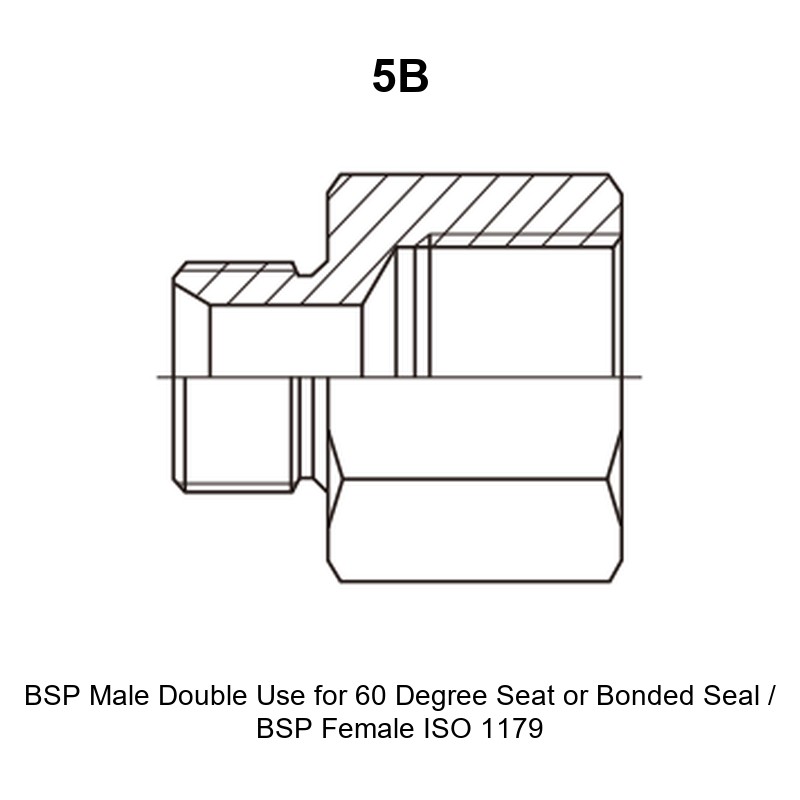
The 5B adapter is a straight male-to-female conversion fitting. Connection 1 is a BSP male stud end with a double use nose, and Connection 2 is a BSP female port built to ISO 1179 practice with a 60 degree cone seat. It joins a male BSPP port that has to be converted into a female BSPP port, or the reverse, in one piece.
Core value: both ends have to match their mating port exactly. The male end must engage the port with the sealing method that port is designed for, and the female end must receive a male stud end with the correct thread and cone. That is the precondition for eliminating leakage at the conversion point.
Sealing principle: the male end is called double use because it can seal in two different ways. Because it is machined with both a 60 degree cone at the nose and a flat shoulder face behind the thread, it can seal either by a 60 degree cone seat against the cone of a matching female port, or by a bonded seal trapped between its flat shoulder and the flat face of the port. The female end seals by the 60 degree cone seat defined in ISO 1179.
2. 5B Specifications
The blocks below present the two ends of the 5B adapter in mirrored form, so a buyer can read off which port each end serves and which sealing method applies.
2.1 Connection 1 — BSP male, double use 60 degree seat or bonded seal (E end)
- Thread standard: ISO 228-1, pipe threads where pressure-tight joints are not made on the threads.
- Thread family: British Standard Pipe Parallel (BSPP / G).
- Gender: male.
- Size range: G1/8″x28 up to G2″x11.
- Sealing method: two alternatives on the same nose, chosen by the port the male end enters.
- Mating port standard: ISO 1179 (BSPP port with a 60 degree cone seat), or a BSPP flat face port where a bonded seal is used.
Method one, 60 degree cone seat. The 60 degree cone machined at the nose of the male end seats metal-to-metal against the cone of the female port. This is the normal choice for an ISO 1179 port, it needs no elastomer, and it suits high temperature service.
Method two, bonded seal on a flat face. The same male end is installed into a port with a flat face, and a bonded seal (a metal washer with a bonded elastomer ring, often called a Dowty-type washer) is trapped between the flat shoulder of the male end and the flat face of the port. This is the normal choice for a flat face port.
The two methods are alternatives, not a sequence: use one or the other on a given port, never both at once. The thread itself never seals; because ISO 228-1 is a parallel thread, no thread sealant is needed once the correct method has been selected and the joint is tightened.
2.2 Connection 2 — BSP female, ISO 1179 60 degree cone seat (F end)
- Thread standard: ISO 228-1.
- Thread family: British Standard Pipe Parallel (BSPP / G).
- Gender: female.
- Size range: G1/8″x28 up to G2″x11.
- Sealing method: 60 degree cone seat.
- Mating port standard: ISO 1179.
- Note: because the two ends are ordered by size code, the female end can be smaller, equal to, or larger than the male end.
2.3 Construction and Materials
The body is machined from bar stock on CNC lathes as one piece, so there is no brazed or welded joint in the pressure path. Body material options are carbon steel, 304 stainless steel, 316 stainless steel and brass. Carbon steel bodies are supplied with trivalent chromium zinc plating (Cr3+) or zinc-nickel plating, and stainless steel bodies are supplied bare.
The male end is turned with its 60 degree cone and its flat seal shoulder in one operation with the thread, which is what allows either sealing method to be used on the same part. The female end is bored and the cone seat is formed in the same setup. The body carries a single hex across flats, given as S1 in the table.
Seal material selection applies only when the bonded seal method is used, or where an O-ring is present elsewhere in the joint. Choose NBR, FKM or EPDM to suit the fluid and temperature. Thread gauges and dimensional checks are applied batch by batch before packing.
2.4 Pressure and Temperature
Working pressure for these sizes is confirmed per order by HENGHUA engineering, based on the sealing method, thread size and material selected. The two sealing methods of the male end do not carry the same pressure capability in every port design, so the confirmation is issued against the actual port and the actual seal chosen.
Carbon steel with zinc plating suits general hydraulic service, and 304 or 316 stainless steel are the options for corrosive and offshore service. Where a bonded seal or O-ring is part of the joint, these material limits apply:
| Seal material | Temperature range |
|---|---|
| NBR bonded seal | approximately -30°C to +100°C |
| FKM (Viton-type) | approximately -20°C to +200°C |
| EPDM | approximately -40°C to +120°C |
The temperature limits of the 60 degree cone seat method itself follow the body material and the fluid, because that joint contains no elastomer.
2.5 Part Number and Dimension Table
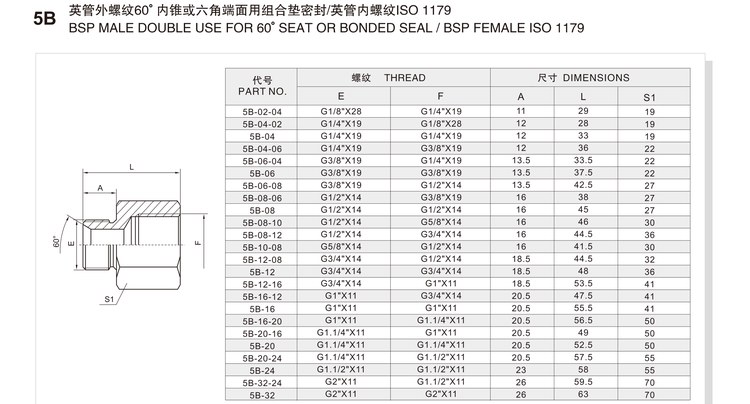
E is the male thread callout on Connection 1 and F is the female thread callout on Connection 2. A is the male end length, L is the overall body length and S1 is the hex (spanner flat) size, all in millimetres and all taken from the drawing above. Thread callouts follow the drawing notation, where G1.1/4″ means G1-1/4″ and G1.1/2″ means G1-1/2″.
| PART NO. | THREAD E (male) | THREAD F (female) | A | L | S1 |
|---|---|---|---|---|---|
| 5B-02-04 | G1/8″x28 | G1/4″x19 | 11 | 29 | 19 |
| 5B-04-02 | G1/4″x19 | G1/8″x28 | 12 | 28 | 19 |
| 5B-04 | G1/4″x19 | G1/4″x19 | 12 | 33 | 19 |
| 5B-04-06 | G1/4″x19 | G3/8″x19 | 12 | 36 | 22 |
| 5B-06-04 | G3/8″x19 | G1/4″x19 | 13.5 | 33.5 | 22 |
| 5B-06 | G3/8″x19 | G3/8″x19 | 13.5 | 37.5 | 22 |
| 5B-06-08 | G3/8″x19 | G1/2″x14 | 13.5 | 42.5 | 27 |
| 5B-08-06 | G1/2″x14 | G3/8″x19 | 16 | 38 | 27 |
| 5B-08 | G1/2″x14 | G1/2″x14 | 16 | 45 | 27 |
| 5B-08-10 | G1/2″x14 | G5/8″x14 | 16 | 46 | 30 |
| 5B-08-12 | G1/2″x14 | G3/4″x14 | 16 | 44.5 | 36 |
| 5B-10-08 | G5/8″x14 | G1/2″x14 | 16 | 41.5 | 30 |
| 5B-12-08 | G3/4″x14 | G1/2″x14 | 18.5 | 44.5 | 32 |
| 5B-12 | G3/4″x14 | G3/4″x14 | 18.5 | 48 | 36 |
| 5B-12-16 | G3/4″x14 | G1″x11 | 18.5 | 53.5 | 41 |
| 5B-16-12 | G1″x11 | G3/4″x14 | 20.5 | 47.5 | 41 |
| 5B-16 | G1″x11 | G1″x11 | 20.5 | 55.5 | 41 |
| 5B-16-20 | G1″x11 | G1.1/4″x11 | 20.5 | 56.5 | 50 |
| 5B-20-16 | G1.1/4″x11 | G1″x11 | 20.5 | 49 | 50 |
| 5B-20 | G1.1/4″x11 | G1.1/4″x11 | 20.5 | 52.5 | 50 |
| 5B-20-24 | G1.1/4″x11 | G1.1/2″x11 | 20.5 | 57.5 | 55 |
| 5B-24 | G1.1/2″x11 | G1.1/2″x11 | 23 | 58 | 55 |
| 5B-32-24 | G2″x11 | G1.1/2″x11 | 26 | 59.5 | 70 |
| 5B-32 | G2″x11 | G2″x11 | 26 | 63 | 70 |
3. How to Read a 5B Adapter Part Number
The prefix 5B identifies the series: straight body, BSP male double use end and BSP female ISO 1179 end. It is followed by one or two size codes that give the BSP size step of the male end and then of the female end.
A single code means both ends share one thread size, so 5B-08 is G1/2″x14 male to G1/2″x14 female. A double code means the ends differ, and the order matters: the first code is always the male E end and the second code is always the female F end.
Worked example from the table: 5B-12-08 has a male E end of G3/4″x14 and a female F end of G1/2″x14, with A 18.5 mm male end length, L 44.5 mm overall length and S1 32 mm hex. Reverse the codes and the part is different: 5B-08-12 is a smaller male end into a larger female end. This series carries no dash suffix; where a bonded seal is needed, it is ordered separately in the matching thread size.
4. Installation and Fitment
Before assembly, identify which sealing method the 5B adapter will use at the male end. Look at the port: a 60 degree cone inside the port calls for the cone seat method, while a flat machined face calls for a bonded seal between the flat face and the shoulder of the male end.
For the cone seat method, clean the cone and wipe the port, thread the male end in by hand until the cone contacts, then tighten snug and apply the tightening angle specified for the size and material. For the bonded seal method, place a new bonded seal on the male end before threading it in, keep it centred on the shoulder, and tighten so the seal is compressed between the two flat faces without being extruded.
Common fitment errors and their symptoms: using the cone seat method in a flat face port leaves a gap at the flat faces and the joint weeps; using a bonded seal in a cone seat port holds the cone off its seat and the joint leaks even when tight; re-using a bonded seal that has already been compressed produces a leak at the first pressure cycle; and a BSPT male end fitted into the female end of this adapter leaks because a taper thread cannot register on a 60 degree cone.
5. Applications and Industries
Application tags for the 5B adapter are hydraulic systems, water jetting, oil and gas equipment, industrial equipment, construction machinery, agriculture, marine and material handling. It is the part to use when a male port has to become a female port, or when one adapter must serve two different port designs in the same machine.
Concrete scenarios: a machine with mixed port designs, where the male end uses a bonded seal in an older flat face port while the female end receives a modern ISO 1179 stud end; a repair workshop that keeps the common sizes so a damaged male port can be converted without re-machining the housing; a test bench where the male end is installed with a bonded seal so it can be removed and refitted repeatedly during a test programme; and an OEM assembly line where one part number covers a male port and a female connection and reduces the number of line items on the bill of materials.
6. Replacement and Cross-Reference Guide
Identify a replacement by standard and sealing method, never by brand. This is a BSPP male to BSPP female part with ISO 228-1 parallel thread, a double use male nose and an ISO 1179 60 degree cone seat in the female end.
Measure these three things before ordering: first, the male thread outside diameter and threads per inch, to confirm an ISO 228-1 G thread at 28, 19, 14 or 11 threads per inch; second, the port the male end enters, checking whether it has a 60 degree cone or a flat face, because that decides which sealing method is used; third, the female end thread size and the seat inside it, confirming a 60 degree cone.
| Mating port at the male end | Thread standard | Sealing method to use | Fits |
|---|---|---|---|
| BSPP female port with 60 degree cone | ISO 228-1 / ISO 1179 | Cone seat on the male nose | Yes, method one |
| BSPP female port with flat face | ISO 228-1 | Bonded seal on the male shoulder | Yes, method two |
| BSPP female port with flat face and no bonded seal | ISO 228-1 | None available | No, a seal must be fitted |
| BSPT female port (Rc thread) | ISO 7-1 | Taper thread on the flanks | No |
| JIC female port, 37 degree flare | SAE J514 | 37 degree flare | No |
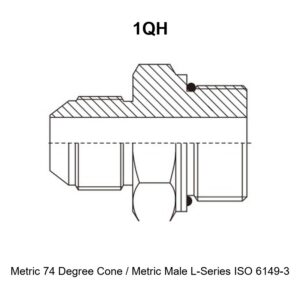
| Metric port with O-ring | ISO 6149-3 | O-ring | No |
| Mating component at the female end | Thread standard | Sealing method | Fits |
|---|---|---|---|
| BSPP male stud end with 60 degree cone | ISO 228-1 / ISO 1179 | 60 degree cone seat | Yes |
| BSPP male stud end with flat face and bonded seal | ISO 228-1 / ISO 1179 | Bonded seal | Only if made to the correct face depth |
| BSPT male end (R thread) | ISO 7-1 | Taper thread on the flanks | No |
7. Ordering, Packaging and Delivery
To order a 5B adapter, give the series code with the full part number, both thread sizes in the order E then F, the body material, the plating, the sealing method planned at the male end, and the quantity. For example: series 5B, part number 5B-12-08, male E end G3/4″x14 with bonded seal, female F end G1/2″x14, carbon steel with trivalent chromium zinc plating, 500 pieces.
Where the bonded seal method is used, state the seal material and order the bonded seal in the matching thread size at the same time; the seal is a separate item and is not part of the adapter. Packaging is arranged for distributor shelves and for direct-to-line delivery, with thread protection in transit and labels carrying the part number and both thread sizes. Samples are available for validation, and lead time is confirmed per order once thread sizes, material and quantity are fixed.
8. FAQ
Q1. What is the difference between BSPP and BSPT, and can they be interchanged? BSPP is the parallel pipe thread defined in ISO 228-1, which is the thread used at both ends of this series. BSPT is the taper thread defined in ISO 7-1, which seals on the thread flanks and needs a sealant. The two are not interchangeable, and a taper male end fitted into the female end of this adapter cannot reach the cone seat, so the joint leaks and both threads are damaged.
Q2. What is the difference between a 60 degree cone seat and a bonded seal, and which should I choose? A 60 degree cone seat is a metal-to-metal seal between the cone on this adapter male nose and the cone inside the port, and it needs no elastomer. A bonded seal is a metal washer with a bonded elastomer ring that seals between two flat faces. On this series the male end is double use, so choose by the port: use the cone seat in an ISO 1179 port with a 60 degree cone, and use a bonded seal in a port with a flat face.
Q3. How do I identify the correct 5B size? Measure the male port the adapter has to enter and the male stud end the female end has to receive. The first size code is the male end and the second is the female end, so 5B-12-08 is a G3/4″x14 male end into a G1/2″x14 female end. Where both connections are the same size, the part number carries one code, for example 5B-08.
Q4. What seal material should I select for my fluid and temperature? Where the male end seals on the 60 degree cone, no elastomer is used and the limit is set by the body material and the fluid. Where the bonded seal method is used, select the seal material for the fluid and temperature: NBR covers approximately -30°C to +100°C, FKM approximately -20°C to +200°C, and EPDM approximately -40°C to +120°C. Body options are carbon steel with zinc plating, 304 or 316 stainless steel, and brass.
Q5. How is the working pressure of this adapter determined? Working pressure for these sizes is confirmed per order by HENGHUA engineering, based on the sealing method, thread size and material selected. The cone seat method and the bonded seal method do not carry the same capability in every port design, so the confirmation is issued against the actual port and the actual seal chosen. Send the sizes, the port type and the expected system pressure with the inquiry.
Q6. Can the male end seal with the cone and a bonded seal at the same time? No. The two methods are alternatives on the same male nose, and using both at once would hold the cone off its seat, so the joint would still leak. Select one method from the port design: cone seat for a 60 degree cone port, bonded seal for a flat face port.
Q7. Is a bonded seal included with the adapter? A bonded seal is a separate item and is not supplied as part of the adapter unless it is ordered as an assembly. State the seal material and the thread size when ordering, and order the bonded seal in the matching size at the same time so the joint can be assembled without a second sourcing step.
Q8. What is the minimum order quantity and can I get samples? Minimum order quantity depends on the size, the material and the plating selected, and is confirmed with the quotation. Samples are available for validation, and for a mixed-size part number such as 5B-12-08 a sample is the normal way to confirm that the male end seats correctly in the actual port before a production order. Lead time is confirmed per order.
Browse the full Hydraulic Adapters range for the complete family, or contact us to request a quote, mill test reports, and samples.
 English
  Spanish
  Portuguese
  French
  German
  Arabic