
Metric Hydraulic Fittings
Metric Hydraulic Fittings: 24° Cone and ISO 6149 Range
Metric hydraulic fittings are the threaded connections built to metric standards, headed by the 24° cone system per ISO 8434-1 (DIN 2353) and the metric O-ring port system per ISO 6149. They are the dominant connection choice across European and Asian machinery. This page is the complete guide to our metric hydraulic fittings range: the 24° cone thread table from M12 x 1.5 to M52 x 2 (DN 6 to 40), light and heavy series, matching hose-side series for every major hose standard, installation rules, and ordering terms. Confirm your metric thread and hose from the tables, then request a quote in minutes.
Why Buy from Us
Five facts that separate us from a parts reseller:
| Trust Anchor | What It Means for You | |
|---|---|---|
| 1 | Factory Direct Manufacturer | We produce the fittings and ferrules, not just sell them. Matched sets keep your assemblies consistent. |
| 2 | Batch-Tested Quality | Every batch is dimension-inspected with calibrated gauges and salt-spray tested to at least 120 hours per ISO 9227. |
| 3 | Metric Systems in One Catalog | 24° cone (ISO 8434-1 / DIN 2353) and ISO 6149 O-ring ports, plus JIC, ORFS, NPT, BSP, and SAE flange, from one supplier. |
| 4 | Verified Quotes in One Business Day | Send your metric thread, hose type, and quantity. You receive a confirmed part number, price, and lead time within one working day. |
| 5 | Free Samples for Qualified Projects | Test the thread fit and crimp quality before committing to production volume. |

What Are Metric Hydraulic Fittings?
Metric hydraulic fittings are threaded connectors dimensioned in millimeters and made to European metric standards, rather than to inch-based American or British pipe threads. Two metric systems dominate hydraulic hose assemblies:
- 24° cone fittings (ISO 8434-1 / DIN 2353): a metric male stud with a 24° cone seat that seals metal-to-metal against the matching cone of a female port or adapter. This is the classic European system, available in light series (L) and heavy series (S).
- Metric O-ring port fittings (ISO 6149, SAE J2244): a metric straight thread with an O-ring compressed against a flat spotface, giving a positive face seal for high-pressure and zero-leak service.
Both systems use metric thread designations such as M22 x 1.5, where the first number is the nominal diameter in millimeters and the second is the thread pitch. Because metric and inch threads are never interchangeable, identifying the thread correctly is the first step of every order.
Core value: confirm the metric system, the thread, and the series — and the connection holds pressure without leakage; guess, and threads gall or ports crack.
Three customer paths:
- For OEM manufacturers — standardize 24° cone or ISO 6149 ports across your machine range and lock in repeatable assembly quality.
- For end users and maintenance teams — identify whether the failed line is 24° cone, ISO 6149, or a look-alike inch thread, then order the correct replacement the first time.
- For distributors — consolidate metric and inch connection families in one catalog, with mixed-size sample kits and private labeling.
Key Specifications
Connection-Side: Metric Thread and Port Table
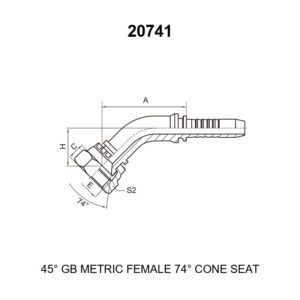
The table below lists the metric male threads and cone profiles we supply, per the 10411-RW technical drawings and ISO 8434-1. Thread E is the metric male thread; the 24° cone seat profile follows ISO 8434-1 (DIN 2353 equivalent).
| Thread E | Dash (DN, mm) | Hex S1 (mm) | System |
|---|---|---|---|
| M12 x 1.5 | 04 (6) | 12 | 24° cone, light |
| M14 x 1.5 | 04–05 (6–8) | 14 | 24° cone, light |
| M16 x 1.5 | 04–06 (6–10) | 17 | 24° cone, light |
| M18 x 1.5 | 05–06 (8–10) | 19 | 24° cone, light |
| M22 x 1.5 | 06–08 (10–12) | 24 | 24° cone, light |
| M26 x 1.5 | 08–10 (12–16) | 27 | 24° cone, light |
| M27 x 1.5 | 10 (16) | 30 | 24° cone, light |
| M30 x 2 | 10–12 (16–20) | 32 | 24° cone, light |
| M36 x 2 | 16 (25) | 38 | 24° cone, light |
| M45 x 2 | 20 (32) | 46 | 24° cone, light |
| M52 x 2 | 24 (40) | 55 | 24° cone, light |
Companion ISO 6149 metric O-ring port studs are available with O-ring face seals in the commonly used sizes from M12 x 1.5 to M60 x 2; confirm your port marking and we supply the matching stud, O-ring, and backup ring.
Hose-Side: Matching Ferrule Series
The hose end of each metric fitting is matched to a hose family and its ferrule series. The table below lists the full crimp-side range, dash 03 to 32 (DN 4 to 50).
| Series | Hose Family | Standard | Dash | Crimp Type |
|---|---|---|---|---|
| 00110-A / 00110 | 1SN | SAE 100 R1AT / EN 853 | 03–32 | No-skive |
| 03310 / 00200 | 2SN | SAE 100 R2AT / EN 853 | 03–32 | No-skive |
| 00210 | 2SN | DIN 20022 | 03–32 | No-skive |
| 00400 | 4SP / 4SH | EN 856 | 04–32 | One-piece |
| 00400 / 01400 | R12 | SAE 100 R12 | 06–24 | One-piece |
| 00018 | R7 thermoplastic | SAE 100 R7 | 03–12 | No-skive |
| 00TF0 / 00710 | PTFE (Teflon) | Per hose maker | 03–32 | One-piece |
The 24° cone hose fittings shown above are the light series for braided hoses (1SN and 2SN); for spiral hoses, use the companion heavy-duty series per the specification. Assembly working pressure follows the hose family: 1SN to 250 bar, 2SN to 400 bar, 4SP to 450 bar in the smallest sizes, R12 at 4,000 psi (276 bar) constant, and PTFE to about 207 bar (3,000 psi) in small bores. Confirm the final value against your hose data sheet.
Material and Surface Finish
Material choice is a key decision when selecting metric hydraulic fittings for corrosive or hygienic service.
| Option | Specification | Application |
|---|---|---|
| Carbon steel, cold formed | Precision-formed threads, cone seats, and serrations | Standard for general hydraulics |
| Yellow zinc plating | Chromate passivation, ≥120 h salt spray per ISO 9227 | Standard finish |
| Zinc-nickel plating | Higher corrosion resistance | Offshore and marine duty |
| Stainless steel | Clean, unplated surface | Chemical, food, and hygienic lines |
Key Features
- 24° cone seat per ISO 8434-1 (DIN 2353), light series; heavy series on request
- ISO 6149 metric O-ring port ends (SAE J2244 equivalent) for zero-leak face seals
- Metric threads from M12 x 1.5 to M52 x 2, hex (S1) wrench design
- Configurations: straight, 45° and 90° elbows, tees, bulkhead, reducers
- Matched hose-tail and ferrule sets for leak-free crimped assemblies
Crimping and Installation
The hose end of every metric fitting is crimped with standard hydraulic crimping machines and common die sets. We provide reference crimp data and die selection for your machine model with every order.
Crimp-side steps:
- Cut the hose square with a sharp hose cutter.
- Prepare the hose end per the hose maker’s instructions (skive where required, e.g. 4SH and R12).
- Insert the stem fully into the hose bore.
- Slide the ferrule over the hose end and seat it against the stem shoulder.
- Crimp with a hydraulic hose crimping machine to the target crimp diameter from the hose maker’s chart.
- Verify the crimp O.D. with a caliper and record the value.
Metric connection-side rules:
- Clean and inspect the 24° cone seat before every assembly; a scratched cone leaks.
- For 24° cone connections, align the stud square with the port, hand-tighten, then torque on the hex to the value for the size.
- For ISO 6149 ports, fit the O-ring and backup ring, and do not exceed the tightening torque — the seal is the O-ring, not the threads.
- Never mix metric threads with inch threads: M22 x 1.5 and 7/8-14 UNF look alike at a glance but are not interchangeable.
- Never apply thread sealant to ISO 6149 O-ring connections; it contaminates the circuit.
Nomenclature: How Metric Sizes Are Designated
Metric part numbers state the thread in millimeters, and every metric thread designation carries a pitch. Learn these rules and you can read any metric fitting description:
| Designation | Meaning | Example |
|---|---|---|
| M + diameter x pitch | Metric male thread | M22 x 1.5 = 22 mm O.D., 1.5 mm pitch |
| 24° cone (L or S) | Cone seat profile and series | Light series for braided hoses |
| ISO 6149 / SAE J2244 | Metric O-ring port system | Stud with O-ring face seal |
| Dash number | Hose I.D. in 1/16 in steps | Dash 08 = DN 12 |
A typical description reads: M22 x 1.5 24° cone male x 1/2 in hose, straight. The first field states the metric thread and cone system, the second states the hose size, and the third states the configuration. We assign the exact part number for your configuration on request — send us the thread, hose family, and dash size, and our engineers confirm the code before you order.
Matching and Identification
The most common error is confusing metric threads with inch threads of similar size. Use this table before ordering metric hydraulic fittings:
| Connection | Thread | Angle / Seal | Identifying Feature |
|---|---|---|---|
| 24° cone (ISO 8434-1) | Metric, e.g. M22 x 1.5 | 24° metal-to-metal cone | Cone seat on the stud |
| ISO 6149 (SAE J2244) | Metric straight, e.g. M22 x 1.5 | O-ring face seal | Flat spotface + O-ring groove |
| BSPP (ISO 228-1) | Inch, e.g. G1/2 | 55° parallel, washer seal | 55° Whitworth form |
| NPT (ASME B1.20.1) | Inch, e.g. 1/2-14 | 60° tapered | Taper + sealant |
Metric and inch threads are not interchangeable. When in doubt, measure the thread O.D. in millimeters, check the pitch with a thread gauge, and count the threads per inch if it could be inch-based — or send us a photo and we identify the connection for you free of charge.
Applications and Industries
Metric hydraulic fittings dominate European and Asian equipment and appear wherever metric ports are specified:
- Machine tools and injection molding machines
- Agricultural machinery: tractors and implements
- Construction and mobile equipment
- Hydraulic power units and industrial hydraulics
- Forestry, mining, and material handling
- Marine and offshore hydraulics
- Food and beverage processing: stainless steel variants
Operating range follows the hose and fluid: rubber assemblies typically run from -40 °C to +100 °C (R12 to +121 °C), and PTFE assemblies from -70 °C to +260 °C at the core.
Ordering and Packaging
- Unit of measure: sold per piece (EA), packed in boxes per size
- MOQ: one box per size; mixed-size sample kits available
- Customization: light or heavy series, ISO 6149 studs, material, surface finish, private labeling, special packaging
- Export packing: corrugated cartons with moisture barrier for sea freight
Metric Hydraulic Fittings FAQ
Can metric fittings be connected to NPT or BSP ports? No. Metric threads are sized in millimeters with a 60° ISO thread profile; NPT is a 60° American tapered pipe thread sized in inches, and BSP is a 55° British thread. They are not interchangeable, and forcing them together causes galling, leaks, or thread damage.
How do I confirm a metric fitting matches my hose? Three checks: confirm the metric thread (e.g. M22 x 1.5) and cone system on the port, match the hose I.D. to the dash size, and confirm the hose construction against the ferrule series table. Send us both measurements and we verify the full part number.
Brass or stainless steel — which do I need? Brass suits low-pressure air, water, and general service. Stainless steel suits corrosive chemicals, food, pharmaceuticals, and marine environments. Our range is supplied in zinc-plated carbon steel or stainless steel.
What is the difference between ISO 8434-1 and DIN 2353? They describe the same 24° cone connection system. DIN 2353 is the original German standard; ISO 8434-1 is the international standard that supersedes it. Most suppliers and drawings still use the DIN 2353 name.
Light series or heavy series — which do I choose? Light series (L) fittings have a lighter body and match the pressure range of braided hoses. Heavy series (S) fittings have thicker bodies for heavier duty and are specified with spiral hoses. Tell us your hose construction and we supply the correct series.
How do I read a metric thread like M22 x 1.5? M means metric thread, 22 is the nominal outside diameter in millimeters, and 1.5 is the pitch in millimeters. The pitch matters: M22 x 1.5 and M22 x 1.0 are different threads that will not mate correctly.
When should I use a 24° cone fitting instead of an ISO 6149 O-ring fitting? Use 24° cone fittings where the port has a 24° cone seat and metal-to-metal sealing is accepted. Use ISO 6149 O-ring studs where the port has a flat spotface with O-ring groove, typically for zero-leak, high-pressure, or high-vibration service.
- Hydraulic Hose2727 products
- Steel Wire Spiraled Hydraulic Hose66 products
- Steel Wire braided Hydraulic Hose1010 products
- Textile Reinforced Hydraulic Hose33 products
- Thermoplastic Hydraulic Hose33 products
- Industrial Hose5959 products
- Air Hose99 products
- Water Hose1111 products
- Oil Hose1616 products
- Chemical Hose66 products
- Steam Hose33 products
- Multipurpose Hose22 products
- Food & Beverage Hoses44 products
- Concrete Hose44 products
- Cement Hose22 products
- Material Handling Hose1111 products
- Dredge Hose44 products
- Hydraulic Fittings162162 products
- Reusable Hose Fittings66 products
- Socketless Hose Fittings88 products
- JIC Hydraulic Fittings1515 products
- Metric Hydraulic Fittings3838 products
- NPT Hydraulic Fittings66 products
- BSP Hydraulic Fittings2626 products
- SAE Hydraulic Fittings3030 products
- Banjo Hydraulic Fittings44 products
- ORFS Hydraulic Fittings1111 products
- Ferrule1111 products
- Flange Fittings2626 products
- One Piece Fittings2323 products
- Hydraulic Adapters2929 products
Send a Mail
henghua@hhgpipe.com
Make a Call
+15822925523
86-22-83859963
Mon - Sun: 09:00 am - 22:00 pm
Main Office
Tianjin, China
Hezhong Building, Youyi North Road
 English
  Spanish
  Portuguese
  French
  German