

Yes — for saturated steam, an EPDM steam hose is a sound default choice. Ethylene propylene diene monomer has a saturated polymer backbone, so hot water and steam do not attack it the way they attack unsaturated rubbers. This guide explains why EPDM works, where its service limit sits, and when another material should take over.
The focus here is the capability boundary of one material in steam service. It does not repeat the catalog overview on the saturated steam hose guide. Read on for the polymer reasoning, the temperature and pressure limits, the conditions that force a material change, and the selection rules that keep an assembly inside its rating.
About a 13-minute read at 250 words per minute; EPDM’s steam capability boundary, service limits and material switching rules.
What Is an EPDM Steam Hose Made Of?
This hose is a layered composite built to carry saturated steam without swelling, cracking or delaminating. The tube carries the steam, the reinforcement carries the pressure, and the cover protects both from the outside. Each layer answers a different part of the same steam problem.
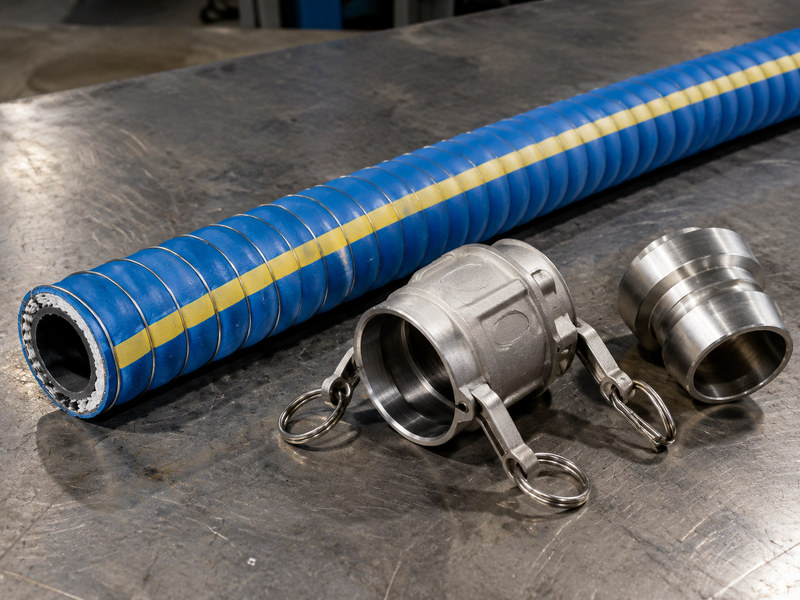
The tube is the only layer that touches the steam, and it is a cured EPDM compound chosen for a saturated backbone that resists hydrolysis. The reinforcement is textile in low-pressure designs and steel wire in high-pressure designs. The cover is compounded for heat, ozone and abrasion resistance, and it is pin-pricked so vapor trapped in the wall can escape.
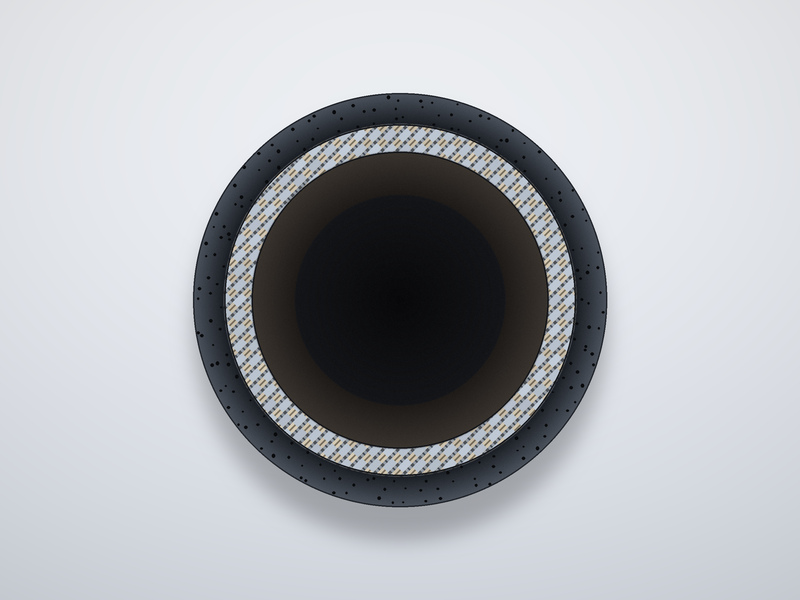
Figure 1. Layer order in a steam hose, from the steam-side tube outward through the reinforcement to the pin-pricked cover.
Table 1. Layer roles in a steam hose.
| Layer | Primary job | Design note |
|---|---|---|
| Tube | Confines the steam and resists hydrolysis | Cured EPDM with a saturated backbone |
| Reinforcement | Carries hoop load and resists internal pressure | Textile for low pressure, steel wire for high pressure |
| Cover | Shields the tube and reinforcement from heat, ozone and abrasion | Compound matched to the external environment |
| Cover vents | Release vapor that has permeated into the wall | Pin-pricked cover for steam service |
The layer order matters because each layer is a separate failure path. A tube that hardens will crack. A reinforcement that corrodes will lose burst strength. A cover that traps vapor will blister and tear. Steam stresses all three at once, so the whole stack is judged, not the tube alone.
That is why the cover compound and the tube compound are selected separately. The tube is chosen for the steam it touches, while the cover is chosen for the weather, the abrasion and the heat around it. A hose can pass on one layer and fail on the other, so both must be right before the assembly goes into service.
Why EPDM Steam Hose Resists Saturated Steam
The reason an EPDM steam hose tolerates steam comes down to one structural fact. EPDM is a terpolymer of ethylene, propylene and a diene, and the diene sits on a short side chain. The polymer backbone itself is fully saturated, meaning it carries no double bonds along the chain.
That saturation is what defeats steam. Unsaturated rubbers such as nitrile or natural rubber carry double bonds in the backbone. Hot water and oxygen attack those sites, and the rubber hardens, cracks or softens. A saturated backbone offers no such site, so hydrolysis has nothing to break.
Crosslinking supplies the second half of the story. Curing ties the polymer chains into a three-dimensional network, and that network resists the softening that heat normally causes. The practical result is a tube that holds its shape and its physical properties across the saturated steam range. That is why EPDM is often the first candidate for wet steam.
Heat aging follows the same logic. High temperature speeds up any reaction that can occur, and a saturated chain simply offers fewer reactive sites for oxygen and water. With a suitable carbon black and antidegradant package, the compound keeps its tensile strength and elongation far longer than an unsaturated rubber would.
That same polymer chemistry also explains the limit. Above the compound’s continuous temperature, the network itself begins to change, and crosslinks break down faster than they form. The rubber then hardens or softens, and either path ends in a leak. The limit is a property of the compound, so it must be read from the data sheet rather than assumed.
Where the EPDM Steam Hose Service Limit Sits
Every material has a ceiling, and EPDM is no exception. The limit comes from the compound, and it is expressed two ways at once: a maximum continuous temperature and a matching pressure. The two travel together because saturated steam ties them to the saturation curve.
The steam hose temperature rating versus pressure rating shows why you cannot pick one number. For saturated steam, read the pressure, look up the saturation temperature, then compare that temperature with the tube limit.
Standards give that ceiling a public shape. ISO 6134:2024 covers rubber hoses and hose assemblies for saturated steam, including metal fittings. It defines two types. Type 1 is the low-pressure textile-reinforced hose: 0.6 MPa (6 bar) maximum working pressure at 164 °C. Type 2 is the high-pressure steel-wire-reinforced hose: 1.8 MPa (18 bar) maximum working pressure at 210 °C. Burst and verification testing follow ISO 1402.
Related test and vocabulary standards can be named without quoting clauses. These include ISO 4023 for steam hose test methods, ISO 7326 for ozone resistance, ISO 8031 for electrical properties, ISO 8033 for adhesion between layers, ISO 8330 for terminology, and ISO 10619-1 for bending tests.
Table 2. Saturated steam pressure and temperature pairs used throughout this guide.
| Pressure (bar g) | Saturation temperature (°C) | Saturation temperature (°F) |
|---|---|---|
| 6 | 165.0 | 329.0 |
| 10 | 184.1 | 363.4 |
| 18 | 209.8 | 409.7 |
| 25 | 226.1 | 438.9 |
Table 3. The two ISO 6134:2024 saturated steam hose types.
| Type | Maximum working pressure | Corresponding temperature | Reinforcement |
|---|---|---|---|
| Type 1 | 0.6 MPa (6 bar) | 164 °C | Textile |
| Type 2 | 1.8 MPa (18 bar) | 210 °C | Steel wire |
The two ISO 6134:2024 figures are not arbitrary. They follow the saturation curve, so they describe the actual steam a hose will meet at that pressure. A hose rated to a temperature but tested only at ambient pressure would be meaningless in steam service. That is why the standard pairs each pressure with its saturation temperature, and it is why the pair should always be read together. A one-degree difference between Table 2 and Table 3 at the same pressure is not a conflict: both figures describe the same wet steam, and either one can be read against the tube limit.
A maker’s line can sit near those anchors. The 170 °C steam hose product page shows one common rating, and the catalog rating should be checked against the saturated steam pair at the working pressure.
Steam Hose Material Boundaries in Steam Service
Temperature is only one axis of the boundary. The steam hose material boundary also depends on chemistry and on how much vapor can pass through the wall. EPDM has a nonpolar, saturated chain, and that is exactly why water, steam and ozone leave it alone.
The same nonpolar chain is why hydrocarbon oil does not. Oil swells nonpolar rubber, so a line that carries oil-contaminated steam sits outside the EPDM boundary. For a full picture of how inner-tube compounds respond to different fluids, see the inner tube selection guide for NBR, EPDM and FKM. That page covers the fluid side, while this one stays on steam.
Permeation is the third axis. Steam and gases diffuse slowly through any rubber wall, and where that loss matters, a barrier construction is chosen instead. For a broader view of how rubber compares with other hose materials, the rubber, PTFE and UHMWPE hose comparison sets out the general trade-offs.

Figure 2. Applicability boundary for EPDM and other tube materials across hot water and steam service.
Table 4. Service conditions and the material decision they drive.
| Service condition | EPDM stays suitable | Reason |
|---|---|---|
| Saturated steam inside the compound limit | Yes | Saturated backbone resists hydrolysis |
| Saturated steam above the continuous limit | No | Aging accelerates above the compound limit |
| Superheated steam | No | Temperature is no longer fixed by pressure |
| Hydrocarbon oil carryover | No | Oil swells the nonpolar EPDM chain |
| Low-permeation or purity duty | No | A barrier tube is needed |
| Outdoor ozone and weather exposure | Yes | Saturated chain resists ozone cracking |
A simple rule keeps the material decision straight. If the steam is saturated, cool enough for the compound, and free of oil, EPDM stays in play. If any one of those three fails, or low permeation is required, the boundary has been crossed. Documenting that decision also defines the safe envelope for later inspection.
High Temperature Steam Hose: When EPDM Is Not Enough
Once steam is superheated, the saturation curve stops constraining the temperature. At a given pressure the steam can run hotter than the saturation value, so the tube may see heat that a saturated-steam rating never anticipated. That is the first condition that pushes a job toward a high temperature steam hose built with a different tube.
A second push comes from the continuous limit itself. Every compound has a maximum continuous temperature, and above it the rubber ages faster. A high temperature steam hose uses a tube compound selected for that hotter duty, and the assembly rating is set by the weakest part of the stack.
The general logic of temperature ratings is covered in the guide to hose temperature rating. The steam-specific twist is that saturated service rarely needs a temperature correction at all, because the curve already fixes the pair. Only superheated steam and hot water break that link.
That distinction shapes how a high temperature steam hose is specified. The buyer states the pressure, then states whether the steam stays saturated or runs superheated. If it is saturated, the temperature is already known from the curve. If it is superheated, the actual temperature must be supplied, because nothing else pins it down.
Steam Hose Selection by Steam Condition
Good steam hose selection starts from the condition, not from the catalog. The order matters: pressure first, then saturation temperature, then superheat, then chemistry and permeation. Working in that order prevents the common mistake of buying on pressure alone.
Table 5. Checkpoints that drive steam hose selection.
| Check | Question to answer | What it protects |
|---|---|---|
| 1 | What is the steam pressure? | Sets the saturation temperature |
| 2 | What is the saturation temperature? | Compares against the tube limit |
| 3 | Is the steam superheated? | Forces a material review |
| 4 | Is oil present in the steam? | Rules EPDM out |
| 5 | Is low permeation required? | Points to a barrier tube |
Once the five answers are in hand, steam hose selection becomes a filter rather than a guess. Each answer either keeps EPDM in the running or removes it. A single disqualifying answer is enough to move the job to another tube material.
Teams that document the five answers before ordering also make inspection easier later. The same numbers define the safe operating envelope, so a technician can compare a pressure reading against the recorded limits. A selection that is written down is also a selection that can be reviewed when the process changes.
Superheated, Oiled and Low-Permeation Sections
Three conditions deserve their own callout, and the full set sits in Table 4.
Superheated sections are hotter than the saturation value for their pressure, and they are the clearest case for a different tube. Oil-contaminated sections attack the nonpolar EPDM chain and cause swelling, so they rule EPDM out even at moderate temperature. Low-permeation sections need a barrier, because steam and gases can diffuse through a rubber wall over time.
When permeation matters, a lined or barrier construction is chosen. The comparison between a PTFE and rubber steam hose explains the difference in behavior between a polymer-lined tube and a rubber tube.
Note that superheat, oil and low permeation are section conditions, not whole-line conditions. A plant can run EPDM on the main saturated header and switch material only on the sections that fail those tests. That keeps the low-cost, flexible material where it fits and reserves the specialist tube for the sections that need it.
Installation Details That Protect an EPDM Steam Hose
A tube that is right for the steam can still fail through installation. Three details matter most: cover venting, end connections and condensate control.
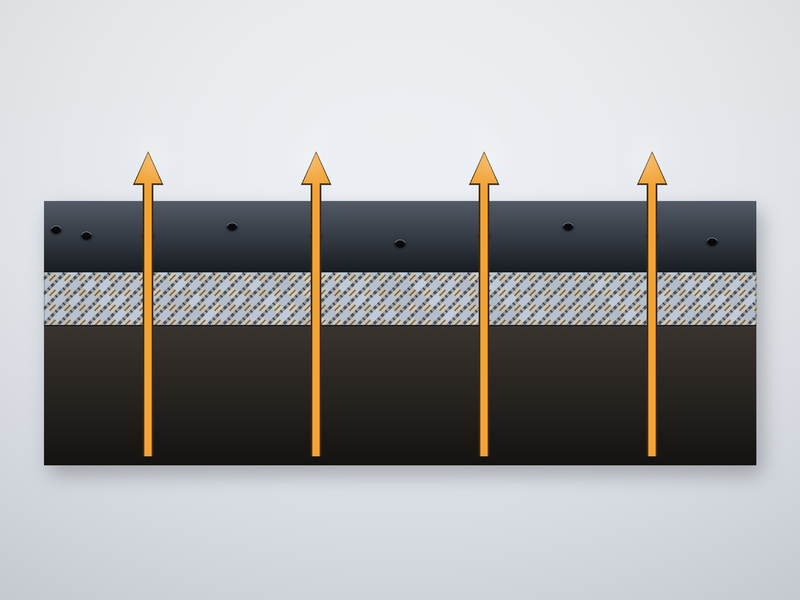
Figure 3. How a pin-pricked cover vents vapor that has diffused into the hose wall.
The cover is pin-pricked so vapor that diffuses into the wall can vent instead of blistering the cover. End connections carry the same weight. ISO 6134:2024 covers saturated steam hose assemblies with metal fittings, and the rating belongs to the hose plus its fitting. A dedicated fitting is what meets that requirement; a band or an ordinary clamp does not, and steam service commonly uses bolted safety clamps instead.
Condensate control is the third installation detail. Trapped water at a low point can hammer the hose when steam arrives, so drains and a slope away from the low point protect the wall. None of these steps changes the rating, but together they extend service life and reduce the chance of a sudden failure.
A final check is to confirm that the installed assembly, not just the hose, carries the rating. The fittings, the couplings and the way they are attached all take part in the limit. When the assembly is reviewed as a whole, the material decision made earlier is protected in service.
Decision Rule: Where EPDM Fits and Where It Stops
Saturated steam inside the compound’s continuous limit, with no oil in the line, still leaves the EPDM steam hose a strong and well-proven answer. Its saturated backbone resists hydrolysis, its limits are publicly defined by ISO 6134:2024, and its flexibility and availability suit most plants.
The moment steam is superheated, oil-contaminated or purity-critical, or hotter than the compound limit, the answer changes and a different tube material takes over. The decision is not about whether EPDM is good, but about whether the steam condition is still inside the boundary.
Bring the pressure, the saturated temperature and the media to the table, and the choice becomes a matter of arithmetic rather than opinion.
About HENGHUA
HENGHUA is a professional hose and fittings manufacturer supplying distributors, retailers and OEM brands worldwide. Its steam hose line centers on an EPDM tube with a textile or steel wire reinforcement, and a cover that is pin-pricked for steam service.
Site-listed steam hose products include an EPDM steam hose rated at 170 °C and a high-temperature EPDM variant rated at 230 °C. End connections are available for the service, including clamp-type safety couplings, flanges and threads. The company also offers factory assemblies, custom lengths, cover printing, private label and OEM/ODM work, with factory-direct pricing, short lead times on volume, and a warranty.
EPDM Steam Hose FAQs
Is EPDM good for steam?
Yes, where the steam is saturated and the duty stays inside the tube’s rated limit. The polymer backbone is fully saturated, so hydrolysis has no reactive site to work on and the rubber keeps its properties instead of hardening or cracking. That balance of steam resistance, flexibility and cost is why wet steam duty usually starts with EPDM. Its scope is the saturated range; superheated steam, oil carryover, low-permeation duty or service above the compound limit each point to a different tube.
What temperature can an EPDM steam hose handle?
It depends on the compound, not on a single universal figure. ISO 6134:2024 anchors the two standard steam hose classes: Type 1 at 0.6 MPa (6 bar) and 164 °C, and Type 2 at 1.8 MPa (18 bar) and 210 °C. A maker’s line may be rated differently, so always read the continuous temperature on the data sheet. Saturated steam temperature rises with pressure, so pressure and temperature must be read together.
Why does EPDM resist steam better than nitrile?
The difference is in the polymer backbone. EPDM is saturated, so it has no double bonds in the main chain for hot water and oxygen to attack. Nitrile rubber is unsaturated, and those double bonds are exactly where steam and oxygen begin to break the chain. That is why nitrile hardens or cracks faster in steam, while a saturated EPDM chain holds its properties longer in the same service.
Does an EPDM steam hose work with superheated steam?
Generally no. Superheated steam is hotter than the saturation temperature for its pressure, so temperature and pressure become independent. That lets the steam run above the range a saturated-steam rating was written for. Above the tube’s continuous limit, aging accelerates and the wall fails sooner. Superheated sections should use a tube chosen for that hotter duty instead of a standard saturated-steam compound.
Can EPDM be used with oil-contaminated steam?
Usually not. Hydrocarbon oil and a nonpolar rubber share similar chemistry, so the oil works its way into the rubber, swells it and degrades it over time. Water and steam are polar, and a polar medium leaves a nonpolar chain intact. The temperature may still be modest, and a line that carries oil still needs an oil-resistant tube compound. Oil carryover alone can decide the selection, even where the steam is comfortably inside the EPDM limit.
What is the difference between ISO 6134 Type 1 and Type 2?
The two ISO 6134:2024 classes differ mainly in reinforcement. Table 3 lists the paired figures for both classes. The steel-wire class reaches the hotter, higher-pressure end of saturated steam service, while the textile class serves the cooler, lower-pressure end. In practice the header pressure decides which class you need, because saturated steam ties temperature to that pressure. A plant that runs on a low-pressure header therefore stays in the cheaper class without giving anything up.
Why does a steam hose cover have pin pricks?
Steam and gases slowly diffuse through a rubber tube wall. If the cover were solid and smooth, that trapped vapor could not escape, and it would build pressure under the cover until the cover blistered or burst. Small pin pricks give the vapor a path out while keeping liquid water and contaminants out. That is why a steam hose cover is pin-pricked rather than sealed.
How do I choose a steam hose material?
Work from the steam condition outward, not from a product page. Begin with the header pressure and convert it to the matching saturation temperature. Then ask whether the steam is superheated, whether oil is carried over, and whether low permeation is required. One failing answer is enough to rule the tube out. If none of the five answers disqualifies the tube, EPDM stays the candidate, and the choice falls to availability and cost.
Does higher steam pressure always mean higher temperature?
For saturated steam, yes. Saturated steam locks pressure and temperature to the saturation curve, so raising the pressure raises the saturation temperature. For example, steam at 6 bar g saturates at 165.0 °C, while steam at 25 bar g saturates at 226.1 °C. Once steam is superheated, that link breaks, and pressure no longer fixes the temperature.
 English
 Spanish
 Portuguese
 French
 German
 Arabic
 Russian
 Indonesian
 Japanese
 Korean