
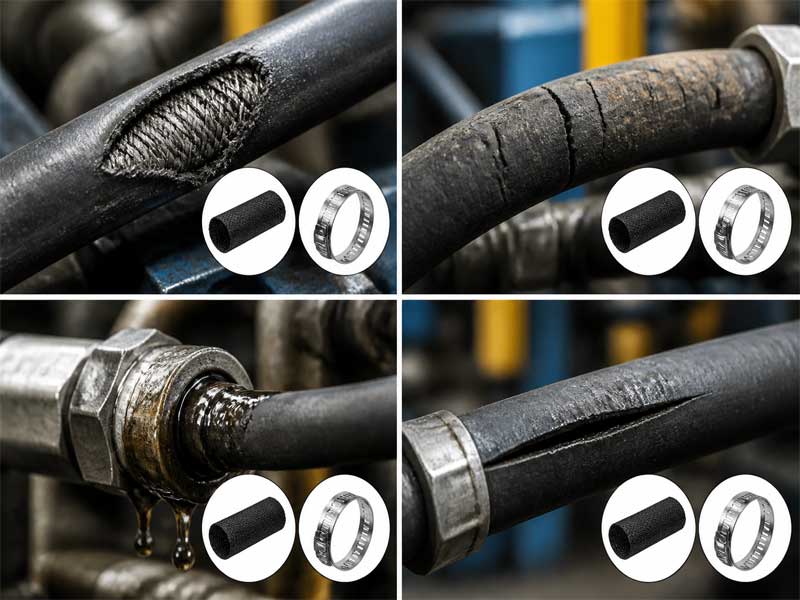
Hydraulic hoses usually fail because of a handful of preventable problems, primarily abrasion, incorrect installation, extreme temperatures, fluid contamination, and operation beyond specified pressure or bend-radius limits. Most premature failures are caused by installation problems and external abrasion rather than hose material defects. This guide explains how each failure mechanism develops, how to identify early warning signs, and what maintenance practices can extend hydraulic hose service life.
Hydraulic hose assemblies (a reinforced flexible pressure hose combined with compatible fittings for transferring hydraulic fluid) are critical to heavy equipment operation, but they are also one of the most common failure points in hydraulic systems. Whether you are a maintenance engineer diagnosing repeat failures, an equipment operator looking to reduce downtime, or a procurement professional evaluating hose suppliers, understanding why hoses fail and how to prevent it directly impacts your bottom line.
Quick Answer: What Causes Hydraulic Hose Failure?
The most common causes of hydraulic hose failure are:
- Abrasion and external damage
- Incorrect installation or hose routing
- Excessive temperature exposure
- Fluid contamination and chemical incompatibility
- Over-pressure and exceeding minimum bend radius
- Fitting and coupling failure
- Hose aging and environmental degradation
Most premature failures are installation-related rather than material defects, and most can be identified during routine inspections before catastrophic failure occurs.
At-a-Glance: The 5 Primary Failure Causes and Their Prevention
| Failure Cause | Why It Happens | How to Prevent It |
|---|---|---|
| 1. Abrasion | Outer cover rubs against equipment frames or other hoses. | Use abrasion-resistant sleeving; route away from contact points; use clamps. |
| 2. Improper Installation | Twisting (as little as 7° can reduce life by 90%), incorrect routing. | Check the layline for straightness; follow correct bend radii; double-wrench fittings. |
| 3. Temperature Extremes | Heat hardens the tube; cold makes the cover brittle and crack. | Select hoses rated for the max. system temp.; install heat shields; warm equipment in winter. |
| 4. Fluid Contamination | Particles, water, or incompatible fluids degrade the tube from inside. | Maintain fluid cleanliness (ISO 4406); regular oil sampling; verify chemical compatibility. |
| 5. Over-Bending/Pressure | Bending tighter than the minimum radius or exceeding working pressure. | Maintain bend radius > manufacturer’s spec.; install pressure relief valves. |
Ranking of Hydraulic Hose Failure Causes by Frequency (Internal Service Data)
Based on HengHua’s internal field failure records, customer feedback analysis, and on-site inspection observations across construction, mining, and agricultural equipment applications, the estimated frequency of failure causes is as follows.
These percentages represent HengHua customer cases and field inspections. Actual failure rates vary depending on equipment type, operating environment, maintenance practices, and hose selection.
| Rank | Failure Cause | Estimated Field Frequency | Most Common in |
|---|---|---|---|
| 1 | Abrasion and cover wear | 35–40% | Excavators, loaders, cable reels |
| 2 | Incorrect routing and installation | 25–30% | All equipment types |
| 3 | Fitting and coupling failure | 15–20% | High-vibration applications |
| 4 | Temperature degradation | 10–15% | Mobile equipment near engines |
| 5 | Fluid incompatibility and contamination | 5–10% | Systems with poor filtration |
1. How Does Abrasion Cause Hydraulic Hose Failure?
Abrasion occurs when the outer rubber cover rubs against equipment frames, other hoses, or debris in the operating environment. The protective layer wears away, exposing the steel wire reinforcement to moisture and contaminants. Rust forms on the wire strands, which weakens their tensile strength and leads to eventual burst failure under pressure.
Identifying Abrasion Damage
- Visible wear marks or exposed reinforcement on the hose surface
- Cover material worn through at contact points
- Steel wire visible or rusted at the damaged area
- Localized bulging near worn sections
Prevention Methods
- Install abrasion-resistant sleeving or spring guards at all contact points
- Use clamps or tie wraps to separate hoses from moving components and sharp edges
- Bundle hoses that flex in the same direction to minimize relative movement
- Select hoses with abrasion-resistant covers for high-wear applications
- Inspect hoses weekly at known contact points, especially on machines with tight component spacing
2. Why Does Improper Installation and Routing Lead to Hose Failure?
Improper installation—particularly twisting, over-tightening, or routing hoses too close to moving parts—is one of the most common preventable failure causes. A hydraulic hose twisted during installation has misaligned reinforcement layers, which severely compromises its pressure rating.
The 90% Rule
Hose manufacturers and field studies commonly report severe service-life reduction when hoses are installed with measurable twist. Even small twisting angles can significantly reduce fatigue resistance; twisting a high-pressure hydraulic hose by as little as 7 degrees during installation can shorten its service life by up to 90%. The layline (the continuous identification text printed along the hose) provides a quick visual check—if it spirals instead of running straight, the hose is twisted and must be reinstalled.
Correct Installation Checklist
| Installation Step | Requirement |
|---|---|
| Twisting check | Layline must remain straight along the hose length |
| Bend radius | Must be greater than the manufacturer’s minimum bend radius at all points |
| Length allowance | Leave 2–4% slack for hose contraction and expansion under pressure |
| Routing | Avoid sharp edges, heat sources, and moving components |
| Fitting torque | Use double-wrenching method; never over-tighten |
| Clamp spacing | Clamps every 24–36 inches (600–900 mm) for supported runs |
Fitting Compatibility
Hydraulic hose assemblies should use hose and coupling components approved together by the manufacturer. Mixed components may reduce crimp reliability unless compatibility has been verified through manufacturer testing. Always crimp fittings using the hose manufacturer’s recommended equipment and crimp diameter specifications.
3. What Is the Impact of Temperature Extremes on Hose Life?
Hydraulic hose temperatures above the rated operating limit accelerate rubber degradation. Excessive heat causes the inner tube to harden, crack, and lose sealing ability, which can lead to leakage or burst failure. Select hoses with temperature ratings above both hydraulic oil temperature and surrounding environmental temperature.
High-Temperature Effects
When the hydraulic fluid or ambient temperature exceeds the hose’s rated range (typically 100°C for standard SAE hoses, or 125°C for high-temperature versions), the tube material softens and can take a permanent set. Over time, the tube hardens, becomes brittle, and develops cracks under pressure cycling. External heat sources like exhaust manifolds or hydraulic oil coolers can also cause localized overheating even if system fluid temperature remains acceptable.
Low-Temperature Effects
At temperatures below -40°C, standard hose materials become stiff and may crack when flexed. Even at -20°C, bend radius requirements double compared to room temperature. For cold-weather applications, use hoses specifically rated for low-temperature flexibility.
Temperature Guidelines
| Temperature Condition | Effect | Prevention |
|---|---|---|
| > Rated maximum (typically +100°C) | Tube hardening, cracking, reduced pressure rating | Use high-temp hoses; shield from heat sources |
| < Rated minimum (typically -40°C) | Stiffness, cracking under flex | Use cold-weather hoses; warm equipment before operation |
| Rapid cycling between extremes | Accelerated aging and seal failure | Select hoses with wide operating ranges |
4. How Does Fluid Contamination and Aging Reduce Hose Life?
Particle contamination, water ingress, and chemical incompatibility degrade the hose tube from the inside out. The tube material may swell, soften, harden, or erode, depending on the contaminant type.
Contamination Damage Mechanisms
- Particle abrasion: Hard particles (metal filings, sand, dirt) erode the tube surface, creating roughness and potential leak paths
- Water contamination: Moisture reacts with the tube material and accelerates oxidation, leading to sludge formation and tube degradation
- Chemical attack: Incompatible hydraulic fluids or cleaning solvents cause swelling, blistering, or extraction of plasticizers
- High-velocity erosion: Fluid velocities above 25 ft/sec (7.6 m/sec) in suction lines or 35 ft/sec (10.7 m/sec) in pressure lines can wash out tube material
Inspection Signs
- Tube material flaking or peeling (visible at fittings)
- Swollen or blistered inner tube
- Hard, cracked tube surface
- Discoloration of the fluid or hose interior
Prevention Methods
- Maintain hydraulic fluid cleanliness to ISO 4406 standards (target 18/16/13 or better)
- Use filtration systems with appropriate micron ratings (typically 10–25 microns for most systems)
- Sample oil regularly and replace filters as recommended by the manufacturer
- Verify fluid compatibility with the hose tube material—consult the hose manufacturer’s chemical resistance chart
- Store spare hoses in a cool, dry environment away from ozone sources (electric motors, welding equipment)
Maximum Service Life
Even in the absence of contamination, hydraulic hoses have a finite service life due to material aging. Industry practice recommends replacing hydraulic hoses after:
| Application Severity | Replacement Interval |
|---|---|
| High-risk (critical systems, exposed locations) | Every 2.5 years |
| Standard (protected, moderate duty) | Every 5 years |
| Maximum regardless of appearance | 10 years |
5. What Happens When Bend Radius and Pressure Ratings Are Exceeded?
Hydraulic hoses must operate within the rated working pressure and minimum bend radius. Pressure spikes above the rated value should be controlled through system design, relief valves, and correct hose selection. Bending a hose tighter than the specified minimum radius places excessive stress on the reinforcement, significantly reducing pressure capacity.
The Physics of Over-Bending
When a hose is bent too sharply, the reinforcement on the inside of the curve compresses while the outside stretches. This uneven loading creates localized stress concentrations. Repeated flexing at or below the minimum radius causes fatigue failure of the wire reinforcement—similar to bending a paper clip back and forth until it breaks.
Pressure Rating Misunderstandings
- Working pressure: The maximum continuous operating pressure
- Proof pressure: Typically 1.5× working pressure (test pressure)
- Burst pressure: Typically 4× working pressure (destructive test limit)
The impulse cycle test is the most demanding evaluation for a hydraulic hose assembly and closely reproduces practical operating conditions. During this test, the hose assembly is subjected to pressure impulses at 133% of the working pressure while maintained at or near minimum bend radius.
Impulse Cycle Ratings and What They Mean
| Rating | Description | Typical Application |
|---|---|---|
| 200,000 cycles | Minimum ISO 18752 requirement | General industrial equipment |
| 400,000 cycles | Enhanced durability | Mobile equipment with moderate pressure cycling |
| 1,000,000+ cycles | Premium durability | High-cycle applications like excavators, injection molding |
Safe Operating Guidelines
| Risk Factor | Prevention Method |
|---|---|
| Over-bending | Maintain bend radius > manufacturer minimum at all installation points |
| Pressure spikes (transients) | Install relief valves or accumulators to absorb surges |
| Operating near burst pressure | Never exceed working pressure; rating includes safety margins |
| Repeated flexing at same location | Use swivel fittings at articulation points; distribute movement along hose length |
| External crushing or kinking | Provide protection guards; avoid routing through trap points |
6. Why Do Hydraulic Hoses Leak at Fittings?
Fitting failures are a common subset of hydraulic hose failure. They are typically caused by:
- Improper crimping: If the ferrule is under-crimped or over-crimped, it won’t hold the hose properly, leading to blow-offs or leakage.
- Incorrect fitting series: Using a fitting from a different manufacturer or series than the hose can cause a mismatch in the coupling geometry.
- Over-tightening: Applying excessive torque to the fitting can deform the sealing surfaces or the hose itself, causing leaks.
- Corrosion: Rust on the fitting can break the seal or allow fluid to escape.
Prevention: Always use a manufacturer-approved hose and fitting combination. Use a crimping machine calibrated for the specific fitting series and verify the crimp diameter with a go/no-go gauge. Apply the correct torque when installing the fitting to the system port.
Hydraulic Hose Failure Symptoms: How to Identify Problems Early
| Symptom | Possible Cause | Risk Level |
|---|---|---|
| Oil leakage near fitting | Crimp failure or fitting damage | High |
| Hose surface cracks | Heat aging or ozone damage | Medium |
| Exposed steel wire | Abrasion damage | Critical |
| Hose swelling | Chemical incompatibility | Critical |
| Soft spots or bubbles | Internal tube failure | High |
| Hose becomes stiff | Thermal aging | Medium |
| Burst without warning | Pressure spike or reinforcement failure | Critical |
Is Hydraulic Hose Failure Always Caused by Poor Quality?
No. Many hydraulic hose failures are caused by incorrect application, installation, or operating conditions rather than manufacturing defects. Understanding the difference is key to selecting the right hose and reducing downtime.
| Failure Cause | Related to Hose Quality? |
|---|---|
| Abrasion damage | Usually installation related |
| Incorrect bend radius | Installation related |
| Wrong pressure rating | Hose selection issue |
| Poor crimping | Assembly quality issue |
| Low impulse resistance | Hose design issue |
| Material incompatibility | Selection issue |
How to Diagnose a Failed Hydraulic Hose Before Replacement
Before replacing a failed hose, take 5 minutes to identify the root cause. This prevents repeated failures and helps select the correct replacement.
| Failure Sign | Possible Root Cause | Recommended Action |
|---|---|---|
| Outer cover worn through or abraded | Abrasion against frame/other components | Install abrasion sleeve; reroute; check clamps |
| Oil leakage near fitting | Improper crimping; incorrect fitting series; over-torqued | Replace assembly; verify crimp diameter; use correct fittings |
| Blistered or swollen cover | Chemical incompatibility; fluid degradation | Change fluid; verify compatibility; select compatible tube material |
| Cracked cover at bend point | Operating below minimum bend radius | Reroute with larger bend radius; use longer hose |
| Burst hose with straight tear | Over-pressure event | Check system pressure; install relief valve; inspect pump |
| Broken wire reinforcement | Fatigue from repeated flexing | Change routing; use hose with higher impulse rating |
| Hard, stiff hose | Thermal aging; prolonged exposure to high heat | Replace; install heat shields; reroute away from heat |
| Tube flaking at fitting | Particle erosion; high fluid velocity | Clean system; improve filtration; increase hose size |
Case Study: Excavator Boom Hose Failures Resolved
Machine: 35-ton crawler excavator
Operating Environment: Quarry operation, dusty environment
Failure History: Two hoses failed within approx. 90 operating days on the boom lift circuit.
Inspection Method: Visual inspection and abrasion point analysis.
Root Cause Analysis: During full articulation, the hoses contacted the steel boom frame, causing severe abrasion damage. Additionally, the layline indicated a slight twist in the hose routing.
Solution:
- Added split-style abrasion sleeve at the contact point.
- Rerouted hoses to avoid contact during full articulation.
- Corrected the twist during reinstallation.
Result: Service interval increased from approx. 90 operating days to over 14 months (approx. 400+ operating days) with no further failures.
Case Study: Wheel Loader Steering Hose Overheating
Machine: Wheel loader
Application: Steering circuit
Failure History: Hoses failed every 4–6 months near the engine compartment.
Inspection Method: Infrared temperature measurement.
Root Cause Analysis: The hose surface temperature was measured at 135°C due to proximity to the exhaust pipe (the hose’s temperature rating was 100°C maximum).
Solution:
- Installed a stainless steel heat shield between the exhaust pipe and hose.
- Rerouted hose 150 mm further from the heat source.
- Upgraded to a high-temperature hose (rated 125°C).
Result: Hose surface temperature dropped to 95°C; no failures were recorded in the following 18 months.
Why Hydraulic Hoses Fail More Frequently on Excavators
Excavators are particularly hard on hydraulic hoses due to:
- High cycle rates: Boom, arm, and bucket circuits cycle hundreds of times per hour.
- Exposed routing: Hoses on the boom and stick are exposed to debris, sunlight, and mechanical damage.
- Tight bend radii: Articulation points often force hoses to bend near their minimum radius.
- Vibration: The diesel engine and pump vibration accelerates fitting loosening and fatigue.
Preventive Measures for Excavators
- Use hoses with >400,000 impulse cycle ratings for boom and arm circuits.
- Install protective sleeving on all exposed sections.
- Inspect hose routing at every service interval—check for contact with boom or bucket linkage.
- Replace swing circuit hoses proactively at 5 years regardless of condition.
- Use swivel fittings at pivot points to prevent twisting.
How to Select the Right Hydraulic Hose Using the STAMPED Method
The STAMPED method is widely used by maintenance professionals to specify the correct hose for each application:
| Element | Questions to Ask |
|---|---|
| Size | What inside diameter (ID) and length are required? System flow determines ID. |
| Temperature | What is the maximum and minimum fluid and ambient temperature? |
| Application | What is the machine doing? How does the hose flex or move? |
| Material | What hydraulic fluid is being conveyed? Check compatibility. |
| Pressure | What is the maximum working pressure and any surge pressure? |
| Ends | What connection types (thread, flange, size) are needed? |
| Delivery | Are there special certification, packaging, or timeline requirements? |
Industry Standards Explained
| Standard | Coverage | Minimum Impulse Requirement |
|---|---|---|
| SAE J517 (100R series) | Defines construction, dimensions, and performance for hydraulic hoses | Varies by type |
| ISO 18752:2017 | International standard for constant-pressure hydraulic hoses—includes impulse testing | 200,000 cycles minimum (Type A) |
When comparing hoses, a higher impulse cycle rating under ISO 18752 directly correlates with expected durability in applications with frequent pressure fluctuations. SAE J517-required performance testing provides a reliable baseline for standard applications.
Hydraulic Hose Maintenance and Inspection Program
A regular visual inspection is the most effective way to prevent premature hydraulic hose failure. Implement the following schedule based on equipment usage:
Daily Visual Inspection (Operator Level)
- Check for visible leaks at fittings and along the hose
- Look for cuts, abrasion, or exposed reinforcement
- Verify hoses are not rubbing against sharp edges
- Listen for unusual noises that might indicate pressure issues
Weekly / Service Interval Inspection
- Check hose routing—hoses should not be twisted or contacting moving components
- Measure hose temperature at suspected hot spots (above 80°C requires attention)
- Inspect fittings for corrosion or signs of movement
- Verify clamps and supports are in good condition
- Check for hardening or cracking—stiff hoses may indicate aging
Documentation
Maintain records showing:
- Hose installation date
- Inspection results
- Replacement history and reason for replacement
- Operating hours at failure
This data helps predict service life for similar applications and supports preventive maintenance planning.
Frequently Asked Questions
Q: Why does my hydraulic hose keep failing even after replacement?
A: A hydraulic hose that repeatedly fails after replacement usually indicates an unresolved system issue rather than a hose quality problem. The most common causes are incorrect routing, excessive vibration, wrong bend radius, incompatible fluid, or incorrect hose assembly—all of which persist even with a new hose. Perform a root cause diagnosis using the failure sign table above.
Q: What causes a hydraulic hose to burst suddenly?
A: Sudden bursting is usually caused by a pressure spike exceeding the hose’s burst strength, severe reinforcement corrosion from abrasion or contamination, or operating below the minimum bend radius for an extended period. The burst pattern (straight tear, spiral tear) can often indicate the root cause.
Q: How can I tell if a hydraulic hose is unsafe to use?
A: Replace any hose showing exposed reinforcement, significant cover cuts deeper than the reinforcement layer, bulges, stiffening (hard and brittle), cracked cover, or any visible leakage at fittings. For pressure hoses, even minor cover damage that exposes steel wire requires immediate replacement.
Q: How many years should hydraulic hoses last?
A: Maximum service life is 10 years regardless of appearance. Replace hoses in exposed or critical locations every 2.5 years, standard hoses every 5 years. Operating conditions, temperature exposure, and pressure cycling significantly affect actual service life.
Q: How much does hydraulic hose replacement cost?
A: The cost varies widely based on hose size, length, fitting type, and application. For small industrial hoses, costs typically range from $50–$150. For construction equipment, a typical assembly may cost $150–$500. Large mining equipment hoses can cost $500–$1,500+. These figures are estimates and vary by region and supplier.
Q: What information should I provide when ordering a replacement hydraulic hose?
A: To receive an accurate quote and the correct assembly, provide the following: working pressure, hose inside diameter (ID), length, fitting type and thread size, hydraulic fluid type, operating temperature range, and application environment (e.g., excavator boom, mining use). A photo of the damaged hose and its identification text can also help in specifying the exact replacement.
About HengHua Hydraulic Solutions
HengHua Hydraulic Solutions specializes in hydraulic hose assembly manufacturing, high-pressure hose testing, and application engineering for construction machinery, mining equipment, agricultural machinery, and industrial hydraulic systems. Our engineering team focuses on failure analysis, hose selection optimization, impulse testing, and customized hydraulic hose solutions to help customers reduce downtime and maintenance costs.
Our Testing Capability
Our impulse test data is generated using:
- Test pressure: 133% of working pressure
- Test temperature: 100°C fluid temperature
- Test frequency: 30–40 cycles per minute
- Bend radius: Maintained at or near manufacturer’s minimum
- Acceptance criteria: Zero leakage or failure through 1,000,000 cycles
Why HengHua
- Certified quality: Products built to SAE J517 (100R series) and ISO 18752:2017 standards
- Verified durability: Pulse testing validates >1,000,000 cycles under demanding conditions
- Application support: Engineering assistance for hose selection and routing optimization
- Full traceability: Each assembly can be traced to manufacturing and test records
Need Help Selecting the Right Hydraulic Hose?
Choosing the correct hydraulic hose depends on pressure rating, working temperature, fluid compatibility, bending requirements, and application environment.
Send HengHua your:
- Hose size (ID and length)
- Working pressure
- Equipment model and application
- Operating environment (temperature, exposure)
- Existing hose photos (if available)
Our engineers can help recommend a suitable hydraulic hose assembly solution.

 English
  Spanish
  Portuguese
  French
  German